How To Become More Self-Sufficient Without Starting a Full-Blown Farm…
Want to start preserving your harvest, making your own soap, or building a backyard root cellar — but not sure where to begin? “Homesteading Advice” gives you instant lifetime access to 35+ practical homesteading books on food preservation, veggie gardening, DIY natural cleaning products (save over $250 per year with this skill alone), brewing, off-grid energy, and a whole lot more…
Click Here To Check It Out Now!
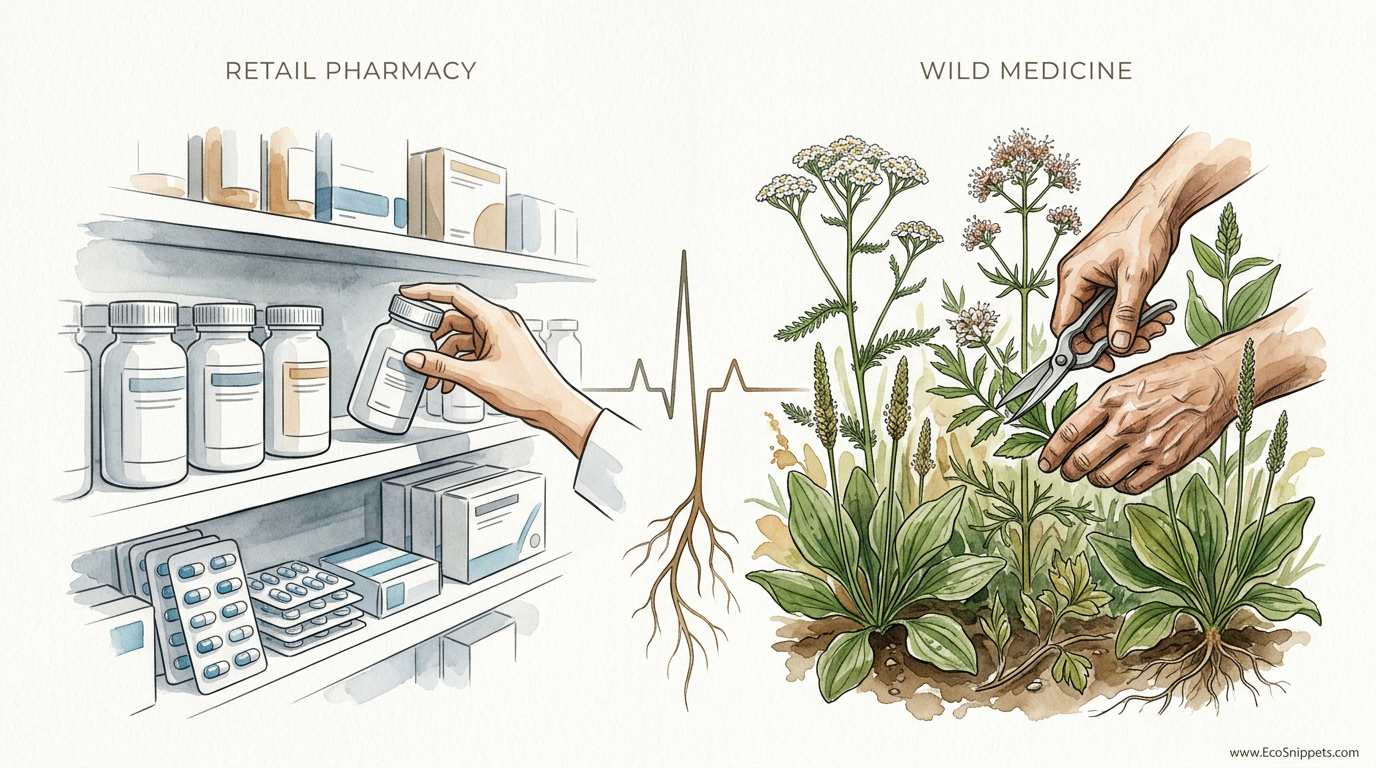
The corner store has a closing time and a supply chain; the forest has neither. Most people think of medicine as something you buy in a bottle. In a grid-down scenario, those bottles run out in days. Real health security means knowing which ‘weeds’ in your backyard can stop a fever or heal a wound. It is time to trade the retail aisle for the forest trail.
This journey is not about becoming a hobbyist; it is about reclaiming a lost lineage of self-reliance. For centuries, the homestead was the first line of defense against illness, and the meadows provided the apothecary. Understanding the flora around you transforms a simple walk in the woods into a survey of a living pharmacy. Whether you are prepping for a systemic collapse or simply want to lower your dependence on industrial pharmaceuticals, the skill of wild medicinal plant identification is the ultimate insurance policy.
Wild Medicinal Plant Identification For Forages
Wild medicinal plant identification for forages is the systematic practice of recognizing, verifying, and harvesting plants from their natural environment for therapeutic use. It is a blend of botanical science and ancestral wisdom that allows an individual to distinguish between a life-saving herb and a deadly lookalike. Unlike gardening, where you control the environment, foraging requires you to meet nature on its own terms, understanding the soil, the season, and the specific markers that define a species.
This practice exists because the modern pharmaceutical complex is a relatively recent invention. For most of human history, the “pharmacopeia” was local. If you had a respiratory infection, you looked for the fuzzy leaves of Mullein. If you had a deep cut, you reached for the feathery fronds of Yarrow. Today, this skill is used by survivalists, homesteaders, and herbalists who recognize that wild-grown plants often possess higher concentrations of secondary metabolites—the “medicine”—than their pampered, cultivated cousins.
Visualizing this concept is simple: imagine your backyard as a library. To the untrained eye, it is just a chaotic shelf of green. To the forager, every leaf is a page of instructions. A ribbed leaf of Plantain is a bandage; a yellow Dandelion head is a liver tonic; a willow branch is a source of salicylic acid. Once you learn the language of botany, you are never truly without resources.
How to Identify Medicinal Plants: The Botanical Toolkit
Mastering identification starts with moving beyond “general appearance” and focusing on specific botanical markers. You must develop a “pioneer’s eye” for detail, looking at the arrangement of leaves, the structure of flowers, and the texture of stems. This process ensures safety and maximizes the medicinal potency of your harvest.
Leaf Arrangement and Structure
One of the first things to observe is how leaves are attached to the stem. Alternate leaves grow one at a time, staggered along the stem. Opposite leaves grow in pairs, directly across from each other. Whorled leaves grow in a circle around a single point on the stem. Recognizing these patterns immediately narrows down your search through a field guide. Additionally, look at the leaf margins: are they smooth (entire), serrated like a saw, or lobed like an oak leaf?
Flower Anatomy and Umbels
Flowers are the reproductive organs of the plant and often the most distinct identifier. Many medicinal plants, like those in the Carrot family (Apiaceae), produce flowers in an “umbel”—a structure where multiple flower stalks spread from a common center, resembling an umbrella. While beautiful, this family contains both life-saving herbs like Yarrow and deadly toxins like Poison Hemlock. Learning the nuance of the umbel, such as the presence of bracts or the shape of the petals, is a life-or-death skill.
The Role of Senses
Identification involves more than just sight. Smell is a powerful tool; many medicinal plants in the Mint family (Lamiaceae) have square stems and a distinct aromatic scent when the leaves are crushed. Texture also plays a role—the “velvet” feel of a Mullein leaf or the “sticky” resin of a Poplar bud provides tactile confirmation. However, never use taste as an identification method for unknown plants, as some toxins can be potent even in small amounts.
The Pioneer Pharmacy: Key Plants to Know
To build a functional knowledge base, focus on the “heavy hitters”—plants that are widespread, easy to identify, and possess multiple medicinal uses. These are the workhorses of the wild apothecary.
Yarrow (Achillea millefolium)
Known as the “military herb,” Yarrow is a premier wound healer. It features feathery, fern-like leaves and flat-topped clusters of small white flowers. Its primary use is as a styptic; the dried, powdered leaves can stop bleeding almost instantly by contracting the blood vessels. Internally, a tea made from the flowers is a powerful diaphoretic, meaning it helps break a fever by inducing sweating.
Plantain (Plantago major and P. lanceolata)
Often called “White Man’s Foot” because it followed European settlers across North America, Plantain is perhaps the most useful “weed” in any yard. Look for broad or narrow leaves with prominent parallel veins that run from the base to the tip. It is an incredible drawing agent. If you are stung by a bee or have a splinter, a “spit poultice”—chewing the leaf and applying it to the skin—will draw out the toxin and reduce inflammation.
Mullein (Verbascum thapsus)
Mullein is the giant of the meadow, often growing a tall flower spike in its second year. Its leaves are large, thick, and covered in soft, silver-green hairs. This plant is a respiratory specialist. The leaves, when prepared as a tea or smoked, act as an expectorant to clear lungs of congestion. The flowers, infused in olive oil, are a traditional remedy for ear infections.
Dandelion (Taraxacum officinale)
While homeowners spray it with poison, the forager sees gold. The jagged, “lion’s tooth” leaves are a bitter tonic that supports liver function and digestion. The roots, when roasted, make a prebiotic coffee substitute, while the flowers are high in antioxidants. Dandelion is a powerful diuretic that, unlike pharmaceutical versions, replenishes the body’s potassium levels.
How to Prepare Your Wild Medicine
Identification is only half the battle. To extract the medicine from the plant fibers, you must use the correct preparation method based on which “active constituents” you are trying to capture.
Infusions and Teas
Infusions are best for delicate parts like leaves and flowers. You simply pour near-boiling water over the herb and let it steep for 10 to 20 minutes. This method extracts volatile oils and water-soluble vitamins. A strong infusion of Chamomile or Lemon Balm is perfect for soothing the nervous system before sleep.
Decoctions for Tough Material
Roots, bark, and seeds require more “brute force” to release their medicine. In a decoction, you place the plant material in cold water, bring it to a boil, and then simmer it for 20 to 45 minutes. This is how you prepare Burdock root for blood purification or Willow bark for pain relief.
Tinctures for Long-Term Storage
A tincture uses alcohol (usually vodka or brandy) as a solvent to extract alkaloids and resins that water cannot. You fill a jar with herbs, cover them with alcohol, and let it sit in a dark place for six weeks. Tinctures are highly concentrated and can last for years, making them ideal for a long-term survival kit.
Poultices and Salves
For topical issues like rashes, burns, or wounds, you want the medicine in direct contact with the skin. A poultice is simply mashed fresh herbs applied directly. A salve is more refined; you infuse the herbs into an oil (like olive or coconut) and then thicken it with beeswax to create a portable, shelf-stable ointment.
Benefits of Wild Foraged Medicine
Choosing wild-harvested medicine over retail options offers several practical advantages that go beyond simple cost savings.
- Resilience: You are no longer dependent on a global shipping network or a local pharmacy. If the shelves are empty, your “pharmacy” is still growing.
- Potency: Wild plants must struggle to survive. This stress causes them to produce more phytochemicals (antioxidants, alkaloids, and terpenes) than cultivated plants, often making them more medicinally active.
- Cost-Effectiveness: Most of the best medicinal plants are considered weeds. Harvesting them is free, requiring only your time and knowledge.
- Holistic Connection: Foraging forces you to observe the seasons and the health of your local ecosystem. This connection to the land provides a mental health benefit that no pill can replicate.
Challenges and Common Mistakes
The stakes are high in wildcrafting. Errors in judgment can lead to ineffective treatment or, in extreme cases, poisoning.
Mistaking Lookalikes: The most dangerous mistake is confusing a medicinal plant with a toxic one. For example, Elderberry flowers look somewhat like Water Hemlock. Both have white umbels, but the Hemlock is deadly. Always verify multiple markers—stem color, smell, and leaf shape—before harvesting.
Harvesting in Contaminated Areas: Plants are excellent at absorbing what is in the soil. Never forage near busy highways (lead and heavy metals), under power lines (herbicides), or near industrial runoff. A “medicinal” tea made from polluted plants is simply a cup of toxins.
Improper Timing: A plant’s chemical profile changes throughout the day and the season. Harvesting Dandelion roots in the heat of summer when the plant’s energy is in the flowers results in a less potent medicine. Roots should generally be harvested in the fall or early spring.
Limitations: When the Forest Isn’t Enough
While wild medicine is powerful, it has realistic boundaries. Understanding these constraints is part of being a responsible practitioner.
In cases of acute trauma—such as a compound fracture, a deep arterial bleed, or a ruptured appendix—the forest trail cannot replace a modern surgical suite. Wild medicine excels at chronic issues, minor infections, and “maintenance” health, but it is not a magic wand for every emergency.
Environmental factors also limit your “supply chain.” A drought can wither your supply of St. John’s Wort, or a harsh winter might delay the emergence of spring tonics. Unlike a retail pharmacy that can ship in supplies from another climate, the forager is bound by the local ecology.
Comparison: Retail Pharmacy vs. Wild Medicine
| Factor | Retail Pharmacy | Wild Medicine |
|---|---|---|
| Accessibility | High (while supply chains last) | Infinite (if you have the knowledge) |
| Cost | Medium to High | Free / Time-based |
| Potency | Standardized / Isolated | Variable / Full-Spectrum |
| Skill Level | None (reading a label) | High (identification & prep) |
Practical Tips and Best Practices
If you are ready to start your wildcrafting journey, follow these rules of the trail to ensure a safe and sustainable practice.
- The 10% Rule: Never harvest more than 10% of a healthy, abundant stand of plants. If you see only five plants, do not take any. This ensures the population can regenerate for the next year.
- Carry a Field Guide: Never rely on memory alone, especially when starting. Use a reputable guide with high-quality photos or botanical illustrations.
- The “Three Points of ID”: Before you pick a plant, verify three distinct botanical markers (e.g., leaf shape, stem texture, and flower structure). If you only have two, keep walking.
- Clean Your Tools: Use sharp, clean shears to make precise cuts. This prevents the mother plant from becoming infected with mold or bacteria.
- Label Everything: Once a plant is dried and chopped, many species look identical. Label your jars immediately with the plant name, the date, and the location of the harvest.
Advanced Considerations: Phytochemistry and Energy
Serious practitioners look beyond basic identification and begin to understand the “why” behind the medicine. This involves learning about the chemical compounds within the plants.
Alkaloids, for instance, are often the most “drug-like” compounds in plants and can have powerful effects on the nervous system. Tannins are astringents that help tighten tissues and stop bleeding. Flavonoids are often responsible for the anti-inflammatory properties of a plant. Knowing which compounds are in your harvest helps you decide whether to use water, alcohol, or oil for your extraction.
Furthermore, the timing of your harvest can be optimized. For example, aromatic plants like Peppermint or Sage should be harvested in the morning after the dew has dried but before the sun gets too hot. This is when the volatile oil content is at its peak. If you wait until the afternoon, those precious oils have often evaporated into the air.
Scenario: Treating a Wound in the Wild
Imagine you are hiking or working on a remote part of your homestead and suffer a deep laceration on your forearm. You have no medical kit, but you have the knowledge of your surroundings.
First, you look for Yarrow. You find a patch in a nearby sunny clearing. You identify it by its feathery leaves and white flower clusters. You crush the leaves between two stones (or chew them if they are clean) to release the juices and apply this “pulp” directly to the wound. The styptic properties of the Achillein in the Yarrow stop the bleeding.
Next, you look for Plantain. You find it growing along the edge of the trail. You apply a layer of crushed Plantain over the Yarrow. The Plantain acts as an antimicrobial barrier and helps “draw” out any dirt or debris from the cut. You secure this natural bandage with a strip of cloth or a large, clean leaf. This immediate field treatment prevents infection and stabilizes the injury until you can get back to the hearth.
Final Thoughts
The transition from a consumer of medicine to a producer of it is a profound shift in mindset. It requires patience, observation, and a willingness to learn the slow rhythms of the natural world. By mastering wild medicinal plant identification, you are not just learning to find “free drugs”; you are building a bridge back to a way of life where humans and the landscape exist in a state of mutual support.
Start small. Choose three plants that grow in your immediate area and learn everything about them. Observe them through the spring, summer, and fall. Make a simple tea, then a salve, and then a tincture. As your confidence grows, so will your pharmacy.
The forest is waiting. It doesn’t care about your insurance plan or the state of the economy. It offers its gifts to anyone with the eyes to see and the grit to learn. Trade the retail aisle for the forest trail today; your future self may depend on it.
