How To Become More Self-Sufficient Without Starting a Full-Blown Farm…
Want to start preserving your harvest, making your own soap, or building a backyard root cellar — but not sure where to begin? “Homesteading Advice” gives you instant lifetime access to 35+ practical homesteading books on food preservation, veggie gardening, DIY natural cleaning products (save over $250 per year with this skill alone), brewing, off-grid energy, and a whole lot more…
Click Here To Check It Out Now!
What if your biggest land-clearing headache was actually your herd’s favorite five-star meal? Most homesteaders spend thousands on brush hogs and herbicides. The strategic homesteader lets the goats do the heavy lifting. Turn those invasive brambles into creamy milk and free fertilizer while you sit back and watch the ‘nuisance’ disappear.
Homesteading is often a battle against the elements, and in many regions, that means a constant fight against encroaching brush, multiflora rose, and stubborn vines. When we look at a wall of green briars or a stand of invasive buckthorn, we see a problem that requires diesel and sweat. However, through the eyes of a goat, that same wall is a buffet of high-protein forage.
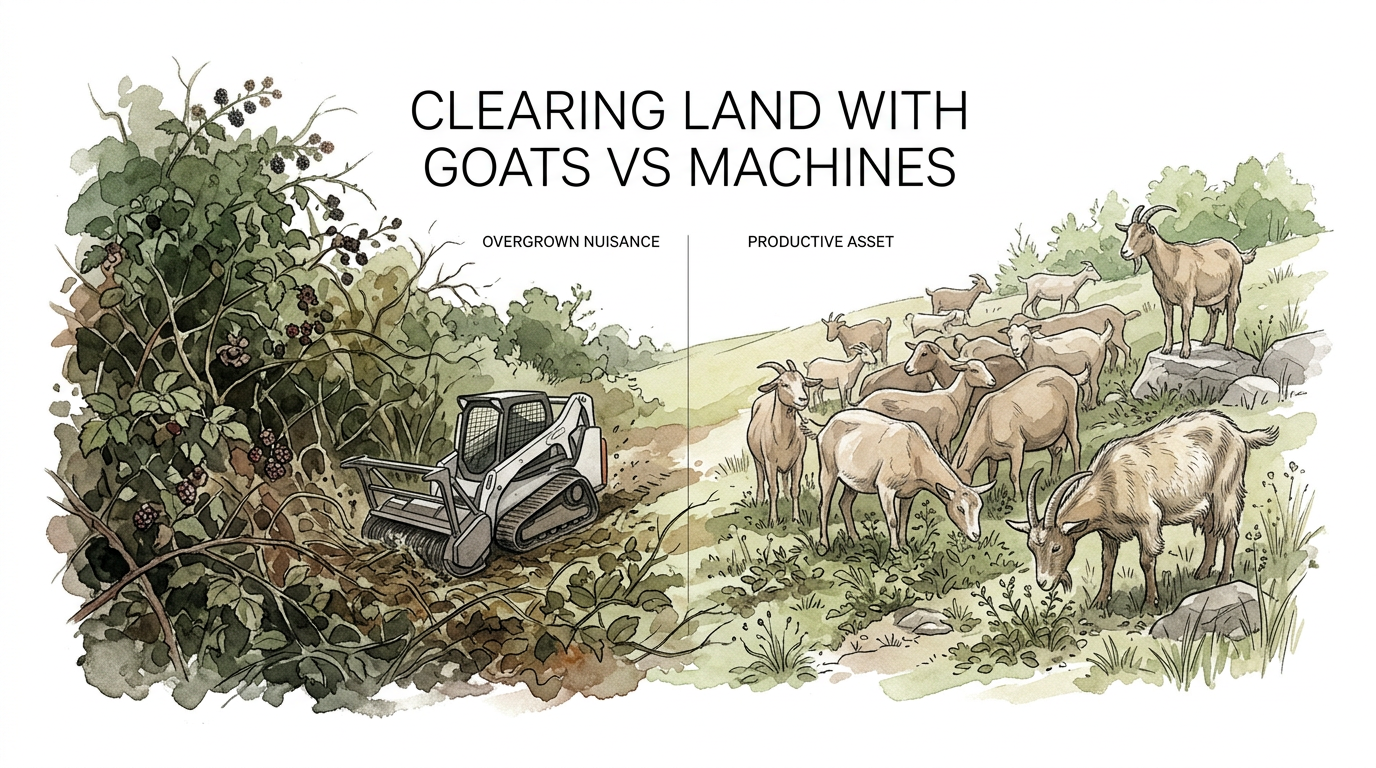
This transition from an overgrown nuisance to a productive asset is at the heart of regenerative land management. Using biological controls like goats isn’t just a clever trick; it is an ancestral practice that aligns with the natural rhythms of the land. It allows the homesteader to step out of the cycle of chemical applications and mechanical destruction, replacing it with a self-sustaining system of growth and renewal.
Clearing Land With Goats Vs Machines
Defining the difference between caprine clearing and mechanical clearing begins with understanding how each impacts the soil and the future of the landscape. Mechanical clearing typically involves heavy equipment like skid steers with brush mowers or bulldozers. While effective at creating an immediate “clean” look, these machines often lead to significant soil compaction and the destruction of the delicate topsoil layer.
Goats, on the other hand, represent a surgical approach to land management. They don’t just “cut” the plant; they process it. A goat’s four-compartment stomach acts as a biological incinerator for weed seeds, significantly reducing the chance of invasive species returning in the next season. Where a machine leaves behind a thick layer of dead mulch that can choke out new grass, goats leave behind highly bioavailable fertilizer in the form of manure pellets.
In real-world situations, machines are often restricted by the terrain. Steep hillsides, rocky outcroppings, and swampy bottoms are dangerous or impossible for tractors to navigate. Goats thrive in these environments. Their small, nimble hooves provide natural aeration for the soil without the crushing weight of steel tracks. Choosing goats over machines means choosing long-term soil health over a weekend of loud, expensive noise.
How the “Caprine Clearing” Process Works
The process of clearing land with a herd is less about “letting them loose” and more about strategic containment. Success relies on a concept called targeted grazing or high-density rotational grazing. By concentrating a specific number of goats in a small area for a short period, you force them to eat the nuisance plants they might otherwise ignore if they had free range of the entire property.
First, you must identify the “target” vegetation. Goats are browsers, not grazers, meaning they naturally reach up to eat leaves, bark, and tender stems rather than looking down for grass. They will stand on their hind legs to reach branches up to six or seven feet high. This creates a “browse line” in the woods, effectively thinning out the understory and allowing light to reach the forest floor for the first time in years.
Once the goats have defoliated the plants, they often move on to the bark. This is a critical step in permanent clearing. By stripping the bark from woody plants—a process known as girdling—the goats prevent the plant from transporting nutrients. This effectively kills the plant from the top down without the need for a single drop of herbicide. Repeated grazing over two to three seasons eventually exhausts the root reserves of even the most stubborn invasive species.
Benefits of the Biological Approach
The practical benefits of using goats for land clearing extend far beyond just “killing weeds.” For the homesteader, the most immediate benefit is the conversion of an unwanted resource into a high-value product. Those thorny blackberries are transformed into high-fat milk for the kitchen or lean, nutrient-dense meat for the freezer. This turns a maintenance cost into a profit center.
Furthermore, the environmental impact is overwhelmingly positive. Because goats are selective, they can be used to target specific invasives while leaving desirable native species alone if managed correctly. They also reduce the “fuel load” in fire-prone areas. By removing the dry, dead brush and low-hanging limbs, goats create natural firebreaks that can protect a homestead from seasonal wildfires.
Soil health is perhaps the most overlooked advantage. Studies have shown that goat manure is rich in nitrogen, phosphorus, and potassium, and it is less likely to “burn” plants than poultry manure. As the goats move across the land, they are essentially walking fertilizer spreaders. Their presence stimulates microbial activity in the soil, which leads to better water retention and more robust growth of desirable pasture grasses once the brush is gone.
Challenges and Common Mistakes
One of the most frequent errors beginners make is underestimating the goat’s ability to escape. There is an old farmer’s saying: “If a fence won’t hold water, it won’t hold a goat.” Using standard cattle or horse fencing for brush clearing is a recipe for a neighbor’s phone call. Goats will find the one weak link in your perimeter and exploit it with ruthless efficiency.
Another common pitfall is ignoring predator pressure. When goats are tucked away in thick brush clearing a remote corner of the property, they are prime targets for coyotes, bobcats, or even neighborhood dogs. Failing to provide a secure night pen or a livestock guardian animal can lead to heart-wrenching losses. You are essentially putting out a “dinner bell” for every predator in the county when you move a herd into the woods.
Lastly, homesteaders often forget about parasite management. Because goats in a land-clearing scenario are often eating close to the ground once the high-reach forage is gone, they are at higher risk for internal parasites like the barber pole worm. Rotating the herd frequently and monitoring their health via FAMACHA scoring is essential. You cannot simply “set them and forget them” if you want a healthy, productive herd.
Limitations of Goat Land Clearing
It is important to maintain a realistic perspective on what goats can and cannot do. Goats are not wood chippers. While they will happily eat the leaves and small twigs of a sapling, they cannot remove a mature tree. If you are looking to turn a dense forest into a flat lawn in one month, goats are not the right tool. They are a tool for management and maintenance, not total land excavation.
Environmental constraints also play a role. Goats require a clean source of water and protection from extreme weather. In areas with high rainfall and heavy clay soils, the constant trampling of a herd in a small area can lead to “pugging,” where the soil becomes a muddy mess that actually inhibits growth. You must time your grazing to the weather and the life cycle of the plants you are trying to kill.
There are also certain plants that are simply off-limits. While goats have a reputation for eating anything, they are highly susceptible to certain toxins found in common landscape plants. If your “brush” consists of rhododendrons or mountain laurel, the goats are more likely to end up in a veterinary clinic than a pasture. Always scout the land for toxic species before the first goat steps off the trailer.
Comparing Methods: Goats vs. Equipment
| Feature | Goats (Biological) | Skid Steer (Mechanical) |
|---|---|---|
| Direct Cost | Low (Feed/Fence) | High (Rental/Fuel) |
| Soil Impact | Positive (Fertilizer/Aeration) | Negative (Compaction/Erosion) |
| Seed Bank | Neutralizes seeds in gut | Disturbs soil, triggering growth |
| Terrain | Goes anywhere | Limited by slopes/rocks |
| Speed | Slow (Weeks/Months) | Fast (Hours/Days) |
Practical Tips for Success
Start with the right infrastructure. Portable electric netting is the gold standard for land clearing. It allows you to create flexible paddocks that can be moved as the goats exhaust the available forage. Ensure you have a high-joule energizer to discourage both escapes and predators. A goat that gets a mild “tickle” from a fence will eventually push through it; a goat that gets a sharp “snap” will learn to respect the boundary.
Timing the grazing is just as important as the fencing. For maximum impact on invasive brush, you should put the goats on the land in late spring or early summer when the plants have put all their energy into their leaves. By stripping the leaves at this stage, you force the plant to use up its root reserves to grow more. Repeating this in the late summer further weakens the plant before winter dormancy.
- Scout for Toxics: Check for Azalea, Yew, and Wilted Black Cherry leaves.
- Water is Non-Negotiable: Even in thick brush, goats need 1-2 gallons of fresh water daily.
- Mineral Support: High-tannin brush can interfere with mineral absorption; provide a high-quality loose mineral.
- Stocking Density: Use approximately 10-15 goats per acre for heavy brush removal over a 4-week period.
Advanced Considerations for Serious Practitioners
For those looking to scale their land clearing, consider multi-species grazing. Sheep and goats have different preferences; sheep will focus on the weeds and grasses at your feet, while goats will handle the woody stems at eye level. Running them together, or in a “flerd,” ensures that every niche of the overgrown area is utilized. This leads to a more uniform clearing and better overall pasture health.
You should also consider the specific breeds for your environment. While the Boer goat is popular for meat, many land-clearing professionals prefer the Kiko or Spanish goat. These breeds were developed with minimal human intervention and possess superior “thrifty” qualities. They can thrive on lower-quality forage and have a natural resistance to parasites and foot rot, which are common in overgrown, humid environments.
Soil testing after a clearing project can provide fascinating insights into your progress. Often, land that was “poor” because it was choked with brush is actually quite fertile once the nutrient cycle is restarted. By monitoring the pH and nutrient levels, you can determine exactly when the soil is ready to be overseeded with high-quality perennial grasses to take the place of the cleared brush.
Examples of Goat Clearing in Action
Imagine a one-acre plot of land completely overtaken by multiflora rose and poison ivy. A homesteader attempts to clear this by hand and realizes it would take weeks of dangerous, itchy labor. Instead, they set up two 164-foot rolls of electric netting, creating a quarter-acre paddock, and introduce five adult goats.
Within seven days, the “green wall” has been stripped of every leaf up to five feet high. The goats are then moved to the next quarter-acre section. By the end of the month, the entire acre has been defoliated. The homesteader notices that without the leaves, the rose bushes are much easier to prune or pull, and the poison ivy has been significantly knocked back.
A year later, the same homesteader brings the goats back for a “maintenance” pass. This time, the goats focus on the new sprouts emerging from the old roots. Because the goats have already killed the main stalks by debarking them the previous year, the amount of work the goats have to do is halved. By the third year, the once-impenetrable thicket has been replaced by a budding silvopasture of grass and healthy trees.
Final Thoughts
Embracing goats as a land-clearing solution is a powerful step toward a more self-reliant and ecologically sound homestead. It moves us away from the “slash and burn” mentality of modern land management and back toward a stewardship-based approach. When we work with the natural instincts of our animals, we find that the hardest jobs on the farm often become the most rewarding.
The key to success lies in preparation and observation. By investing in quality fencing, choosing hardy breeds, and understanding the nutritional needs of your herd, you can transform your property’s biggest nuisance into its greatest asset. The grit of the pioneer wasn’t just in their muscles, but in their ability to see the potential in the wild landscape and use the tools at hand to shape it.
Experiment with your herd, watch how they interact with different plants, and don’t be afraid to adjust your strategy as the seasons change. Whether you are clearing a small garden patch or reclaiming twenty acres of timber, the goats are ready to do the work. All you have to do is open the gate and let nature take its course.
