How To Become More Self-Sufficient Without Starting a Full-Blown Farm…
Want to start preserving your harvest, making your own soap, or building a backyard root cellar — but not sure where to begin? “Homesteading Advice” gives you instant lifetime access to 35+ practical homesteading books on food preservation, veggie gardening, DIY natural cleaning products (save over $250 per year with this skill alone), brewing, off-grid energy, and a whole lot more…
Click Here To Check It Out Now!
Stop paying for poisons when nature provides the bodyguards for free. Pesticides kill the bad guys AND the good guys. Planting an insectary invites the predators to stay and manage the pests for you. No chemicals required.
Every homesteader reaches a point where they must choose between the easy path of a spray bottle and the enduring path of a balanced ecosystem. Natural pest management is not just a garden hobby; it represents a commitment to land stewardship that mirrors the wisdom of those who farmed before the chemical age began. Growing an insectary garden means you are creating a permanent home for the very creatures that keep your crops safe from destruction.
Establishing this “bug bank” requires a shift in perspective. Instead of seeing every six-legged visitor as a threat, you begin to see them as the tiny gears of a high-functioning machine. This guide will walk you through the process of turning your land into a fortress guarded by nature’s police, ensuring your harvest is protected by biology rather than chemistry.
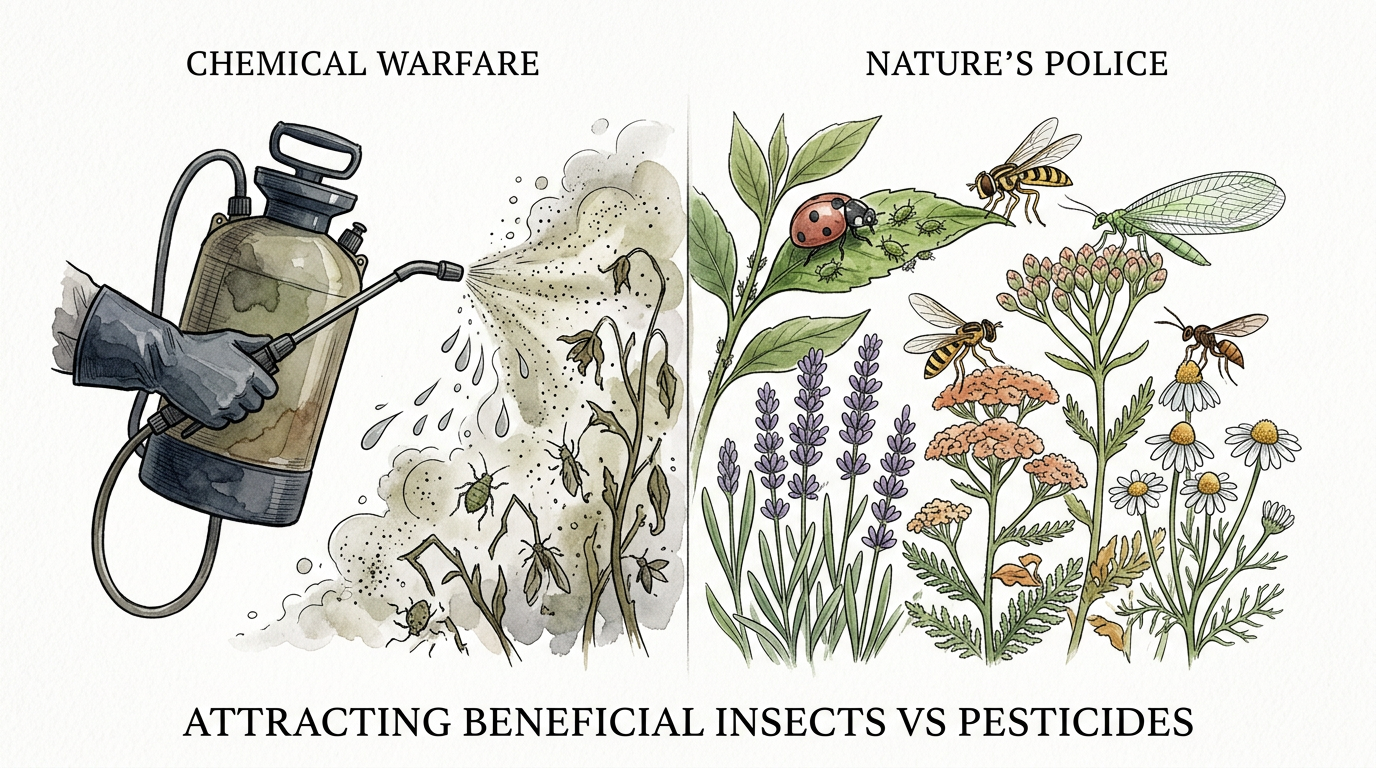
Attracting Beneficial Insects Vs Pesticides
Natural pest control involves the deliberate use of habitat to invite and sustain beneficial insects that prey on harmful pests. This method stands in stark contrast to traditional chemical applications. Pesticides act as a broad-spectrum scorched-earth policy, often wiping out the ladybugs and lacewings along with the aphids they were meant to eat. This creates a vacuum that allows pests—who often reproduce faster than their predators—to return in even greater numbers.
Choosing to attract beneficial insects is like hiring a dedicated security team that lives on-site. These insects do more than just kill pests; they pollinate your crops, improve the local food web, and maintain the delicate balance of your soil. Real-world applications range from small backyard raised beds to sprawling organic farms where insectary strips are used to reduce the need for synthetic inputs by up to 90% in some cases.
Think of it as the difference between a high-fenced prison and a healthy neighborhood. In a neighborhood, everyone has a job, and the local “police” (predators) keep the peace simply by living there. In the chemical model, you are constantly fighting a war of escalation, using stronger poisons to deal with pests that have built up resistance. Inviting beneficials back to the land ends that cycle of dependency once and for all.
How to Build Your Own Natural Defense System
Creating an insectary garden is a deliberate process of habitat engineering. You are not just planting flowers; you are providing the basic necessities of life: protein, carbohydrates, and housing. Most adult beneficial insects, such as hoverflies and parasitic wasps, actually feed on nectar and pollen, while their larvae are the ones that do the heavy lifting of eating pests.
Designing for the “Big Three”
Success starts with offering three things in abundance: nectar for energy, pollen for protein and reproduction, and structural shelter for protection from the elements. Small, shallow flowers are often the most effective because many beneficial insects, like the tiny Braconid wasp, have mouthparts that cannot reach into deep, tubular blossoms. Planting a variety of shapes and sizes ensures you are catering to the widest range of allies.
Selecting Your Plant Allies
Diversity is your greatest weapon. You should aim for plants that bloom at different times of the year to provide a constant food source. Early spring bloomers are particularly vital because they feed the first wave of predators emerging from winter dormancy. Some of the most potent plants for an insectary include:
- Dill and Fennel: These “umbellifers” produce large, flat flower heads that are perfect landing pads for lacewings and hoverflies.
- Sweet Alyssum: This low-growing carpet plant provides a steady supply of nectar and is a favorite of the tiny wasps that parasitize aphids.
- Yarrow: A rugged perennial that attracts almost every type of beneficial insect while being drought-tolerant and easy to maintain.
- Calendula: These bright flowers attract hoverflies, whose larvae are voracious aphid hunters.
Strategic Placement
Locating your insectary plants near your most vulnerable crops is essential. Insects are small and have limited energy; they are much more likely to patrol your tomato plants if there is a “cafeteria” of nectar nearby. Integrating these plants directly into your vegetable rows or planting them as a border (a hedgerow) creates a continuous corridor of safety for your insect allies.
The Long-Term Rewards of Nature’s Police
The primary advantage of this approach is its self-sustaining nature. Unlike a pesticide spray that loses effectiveness as soon as the next rain falls, a healthy population of beneficial insects will reproduce and grow alongside your garden. This creates a legacy of protection that actually gets stronger year after year as the local ecosystem matures.
Cost is another significant factor. A single packet of seeds for borage or yarrow can provide years of protection for a fraction of the price of high-end chemical treatments. Furthermore, you are removing the risk of chemical residue on your food. Growing your own food is about health and self-reliance; using nature’s bodyguards ensures that your “organic” label actually means something at the dinner table.
Soil health also thrives when you step away from the sprayer. Many pesticides can disrupt the microbial life in the dirt, which eventually weakens your plants and makes them even more susceptible to pests. By allowing nature to take the lead, you are fostering a deep, subterranean health that translates into more resilient crops and better yields.
Common Pitfalls in Insectary Gardening
One of the most frequent errors is the “clean garden” syndrome. Pioneers often feel the urge to tidy up every dead leaf and spent stalk, but these are exactly where beneficial insects overwinter. Leaving some areas of the garden a bit “wild” or messy provides the necessary cover for predators to survive the cold months. If you strip the land bare every autumn, you are effectively evicting your security team right when they need a home.
Mistaken identity is another major hurdle. Many beneficial insect larvae look quite different from their adult forms. For example, ladybug larvae look like tiny, black-and-orange alligators. Many well-meaning gardeners see these “monsters” on their plants and reach for the spray, unknowingly killing the very creatures that were about to decimate their aphid problem. Education is the first step in successful management.
Impatience can also ruin a good plan. Nature works on a slower timeline than a chemical spray. You might see a small explosion of pests before the predators arrive to clean them up. This “lag time” often panics gardeners into spraying, which resets the entire process. Trusting the system is the hardest part of the transition from chemical warfare to natural balance.
Knowing the Limits of the Biological Method
Biological control is rarely a 100% solution, and it shouldn’t be. To keep a population of predators around, you must have at least a small population of pests for them to eat. This concept is sometimes called “ecological tithing.” You have to be willing to lose a few leaves to the aphids to ensure the ladybugs don’t starve and fly away.
Environmental factors can also play a role. Extreme weather events or unseasonably cold springs can disrupt the hatching cycles of beneficial insects, potentially leaving your crops vulnerable for a short window. In these cases, you may need to use physical barriers like row covers to bridge the gap until the insect population recovers.
Furthermore, an insectary cannot fix a fundamentally unhealthy garden. If your plants are stressed by poor soil, lack of water, or improper light, they will emit chemical signals that attract pests in overwhelming numbers. Nature’s police are effective, but they cannot save a sinking ship. Healthy soil remains the foundation of all pest management.
CHEMICAL WARFARE vs NATURE’S POLICE
Understanding the differences between these two approaches helps in deciding how to manage your land. The table below compares the two methods across several critical factors for the modern homesteader.
| Feature | Chemical Pesticides | Beneficial Insectaries |
|---|---|---|
| Initial Cost | Medium to High (recurring) | Low (seed costs only) |
| Maintenance | Constant reapplications | Low (annual pruning/mulching) |
| Targeting | Broad-spectrum (kills all) | Specific (predator/prey) |
| Soil Impact | Negative/Disruptive | Positive/Biodiversity-focused |
| Long-term Efficacy | Decreases (resistance) | Increases (habitat stability) |
Practical Tips for Immediate Application
Start small by designating just 10% of your garden space to insectary plants. This “ten percent rule” is often enough to provide a base of operations for predators without taking too much room away from your food crops. Mixing these plants throughout your beds is better than putting them all in one isolated corner.
Providing a water source is an often-overlooked secret to success. A shallow birdbath filled with pebbles allows insects to drink without drowning. In the heat of mid-summer, a reliable water station can be the difference between your beneficials staying in your garden or leaving to find a more hospitable environment.
Stop using broad-spectrum organic sprays if you can. Even “natural” options like Neem oil or insecticidal soap can kill beneficial insects if they come into direct contact. If you must use a spray for a severe infestation, apply it only to the specific affected area and do it late in the evening when most beneficials are less active.
Advanced Considerations for the Serious Practitioner
Once you have mastered the basics, you can begin to look at “trap cropping.” This involves planting a specific crop that is even more attractive to the pests than your main harvest. For instance, planting sunflowers can lure aphids away from your peppers. The sunflowers then act as a concentrated feeding ground for ladybugs, creating a high-density “kill zone” that protects the rest of your garden.
Succession planting is another advanced technique. By staggering the planting of your insectary flowers every two weeks, you ensure a continuous wave of fresh nectar. This prevents “hunger gaps” where the predators might leave your land because the first round of flowers has gone to seed before the next round has opened.
Consider the role of native plants. While garden herbs like dill and cilantro are fantastic, native wildflowers are co-evolved with your local beneficial insects. They often require less water and are perfectly tuned to the life cycles of the predators in your specific region. Researching the native “prairie” or “woodland” plants for your area can add a powerful layer of resilience to your homestead.
Example Scenario: The Great Aphid Reckoning
Imagine a spring where your cabbage starts to curl under the weight of an aphid infestation. In a chemical-dependent garden, you would reach for the spray. In an insectary-managed garden, you wait three days. On day one, you see the aphids. On day two, you notice small, hoverfly adults hovering over the plants like tiny helicopters. On day three, you spot the orange, slug-like larvae of those flies crawling through the aphid colonies.
Within a week, the hoverfly larvae have consumed the majority of the aphids. Because you have a border of Sweet Alyssum nearby, the adult hoverflies have the energy to stay and lay a second round of eggs. By the time the cabbage is ready for harvest, the pest problem has been solved with zero labor on your part and zero chemicals on your food. This is the biological method in action—efficient, quiet, and absolutely free.
Final Thoughts
Building a home for beneficial insects is an act of defiance against the modern cycle of chemical dependency. It is a return to a way of gardening that respects the complexity of life and the efficiency of natural systems. By planting an insectary, you are not just growing flowers; you are cultivating a legacy of balance and health that will serve your land for generations to come.
Take the first step this season by letting a few of your herbs go to flower. Watch the life that returns to your garden when you stop the “chemical warfare” and start supporting “nature’s police.” You will likely find that the garden thrives best when you step back and let the bodyguards do the work they were born to do. Experiment with different plants, observe the results, and enjoy the peace of mind that comes with a poison-free harvest.
