How To Become More Self-Sufficient Without Starting a Full-Blown Farm…
Want to start preserving your harvest, making your own soap, or building a backyard root cellar — but not sure where to begin? “Homesteading Advice” gives you instant lifetime access to 35+ practical homesteading books on food preservation, veggie gardening, DIY natural cleaning products (save over $250 per year with this skill alone), brewing, off-grid energy, and a whole lot more…
Click Here To Check It Out Now!
The Great Transition: Turning a Biological Desert into an Integrated Food Forest
One of these landscapes takes your money and time, while the other gives you back abundance every single day. Is your backyard a biological desert? Traditional lawns are isolated systems that require constant inputs of water and chemicals for zero output. Learn how integrated permaculture guilds create a self-sustaining ecosystem that feeds your family while healing the planet.
For decades, we have been told that a flat, green expanse of manicured grass is the pinnacle of homeownership. This aesthetic, borrowed from European aristocrats, has become a burden on the modern pioneer. It is a sterile landscape that demands our labor but offers nothing in return. It is an isolated lawn, disconnected from the rhythm of the earth.
In contrast, the integrated food forest represents a return to ancestral wisdom. It is a system designed to mimic the patterns of a natural woodland while providing a harvest of fruits, nuts, herbs, and vegetables. By understanding how plants work together in guilds, you can stop fighting against nature and start partnering with it. This is the path to true self-reliance.
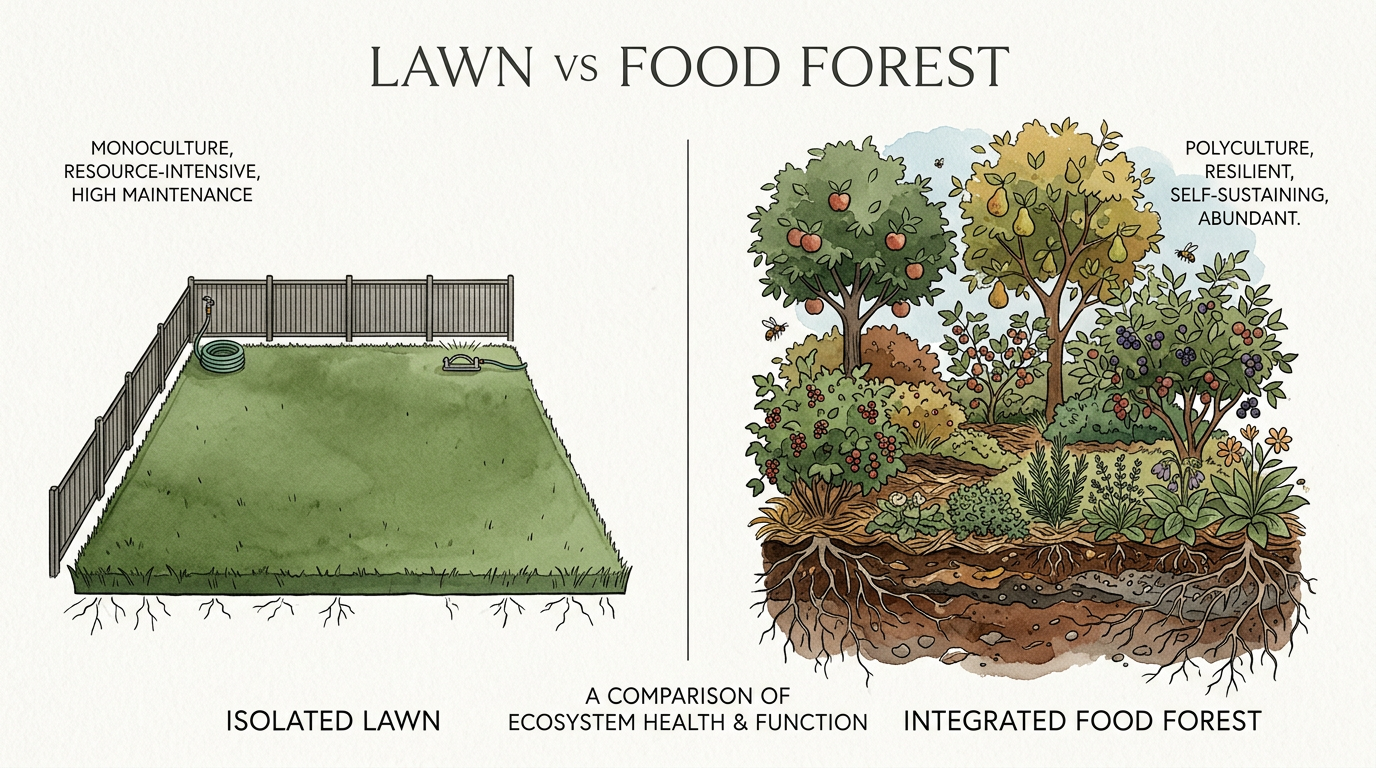
Lawn Vs Food Forest Comparison
To understand the value of an integrated forest, we must first look at the failure of the isolated lawn. A lawn is essentially a crop that we refuse to harvest. We spend our weekends mowing, fertilizing, and watering a monoculture that provides no habitat for pollinators and no nutrition for our tables. It is a high-maintenance, low-yield trap.
The isolated lawn relies on external inputs. If you stop watering, it dies. If you stop fertilizing, it turns yellow. If you stop mowing, it becomes “unsightly” by modern standards. It is a fragile system that requires a constant flow of fossil fuels and chemical treatments to maintain its appearance. It provides no shade, no wind protection, and no ecological service.
An integrated food forest, however, is a resilient powerhouse. It is a multi-layered system where every plant has a job. Tall canopy trees provide shade and shelter. Understory trees produce fruit. Shrubs offer berries, while the ground layer provides herbs and medicinal plants. Below the surface, the rhizosphere is a bustling city of fungal networks and beneficial microbes. This is a system that grows stronger over time, requiring less work as it matures.
When we compare the two, the choice becomes clear. One is a drain on your resources; the other is an investment in your future. Moving from an isolated lawn to an integrated forest is not just a gardening choice—it is a reclamation of your land and your autonomy.
How It Works: The Mechanics of Permaculture Guilds
The secret to a successful food forest lies in the concept of a “guild.” In permaculture, a guild is a group of plants that support one another. Think of it as a community where each member contributes something unique. A well-designed guild reduces the need for human intervention by managing its own fertility and pest control.
The centerpiece of a guild is usually a central “anchor” plant, such as a fruit or nut tree. Surrounding this anchor are “support” plants. Some are nitrogen fixers, like clover or lupine, which pull nitrogen from the air and store it in the soil for their neighbors. Others are dynamic accumulators, like comfrey, which have deep taproots that pull minerals from deep underground to the surface.
Another essential part of the guild is the “insectary” layer. These are flowering plants that attract pollinators and predatory insects. By bringing in bees, butterflies, and ladybugs, you ensure your crops are pollinated and your pests are kept in check naturally. This eliminates the need for toxic sprays that kill the very life we are trying to encourage.
Setting up these systems requires careful observation. You must look at your land and see where the water flows, where the sun hits, and how the wind moves. Instead of forcing a design onto the landscape, a pioneer listens to what the land is telling them. You plant with intention, placing each species where it will thrive and support the whole.
The Seven Layers of the Forest
To maximize production in a small space, we look at the forest in vertical layers. This allows us to grow significantly more food in the same square footage compared to a traditional garden. This vertical integration is what turns a backyard into a self-sustaining pantry.
- The Canopy: Large trees like walnuts, chestnuts, or tall oaks that form the top layer.
- The Understory: Smaller fruit trees like apples, pears, peaches, and plums.
- The Shrub Layer: Berry bushes such as currants, blueberries, and raspberries.
- The Herbaceous Layer: Perennial herbs, culinary greens, and medicinal plants.
- The Rhizosphere: Root crops and the complex fungal networks in the soil.
- The Groundcover: Plants that hug the earth, preventing erosion and suppressing weeds.
- The Vertical Layer: Vining plants like grapes, kiwis, or hops that climb the trees.
The Practical Benefits of Self-Sustaining Ecosystems
The most immediate benefit of an integrated forest is food security. When you have a diverse range of crops, you are not dependent on a single harvest. If a late frost hits the apple blossoms, you may still have a bumper crop of berries or late-season nuts. This diversity is the hallmark of a resilient homestead.
Beyond the food, you gain significant time. While a lawn demands weekly attention during the growing season, a mature food forest requires only light pruning and harvesting. Once the system is established, the groundcovers and mulch suppress the weeds for you. The nitrogen fixers fertilize the soil for you. You are no longer a slave to the mower.
Environmentally, the benefits are staggering. A food forest builds soil health rather than depleting it. It sequesters carbon, helping to cool the local microclimate. It also acts as a giant sponge, absorbing rainwater and preventing runoff. During a drought, an integrated forest stays green and productive long after the neighbor’s lawn has turned brown and brittle.
There is also the intangible benefit of connection. Walking through a food forest is a sensory experience. The air is cooler, the birds are louder, and the ground feels alive beneath your boots. It is a place of peace and abundance, providing a legacy that can be passed down to future generations.
Challenges and Common Mistakes to Avoid
The transition from a lawn to a forest is not without its hurdles. The most common mistake is trying to do too much too fast. Nature moves at its own pace, and a pioneer must respect that. Planting an entire acre in a single weekend often leads to overwhelmed gardeners and neglected plants.
Another pitfall is ignoring the soil. You cannot simply dig a hole in a compacted lawn and expect a fruit tree to thrive. Lawns are often “dead” soil, lacking the fungal life necessary for forest plants. You must focus on building the soil first. Use techniques like sheet mulching to break down the grass and invite the worms back into the earth.
Spacing is also a critical factor. It is easy to plant small saplings close together, forgetting that they will eventually grow to their full size. If you crowd your trees, they will compete for light and air, leading to disease and lower yields. Always research the mature spread of your plants before you put them in the ground.
Finally, don’t forget the water. While a mature forest is drought-tolerant, young plants need consistent moisture to establish their roots. Design your system with water catchment in mind—using swales, berms, or rain barrels to ensure your guild gets the hydration it needs during those critical first few years.
Lawn vs. Food Forest: A Comparison of Resource Use
| Feature | Isolated Lawn | Integrated Food Forest |
|---|---|---|
| Maintenance | Weekly mowing, edging, and weeding. | Seasonal pruning and harvesting. |
| Water Needs | High; requires constant irrigation. | Low; designed for water retention. |
| Fertility | Synthetic chemicals/external inputs. | Self-fertilizing through guilds. |
| Biodiversity | Near zero; biological desert. | High; supports birds and bees. |
| Yield | Zero (except for grass clippings). | High; food, medicine, and fuel. |
Practical Tips for the Modern Pioneer
If you are ready to reclaim your land, start small. Choose one corner of your yard and turn it into a single guild. This “island of abundance” will give you the confidence to expand further each year. It is better to have one thriving guild than a dozen struggling ones.
Use the “Sheet Mulch” method to kill your grass without tilling. Tilling destroys the soil structure and wakes up dormant weed seeds. Instead, lay down a thick layer of cardboard or newspaper, soak it with water, and cover it with 6-12 inches of organic matter like wood chips, straw, or leaves. Over time, the grass will rot and turn into rich, black gold for your trees.
Prioritize native species when choosing your support plants. Native plants are already adapted to your climate and soil conditions, and they provide the best habitat for local wildlife. A mix of native flowers and edible perennials creates a robust system that can withstand local pests and weather extremes.
Observe your patterns. Where do you walk? Where do you sit? Place your most frequently harvested plants—like herbs for tea or greens for salad—closest to your back door. This is “Zone 1” in permaculture. The further away from the house you go, the more self-sufficient the plants should be. This smart design ensures that your work is minimized and your enjoyment is maximized.
Don’t be afraid of “messiness.” A forest floor is covered in leaves and twigs. In the pioneer mindset, this isn’t clutter—it’s mulch. It is the lifeblood of the forest. Leave the leaves where they fall. Let the spent flower heads stand through the winter to provide seeds for birds. Embracing the natural cycle of decay and rebirth is essential for a thriving ecosystem.
Final Thoughts: The Path to Ancestral Abundance
Transforming an isolated lawn into an integrated food forest is more than just a gardening project. It is an act of defiance against a culture of consumption and waste. It is a return to the ways of our ancestors, who understood that we are not separate from nature, but a part of it. By building these systems, we take a stand for self-reliance and ecological health.
The abundance that comes from a well-tended forest is not just measured in pounds of fruit or jars of honey. It is measured in the security of knowing where your food comes from. It is found in the joy of watching a sterile patch of grass transform into a vibrant, living sanctuary. This is the pioneer spirit in action—working hard today to build a better, more resilient tomorrow.
As you begin your journey, remember that every great forest started with a single seed. Be patient with yourself and with the land. The transition from a biological desert to a productive ecosystem takes time, but the rewards are eternal. Your land is waiting to be integrated. It is time to stop fighting the earth and start growing with it.
