How To Become More Self-Sufficient Without Starting a Full-Blown Farm…
Want to start preserving your harvest, making your own soap, or building a backyard root cellar — but not sure where to begin? “Homesteading Advice” gives you instant lifetime access to 35+ practical homesteading books on food preservation, veggie gardening, DIY natural cleaning products (save over $250 per year with this skill alone), brewing, off-grid energy, and a whole lot more…
Click Here To Check It Out Now!
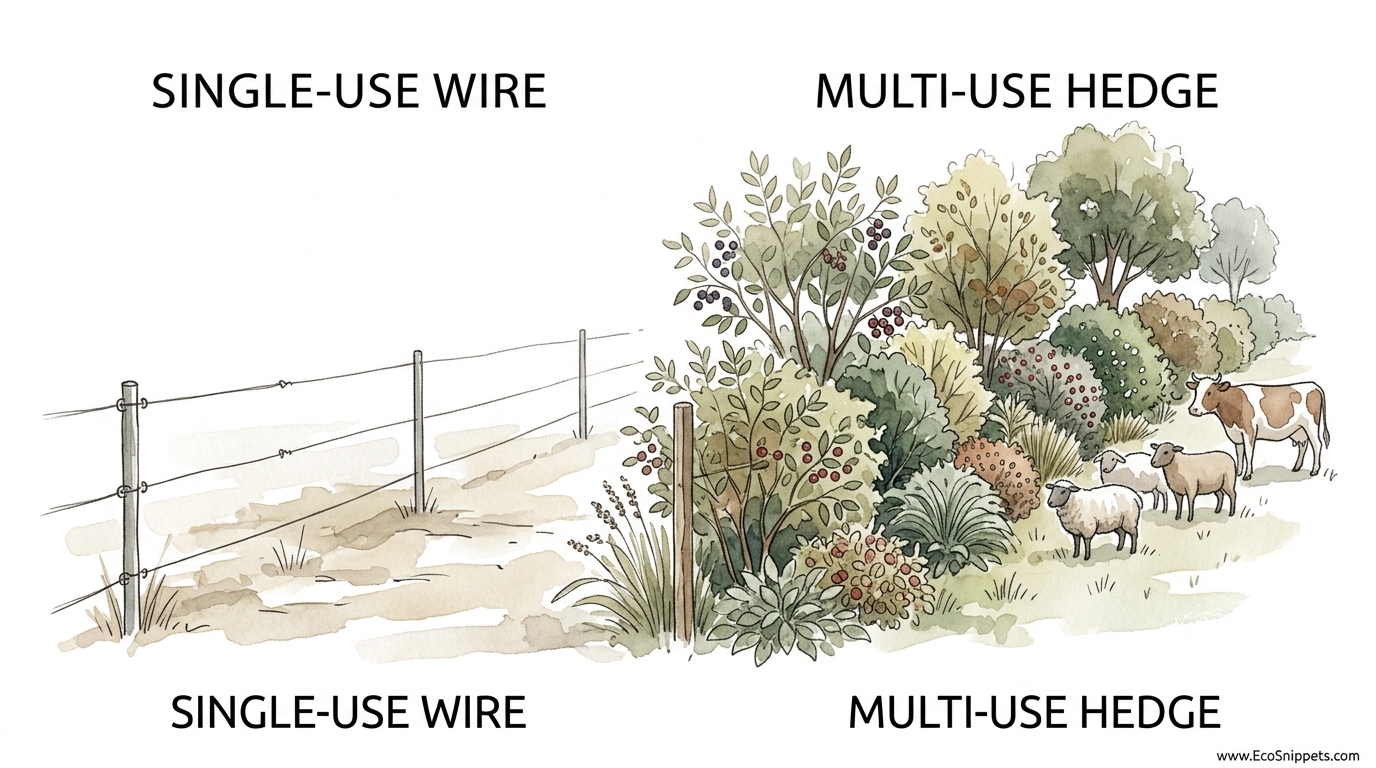
Your fence is either a maintenance liability or a free protein factory – which one are you currently paying for? Most homesteaders view a fence as a boundary, but in an integrated system, a fence is a fodder bank. We swapped our rusting wire for a living hedgerow, and our feed bill dropped by 20% overnight while providing a permanent windbreak for the herd.
Modern agriculture teaches us to separate functions, keeping the trees in the woodlot and the livestock in the grass. This artificial divide creates more work for the steward and more expense for the farm. Ancestral wisdom suggests a different path, where the barrier itself serves as a nutrient-dense supplement. Building a living fence requires patience, yet the result is a self-repairing, high-protein asset that outlasts any galvanized wire.
Multi-functional Living Fences For Livestock
A multi-functional living fence is a densely planted line of trees or shrubs managed to provide both a physical barrier and a biological resource. Unlike a static wire fence, these systems grow stronger with age and offer secondary yields such as animal feed, fuel, and medicinal benefits. They act as “fodder banks,” storing nutrients in their leaves and bark for times when pasture grass is dormant or drought-stricken.
Historically, European and American pioneers utilized techniques like hedgelaying and pollarding to manage these boundaries. These methods involve manipulating the growth of deciduous trees to create impenetrable thickets. Today, regenerative farmers use living fences to create microclimates, shielding livestock from bitter winter winds and scorching summer sun. A well-designed living fence is more than a line on a map; it is a living organ of the homestead ecosystem.
High-Protein Species Selection
Selecting the right trees determines the success of your fodder system. You need species that respond well to heavy pruning and offer high nutritional value.
Mulberry (Morus alba)
Mulberry is perhaps the king of fodder trees. Its leaves contain between 15% and 28% crude protein, making it comparable to high-quality alfalfa. Because it has low levels of phenolic compounds, it does not cause bloat in ruminants. Mulberry thrives in most soils and can be managed as a low hedge or a tall pollard.
Willow (Salix spp.)
Willow is prized for its rapid growth and medicinal properties. It contains salicin, a natural precursor to aspirin, which helps reduce inflammation and heat stress in cattle and sheep. While it has higher tannins than mulberry, these compounds help suppress internal parasites like nematodes. Willow is an excellent choice for wet or boggy areas where other species might fail.
Black Locust (Robinia pseudoacacia)
Black locust is a nitrogen-fixing powerhouse. Its leaves offer 18% to 20% protein and are highly palatable to goats and cattle. The wood is also legendary for its rot resistance, providing a source of natural fence posts for the future. Note that black locust is toxic to horses, so use it only in ruminant-focused systems.
Tagasaste (Chamaecytisus palmensis)
Also known as the Lucerne Tree, Tagasaste is a deep-rooted evergreen that thrives in dry conditions. Its foliage remains green year-round and contains 20% to 27% protein. It recovers quickly from browsing and provides excellent winter forage when other sources are scarce.
Traditional Management Techniques
Establishing a living fence is not a “plant and forget” project. You must apply specific pruning techniques to ensure the barrier remains dense and accessible.
The Art of Hedgelaying
Hedgelaying is the process of partially cutting through the base of a young tree and bending it at a 45-degree angle. These bent stems, called pleachers, are woven together between upright stakes. This encourages new shoots to grow vertically from the entire length of the laid stem, filling in gaps at the base. A properly laid hedge is completely stock-proof, preventing even small lambs or pigs from pushing through.
Pollarding for Vertical Storage
Pollarding involves cutting the top of a tree above the “browse line” or the height your animals can reach. This forces the tree to produce a dense crown of succulent new growth out of reach of the herd. You can then harvest this growth as “tree hay” or allow the animals to eat the trimmings when you prune. This technique protects the tree’s photosynthetic base while providing a steady supply of fodder.
Coppicing for Biomass
Coppicing is similar to pollarding but occurs at ground level. This is used for species like hazel or willow to produce a “mad tuft” of straight stems. These stems can be harvested on a 3-to-7-year rotation for fencing material, tool handles, or mulch. Coppiced areas must be fenced off from livestock for the first few years to allow the new shoots to escape the “death by browsing” stage.
Benefits of Living Boundaries
The advantages of a living system extend far beyond the feed bucket. These fences provide measurable improvements to the health of your land and your livestock.
Nutritional Resilience
Tree fodder often provides trace minerals that deep roots pull from the subsoil, minerals that shallow-rooted grasses cannot reach. Zinc, magnesium, and selenium levels are often significantly higher in tree leaves. During summer droughts, trees remain green and nutrient-dense long after the pasture has turned brown.
Microclimate Control
A dense living fence acts as a windbreak, reducing wind speed by up to 50% for a distance of ten times the fence height. This reduces the energy livestock must spend on thermoregulation, leading to better weight gain and lower winter feed requirements. In summer, the shade provided by a living fence keeps canopy temperatures up to 6 degrees Celsius cooler.
Permanent Infrastructure
Wire fences have a defined lifespan, usually 20 to 25 years. A living hedge, if managed correctly, can last for centuries. It does not rust, it does not sag under snow load, and it actually grows stronger the more the wind pushes against it.
Challenges and Common Pitfalls
Impatience is the primary reason living fences fail. Most homesteaders expect a barrier to work immediately, which is impossible with biological systems.
The Five-Year Gap
A living fence requires 5 to 7 years to become truly stock-proof. During this period, you must protect the young trees from the very animals they are intended to serve. Failure to provide “intermediate fencing” like a single strand of electric wire will result in the trees being browsed to death before they can establish.
Species Mismatch
Planting moisture-loving willow on a dry, rocky ridge is a recipe for wasted labor. You must match the tree’s requirements to your specific site. Likewise, consider the behavior of your animals. Goats are more destructive to bark than cattle, requiring thornier species like hawthorn or Osage orange to discourage rubbing.
Maintenance Overload
While a living fence outlasts wire, it requires more “calories” in the form of human labor. You must commit to an annual or biennial pruning schedule to prevent the hedge from becoming a line of gappy, tall trees. Neglecting the pruning for even a few years can leave holes at the bottom that livestock will exploit.
Limitations and Environmental Constraints
Living fences are not a universal solution for every acre. High-density systems require a baseline of soil moisture and fertility to get started.
Establishment in arid environments is significantly more difficult and may require supplemental irrigation for the first two years. In areas with extreme predator pressure, a living fence may need to be reinforced with a wire apron to prevent burrowing animals like foxes or coyotes from entering.
Total acreage also plays a role. If you are managing thousands of acres, the labor required to lay miles of hedge may be prohibitive. Living fences are best suited for smaller, intensive homesteads or for perimeter boundaries where permanence is the highest priority.
SINGLE-USE WIRE vs MULTI-USE HEDGE
| Feature | Woven Wire Fence | Multi-functional Living Fence |
|---|---|---|
| Initial Cost | $1,500+ per quarter mile | Low (seeds/cuttings are often free) |
| Installation Time | Fast (days) | Slow (years to establish) |
| Lifespan | 20 – 25 Years | 100+ Years |
| Yields | None | Fodder, fuel, medicine, windbreak |
| Maintenance | Replacing posts, tightening wire | Pruning, laying, pollarding |
Practical Tips for Establishment
Successful installation begins with soil preparation and a clear planting pattern.
- Site Preparation: Clear a 3-foot wide strip of grass and mulch it heavily. Grass competition is the number one killer of young fodder trees.
- Double-Row Staggering: Plant your trees in two parallel rows, roughly 18 inches apart, in a zig-zag pattern. This creates a much denser barrier than a single line.
- Use Live Stakes: For species like willow and poplar, you can simply push 10-foot dormant “stakes” into wet ground in early spring. They will root and grow, providing instant height and shade.
- Timing: Always perform your heavy pruning and hedgelaying during the dormant season (late autumn to early spring). This protects nesting birds and ensures the sap is in the roots.
- Internal Protection: Use a single strand of high-tensile electric wire offset by 12 inches from the hedge to keep animals from leaning on the young plants.
Advanced Fodder Strategies
Once your fence is established, you can optimize the nutrient delivery to your herd.
Strategic pollarding allows you to stockpile “tree hay” for winter. In mid-summer, when the leaves are at their nutritional peak, prune the branches and dry them in a shaded, well-ventilated barn. These “leaf wands” retain about 60-70% of their protein and minerals, providing a vital supplement when the snow is deep.
Condensed tannins found in species like black locust and willow do more than just fight parasites. They also increase nitrogen use efficiency in the rumen by reducing ammonia volatilization. This means your animals actually get more out of the protein they eat. Serious practitioners use a multi-species mix to ensure their livestock have access to a variety of these secondary metabolites throughout the season.
A Working Scenario: The Goat Paddock
Imagine a five-acre perimeter currently enclosed by aging woven wire. Instead of replacing it with more steel, you plant a double row of White Mulberry and Hawthorn.
In the first three years, you keep a single hot wire 12 inches inside the old fence to prevent the goats from girdling the young trees. By year five, the Mulberry is 8 feet tall. You pollard the Mulberry at 6 feet, allowing the crown to bush out. The Hawthorn is laid in the traditional style to create a thorny, impenetrable base.
By year seven, you remove the old wire entirely. The goats now spend their afternoons browsing the Mulberry regrowth that you periodically clip and drop for them. Your summer parasite load drops because of the willow tannins in the mix, and the goats have a permanent, shaded “living barn” that protects them from summer storms. You have transitioned from a consumer of industrial fencing to a producer of biological wealth.
Final Thoughts
Shifting from wire to wood requires a change in how we perceive time. A wire fence is at its best the day it is finished, and it only degrades from there. A living fence is at its weakest the day it is planted, but it gains value, strength, and utility with every passing season.
Embrace the role of the landscape architect. By integrating fodder production into your boundaries, you create a farm that is more resilient to market fluctuations and environmental extremes. You are not just building a fence; you are cultivating a legacy of self-reliance.
Start small. Plant a hundred-foot section this spring and watch how your animals interact with it. Once you see the “protein factory” in action, you will never look at a roll of barbed wire the same way again. Experiment with different species and local techniques to find the system that best serves your specific patch of earth.
