How To Become More Self-Sufficient Without Starting a Full-Blown Farm…
Want to start preserving your harvest, making your own soap, or building a backyard root cellar — but not sure where to begin? “Homesteading Advice” gives you instant lifetime access to 35+ practical homesteading books on food preservation, veggie gardening, DIY natural cleaning products (save over $250 per year with this skill alone), brewing, off-grid energy, and a whole lot more…
Click Here To Check It Out Now!
Your garden isn’t hungry for chemicals; it’s starving for life. Most modern gardeners are essentially running a life-support system for their plants. If you have to add chemicals every week, your soil is biologically dead. True self-sufficiency starts with a living ecosystem beneath your feet that feeds your plants for free.
In the old days, nobody went to the store to buy a plastic bag of synthetic salts to grow a tomato. They understood that the earth is a stomach. If you feed the stomach, the stomach feeds the plant. This is the essence of living soil. It is a return to a way of growing that honors the complex, invisible workforce that has been tilling the earth since long before humans ever picked up a plow.
Building this system isn’t about following a complex laboratory manual. It is about observing the forest floor and realizing that nature never leaves its skin bare, and it never needs a fertilizer spike. We are going to step away from the sterile, industrial mindset and rebuild the ancestral health of your land.
How To Build Living Soil For Beginners
Living soil is a biological community composed of minerals, organic matter, and billions of microorganisms working in a closed-loop system. Unlike standard potting soil, which is often sterilized to remove pathogens, living soil is intentionally inoculated with beneficial life. This community is known as the Soil Food Web.
This concept exists because plants and microbes have a bartering system that is millions of years old. Plants produce sugars through photosynthesis and pump them out through their roots as “exudates.” These sugars attract bacteria and fungi. In exchange for the sweets, these microbes hunt down minerals and water that the plant roots cannot reach on their own.
In the real world, living soil is used by regenerative farmers, market gardeners, and homesteaders who want to grow high-quality food with minimal external inputs. It is the foundation of “no-till” agriculture. When you build this system, you stop being a plant nurse and start being an ecosystem manager. You are not just growing a crop; you are stewarding a microscopic livestock of billions.
The Mechanics of the Underground Workforce
To understand how to build living soil, you must meet the players who make it work. Each organism has a specific job description that keeps the cycle turning without your constant intervention.
Bacteria are the primary decomposers. They are the first on the scene when organic matter hits the ground. They consume simple sugars and proteins, locking those nutrients into their tiny bodies. When they die or get eaten, those nutrients are released in a form the plant can actually swallow.
Fungi are the engineers of the soil. They grow long, thread-like structures called hyphae that act like a massive underground internet. Mycorrhizal fungi actually plug into plant roots, extending the root system’s reach by up to a thousand times. They are particularly good at mining phosphorus and transporting water during dry spells.
Protozoa and beneficial nematodes are the predators. They eat the bacteria and fungi. Because these predators require less nitrogen than the microbes they consume, they poop out the excess nitrogen right next to the plant roots. This is nature’s version of a slow-release fertilizer.
Earthworms and arthropods are the heavy laborers. They shred large pieces of organic matter into smaller bits that microbes can handle. As they move through the earth, they create tunnels that allow oxygen and water to reach the deep layers. Their castings (manure) are some of the most nutrient-dense substances on the planet.
The Blueprint: Building Your First Living Soil Mix
If you are starting with a raised bed or a large container, you need a solid foundation. A common and reliable starting point is the “Thirds Rule.” This provides the physical structure and the biological “spark” needed to get the system running.
Mix one part aeration material, such as perlite, pumice, or crushed lava rock. This ensures the soil never compacts and allows the microbes to breathe. Without oxygen, your soil will go “anaerobic,” which smells like rotten eggs and kills your plants.
Add one part base material for moisture retention. Peat moss is the traditional choice, but coconut coir or well-aged leaf mold are more sustainable alternatives. This component acts like a sponge, holding onto the water that the fungi will eventually transport to your crops.
Incorporate one part high-quality compost or worm castings. This is the most important step. This isn’t just “fertilizer”; it is the initial inoculation of life. High-quality worm castings are teeming with the bacteria and protozoa that jumpstart the Soil Food Web.
Once your base is mixed, you should add mineral amendments like rock dust (basalt or azomite), kelp meal, and crushed oyster shells. These provide the “multivitamin” that the microbes will mine over the coming months. Mix it all together, dampen it until it feels like a wrung-out sponge, and let it “cook” for two to four weeks. This resting period allows the microbial populations to stabilize before you introduce sensitive plant roots.
The No-Till Approach for Existing Gardens
Building living soil in an existing garden bed requires a different tactic. You do not need to dig. In fact, digging is the fastest way to destroy the fungal networks you are trying to build. Instead, use a technique called sheet mulching or lasagna gardening.
Start by mowing any existing weeds or grass as short as possible. Leave the clippings where they fall to provide an initial boost of nitrogen. Cover the entire area with a layer of plain brown cardboard, making sure the edges overlap so no light can get through. This smothers the weeds without chemicals.
Layer at least four to six inches of high-quality compost directly on top of the cardboard. This serves as your primary growing medium for the first season. Over time, the cardboard will rot away, and the earthworms will pull that compost down into the native soil, mixing it for you.
Protect the surface with a thick layer of mulch, such as straw, wood chips, or shredded leaves. This mimics the forest floor. It keeps the soil cool, prevents water evaporation, and provides a “long-term” food source for the fungi. You can plant directly into the compost layer by cutting small holes in the cardboard for deep-rooted crops.
Benefits of a Living Ecosystem
Choosing living soil over synthetic “dirt” offers measurable advantages that show up in the health of your family and the resilience of your land.
Plants grown in biologically active soil are significantly more nutrient-dense. Because the microbes are mining a wide spectrum of minerals from the rock dust and organic matter, those minerals end up in the fruit and vegetables you eat. Synthetic fertilizers usually only provide three main elements (NPK), leaving the plant—and you—starved of trace minerals.
Water efficiency increases dramatically. Living soil rich in humus can hold up to 90% of its weight in water. The fungal hyphae also act as a secondary plumbing system. This means you spend less time holding a hose and your plants don’t wilt the moment the sun gets hot.
Pest and disease resistance becomes a built-in feature. A healthy soil microbiome acts like an immune system for the plant. Many beneficial bacteria produce natural antibiotics, while certain fungi actually wrap themselves around roots to protect them from pathogenic “bad guy” microbes.
Challenges and Common Mistakes
The transition to living soil requires a shift in mindset. The biggest hurdle for most beginners is the urge to “do something” when they should be letting nature work.
Tilling is the most common mistake. Every time you turn the soil with a tiller or a spade, you are effectively a giant earthquake destroying a city. You shatter the fungal networks and slice the earthworms in half. If your soil is compacted, use a broadfork to gently crack the surface and allow air in without flipping the layers.
Using city water can be a hidden “microbe killer.” Most municipal water contains chlorine or chloramines designed to kill bacteria. Unfortunately, they don’t distinguish between the bad bacteria in a pipe and the good bacteria in your garden. If possible, use a charcoal filter on your hose or let your water sit in a barrel for 24 hours to allow the gases to dissipate.
Relying on “magic bottles” is another pitfall. The market is full of “liquid organic” fertilizers. While these are better than synthetics, they can still cause a “boom and bust” cycle where microbes gorge on the sugar and then starve. Focus on feeding the soil with solid organic matter like compost and mulch rather than constant liquid feedings.
Limitations and Realistic Constraints
While living soil is the gold standard for sustainability, it is not a magic wand that works instantly in every situation.
Time is the primary constraint. You cannot build a centuries-old forest floor ecosystem in a single weekend. While you will see improvements in the first season, it often takes three to five years for a truly self-sustaining soil food web to reach its peak performance. Patience is a requirement, not an option.
Environmental factors like extreme cold or heat can slow down the biology. Microbes are most active when the soil is between 60 and 80 degrees Fahrenheit. If you live in a desert or an arctic climate, you will need to use heavy mulching or greenhouses to keep the “biological engine” at a comfortable operating temperature.
Initial labor and material costs can be higher if you don’t have access to your own compost. Buying enough high-quality castings and rock dust to fill large beds can be an investment. However, this is a front-loaded cost. Once the system is established, your “input” costs drop almost to zero.
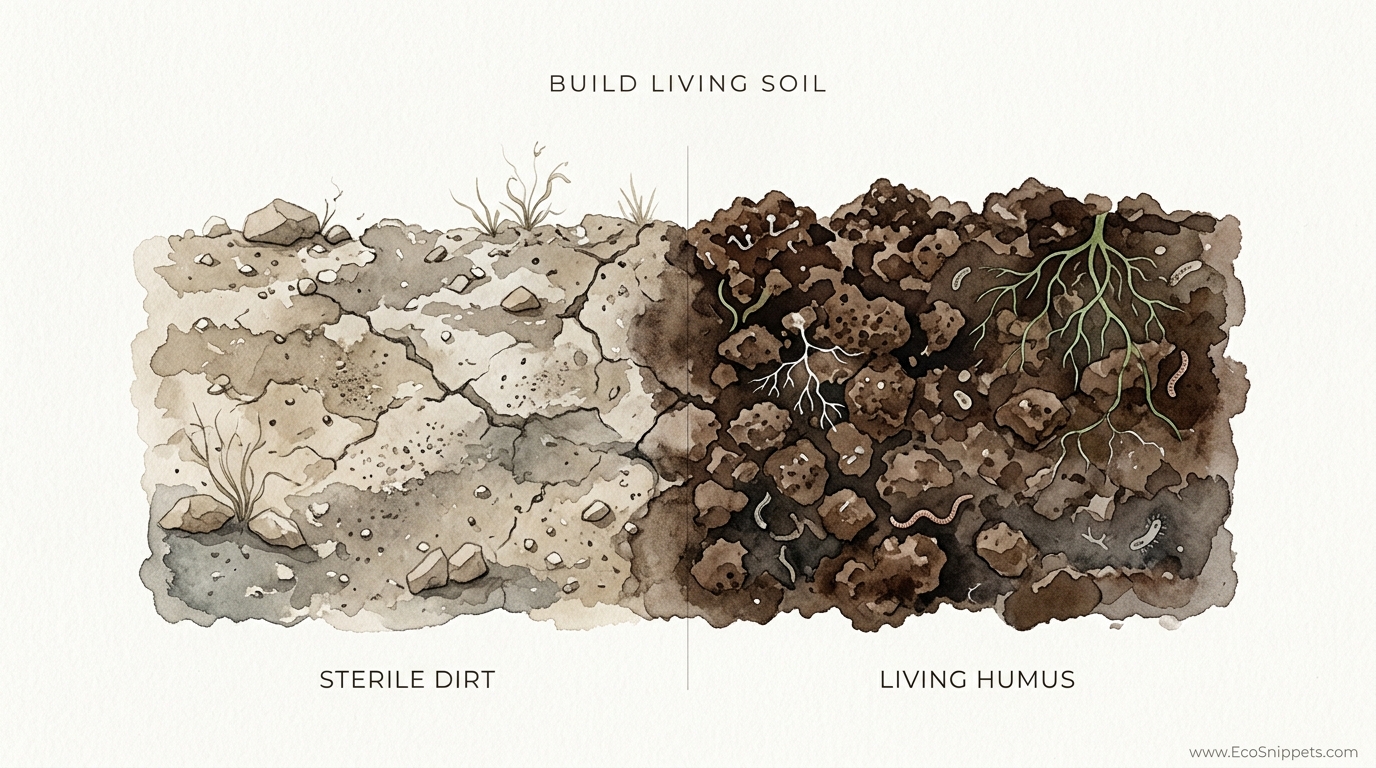
Living Humus vs. Sterile Dirt
Understanding the difference between these two mediums is the difference between a thriving homestead and a struggling garden.
| Feature | Sterile Dirt (Modern) | Living Humus (Ancestral) |
|---|---|---|
| Nutrient Source | Synthetic Salts (Bottles) | Biological Cycling |
| Maintenance | Weekly Inputs Required | Seasonal Mulching |
| Soil Structure | Compacts Easily | Loose and Spongy |
| Water Retention | Low (Fast Runoff) | High (Sponge Effect) |
| Long-term Health | Degrades over time | Improves every year |
Practical Tips for Immediate Success
If you want to jumpstart your living soil today, there are several small actions that yield big results.
Always keep the soil covered. Bare soil is dying soil. The sun bakes the life out of the top two inches where most of the biological activity happens. If you don’t have mulch, use “cover crops” like clover or buckwheat to provide a living skin.
Use diverse organic materials. Just as you wouldn’t want to eat only potatoes, your microbes want a varied diet. Mix your straw mulch with shredded leaves, grass clippings (free of herbicides), and wood chips. This diversity of “carbon” sources encourages a wider variety of fungal and bacterial species.
Observe your weeds. Weeds are actually “soil doctors” sent by nature to fix specific problems. Dandelions have deep taproots designed to bring minerals up from the subsoil and break up compaction. Instead of pulling them, cut them at the surface and leave the root to rot—this creates a pre-made tunnel for your vegetables.
Advanced Considerations for Serious Practitioners
Once you have the basics down, you can begin to look into more advanced regenerative techniques that decrease your reliance on even organic store-bought inputs.
Korean Natural Farming (KNF) and JADAM are systems that teach you how to collect indigenous microorganisms (IMO) from your local forest and multiply them in your backyard. This ensures that the life in your garden is perfectly adapted to your specific climate and soil type.
Focus on the “Fungal to Bacterial Ratio.” Different plants prefer different soil balances. Most vegetables prefer a soil that is slightly more bacterial, while fruit trees and perennials want a fungal-dominated environment. You can steer this by using “green” nitrogen-rich mulches for vegetables and “brown” woody mulches for trees.
Consider testing for biology rather than just chemistry. Standard soil tests tell you how much phosphorus is in the dirt, but they don’t tell you if that phosphorus is “locked up” or if you have the microbes needed to unlock it. A Haney Test or a biological microscopy report can give you a much clearer picture of the actual health of your underground ecosystem.
Scenario: Transforming a Lifeless Backyard
Imagine a typical suburban backyard: compacted clay, a history of weed-and-feed chemicals, and struggling grass. To turn this into a living paradise, the process is straightforward but methodical.
First, the area is mowed and deeply watered. A layer of high-quality worm castings is spread like a thin dusting of snow across the entire surface. This provides the initial “probiotic” boost. Next, large sheets of recycled cardboard are laid down, soaked with water until they are floppy, and weighted down with three inches of aged wood chips.
In the first spring, small “pockets” are cut into the cardboard. A handful of compost is dropped in, and a squash or tomato starts its journey. By the end of summer, the cardboard is half-gone, and the clay underneath is starting to turn dark and crumbly. By the second year, the wood chips have become a home for white fungal mycelium, and the “dirt” has officially become “living humus.”
Final Thoughts
Building living soil is perhaps the most radical act a gardener can perform. It is a quiet rebellion against a system that wants you to be a perpetual consumer of plastic jugs and synthetic powders. By stepping back and allowing the natural cycle of decay and rebirth to take over, you are creating a garden that is not only more productive but also more deeply connected to the ancestral wisdom of the land.
The beauty of this system is that it gets easier with time. As the Soil Food Web becomes more established, your workload decreases. You will find yourself weeding less, watering less, and worrying less. The earth wants to be alive; it simply needs you to stop standing in its way with a tiller and a bag of salt.
Take a handful of your soil. If it smells like a fresh forest after a rain, you are on the right path. If it is hard, grey, and odorless, it’s time to start layering. Feed the life beneath you, and it will unfailingly feed the life above you. Experiment, observe, and trust the millions of tiny workers who are ready to go to work for you.
