How To Become More Self-Sufficient Without Starting a Full-Blown Farm…
Want to start preserving your harvest, making your own soap, or building a backyard root cellar — but not sure where to begin? “Homesteading Advice” gives you instant lifetime access to 35+ practical homesteading books on food preservation, veggie gardening, DIY natural cleaning products (save over $250 per year with this skill alone), brewing, off-grid energy, and a whole lot more…
Click Here To Check It Out Now!
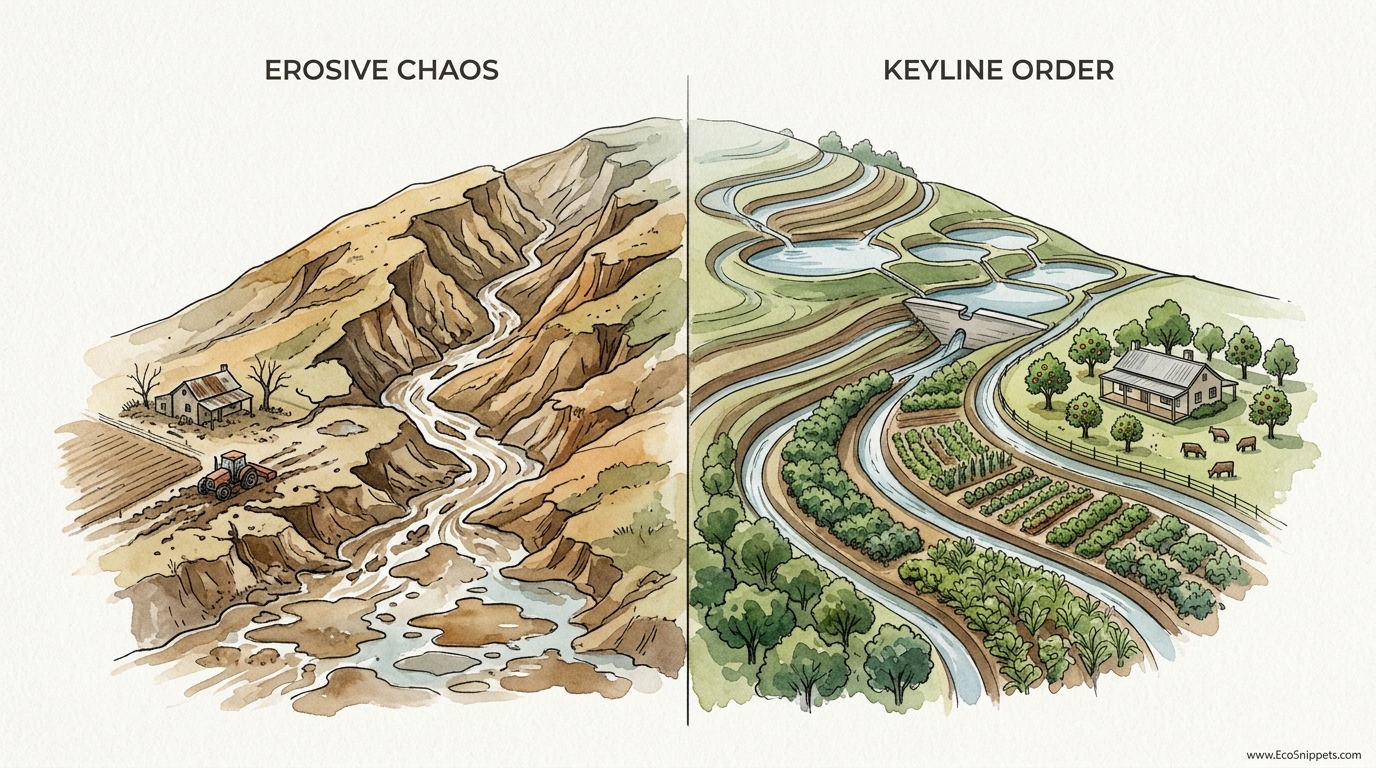
When it rains, do you see a flood or a free irrigation opportunity? Water is a wild force that naturally wants to take the path of least resistance—usually straight down your hills, taking your topsoil with it. Keyline design uses precise geometry to spread that water out, moving it from the ‘valleys’ to the ‘ridges’ of your land. It turns a destructive flood into a slow-motion hydration system.
Working with the land instead of against it is the hallmark of the self-reliant homesteader. For generations, we have seen the sky dump its bounty only for the earth to reject it, leading to EROSIVE CHAOS that scars the landscape. Keyline design offers a return to KEYLINE ORDER, a systematic way to invite that water deep into the soil profile where it can do the most good.
If you have ever stood on a hillside and watched a heavy downpour carve out a new gully, you know the feeling of helplessness. This method, born from the practical necessity of the Australian outback, provides the tools to change that narrative. It is about understanding the secret language of your land’s topography and using it to build resilience, fertility, and long-term water security.
The beauty of this system lies in its permanence. Once you establish these patterns, they serve as the foundation for everything else on your farm—from where you build your roads to where you plant your orchards. It is a philosophy of stewardship that respects the ancestral wisdom of reading the terrain while utilizing modern geometrical precision.
Keyline Design For Water Management On The Homestead
Keyline design is a whole-farm planning system developed in the 1950s by P.A. Yeomans, an Australian mining engineer and farmer. He realized that traditional “soil conservation” methods often focused on stopping erosion after it started, rather than managing the water that caused it. Keyline focuses on the topographical geometry of the land to optimize the use of every drop of rain.
At its heart, Keyline design is about moving water from where it naturally gathers—the damp, shaded valleys—to where it is naturally scarce—the dry, sun-baked ridges. In most landscapes, water concentrates in the valleys, leading to waterlogging and erosion. Meanwhile, the ridges remain thirsty. By identifying a specific point on the slope called the Keypoint, we can redirect that flow horizontally across the hillside.
This system exists to solve the twin problems of drought and flood. In real-world homesteading, it means your pastures stay green longer into the summer and your soil stays put during the spring thaw. It is used on broadacre farms for cattle grazing and on small-scale homesteads to layout orchards and gardens that thrive without constant manual irrigation. Think of it as installing a massive, invisible sponge underneath your topsoil.
The Mechanics of Moving Water Upward
Finding the Keypoint is the first step in unlocking your land’s potential. Every primary valley has a specific spot where the slope changes from being steep and narrow at the top to flatter and wider at the bottom. This transition point—the “inflection point”—is the Keypoint. It is often visible after a rain because it is where the water stops rushing and starts to pool or soak in.
The Keyline itself is a contour line that passes through this Keypoint. Unlike a standard contour line that stays perfectly level, a Keyline-influenced cultivation pattern is designed to have a very slight “fall”—usually about 1%—as it moves away from the valley center toward the ridges. This subtle gradient acts like a slow-motion gutter, gently coaxing water out of the valley and spreading it across the thirsty ridge-shoulders.
To implement this, homesteaders often use a Yeomans Plow or a subsoiler. This tool doesn’t flip the soil like a traditional plow; instead, it “rips” narrow channels deep into the subsoil. These rips provide a path for water and air to penetrate the hardpan. Over several years, you gradually rip deeper, allowing roots to follow the moisture and turn lifeless subsoil into rich, carbon-heavy topsoil.
Step-by-Step Implementation
- Map Your Contours: Use a laser level, a transit, or a simple A-frame to find the level lines on your slope.
- Identify the Keypoint: Look for the change in slope in your primary valleys; mark this point clearly.
- Peg the Keyline: Run a line from the Keypoint out toward the ridges.
- Pattern Cultivation: Plow parallel to this Keyline. In the valleys, you plow parallel to the line below it; on the ridges, you plow parallel to the line above it.
- Deep Rip: Use a subsoiler to break the hardpan without turning the soil, allowing the water to “sink and spread.”
The Practical Benefits of a Hydrated Homestead
The most immediate benefit is drought proofing. By sinking water deep into the soil, you are essentially creating an underground reservoir. Soil that has been managed with Keyline principles can hold significantly more water than compacted soil. For every 1% increase in soil organic matter you achieve through this process, your land can hold an additional 20,000 to 25,000 gallons of water per acre.
Another measurable advantage is topsoil creation. Traditional agriculture can take centuries to build an inch of topsoil. P.A. Yeomans proved that by combining Keyline water management with planned grazing or cover cropping, you can build several inches of fertile soil in just a few seasons. The deep rips allow oxygen to reach the microbes, which then go into a feeding frenzy, converting organic matter into humus at an accelerated rate.
Finally, Keyline design offers flood mitigation. When a heavy storm hits, the “combing” effect of the rip lines slows the water down. Instead of a flash flood tearing through your bottomland, the water is forced to travel a long, circuitous path across the ridges. This takes the “peak” out of the flood, protecting your infrastructure and downstream neighbors.
Challenges and Common Pitfalls to Avoid
The biggest mistake beginners make is misidentifying the Keypoint. If you start your pattern from the wrong spot, you might accidentally concentrate water into a sensitive area, causing more erosion than you started with. It is vital to spend a full season observing your land during heavy rains before you commit to permanent earthworks or deep ripping.
Another challenge is the cost and scale of equipment. A true Yeomans plow is a heavy, specialized piece of machinery that requires a tractor with significant horsepower. Many homesteaders try to use small garden tillers or light subsoilers that simply cannot penetrate deep enough to break the hardpan. If your tractor is too small, you may need to hire a professional for the initial “rip” or work in very shallow passes over several years.
Over-irrigation is also a risk in certain climates. If you live in an area with very high rainfall and heavy clay soils, moving too much water into the ridges can lead to slope instability or “slumping.” Always ensure your design includes safe “overflow” points where excess water can be discharged into a stable, vegetated waterway once the soil has reached its saturation point.
Realistic Limitations of the Keyline System
Keyline design is most effective on undulating or hilly terrain. If your homestead is on a pancake-flat plain, there are no valleys or ridges to work with, and the geometry of the system doesn’t apply. In those cases, other water management strategies like laser-leveled irrigation or raised beds might be more appropriate.
Environmental constraints also play a role. In very sandy soils, the water may sink so fast that it never has a chance to move horizontally to the ridges. In these landscapes, the focus should be on building organic matter first through mulching and cover crops rather than relying on the geometry of the plow lines to move water.
The property size can also be a boundary. Keyline was originally designed for broadacre farms (hundreds or thousands of acres). While the principles work on a 5-acre homestead, the turning radius of the machinery and the complexity of the mapping can make it feel like overkill for very small plots. For a quarter-acre urban lot, simple swales or rain gardens are often more practical than a full Keyline pattern.
Keyline Design vs. Standard Swales
Many homesteaders confuse Keyline plowing with swales. While both involve working on the contour, they serve different primary purposes and have different maintenance requirements. Understanding these differences helps you choose the right tool for your specific terrain.
| Feature | Keyline Plowing | Standard Swales |
|---|---|---|
| Primary Goal | Redistribute water from valley to ridge. | Capture and sink water on contour. |
| Earthwork | Deep subsoil rips (invisible). | Mounds and ditches (visible). |
| Complexity | High (requires mapping geometry). | Moderate (follow the level line). |
| Best For | Pastures, hay fields, and orchards. | Food forests and tree belts. |
| Maintenance | Requires re-ripping every few years. | Permanent structure; occasional dredging. |
Practical Tips for the Homestead Practitioner
When starting out, begin with a single valley. Don’t try to map the entire property at once. Choose the area where erosion is most evident and focus your efforts there. Marking the Keypoint and the first few lines with simple wooden stakes will give you a visual reference of how the water will move before you bring out the heavy iron.
Timing your cultivation is critical. You should only use a subsoiler when the soil is moist but not wet. If the soil is too dry, you won’t get the “shattering” effect needed to break the hardpan; if it is too wet, the plow will simply “smear” the clay, creating a seal that actually blocks water rather than absorbing it. A good rule of thumb is the “ribbon test”—if you can roll the soil into a thin ribbon that doesn’t break, it is too wet to rip.
- Use a “Bury” Line: When plowing, ensure your plow depth is consistent. Use a marker on the shank to ensure you are hitting the target depth across the entire slope.
- Integrate Animals: Immediately after ripping, move your livestock onto the area. Their manure and hoof action will help drive organic matter into the new fissures.
- Observe the “Wet Foot” Plants: Use plants like willow or sedges to mark your natural valley seeps; these are your best indicators of where a Keypoint might be hidden.
The Scale of Permanence: Advanced Planning
Serious practitioners use the Keyline Scale of Permanence to guide all farm development. This is a hierarchy of eight factors, ordered from most difficult to change to easiest. When you design your homestead, you should work from the top down. This ensures that your most expensive and permanent decisions (like where a road goes) don’t conflict with the natural flow of water.
The scale is as follows: 1. Climate, 2. Landform, 3. Water, 4. Roads, 5. Trees, 6. Buildings, 7. Fences, and 8. Soil. Notice that soil is at the bottom. This is because soil is the most dynamic and easiest to change once the water and roads are correctly placed. By prioritizing the landform and water first, you create a framework where soil fertility becomes an inevitable byproduct of your design.
Advanced homesteaders often link their Keyline dams. By placing dams at the Keypoints of different valleys and connecting them with slightly sloped “diversion drains,” you can move water across the entire property using nothing but gravity. This allows for low-cost flood irrigation of pastures during dry spells without ever needing to turn on a pump.
A Realistic Scenario: The 10-Acre Slope
Imagine a 10-acre homestead with a central valley that stays muddy until June and two ridges that are crispy by July. The homesteader identifies the Keypoint halfway down the valley. They peg a line on contour from that point and begin plowing parallel to it with a subsoiler, moving water from the muddy center out toward the dry edges.
In the first year, they rip to a depth of 6 inches. The following year, they go to 10 inches. By the third year, they reach 15 inches. They notice that the “muddy spot” in the valley is now firm enough to walk on even after a spring rain, and the grass on the ridges stays green two weeks longer than their neighbor’s. They have effectively increased their “available rainfall” without the sky ever dropping an extra inch of water.
This success allows them to plant an orchard on the ridges. Because the subsoil is now hydrated and aerated, the fruit trees’ roots dive deep, making them resilient to the late-summer heat. The roads, built on the ridge-lines as suggested by the Scale of Permanence, remain dry and passable year-round because water is being moved away from them rather than across them.
Final Thoughts
Keyline design is more than just a plowing pattern; it is a way of seeing. It asks us to look at the land not as a flat surface for our convenience, but as a living, breathing three-dimensional form with its own logic and flow. When we master the geometry of the Keyline, we stop being victims of the weather and start becoming active participants in the hydration of our earth.
True self-reliance is built on the foundation of healthy, hydrated soil. Whether you are managing a small orchard or a multi-acre pasture, the principles of moving water from valley to ridge will serve you for decades. It is a slow, methodical process that requires patience and observation, but the reward is a landscape that grows more fertile and more resilient with every passing year.
Take the time to walk your land during the next big storm. Find your Keypoints, watch the water’s path, and begin the work of bringing order to the chaos. As you deepen your understanding of these systems, you might find that other related skills—like silvopasture or holistic grazing—naturally fit into the pattern you have carved into the earth.
