How To Become More Self-Sufficient Without Starting a Full-Blown Farm…
Want to start preserving your harvest, making your own soap, or building a backyard root cellar — but not sure where to begin? “Homesteading Advice” gives you instant lifetime access to 35+ practical homesteading books on food preservation, veggie gardening, DIY natural cleaning products (save over $250 per year with this skill alone), brewing, off-grid energy, and a whole lot more…
Click Here To Check It Out Now!
Is your fruit tree a lonely island or a thriving community member? Nature never plants in a monoculture. When you stick a tree in the middle of a lawn, you’re creating a high-maintenance project. Building a ‘guild’ of supporting plants creates a self-fertilizing, pest-repelling ecosystem that does the work for you.
Ancient wisdom tells us that nothing in the wild exists in isolation. Our ancestors didn’t have bags of synthetic 10-10-10 fertilizer or chemical sprayers. They relied on the relationships between plants, insects, and the soil to produce a harvest. Transitioning from a high-input orchard to a self-sustaining guild requires a shift in how you view “weeds” and “tidiness.”
Establishing a fruit tree guild is a fundamental step toward food security and land stewardship. This approach focuses on cooperation rather than competition. You are essentially building a small, functional forest around your central tree. Every plant you choose has a specific job, whether it is pulling minerals from the deep earth or calling in predatory wasps to manage aphids.
Permaculture Fruit Tree Guild Layout For Beginners
A permaculture fruit tree guild is an intentional association of plants clustered around a central fruit tree. This grouping mimics the structure of a natural young woodland. The goal is to maximize health and yield while minimizing the gardener’s workload. Instead of fighting nature with a lawnmower, you are partnering with it to create a biological engine.
Beginners often feel overwhelmed by the complexity of ecology, but the concept is simple. Imagine your fruit tree as the captain of a ship. The captain cannot run the vessel alone. He needs a crew to handle the sails, cook the food, and navigate the waters. In a guild, the supporting plants act as the crew, performing vital functions that the fruit tree cannot do for itself.
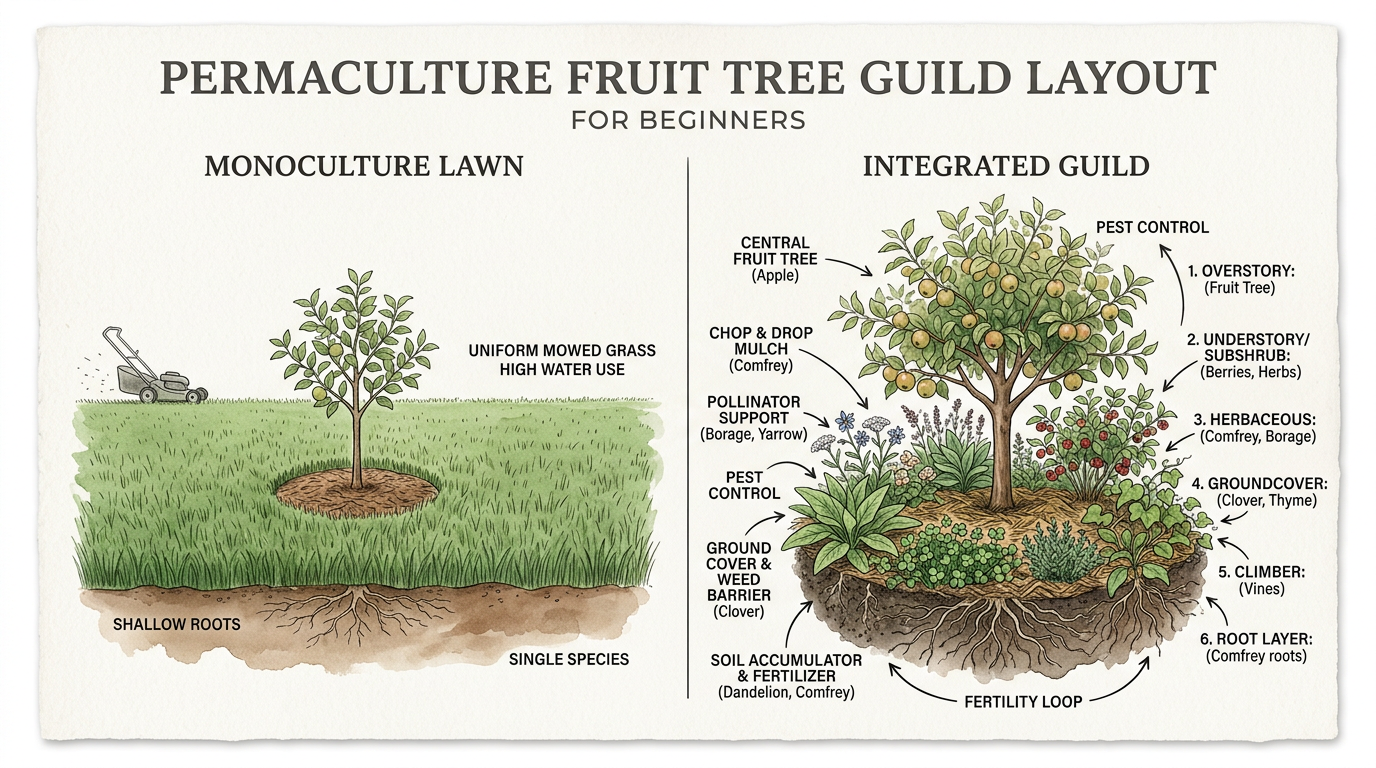
This layout is used in backyard gardens, homesteads, and large-scale restorative agriculture projects. It transforms a sterile grass patch into a productive “island” of fertility. Most guilds are designed in a circular or “keyhole” shape, extending out to the drip line of the tree’s canopy. This is where the most active root growth and nutrient exchange occur.
Successful layouts take advantage of vertical space. While the fruit tree occupies the upper story, smaller shrubs, herbaceous perennials, and groundcovers fill the gaps below. This dense planting shades the soil, prevents evaporation, and crowds out opportunistic weeds that would otherwise steal nutrients. It is a calculated use of space that yields more food per square foot than traditional row cropping.
How to Design and Build Your Fruit Tree Guild
Building a guild starts with observation. Before you dig a single hole, look at your land. Notice where the sun hits at noon and where the wind blows hardest during the winter. These factors will dictate which supporting plants will thrive alongside your tree. Start small with one tree and expand your “crew” as you become more comfortable with the process.
Step 1: The Central Element
Choose a fruit or nut tree that is well-suited to your hardiness zone. Heirloom varieties often have better natural resistance to local pests and diseases compared to modern hybrids designed for industrial farming. Place this tree in a spot with adequate drainage and sunlight. This tree is the anchor of your system, and its needs for light and space come first.
Step 2: Nitrogen Fixers
Nitrogen is the fuel of plant growth. Instead of buying fertilizer, plant “nitrogen fixers” like clover, alfalfa, or even small shrubs like Siberian Pea Shrub or Goumi berry. These plants have a symbiotic relationship with bacteria in their roots that allows them to take nitrogen from the air and put it into the soil. Chop and drop these plants once or twice a year to release that stored nitrogen directly to the fruit tree’s roots.
Step 3: Dynamic Accumulators
Dynamic accumulators are plants with deep taproots that act as mineral miners. Comfrey is the king of this category. Its roots can reach ten feet into the subsoil, pulling up potassium, calcium, and magnesium that other plants cannot reach. When the comfrey leaves die back or are cut, these minerals become available at the surface for your fruit tree. Dandelions and borage also serve this function admirably.
Step 4: The Pollinator and Predator Attractors
You need “good bugs” to ensure fruit set and to keep “bad bugs” in check. Umbrella-shaped flowers like dill, fennel, and yarrow are magnets for hoverflies and parasitic wasps. These insects are the natural enemies of aphids and caterpillars. Planting a variety of flowering herbs ensures that something is blooming throughout the growing season, providing a constant nectar source for your biological security team.
Step 5: Grass Suppressors and Bulbs
Grass is the enemy of a young fruit tree. It is a heavy feeder that competes aggressively for water and nitrogen. Use bulbous plants like daffodils, garlic, or chives to create a “no-grow zone” around the base of the tree. These plants form a thick root barrier that grass finds difficult to penetrate. Garlic and chives also emit scents that can confuse or deter deer and certain boring insects.
Step 6: Groundcovers for Living Mulch
Bare soil is a wound in nature. Cover it with living mulch like strawberries, creeping thyme, or nasturtiums. These plants act as a protective skin, keeping the soil cool and moist. They also provide an extra harvest of berries or edible flowers from the same footprint of land. Living mulches eventually replace the need for hauling in wood chips every year.
Benefits of the Guild Approach
The primary advantage of a fruit tree guild is the drastic reduction in external inputs. A well-designed guild becomes a closed-loop system. The plants provide their own fertilizer, their own pest control, and their own mulch. This self-sufficiency is the hallmark of a resilient homestead. You spend less money on bags of compost and less time dragging a garden hose across the yard.
Soil health improves significantly under a guild system. The diversity of root structures encourages a robust fungal network. Mycorrhizal fungi connect the roots of different plants, allowing them to trade nutrients and even send “chemical signals” about pest attacks. This “underground internet” creates a level of vigor that is impossible to achieve in a sterile, tilled orchard.
Water conservation is another measurable benefit. The thick layers of herbaceous plants and groundcovers act as a sponge. They slow down rainwater, allowing it to soak into the earth rather than running off. In times of drought, the shaded soil inside a guild remains moist long after the surrounding lawn has turned brown and brittle.
Biodiversity increases almost immediately. Within a single season, you will notice more bees, butterflies, and birds visiting your garden. This isn’t just for show; it’s a functional benefit. Birds help control larger pests, and the increased pollinator activity often leads to larger, more consistent fruit harvests. You are not just growing food; you are restoring a piece of the local ecosystem.
Challenges and Common Mistakes
The most frequent mistake is planting too many aggressive species too close to the trunk. While comfrey is beneficial, its vigorous growth can sometimes overwhelm a very young sapling if not managed. Keep a small ring of clear mulch immediately around the trunk to prevent moisture buildup against the bark and to give the young tree a head start before the “crew” takes over the space.
Invasive species choice is another pitfall. Some nitrogen-fixing shrubs, like Autumn Olive, are considered invasive in many regions. Always check local regulations and ecological impact reports before introducing a new species to your guild. There is always a non-invasive alternative that can perform the same ecological function without threatening the surrounding wilderness.
Neglecting the “chop and drop” maintenance can lead to a messy, tangled thicket. A guild is a managed ecosystem, not a wild jungle. You must be willing to step in and prune or cut back biomass plants to keep the system balanced. If the dynamic accumulators grow too tall and start shading out the fruit tree’s lower branches, they need to be trimmed and laid on the ground as mulch.
Lack of patience kills many projects. A guild takes three to five years to reach full maturity. In the first year, it might look like a few random weeds stuck in some mulch. People often give up and return to mowing because they don’t see instant results. Trust the biological process. The roots are doing work underground that your eyes cannot see yet.
Limitations and When This May Not Be Ideal
Environmental constraints play a huge role in guild success. In extremely arid climates, the sheer number of plants in a guild might compete too heavily for limited water during the establishment phase. In these cases, you must focus on extreme mulching and perhaps reduce the number of thirsty supporting plants until the tree is well-established.
Space is a practical boundary. If you have a tiny urban lot, a full seven-layer guild might be physically impossible. You may need to choose “multi-functional” plants that do two or three jobs at once to save space. For example, chives act as a grass suppressor, a pollinator attractor, and a culinary herb, making them a high-value choice for small spaces.
Aesthetic expectations can be a hurdle. A permaculture guild looks “wild” compared to a manicured lawn. If you live in a neighborhood with strict Homeowners Association (HOA) rules regarding “weeds” and garden height, you may face challenges. You can mitigate this by using “edible landscaping” techniques—choosing support plants that are traditionally considered ornamental, such as lavender, echinacea, and blueberries.
Monoculture Lawn vs. Integrated Guild
Comparing these two methods reveals the inefficiency of modern landscaping. A monoculture lawn requires constant energy—mowing, watering, and fertilizing—only to produce a crop of grass clippings that most people throw away. An integrated guild, however, uses that same energy to produce food, habitat, and soil fertility.
| Feature | Monoculture Lawn | Integrated Guild |
|---|---|---|
| Maintenance | High (Weekly mowing/weeding) | Low (Seasonal pruning/harvest) |
| Fertility | External (Synthetic bags) | Internal (Nitrogen fixers) |
| Water Need | High (Rapid evaporation) | Low (Self-shading soil) |
| Pest Control | Chemical (Pesticides) | Biological (Predatory insects) |
| Yield | Zero (Only grass) | Multiple (Fruit, herbs, berries) |
Practical Tips and Best Practices
Sheet mulching is the best way to start a guild without tilling. Lay down a layer of plain brown cardboard over the grass, soak it with water, and then pile on 6-12 inches of wood chips or straw. This smothers the grass and creates a “blank slate” for your guild plants. You can cut holes through the cardboard to plant your support species directly into the soil.
Observe the “drip line” of your tree. This is the circle on the ground where rain would naturally fall from the outermost leaves. Most of the tree’s feeder roots are located in this zone. Concentrating your nitrogen fixers and dynamic accumulators around this drip line ensures the tree gets maximum benefit from their presence.
Use “stacking” to maximize your harvest. Under an apple tree, you can plant currants (shrub layer), comfrey (herbaceous layer), and strawberries (groundcover layer). This uses three different vertical levels in the same square footage. It mimics how a forest works and ensures that every bit of sunlight hitting the ground is being used for production.
- Label your plants: In the early stages, many guild plants can look like weeds. Use sturdy markers so you don’t accidentally pull up your expensive herbs.
- Plant in groups: Instead of one single plant, use “drifts” of three or five to provide a more significant signal to pollinators.
- Prioritize native species: Native plants are already adapted to your soil and weather, making them the most resilient choices for a guild.
- Stay mobile: If a certain plant isn’t working in the guild, don’t be afraid to move it. Observation and adjustment are part of the pioneer spirit.
Advanced Considerations
Serious practitioners look at the fungal-to-bacterial ratio of their soil. Fruit trees generally prefer fungal-dominated soil, which is found in established woodlands. You can encourage this by using “ramial wood chips”—chips made from small branches that have a high ratio of bark to wood. These chips break down into the perfect medium for beneficial fungi to thrive.
Succession planting is another advanced technique. You might plant a “nurse tree” like an Alder or Black Locust next to your fruit tree. These trees grow quickly and fix massive amounts of nitrogen. Once the fruit tree is large enough to handle the space, the nurse tree is cut down or heavily pruned to provide “instant mulch” and a large release of nitrogen into the ground.
Microclimate creation is the hallmark of an expert guild designer. By placing large stones or water barrels on the sun-facing side of a guild, you can create “heat sinks.” These absorb heat during the day and radiate it back at night, potentially protecting a sensitive fruit tree from early spring frosts. You can also use taller “buffer” plants to create windbreaks for more delicate species.
Real-World Examples: The Apple Tree Guild
Let’s look at a classic temperate climate guild centered around a semi-dwarf Apple tree. In a circle extending six feet out from the trunk, the gardener starts with a thick ring of Daffodils and Chives near the trunk to ward off rodents and grass. This creates a clear boundary that requires zero mowing.
Moving outward, the gardener plants three Comfrey plants spaced evenly around the drip line. These are cut down three times a summer and left to rot in place, providing a steady supply of potassium for fruit development. In between the comfrey, White Clover is sown as a living groundcover to keep the soil nitrogen-rich and cool.
On the sunny southern edge, a patch of Dill and Fennel is allowed to go to flower. These attract the braconid wasps that prey on the codling moth larvae—a common apple pest. Finally, Alpine Strawberries fill every remaining gap on the ground, providing a sweet snack for the gardener while protecting the soil from erosion.
In this scenario, the gardener has replaced a 100-square-foot patch of useless lawn with a system that produces apples, strawberries, chives, and medicinal herbs. The tree is healthier than its neighbor in a lawn because it is part of a community. There is no need for chemical sprays because the ecosystem is in balance. This is the power of the guild layout.
Final Thoughts
Building a permaculture fruit tree guild is an act of rebellion against the high-maintenance, low-output methods of industrial gardening. It is a return to a more intuitive way of working with the land—one that honors the complexity of nature and rewards the gardener with abundance. By moving away from the “lonely island” approach, you create a resilient system that can withstand the tests of time and weather.
Start with one tree. Observe how the insects respond to your herbal additions. Notice how the soil softens and darkens under the protective layer of mulch. This is a journey of discovery that reconnects us with the ancestral wisdom of land stewardship. You aren’t just planting a tree; you are fostering a legacy of fertility.
As you gain confidence, you can expand these principles to your entire landscape. The skills you learn by managing a single fruit tree guild are the same skills needed to design entire food forests. Embrace the “pioneer grit” required to rethink your lawn and trust that nature, when given the right partners, knows exactly how to thrive.
