How To Become More Self-Sufficient Without Starting a Full-Blown Farm…
Want to start preserving your harvest, making your own soap, or building a backyard root cellar — but not sure where to begin? “Homesteading Advice” gives you instant lifetime access to 35+ practical homesteading books on food preservation, veggie gardening, DIY natural cleaning products (save over $250 per year with this skill alone), brewing, off-grid energy, and a whole lot more…
Click Here To Check It Out Now!
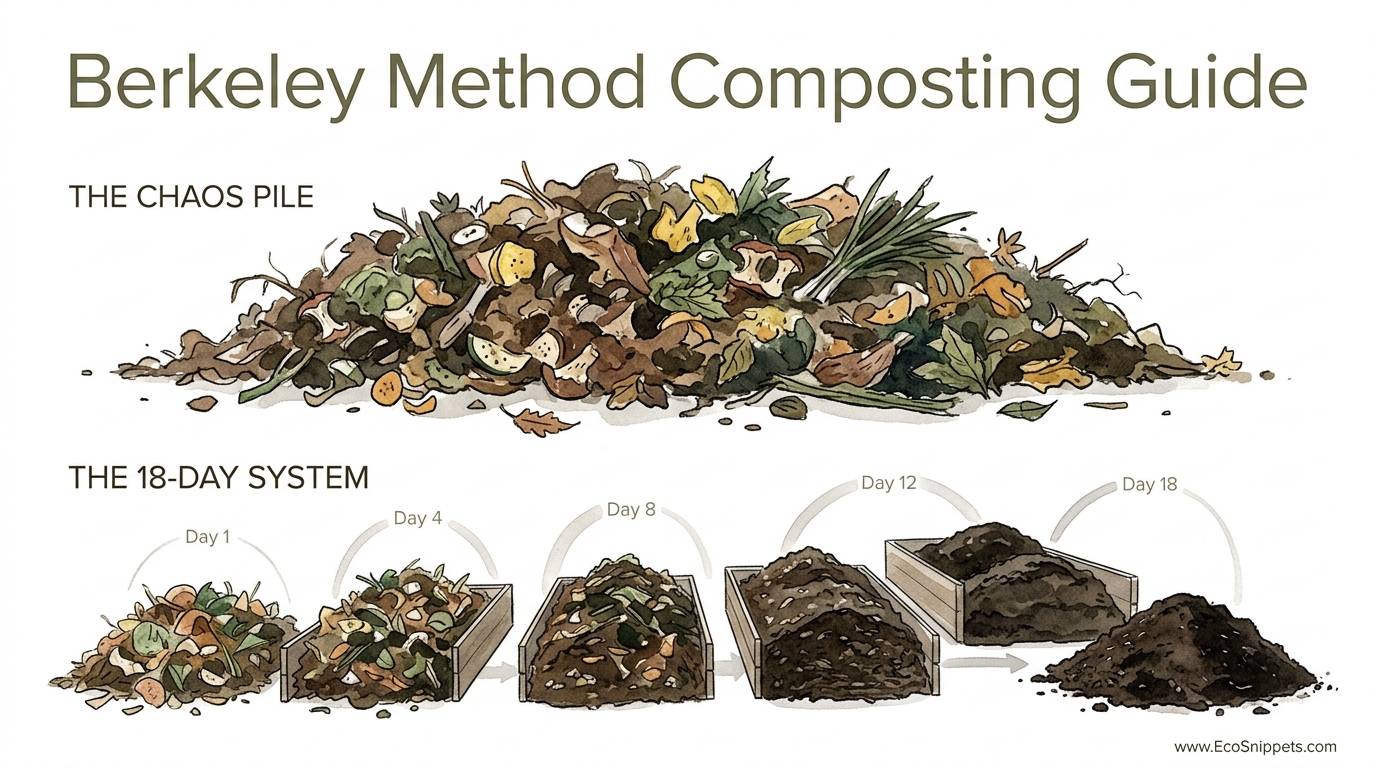
One of these piles takes a year to rot; the other produces perfect garden fuel in less than three weeks. Most gardeners practice ‘cold composting,’ which is really just a slow way to grow weeds. If you want high-speed results, you need the order of the Berkeley Method. By organizing your carbon-to-nitrogen ratios and following a turning schedule, you can turn trash into fuel in 18 days flat.
This system is not for the faint of heart or the gardener who prefers a hands-off approach. It requires a bit of sweat, a sharp pitchfork, and a keen eye for the biological fires burning in your backyard. Ancestral wisdom often taught us that patience is a virtue, but in the case of soil building, precision can be an even greater one. This method allows you to take control of the decomposition process, forcing nature to work at an accelerated pace that matches the urgency of a growing season.
When you master this technique, you stop being a passive observer of decay and become an active manager of life. You are essentially building a biological reactor. Every layer you stack and every turn you execute serves a specific purpose in fueling the thermophilic bacteria that do the heavy lifting. The result is a dark, crumbly, and nutrient-dense humus that smells of the deep woods and provides your plants with everything they need to thrive.
Berkeley Method Composting Guide
The Berkeley Method, also known as rapid or hot composting, was refined by Robert Raabe at the University of California, Berkeley. This technique is designed to produce finished, high-quality compost in a remarkably short timeframe, typically eighteen days. While traditional composting relies on a slow, cool breakdown over months or years, this system leverages the power of heat-loving microorganisms to tear through organic matter with industrial efficiency.
At its core, the method is a recipe for success that balances four critical factors: carbon, nitrogen, oxygen, and water. When these elements are provided in the correct proportions and within a specific physical structure, the internal temperature of the pile skyrockets. This heat is not just a byproduct; it is the engine of the system. It reaches levels high enough to cook weed seeds and neutralize common plant pathogens, leaving you with a clean product that won’t haunt your garden beds with unwanted sprouts.
In the real world, this method is a godsend for small-scale farmers and serious home gardeners who need large amounts of soil amendment quickly. Instead of maintaining several “chaos piles” in various states of half-rot, you can process a massive amount of material in one concentrated burst. It is particularly useful in the spring when the need for fertility is high and the clock is ticking on planting dates.
The Mechanics of High-Speed Decomposition
Success with the Berkeley Method depends on your ability to create an environment where thermophilic bacteria can thrive. These microbes are the heavy hitters of the composting world, and they only show up when the “kitchen” is hot enough. To get them to work, you must follow a set of non-negotiable physical and chemical standards.
The Magic Ratio: Carbon to Nitrogen
Every piece of organic matter has a carbon-to-nitrogen (C:N) ratio. Carbon provides the energy for the microbes, while nitrogen provides the protein needed for them to grow and multiply. For the Berkeley Method to hit its 18-day target, the overall ratio of your pile needs to sit between 25:1 and 30:1. If you have too much carbon, the process slows to a crawl. If you have too much nitrogen, the pile will become a stinky, anaerobic mess and lose much of its nutrient value to the air as ammonia gas.
The Physical Foundation: Volume and Particle Size
A pile needs mass to hold onto its heat. The minimum size for a Berkeley pile is one cubic meter (roughly 3 feet by 3 feet by 3 feet). Anything smaller will lose heat too quickly to maintain the required temperatures. Anything much larger than five feet high becomes difficult to aerate and can actually compress itself into an anaerobic state.
Equally important is the surface area of your materials. Microbes eat from the outside in. If you throw a whole cornstalk into the pile, it will take months to break down. If you shred that stalk into one-inch pieces, the microbes can attack it from all sides simultaneously. Aim for a particle size between 0.5 and 1.5 inches for the best results.
The Turning Schedule
This is the heartbeat of the 18-day system. You aren’t just moving dirt; you are reintroducing oxygen and ensuring that the material on the outside of the pile—which is cooler and less decomposed—gets moved into the “furnace” at the center.
- Day 1: Build the pile by layering greens and browns. Water each layer until it is as damp as a wrung-out sponge.
- Days 2-4: Let the pile sit. This is the activation phase where the temperature begins to climb.
- Day 4: The first turn. Move the outside to the inside.
- Days 6, 8, 10, 12, 14, 16: Turn the pile every second day.
- Day 18: Harvest your finished compost.
Benefits of the 18-Day System
The most obvious advantage is speed. In the time it takes most people to wait for a single delivery of mulch, you can manufacture your own high-grade soil amendment. But the benefits go deeper than just the calendar.
One of the greatest rewards is the elimination of weeds. Because a properly managed Berkeley pile maintains temperatures between 131°F and 149°F (55-65°C), most weed seeds are effectively sterilized. This means you can compost invasive species or garden cleared of weeds without worrying about spreading the problem back into your vegetable beds.
The nutrient profile of hot compost is often superior to that of cold compost. In a slow, cold pile, nutrients often leach out into the ground or evaporate over the months of exposure to rain and air. The rapid nature of the Berkeley Method “locks in” the nutrients within the bodies of the microbes, which then die off and leave behind a rich, stabilized fertilizer. Additionally, the high-heat process breaks down complex proteins and carbohydrates more thoroughly than cold rot, making the minerals more immediately available to your plants.
Challenges and Common Mistakes
The primary challenge of the Berkeley Method is the labor. Turning a cubic meter of heavy, wet organic matter every other day is a significant physical undertaking. Many gardeners start with high hopes but lose steam by day eight. Consistency is the only way to hit the 18-day mark. If you skip turns, the oxygen levels drop, the temperature falls, and you revert to a standard slow-compost timeline.
Another frequent error is incorrect moisture management. The “squeeze test” is your best tool here. Pick up a handful of material from the center and squeeze it hard. You should see a few drops of water, but it shouldn’t be a stream. If the pile is too dry, the microbes die of thirst. If it is too wet, the water fills the air pockets, suffocating the aerobic bacteria and creating a foul smell.
Overheating is a hidden danger. If your pile climbs above 160°F (70°C), you risk killing off the very thermophilic bacteria you worked so hard to cultivate. At these extreme temperatures, the pile can also develop “fire blight,” a white, ashy-looking growth of actinomycetes that indicates the pile is too hot and likely too dry. When this happens, you must turn the pile immediately and add water to bring the temperature back into the safe zone.
Limitations and Environmental Constraints
The Berkeley Method is a “batch” system, meaning you must have all your materials ready at the start. This makes it poorly suited for households that only produce a few handfuls of kitchen scraps every day. To make this work, you often have to stockpile “browns” (like dried leaves or straw) and “greens” (like grass clippings or manure) until you have enough to build the full cubic meter.
Space is another consideration. You need enough room not just for the pile itself, but for the footprint of the pile you are turning it into. Since you are moving the material from one spot to an adjacent one to ensure a thorough mix, you effectively need twice the square footage of the pile’s base.
Climate can also dictate success. In extremely cold winters, the ambient air temperature may sap the heat from your pile faster than the microbes can generate it. While you can mitigate this by covering the pile with a heavy tarp or building it inside a wooden bin, the Berkeley Method is significantly easier to execute during the warmer months.
The Chaos Pile vs. The 18-Day System
To truly appreciate the Berkeley Method, it helps to see how it stacks up against the traditional “add-as-you-go” method many gardeners use.
| Feature | The Chaos Pile (Cold) | The 18-Day System (Hot) |
|---|---|---|
| Time to Finish | 6 to 12 months | 18 to 21 days |
| Effort Level | Low (Set and forget) | High (Frequent turning) |
| Weed Seeds | Often survive and sprout | Killed by high heat |
| Nutrient Retention | Variable (Leaching likely) | High (Rapid stabilization) |
| Volume Loss | Up to 80% shrinkage | Minimal (High yield) |
Practical Tips and Best Practices
If you want to ensure your first attempt at the Berkeley Method is a success, start with a “manure fork” rather than a standard garden spade. A fork with many thin tines allows you to lift and fluff the material, which is much more effective for aeration than simply moving a heavy clod of dirt.
Use “activators” to jumpstart the biological fire. If your pile is slow to heat up on day two or three, you can add high-nitrogen boosters like comfrey leaves, stinging nettles, or even a few handfuls of blood meal. These materials are like kindling for the microbial population. Some old-timers even suggest using human urine as a free and potent nitrogen source to get a stubborn pile cooking.
Always keep a compost thermometer handy. While the “arm test”—sticking your arm into the pile up to the elbow to see if it’s uncomfortably hot—works in a pinch, a probe thermometer provides the data you need to make informed decisions. Knowing exactly when your pile hits 140°F allows you to time your turns for maximum efficiency.
Advanced Considerations for Serious Practitioners
For those looking to scale up or optimize their results, consider the biological dominance of your finished product. Frequent turning favors bacteria over fungi. This makes Berkeley compost incredible for nitrogen-hungry annual vegetables and leafy greens. However, if you are growing perennial fruit trees or berry bushes, they often prefer a more fungal-dominant soil. You can adjust this by letting your finished 18-day compost “cure” for an additional few weeks without turning, allowing fungal hyphae to move in and establish themselves.
Scaling the system is another area for exploration. While a single cubic meter is the baseline, you can create long “windrows” using the same principles. The height and width remain the same to manage heat and oxygen, but the length can extend as far as your available material allows. This is how small farms manage high-volume fertility without resorting to industrial machinery.
Example Scenario: The Spring Garden Rush
Imagine it is three weeks before you need to transplant your tomato starts. Your old compost bin is still a frozen block of half-rotted kitchen scraps. To get the beds ready, you gather four bags of dried leaves from the neighbor’s curb (your browns) and spend an afternoon mowing a lush, nitrogen-rich clover patch (your greens).
You shred the leaves by running over them with the mower, then stack them in alternating layers with the fresh clippings, watering as you go. By day four, the pile is steaming in the cool morning air. You turn it faithfully every other day. By day eighteen, those recognizable leaves and grass blades have transformed into a dark, earthy humus. You spread this “garden fuel” over your beds, giving your tomatoes a concentrated dose of nutrients just as they hit the soil. This is the practical power of the Berkeley Method.
Final Thoughts
The Berkeley Method is more than just a way to rot garden waste; it is a discipline that connects the gardener to the invisible cycles of life and death. It proves that with a bit of grit and a respect for biological principles, we can achieve in weeks what nature usually does in years. It is a testament to self-reliance and the wisdom of managing resources with intention.
Experimenting with this system will teach you more about soil health than any textbook ever could. You will learn the smell of a healthy pile, the feel of thermophilic heat, and the satisfaction of seeing your garden explode with growth fueled by your own labor. Whether you are a pioneer at heart or just a gardener in a hurry, the 18-day system is a tool that belongs in your kit.
As you move forward, remember that every pile is a lesson. Some will be hotter than others, and some might take twenty days instead of eighteen. Don’t be discouraged by a slow start. Adjust your ratios, keep your pitchfork moving, and trust in the power of the microbes. The rewards, measured in heavy harvests and resilient plants, are well worth the sweat.
