How To Become More Self-Sufficient Without Starting a Full-Blown Farm…
Want to start preserving your harvest, making your own soap, or building a backyard root cellar — but not sure where to begin? “Homesteading Advice” gives you instant lifetime access to 35+ practical homesteading books on food preservation, veggie gardening, DIY natural cleaning products (save over $250 per year with this skill alone), brewing, off-grid energy, and a whole lot more…
Click Here To Check It Out Now!
You can’t be awake 24/7, but your security system can – and it doesn’t need batteries. Chasing off coyotes at 2 AM is a recipe for burnout. Livestock Guardian Dogs are the ultimate strategic homestead hack. They live with the flock, breathe with the flock, and provide 24/7 protection while you get the sleep you need to run the farm.
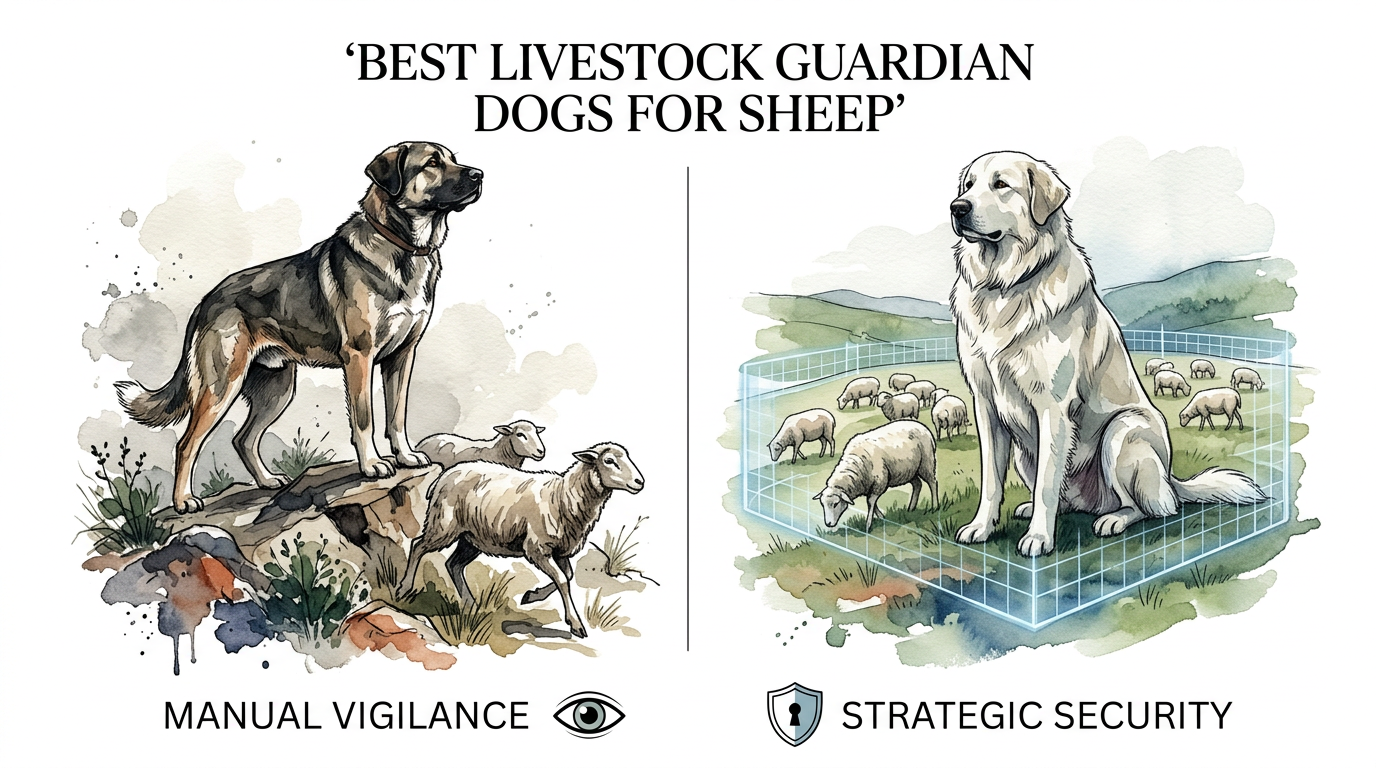
Owning sheep is an exercise in perpetual vulnerability. These animals are the “potato chips” of the predator world—slow, defenseless, and appealing to everything from the neighbor’s roaming mutt to the local coyote pack. Manual vigilance, where the farmer spends nights with a spotlight and a rifle, is a noble but unsustainable tradition. Transitioning to strategic security means putting ancient biology to work.
A Livestock Guardian Dog (LGD) is not a pet; it is a specialized biological tool. These breeds have spent thousands of years in the mountains of Europe and Asia, evolving alongside shepherds who prioritized grit, independence, and a low prey drive. This guide will walk you through the heavy lifting required to integrate these noble beasts into your operation.
Best Livestock Guardian Dogs For Sheep
Selecting the right breed is the foundation of your security strategy. While many dogs look the part, the internal “software” of a true guardian is what keeps your sheep alive. These dogs differ from herding breeds because they do not chase; they stay, they watch, and they deter.
Great Pyrenees
The Great Pyrenees is often the gateway breed for modern homesteaders. Their thick white coats allow them to blend into a flock of sheep, making them a “ghost” that predators don’t see until they are too close. They are famous for their patience and tend to be more accepting of human visitors than some of the more intense Turkish breeds.
Anatolian Shepherd
Anatolian Shepherds are the endurance athletes of the LGD world. Originating from the rugged Anatolian Plateau, these dogs are built for speed and power. They are highly territorial and possess an imposing presence that can deter a predator before a single bark is issued. Their shorter coat makes them better suited for warmer climates than the Pyrenees.
Akbash
The Akbash is another Turkish powerhouse, specifically bred for its white coat to distinguish it from the wolves it fights. They are known for their extreme maternal instincts toward the flock and a high level of alertness. An Akbash often patrols the perimeter rather than sitting in the middle of the herd, creating a wide buffer of safety.
Maremma Sheepdog
The Maremma is Italy’s gift to the shepherd. These dogs are fiercely independent thinkers. They bond deeply with their charges and are known for a “sticky” guarding style, meaning they stay close to the sheep rather than wandering off to investigate distant sounds. This makes them ideal for smaller acreages where boundary disputes are a concern.
Kangal Shepherd Dog
If you face heavy predator pressure from wolves or mountain lions, the Kangal is the heavy artillery. They possess one of the strongest bite forces in the canine world. Despite their power, they are remarkably calm and predictable with their own flock, reserving their ferocity for genuine threats.
How the Bonding Process Works
Training a livestock guardian is less about teaching “sit” and more about managing an environment where instinct can flourish. The goal is to establish a social bond between the dog and the sheep so deep that the dog views the flock as its only true family. This process is the most critical phase of your farm’s security setup.
The critical window for social attachment occurs between 8 and 16 weeks of age. During this time, the puppy must live with the sheep 24/7. Placing a puppy in a small “bonding pen” with a few calm, dog-broke ewes is the standard practice. This prevents the puppy from viewing humans as its primary social outlet.
Supervision is mandatory during the early months. A puppy that plays too roughly with lambs can cause injury or death, even without malicious intent. Corrective behavior, such as a firm “No” or a temporary separation, ensures the dog learns that sheep are to be protected, not chased. By the time the dog reaches five months, it should remain with the flock even when the shepherd leaves the field.
Benefits of Biological Security
Deploying an LGD offers advantages that no fence or electronic alarm can match. Their primary weapon is psychological. A predator that smells the scent of a large canine and hears a deep, rhythmic bark at midnight will often choose an easier target elsewhere. This “deterrence by presence” reduces the actual frequency of physical confrontations.
LGDs are also 24/7 workers. They don’t have shifts, and they don’t get distracted by smartphones. They are highly attuned to the sounds of the night, identifying the difference between a falling branch and the deliberate footfall of a fox. This allows the farmer to focus on higher-level management tasks, trusting that the perimeter is held.
The efficiency of an LGD becomes clear when calculating the cost of lost stock. Replacing a high-value ewe or a season’s worth of lambs is far more expensive than the maintenance of a well-bred guardian. Over a ten-year lifespan, a single dog can save a farm thousands of dollars in livestock assets.
Challenges and Common Mistakes
The road to a reliable guardian is paved with potential pitfalls. One of the most frequent errors is treating the LGD like a pet. Inviting the dog onto the porch or into the house “just for the night” breaks the psychological bond with the sheep. Once a dog realizes that the couch is more comfortable than the pasture, its effectiveness drops significantly.
Wandering is another major hurdle. LGDs are bred to patrol large territories. Without secure fencing, a dog may decide its territory includes the neighbor’s property or the local highway. Using “hot wire” or electric fencing during the training phase is often necessary to teach the dog the physical boundaries of its job site.
Littermate syndrome is a trap that catches many well-meaning farmers. Buying two puppies at once often leads to the dogs bonding with each other rather than the sheep. They may team up to play-chase the livestock or ignore commands entirely. It is always better to start with one dog, get it through the “teenage” phase, and then introduce a second, younger dog to learn from the veteran.
Limitations and Environmental Constraints
LGDs are not a universal solution. They require space and a specific environment to be successful. On very small homesteads (under 2 acres) with close neighbors, the constant nighttime barking—which is the dog’s way of doing its job—can lead to legal disputes and noise complaints.
The presence of high public traffic is also a constraint. If your sheep graze along a popular hiking trail, an LGD may view every passerby and their pet poodle as a lethal threat. Managing a guardian in a high-traffic area requires advanced socialization and specialized fencing that keeps the public at a distance.
Environmental climate also dictates breed choice. A Great Pyrenees will struggle in the humid heat of the deep South, while a short-haired Anatolian might need extra shelter during a Montana blizzard. You must match the dog’s coat and metabolic needs to your specific geography to ensure they can remain on duty year-round.
Strategic Comparison: Dogs vs. Donkeys vs. Llamas
When building a predator mitigation strategy, you must choose the right tool for the job. While LGDs are the gold standard, other biological guardians exist.
| Factor | Livestock Guardian Dog | Guardian Donkey | Guardian Llama |
|---|---|---|---|
| Predator Capability | High (Can tackle packs/bears) | Moderate (Good against solo canids) | Low/Moderate (Alerts & kicks) |
| Training Complexity | High (Requires 18-24 months) | Low (Inherent instinct) | Low (Minimal training needed) |
| Maintenance | Dog food, grooming, vet care | Pasture, hay, hoof care | Pasture, hay, shearing |
| Bonding Style | Socially integrated with flock | Territorial / Herd-centric | Socially aloof / Vigilant |
Practical Tips for Success
Maintaining a working dog requires a different approach than a companion animal. Nutrition is the most overlooked aspect of performance. Working LGDs need high-calorie, high-protein kibble to maintain their body condition, especially in the winter when they burn significant energy just staying warm.
Build “dog-only” feeding stations. Sheep are notorious for eating dog food, which is not only expensive but can also make the sheep sick. A small creep-feeder or a fenced area with an entry hole just large enough for the dog ensures your guardian gets the calories it needs without the flock interfering.
Regular health checks are a mandatory part of stewardship. Because LGDs are incredibly stoic, they will often hide injuries from thorns, fence wire, or predator scuffles. You should handle your dog at least once a week—checking paws, ears, and teeth—to ensure they are physically sound and to maintain enough of a bond that you can catch them if they need veterinary attention.
Advanced Considerations for Serious Practitioners
For those running large flocks over diverse terrain, a single dog may not be enough. Multi-dog teams offer layered security. One dog might stay “sticky” with the sheep while another “ranges” the perimeter. This pincer strategy makes it nearly impossible for predators to find an opening.
When introducing a second dog, age-staggering is vital. A mature, 3-year-old dog can act as a mentor to a new puppy. The younger dog will watch the veteran’s behavior, learning when to bark and when to ignore a passing deer. This “apprenticeship” model reduces the training burden on the farmer and ensures continuity of security.
If you are a multi-species farm, you must ensure your dog is “cross-bonded.” A dog raised only with sheep may view a new goat or a flock of chickens as prey. The best practice is to expose your LGD to all the farm’s permanent residents during that 8-16 week window, teaching them that anything under your stewardship is part of the protected family.
Practical Scenario: The Midnight Challenge
Imagine a coyote pack approaching a 40-acre pasture at 1:00 AM. Without a dog, the coyotes will circle until they find a weak point in the fence or an isolated lamb. The sheep will panic, potentially causing injury as they trample one another in the dark.
With a pair of Akbash or Maremmas on duty, the scenario changes entirely. At the first scent of a coyote, the dogs begin a low, booming warning bark. They move to the edge of the flock, pushing the sheep together into a tight group. If the coyotes persist, the dogs advance, barking with increasing intensity. Most predators will turn back at this point, unwilling to risk a fight with a 120-pound guardian. The sheep remain calm, the coyotes move on, and the farmer sleeps through the entire event.
Final Thoughts
Integrating a Livestock Guardian Dog is a commitment to a way of life that values ancestral wisdom over modern convenience. It requires patience, a firm hand, and the discipline to let the dog be what it was born to be: a worker, not a pet. The first two years are an investment in time and oversight, but the reward is a level of security that no technology can replicate.
A well-trained dog becomes the soul of the farm. They are the silent sentinels that allow you to grow your flock with confidence, knowing that the “pioneer grit” required to survive in the wild has a champion on your side of the fence. Experiment with the breeds that suit your climate, respect the bonding process, and you will find that a good dog is the most valuable hired hand you will ever employ.
By returning to these biological systems, we reclaim a piece of agricultural heritage that has worked for millennia. Trust the dog, verify the perimeter, and let the ancient bond between shepherd and guardian protect your legacy.
