How To Become More Self-Sufficient Without Starting a Full-Blown Farm…
Want to start preserving your harvest, making your own soap, or building a backyard root cellar — but not sure where to begin? “Homesteading Advice” gives you instant lifetime access to 35+ practical homesteading books on food preservation, veggie gardening, DIY natural cleaning products (save over $250 per year with this skill alone), brewing, off-grid energy, and a whole lot more…
Click Here To Check It Out Now!
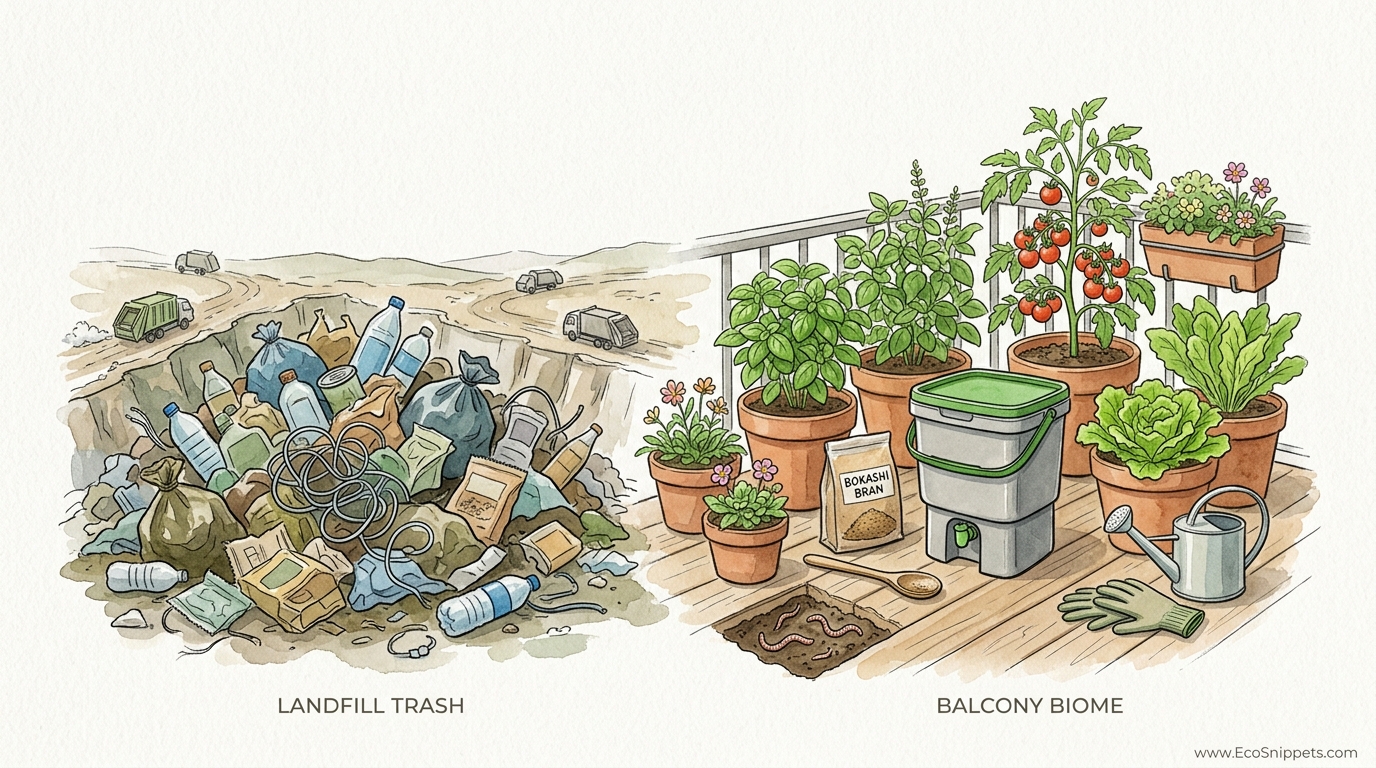
Most city dwellers pay a monthly fee to haul away their garden’s best fuel, while one simple bucket turns a studio apartment into a fertility factory. Living in a 20th-floor high-rise doesn’t mean you have to be a waste generator. While your neighbors are sending their scraps to a methane-producing landfill, you could be fermenting ‘black gold’ right under your sink. The Bokashi method isn’t just composting; it’s an urban rebellion against the waste stream.
Our ancestors understood that nothing in nature is ever truly lost; it only changes form. In the modern concrete jungle, we have forgotten how to close the loop. We treat our leftovers as a burden to be banished, yet these scraps carry the very essence of the earth’s vitality. Reclaiming this power requires no sprawling acreage or steaming heaps of manure. It only requires a vessel, a handful of microbes, and the willingness to let a little biology happen in the dark.
This guide serves as a manual for the modern pioneer. It is for the person who wants to grow a lush balcony garden or simply stop contributing to the rot of the local landfill. We will strip away the marketing fluff and look at the raw science and grit of indoor fermentation. You are about to turn your kitchen into a laboratory of life.
Bokashi Composting For Beginners – Urban Guide
Bokashi is a Japanese term that roughly translates to “fermented organic matter.” Unlike the traditional compost pile you might see on a farm, which breathes oxygen and generates heat, Bokashi is an anaerobic process. It relies on a specific community of microbes to pickle your food scraps in a sealed environment. This is a controlled fermentation, much like making sauerkraut or kimchi, but for your soil instead of your stomach.
The core of this system is the inoculant, often called Bokashi bran. This carrier—usually wheat or rice bran—is infused with Effective Microorganisms (EM). These microbes include lactic acid bacteria, yeasts, and phototropic bacteria. When you seal these tiny workers in a bucket with your kitchen waste, they begin a process of “pre-digestion” that prevents rotting and preserves nutrients that would otherwise vanish into the air.
This method exists because urban spaces demand efficiency and discretion. You cannot have a steaming, five-foot-tall pile of decomposing vegetable skins in a studio apartment without attracting every fly in the zip code. Bokashi solves this by keeping the process contained and nearly odorless. It transforms “waste” into a shelf-stable fermented product that soil organisms find irresistible.
In a world of fast-paced consumption, Bokashi is a return to slow, deliberate stewardship. It is used by apartment dwellers, small-scale gardeners, and even large-scale farmers who want to sequester carbon and rebuild soil biology. It is the bridge between the sterile kitchen and the living earth.
How the Fermentation Process Works Step by Step
Mastering the bucket requires more than just tossing in scraps; it requires discipline. You are creating a sanctuary for microbes, and like any living thing, they have specific needs. The goal is to exclude oxygen and provide a consistent food source.
Begin with a dedicated Bokashi bucket. These specialized containers feature an airtight lid and a spigot at the bottom. The spigot is crucial because fermentation releases liquid, often called “Bokashi tea,” which must be drained to prevent the bucket from becoming a swamp. Excess moisture can drown the microbes and lead to putrefaction—the foul-smelling rot we are trying to avoid.
The daily routine is simple but non-negotiable. Chop your scraps into small, one-inch pieces to maximize surface area for the microbes. Large chunks take longer to ferment and can harbor pockets of air. Add your daily scraps to the bin, then sprinkle a generous handful of Bokashi bran over the top. Use a dedicated press or an old plate to mash the scraps down, forcing out any trapped oxygen.
Once the bucket is full, the real work begins in silence. Seal the lid tightly and set the bucket aside for at least two weeks. This is the fermentation phase. During this time, the microbes produce lactic acid, which drops the pH of the mixture to around 3.5. This acidity kills pathogens and “pickles” the waste. The scraps will look mostly the same when you open the bin, but their internal structure has been fundamentally altered.
After the two-week fermentation, the material is ready for the second stage: soil integration. This “pre-compost” is still highly acidic and cannot be applied directly to plant roots. It must be buried in the earth or mixed into a “soil factory” (a tub of soil) for another two to four weeks. Only then do the soil-dwelling microbes and worms finish the job, turning the pickled scraps into rich, dark humus.
Benefits of Fermenting Your Kitchen Scraps
The most immediate advantage of the Bokashi method is its appetite. Traditional aerobic composting is picky; it shuns meat, dairy, oily foods, and small bones because they attract pests and rot slowly. Bokashi microbes have no such qualms. They thrive on the proteins and fats that would ruin a backyard pile. This means you can divert nearly 100% of your organic kitchen waste away from the trash can.
Nutrient retention is another victory for the pioneer. In a hot compost pile, a significant portion of nitrogen is lost as ammonia gas, and carbon escapes as CO2. Because Bokashi is a closed, anaerobic system, these nutrients stay locked within the organic matter. When you finally bury the fermented waste, you are delivering a concentrated dose of fuel directly to your soil’s microbial bank account.
Space efficiency is the ultimate selling point for the city dweller. A single five-gallon bucket can handle the weekly waste of a small family. It fits under a sink, in a closet, or on a balcony. You don’t need a yard to start the cycle; you only need a corner of your home and a commitment to the process.
Finally, we must talk about the “liquid gold.” The leachate drained from the spigot is a potent microbial inoculant. Diluted with water at a 1:100 ratio, it serves as a foliar spray or a root drench that stimulates plant growth and improves resistance to disease. Undiluted, this acidic liquid acts as a natural drain cleaner, consuming the organic gunk that clogs pipes.
Challenges and Common Pitfalls
The greatest enemy of a healthy Bokashi bin is oxygen. If the lid is not airtight, or if you open the bucket too frequently to add a single grape skin, you invite the wrong kind of biology. Aerobic bacteria will begin to rot the food, leading to a smell that is more “rancid dumpster” than “sweet pickle.” A healthy bin should smell vinegary or slightly alcoholic. If it smells like death, something has gone wrong.
Moisture management is the second hurdle. Newcomers often forget to drain the liquid every few days. If the bottom of the bin becomes a stagnant pool, the fermentation stops, and the contents begin to putrefy. This liquid is the byproduct of the microbes’ labor; it must be harvested and used, not left to drown the colony.
Under-dosing the bran is a common mistake born of frugality. While you don’t need to bury the scraps in bran, you must ensure every layer is adequately inoculated. Meat and dairy require a heavier hand with the bran than vegetable peelings do. If you are unsure, add a little extra. The microbes are your employees; you must pay them in bran if you want them to work.
Temperature can also play a role. Microbes are most active in a temperate environment, ideally between 60°F and 75°F. If the bucket is left on a frozen balcony or in a scorching sunroom, the fermentation will stall or the microbes will die. Treat your bucket like a living organism, and keep it in a place where you would be comfortable sitting.
Limitations of the Bokashi System
It is vital to understand that Bokashi is not a “finished” product when it leaves the bucket. You cannot simply sprinkle fermented orange peels on top of your petunias. The material is extremely acidic and will burn delicate roots if placed in direct contact. This is the primary trade-off: Bokashi requires a “Stage 2” that involves soil.
For an apartment dweller with zero access to the outdoors, this presents a logistical challenge. You must either maintain a “soil factory”—a secondary container filled with soil to bury the waste—or find a community garden or a friend with a yard to accept your fermented gifts. Without a plan for the finished ferment, your bucket will eventually just be a full container of pickled trash.
Cost is another factor. Unlike a traditional pile that only requires “browns” (leaves/cardboard) and “greens” (scraps), Bokashi requires a constant supply of inoculated bran. While you can make this yourself, as we will discuss later, most beginners start by purchasing it. This adds an ongoing expense to your waste management system that traditional methods don’t have.
Environmental limitations also exist. Large, woody materials like corn cobs or avocado pits will ferment on the surface, but they take a very long time to break down in the soil afterward. Bokashi excels at soft kitchen waste, but it won’t replace a wood chipper or a heavy-duty outdoor pile for garden debris.
Comparison: Bokashi vs. Traditional Composting
Choosing a method depends on your terrain and your goals. Traditional composting is a test of patience and physical labor, while Bokashi is a test of observation and containment. Below is a comparison of the two paths.
| Feature | Bokashi (Anaerobic) | Traditional (Aerobic) |
|---|---|---|
| Location | Indoors / Compact spaces | Outdoors / Large footprint |
| Speed | Fast (4-6 weeks total) | Slow (3-12 months) |
| Food Waste | Meat, dairy, oils allowed | Mostly vegan / No oils |
| Odor | Sour/Pickled (low impact) | Earthy (if balanced) |
| Maintenance | Low (drain tea, no turning) | High (regular turning) |
Traditional composting requires a balance of Carbon (browns) and Nitrogen (greens). Bokashi ignores this ratio during the fermentation phase, though the burial phase eventually benefits from being mixed with carbon-rich soil. If you have the space and the time, traditional composting is nearly free. If you have a busy life and a small apartment, Bokashi is the superior tool.
Practical Tips for Success
To keep your system running like a well-oiled machine, adopt the “lasagna” approach. Never leave food scraps exposed to the air at the top of the bucket. Every time you add waste, cover it immediately with bran. If you are going away for a few days, add an extra thick layer of bran and a piece of plastic or a “smash plate” on top to ensure the seal remains tight while you are gone.
Chop your scraps as if you were preparing a fine stew. Small pieces ferment more evenly and break down faster once buried. This is especially true for citrus rinds and thick stalks. A little extra time at the cutting board saves weeks of waiting in the soil.
Keep a second bucket ready. The “Bokashi shuffle” is the secret to a continuous waste stream. When your first bucket is full and enters its two-week “nap” (dormant fermentation), you need a second bucket to start collecting your daily scraps. Without a two-bucket system, you will find yourself throwing scraps in the trash while you wait for the first bin to finish.
Use the “white mold” test. If you open your bin and see a fuzzy white growth on top, do not panic. This is often a sign of healthy yeast and beneficial fungi. It means your microbes are winning the war. However, if you see green, black, or blue mold, it indicates that oxygen has entered the system or putrefaction has begun. In those cases, you may need to bury the contents deep in a remote corner of a garden or, in extreme cases, discard them.
Advanced Considerations: Making Your Own Bran
Once you have mastered the basics, you may want to achieve true self-reliance by making your own Bokashi bran. The commercial stuff is convenient, but it is essentially just agricultural byproduct and microbes. You can produce large batches for a fraction of the cost, ensuring you never run out of the fuel your system needs.
The recipe is straightforward. You need a substrate (wheat bran, rice hulls, or even sawdust), a source of sugar (molasses), and the EM-1 microbial concentrate. Mix the molasses and EM-1 into non-chlorinated water, then slowly incorporate it into your bran until it reaches the consistency of damp sand. It should hold its shape when squeezed but not drip water.
Ferment this damp mixture in an airtight bag or bucket for two to four weeks. Once the “pickled” smell develops, spread the bran out to dry in a dark, well-ventilated area. Once bone-dry, this homemade bran can be stored in an airtight container for up to a year. Making your own bran is the mark of a serious practitioner who understands the economics of the urban biome.
You can also experiment with different substrates. Some urban pioneers use spent coffee grounds from local cafes as their carrier. This not only saves money but also diverts yet another waste stream from the landfill. Just ensure the grounds are properly dried before inoculation to prevent premature mold growth.
Scenario: The “Soil Factory” in a Small Apartment
Consider the case of a gardener living on the 10th floor with only a small balcony of potted tomatoes. When their Bokashi bucket is full and has fermented for two weeks, they cannot dig a trench in the floor. Instead, they use a 20-gallon plastic tote filled halfway with cheap potting soil.
They dump the fermented scraps into the tote, break them up with a spade, and mix them thoroughly with the soil. They then cover the mixture with a final two-inch layer of fresh soil to act as a “bio-filter” for any lingering smells. They place the lid loosely on top—this stage requires oxygen for the final breakdown—and wait.
In three weeks, the scraps have completely disappeared, transformed into a rich, black soil that smells like a forest floor after a rainstorm. The gardener then uses this super-charged soil to top-dress their balcony containers. This is the “Soil Factory” method, and it is the key to closing the loop when you don’t have a backyard. It proves that fertility is a matter of biology, not geography.
Final Thoughts
Bokashi composting is more than a waste management strategy; it is a fundamental shift in how we relate to our environment. It forces us to slow down, to observe the invisible work of microbes, and to take responsibility for the scraps we create. By choosing fermentation over the landfill, you are participating in an ancient cycle of renewal that predates our modern cities by millennia.
The path of the urban pioneer is one of practical wisdom. It acknowledges the constraints of the high-rise and the sidewalk but refuses to accept them as barriers to a life of stewardship. Whether you are seeking better tomatoes or a smaller carbon footprint, the humble bucket is your most powerful ally.
Start small, stay consistent, and don’t be afraid to get your hands a little dirty. The transition from waste generator to fertility factory doesn’t happen overnight, but once you see your first batch of “black gold” emerge from a pile of old leftovers, you will never look at your trash can the same way again. Experiment with the process, find what works for your space, and let the microbes do what they do best: turn the old into the new.
