How To Become More Self-Sufficient Without Starting a Full-Blown Farm…
Want to start preserving your harvest, making your own soap, or building a backyard root cellar — but not sure where to begin? “Homesteading Advice” gives you instant lifetime access to 35+ practical homesteading books on food preservation, veggie gardening, DIY natural cleaning products (save over $250 per year with this skill alone), brewing, off-grid energy, and a whole lot more…
Click Here To Check It Out Now!
Are you poisoning your soil’s biology just to kill a few worms in your sheep? Every time you use a synthetic dewormer, you’re not just killing parasites—you’re wiping out the dung beetles and soil microbes that make your pasture work. Learn how to use ‘herbal leys’ and rotational grazing to turn your animals into their own pharmacists.
For generations, the solution to a “wormy” lamb was simple: reach for the bottle. We were taught that a clean animal was a healthy animal and that any parasite in the gut was a failure of management. But we have reached the end of that road. Modern science and hard-earned experience show us that the “slash and burn” approach to internal parasites is failing us, our livestock, and the very ground they walk on.
Chemical resistance is no longer a distant threat; it is a present reality. On many farms, common dewormers now have an efficacy rate as low as 21% to 34% for certain worm species. This means we are pouring money into the gut of an animal only to have the parasites thrive anyway. Meanwhile, the residues of those same chemicals are wreaking havoc on the soil’s clean-up crew—the dung beetles and microbes that cycle nutrients and keep our pastures productive.
Taking a step back toward ancestral wisdom doesn’t mean letting your animals suffer. It means building a system where the forage itself acts as a defense. By integrating herbal leys and strategic rotational grazing, you can create a resilient ecosystem where the livestock’s health is a natural byproduct of the soil’s health. This is a journey from being a chemical applicator to becoming a pasture manager.
Chemical Free Livestock Parasite Control
Chemical free livestock parasite control is a holistic management strategy that prioritizes environmental health and animal immunity over the use of synthetic anthelmintics (dewormers). Rather than trying to eradicate every single worm in a flock, this method focuses on managing the parasite population so it never reaches a level that causes clinical disease or production loss.
This approach exists because parasites, particularly the Barber’s Pole worm (Haemonchus contortus), have evolved to survive almost every chemical class we have created. In real-world situations, such as regenerative sheep and goat farming, this method uses the animal’s natural behavior and specialized “medicinal” plants to break the worm’s lifecycle. Think of it like a chess match: you aren’t trying to remove the opponent’s pieces all at once; you are simply making the board so difficult to navigate that they can never checkmate your livestock.
Instead of a sterile gut, we aim for a balanced one. This system is used by producers who want to save on input costs, protect their soil’s biodiversity, and produce meat or fiber that is free from chemical residues. It relies on two main pillars: Forage Defense (using specific plants) and Rotational Strategy (using time and distance).
How It Works: Breaking the Lifecycle
To control parasites without chemicals, you must understand their lifecycle better than they do. Most internal parasites follow a predictable path: the adult worm lives in the animal’s gut and sheds eggs into the manure. Once the manure hits the ground, those eggs hatch into larvae. In warm, moist conditions, these larvae crawl up blades of grass, waiting to be eaten by the next grazing animal.
The key is to interrupt this loop at its weakest points. There are several ways to do this through management:
- The 4-Day Rule: Most worm eggs take at least 5 to 6 days to reach the infective larval stage (L3) in the summer. If you move your livestock to a new paddock every 3 to 4 days, they are always “walking away” from the next generation of worms before they become dangerous.
- The 4-Inch Rule: Roughly 80% to 90% of infective larvae reside in the bottom 2 to 4 inches of the pasture. If you manage your grazing so that animals never graze lower than 4 inches (leaving a 6-to-8-inch residual), they simply won’t ingest the bulk of the parasite load.
- Extended Rest Periods: Once animals leave a paddock, the larvae begin to die off if they aren’t eaten. In hot, dry weather, larvae may die in 30 days; in cool, moist conditions, they can survive for months. Giving a pasture 40 to 65 days of rest drastically reduces the number of survivors waiting for the flock’s return.
- The Multi-Species Buffer: Sheep and cattle do not share the same parasites. If cattle graze a “dirty” sheep pasture, they act like vacuum cleaners—ingesting sheep-specific larvae that cannot survive in a bovine gut, effectively cleaning the pasture for the next round of lambs.
The Power of Herbal Leys
If rotational grazing is the shield, “herbal leys” are the sword. An herbal ley is a diverse mixture of grasses, legumes, and herbs—many of which have direct anthelmintic (deworming) properties. Plants like Chicory, Sainfoin, and Birdsfoot Trefoil contain condensed tannins. These tannins aren’t just for making wine; in the gut of a sheep or cow, they make the environment hostile to parasites.
Research indicates that condensed tannins can inhibit the hatching of worm eggs and the mobility of larvae. Furthermore, these plants are often deep-rooted, allowing them to pull up minerals like zinc, copper, and selenium from deep in the soil profile. A well-mineralized animal has a much stronger immune system, making them naturally more resistant to the worms they do encounter. Think of these plants as your animals’ own natural pharmacy, available with every bite.
Benefits of the Natural Approach
Choosing a chemical-free or reduced-chemical approach offers measurable advantages that go beyond just saving money on drench. One of the most significant benefits is the preservation of Dung Beetles. These incredible insects are the “liver” of your pasture. They tunnel into the ground, burying manure and the parasite eggs within it, which effectively removes them from the grazing surface. Synthetic dewormers, particularly macrocyclic lactones like Ivermectin, are highly toxic to dung beetles, often killing them or reducing their ability to reproduce.
Beyond the soil, this method promotes long-term flock resilience. When you stop “blanket drenching” every animal, you allow a small population of susceptible worms to survive. This is known as Refugia. These susceptible worms interbreed with any resistant ones, diluting the “super-worm” genetics and ensuring that if you ever do have an emergency and need a chemical, it will actually work. Additionally, herbal leys are more drought-resistant and can fix up to 180kg of nitrogen per hectare, slashing your fertilizer bills.
Challenges and Common Mistakes
The most frequent error in natural parasite control is overgrazing. If you run out of grass and force your animals to eat “down to the roots,” you are essentially forcing them to eat a concentrated dose of parasites. No amount of herbal leys can overcome the sheer volume of larvae found in the bottom two inches of a pasture.
Another pitfall is “set stocking,” where animals are left in one large field for weeks at a time. This creates a perpetual reinfection loop. Many producers also fail because they don’t monitor their livestock closely enough. Natural control is not “zero management”; it is “different management.” It requires regular observation, such as using the FAMACHA score (checking the color of the inner eyelid for anemia) to identify which individual animals are struggling, rather than treating the whole group blindly.
Limitations and Realistic Constraints
This method is not a “magic bullet” that works perfectly in every environment from day one. In very high-density systems or on small acreages where long rest periods are impossible, parasites can still overwhelm the system. Environmental factors, such as an exceptionally wet and warm summer, can create a “bloom” of parasites that moves faster than your rotation.
It is also important to note that certain classes of livestock, such as newly weaned lambs or does in late pregnancy, have lower natural immunity. There may be times when a targeted chemical intervention is the only way to save an animal’s life. A balanced understanding means recognizing that forage defense is your primary tool, but the drench bottle is a “break glass in case of emergency” tool that should be used sparingly and strategically.
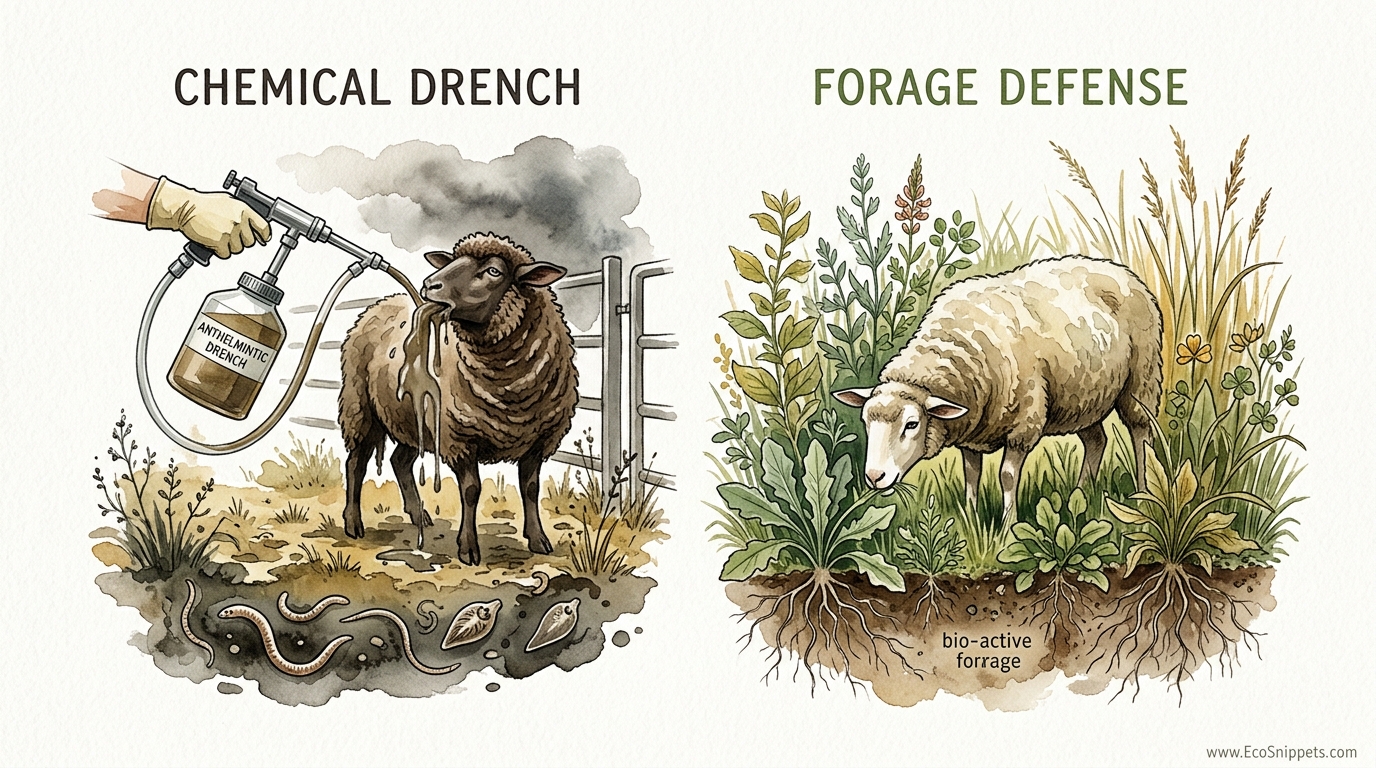
Comparison: CHEMICAL DRENCH vs. FORAGE DEFENSE
Comparing these two methods helps clarify the shift in mindset required for sustainable livestock management. While one is a quick fix, the other is a long-term investment in biological capital.
| Factor | CHEMICAL DRENCH | FORAGE DEFENSE |
|---|---|---|
| Cost | Recurring per-animal expense; rising prices. | One-time seed cost; management time. |
| Soil Impact | Often toxic to dung beetles and soil life. | Builds organic matter and nitrogen. |
| Effectiveness | Decreasing rapidly due to resistance. | Increases over time as soil health improves. |
| Sustainability | Low; leads to “super-worms.” | High; creates a closed-loop system. |
Practical Tips and Best Practices
If you are ready to transition away from heavy chemical use, start with these actionable steps. The goal is to build a system that works for your specific land and climate.
- Seed the Medicine: Overseed existing pastures with a mix of Chicory, Plantain, and Birdsfoot Trefoil. These species are hardy and provide the tannins needed for parasite suppression.
- Learn to FAMACHA: Obtain a FAMACHA card and learn how to score your animals. This allows you to identify the 20% of the flock that carries 80% of the parasites, allowing you to treat only those that truly need it.
- Use Temporary Fencing: Use poly-wire and step-in posts to create smaller paddocks. Moving the “mob” frequently is the single most effective way to stay ahead of the worm cycle.
- Monitor Fecal Egg Counts (FEC): Don’t guess; test. A simple fecal egg count can tell you exactly which worms you have and how high the burden is before you see symptoms like weight loss or “bottle jaw.”
Advanced Considerations: Genetics and Breeding
For the serious practitioner, the ultimate goal is breeding for resistance. Not all animals are created equal; some individuals are genetically predisposed to have a higher “immune response” to parasites. By identifying and culling the animals that consistently require drenching, you are “selecting for health.”
Over several generations, you can develop a flock or herd that thrives on your specific herbal leys with minimal intervention. This “pioneer-grit” approach to genetics means you are no longer supporting weak animals with a chemical crutch. Instead, you are building a legacy of self-reliant livestock that can handle the challenges of the natural world.
Example Scenario: The 40-Acre Transition
Imagine a shepherd with 100 ewes on 40 acres of “set-stocked” grass. Every summer, they struggle with Barber’s Pole worm, drenching the whole flock three times a year. By switching to a 10-paddock rotation and frost-seeding an herbal ley mix, the transformation begins.
In the first year, they move the sheep every 4 days, ensuring a 36-day rest for each paddock. They leave 6 inches of grass behind. Using FAMACHA scoring, they find that only 15 ewes need treatment, saving the cost of 85 doses of chemical. By year three, the dung beetle population has exploded, manure disappears into the soil within days, and the ewes are weaning heavier lambs because they aren’t losing blood to internal parasites. The “poison” is gone, and the biology is back.
Final Thoughts
Transitioning to chemical-free livestock parasite control is more than just a change in farming technique; it is a return to a more natural, observation-based way of life. By understanding the intricate dance between the parasite, the host, and the pasture, we can stop the cycle of resistance and environmental degradation. The tools—herbal leys, rotational grazing, and selective breeding—are available to any producer willing to put in the time to learn them.
True self-reliance comes from a healthy landscape. When we prioritize the soil’s biology, we create a ripple effect that touches everything: from the health of our animals to the quality of the food we produce. It is time to stop fighting nature with a bottle and start working with her using the wisdom of the land.
If you have found value in these strategies, consider looking into advanced soil health practices or mixed-species grazing to further diversify your farm’s resilience. The more we learn about the ancestral wisdom of the pasture, the more we realize that the best medicine was growing under our feet all along.
