How To Become More Self-Sufficient Without Starting a Full-Blown Farm…
Want to start preserving your harvest, making your own soap, or building a backyard root cellar — but not sure where to begin? “Homesteading Advice” gives you instant lifetime access to 35+ practical homesteading books on food preservation, veggie gardening, DIY natural cleaning products (save over $250 per year with this skill alone), brewing, off-grid energy, and a whole lot more…
Click Here To Check It Out Now!
The Modern Pioneer’s Guide to the Chicken Tractor: Why Your Lawn Needs Birds, Not Gas
One costs you fuel and sweat, the other gives you eggs and fertilizer. Why spend your Saturday morning fighting a noisy engine and burning fossil fuels? By using a chicken tractor, you turn a chore into a system. Your birds get fresh greens and bugs, your soil gets instant nitrogen, and you get to sit back and watch the ‘mower’ work for you. Work smarter, not harder.
For generations, our ancestors understood a fundamental truth that we have largely forgotten: nature is not something to be conquered with loud machinery, but a partner to be managed with wisdom. When you look at your backyard, do you see a liability that requires weekly maintenance, or do you see a resource waiting to be harvested? The shift from a gas-powered mower to a mobile poultry system is more than just a change in tools; it is a return to a self-reliant mindset.
In this guide, we will explore the transition from mechanical lawn maintenance to biological stewardship. We will look at the mechanics of the chicken tractor, the science of soil health, and the practical grit required to manage a living system. Whether you are tending a quarter-acre or a sprawling homestead, the principles of the chicken tractor remain the same: efficiency, health, and yield.
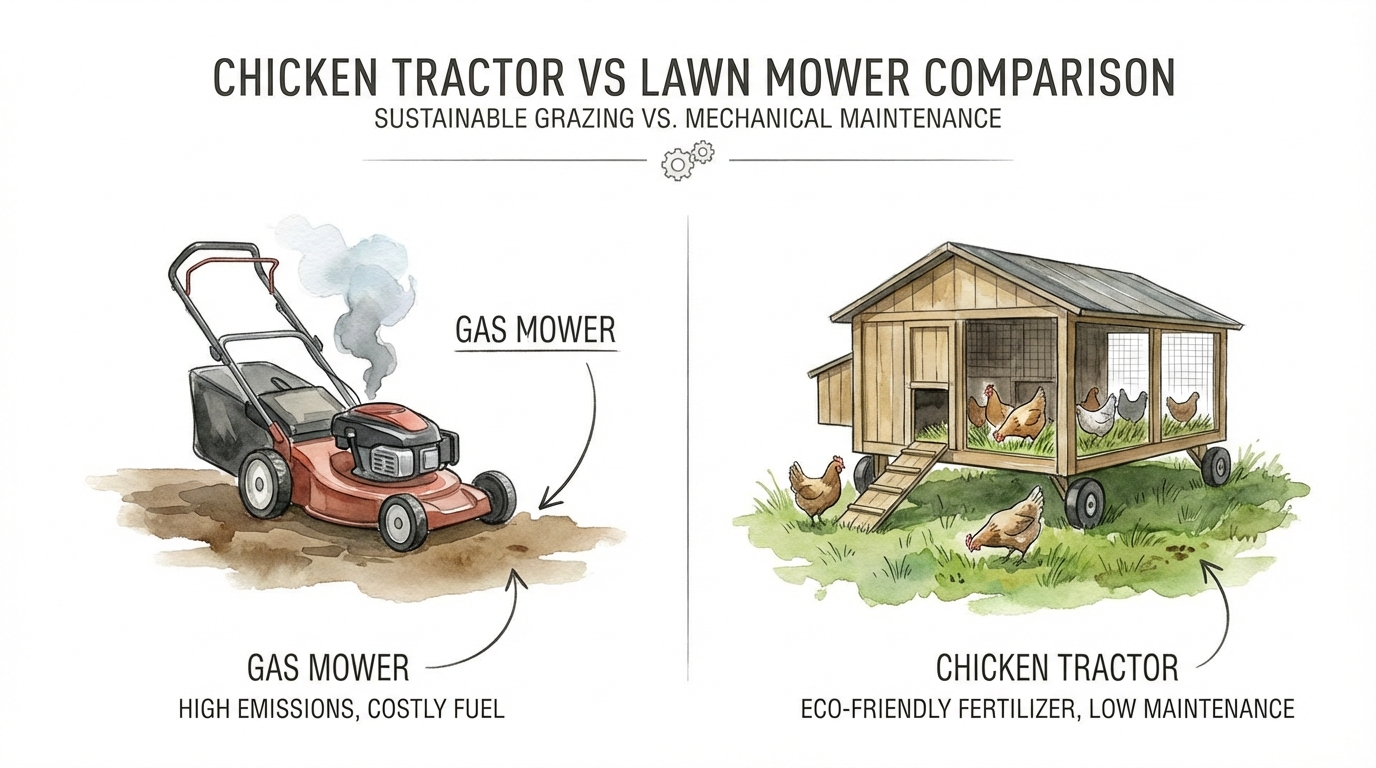
Chicken Tractor Vs Lawn Mower Comparison
To understand the value of a chicken tractor, we must first look at the traditional lawn mower for what it actually is. A gas mower is a linear tool. It consumes expensive fuel, creates noise pollution, and leaves behind grass clippings that often go to waste. It is a machine designed to maintain an aesthetic, but it produces nothing of intrinsic value. In fact, it often compacts the soil and removes nutrients without replacing them.
Contrast this with the chicken tractor. A chicken tractor is a bottomless, portable coop that allows birds to forage on a specific patch of ground while staying protected from predators. Instead of a “GAS MOWER vs CHICKEN TRACTOR” debate centered solely on speed, we should look at the outputs. The chicken tractor is a circular system. The birds eat the grass (the “fuel”), and in return, they produce high-quality protein (eggs and meat) and high-nitrogen fertilizer (manure).
While a mower leaves the soil depleted, the chicken’s constant scratching aerates the top layer of earth. Their waste provides the exact nutrients needed for the grass to grow back stronger and greener. This is the essence of pioneer-grit: finding ways to make one action solve three problems at once. You are mowing the grass, feeding your livestock, and fertilizing your land in a single movement.
How It Works: Implementing the Mobile Pasture System
Transitioning to a chicken tractor system requires a shift in how you view your daily routine. It is not as simple as pulling a starter cord, but it is infinitely more rewarding. The process begins with the design of the tractor itself. It must be light enough for one person to move, yet sturdy enough to withstand a determined predator like a fox or a raccoon.
Step 1: The Daily Move
The secret to a successful chicken tractor is the frequency of movement. Most homesteaders move their tractors once or twice a day. This ensures the birds always have access to fresh forage and prevents them from over-grazing a single spot into a mud pit. When you move the tractor, you are essentially “resetting” their buffet. They will immediately go for the tender clover and the hidden insects that were previously out of reach.
Step 2: Stocking Density
You cannot cram twenty birds into a tiny box and expect a healthy lawn. A general rule of thumb is to provide at least 2 to 4 square feet of floor space per bird within the tractor. This gives them enough room to move comfortably without competing for space. Proper density ensures that the manure is spread evenly across the lawn rather than concentrated in one suffocating layer.
Step 3: Predator Proofing
A chicken tractor must be a fortress. Because it sits directly on the grass, you need to ensure there are no gaps between the frame and the ground. Many experienced keepers use a “predator skirt”—a strip of hardware cloth that lays flat on the ground around the perimeter—to discourage digging. Remember, you are building a tool for self-reliance, so do not cut corners on the materials. Use heavy-gauge wire and solid wood or aluminum frames.
Designing for Ergonomics
If the tractor is too heavy, you won’t want to move it. Use large wheels on one end and a sturdy handle on the other. Some modern designs use a “dolly” system or a lever lift to make the tractor feel weightless during the move. The goal is to make the daily move take less than two minutes of your time.
The Benefits of Biological Mowing
When you replace a mower with a flock, you are investing in the long-term health of your ecosystem. The benefits extend far beyond just keeping the grass short. This is where the ancestral wisdom of integrated farming shines.
- Unmatched Fertilization: Chicken manure is “hot,” meaning it is incredibly rich in nitrogen, phosphorus, and potassium. In a tractor system, this fertilizer is applied directly and evenly. There is no need for chemical sprays that kill beneficial soil microbes.
- Pest Eradication: Chickens are natural hunters. They will spend their day seeking out ticks, grasshoppers, crickets, and beetle larvae (grubs). If you have a pest problem in your garden or yard, a chicken tractor is the most effective organic solution available.
- Weed Management: While they love grass, chickens also have a penchant for weed seeds. By grazing them across your lawn, you are reducing the seed bank of dandelions, crabgrass, and other unwanted plants before they have a chance to take over.
- Superior Nutrition: Birds that have daily access to fresh greens and insects produce eggs with darker yolks and higher levels of Omega-3 fatty acids. You aren’t just maintaining a lawn; you are upgrading your diet.
Challenges and Common Pitfalls
Modern self-reliance requires an honest look at the difficulties. A chicken tractor is not a “set it and forget it” solution. It requires a level of discipline that a mechanical mower does not. If you are unprepared for these challenges, the system can fail.
One common mistake is over-grazing. If you leave the tractor in one spot for too long, the chickens will scratch the grass down to the roots and eventually kill it. This is why the daily move is non-negotiable. You must also monitor the weather. In heavy rain, the chickens can turn a patch of grass into a muddy mess in hours. During extreme weather, you may need to move the tractor to higher ground or a sheltered area.
Another pitfall is inadequate protection. Because the tractor is mobile, it is often further away from the safety of the house. Hardware cloth is essential; standard chicken wire is too weak and can be torn open by a determined predator. Furthermore, ensure your birds have a shaded area within the tractor. If they are out in the direct sun all day without relief, they will overheat and stop producing.
Comparison of Inputs and Outputs
To help visualize the difference between these two systems, consider the following comparison. We are looking at the long-term impact on your time, wallet, and land.
| Feature | Gas Lawn Mower | Chicken Tractor |
|---|---|---|
| Primary Fuel | Gasoline / Oil | Grass / Insects / Scraps |
| Main Output | Grass Clippings (Waste) | Fresh Eggs and Meat |
| Soil Impact | Compaction and Depletion | Aeration and Fertilization |
| Noise Level | High (Hearing protection needed) | Low (Natural clucking) |
| Maintenance | Mechanical repairs and parts | Basic bird husbandry |
| Financial Cost | Continuous expense | One-time build / High ROI |
As the table shows, the gas mower is a drain on resources, while the chicken tractor is a source of them. For those following a path of self-sufficiency, the choice becomes clear. The tractor turns your property into a productive micro-farm.
Practical Tips for Success
If you are ready to start, keep these best practices in mind to ensure your flock and your lawn thrive together. This is where the “pioneer-grit” meets practical application.
- Observe the Grass: Learn to read your lawn. If the grass is growing rapidly in the spring, you may need to move the tractor twice a day or increase the number of birds. In the dry summer months, move them more quickly to avoid stressing the dormant grass.
- The “Morning Move” Ritual: Make moving the tractor the first thing you do in the morning. This gives the birds the coolest part of the day to forage and ensures they have fresh ground before the sun gets too high.
- Water and Feed Management: Use hanging waterers and feeders inside the tractor. If they sit on the ground, they will get knocked over or filled with dirt as the chickens scratch. Gravity-fed nipple waterers are particularly effective for keeping the water clean.
- Choose the Right Breeds: Not all chickens are created equal. For a tractor system, look for active foragers. Breeds like Rhode Island Reds, Australorps, or Plymouth Rocks are hardy and excellent at finding their own food.
- Rotate Your Pasture: Don’t just move the tractor in a straight line. Map out a rotation that allows the grass at least 21 to 30 days to recover before the chickens return to the same spot. This prevents parasite buildup and allows the nutrients to soak into the roots.
Integrating Your Garden
One of the best ways to use a chicken tractor is as a “pre-treatment” for your vegetable garden. Before you plant your spring crops, run the chicken tractor over the garden beds. The birds will clear out the weeds and larvae, leaving behind a perfectly fertilized bed ready for planting. This is the ultimate way to close the loop on your homestead.
The Philosophy of the Tractor
Ultimately, choosing a chicken tractor over a lawn mower is an act of defiance against a culture of convenience. It is an acknowledgment that the most efficient systems are those that mimic nature. We have been conditioned to believe that “work” must be noisy, sweaty, and mechanical. But true stewardship often looks like a quiet morning move and a bucket of fresh eggs.
When you stand on your porch and look out at your lawn, you shouldn’t feel the dread of a looming chore. Instead, you should see a vibrant, living system that is working for you. The chicken tractor represents a return to a simpler, more robust way of life—one where every element of the homestead has a purpose and nothing is wasted.
Final Thoughts
The transition from a gas mower to a chicken tractor is a journey toward greater independence. It requires you to be more observant and more connected to the cycles of your land. While it takes more thought than a mechanical mower, the rewards—the soil health, the pest control, and the nutrient-dense food—are far superior to a manicured lawn.
Remember that you don’t have to change everything overnight. Start with a small flock and a simple tractor design. As you gain confidence and see the transformation in your soil, you will likely find yourself looking for more ways to replace machines with biology. This is the path of the modern pioneer: building a life that is grounded in reality and fueled by the natural world.
By taking this step, you are not just cutting the grass. You are building fertility, securing your food supply, and honoring the wisdom of those who came before us. It’s time to stop fighting the engine and start working with the flock. Your lawn, and your family, will thank you for it.
