How To Become More Self-Sufficient Without Starting a Full-Blown Farm…
Want to start preserving your harvest, making your own soap, or building a backyard root cellar — but not sure where to begin? “Homesteading Advice” gives you instant lifetime access to 35+ practical homesteading books on food preservation, veggie gardening, DIY natural cleaning products (save over $250 per year with this skill alone), brewing, off-grid energy, and a whole lot more…
Click Here To Check It Out Now!
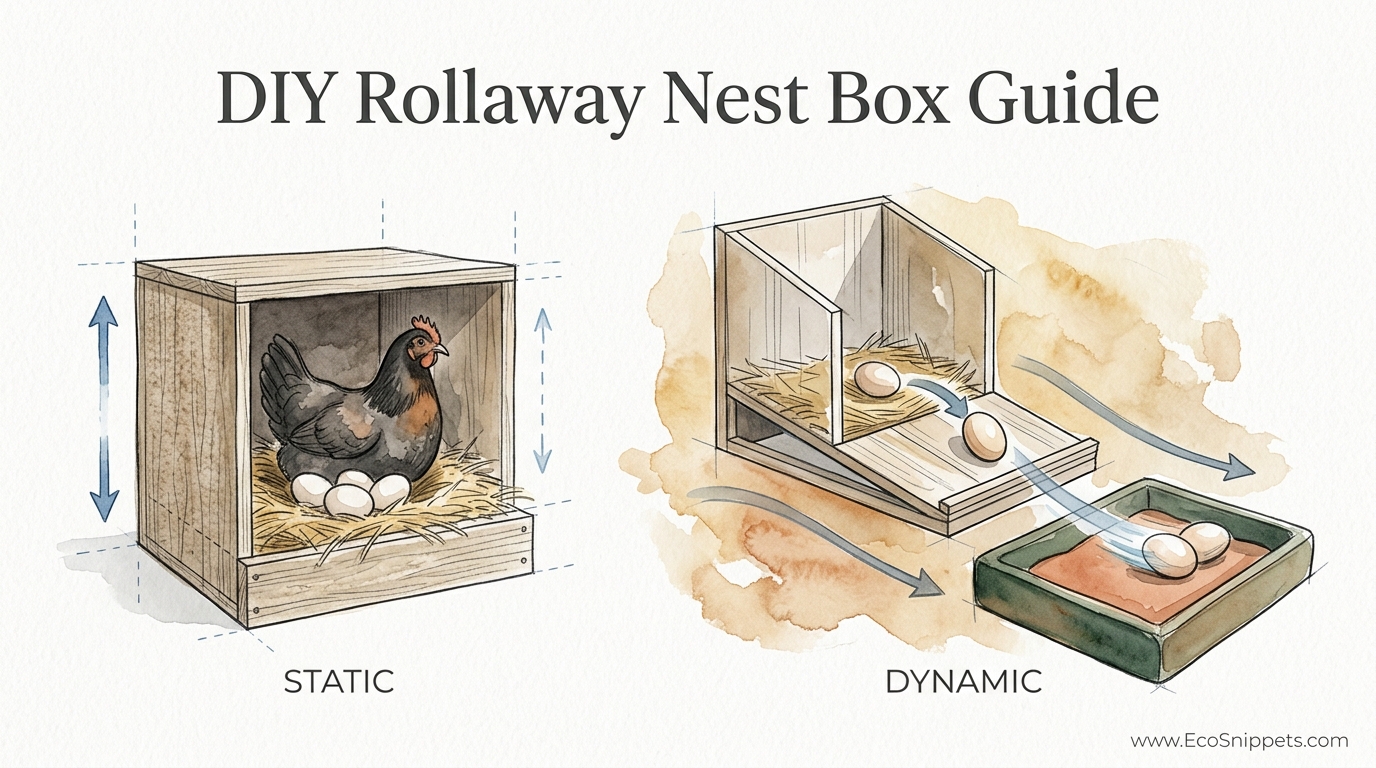
How much time are you wasting scrubbing manure off eggs that should have been clean from the start? Static nesting boxes are a recipe for bacteria and broken shells. A dynamic roll-away system uses gravity to ensure every egg is protected the second it’s laid.
For the modern homesteader, every minute saved is a minute earned for more honest work. Scrubbing filth off a fragile shell is not just a chore; it is a failure of design. Our ancestors knew that working with nature, rather than against it, was the only way to thrive. A DIY rollaway nest box applies the simple law of gravity to solve three of the most frustrating problems in the coop: dirty eggs, broken shells, and the dreaded habit of egg-eating.
This guide will walk you through the grit and the gear needed to build a system that respects the hen’s instinct for privacy while securing your harvest before a single muddy foot can touch it. Whether you are managing a small backyard flock or a sprawling pasture, understanding the physics of the rollaway is a step toward true self-reliance.
DIY Rollaway Nest Box Guide
A DIY rollaway nest box is a specialized nesting compartment designed with a sloped floor. Unlike a traditional “static” box where the egg sits in bedding until you come to collect it, the rollaway system uses a gentle incline to guide the egg into a protected tray or “collection chamber” [1.1, 1.3]. This separate area is typically out of the hen’s reach, shielded by a baffle or a small lid.
In the real world, this system is a favorite among those who cannot check their coop multiple times a day. If you work a full shift or have chores across the back forty, eggs left in a static box are prone to being stepped on, pooped on, or discovered by a curious hen who realizes that a fresh egg is a tasty snack [1.7, 1.8]. By moving the egg to a “dynamic” storage area, you effectively remove the temptation and the mess.
The concept is similar to a gravity-fed grain bin or a sloping cellar floor; it uses the earth’s pull to do the heavy lifting. While the design is often found in commercial poultry operations, a DIY version allows you to use sturdy, local materials like cedar or repurposed plywood to build a unit that fits your specific coop layout [1.10, 1.11].
How It Works: The Physics of the Rollaway
The soul of the rollaway nest box is the slope. Without the correct angle, the system fails. If the floor is too flat, the egg sits under the hen; if it is too steep, the egg gains too much velocity and cracks against the back wall [1.3, 1.4].
The standard measurement for success is a 1-inch drop for every 12 inches of run, which creates an angle of approximately 5 to 7 degrees [1.3, 1.4]. Some builders prefer a slightly steeper 10-degree pitch for heavier eggs or if they are using a high-friction flooring material like AstroTurf [1.4].
Beyond the slope, the system relies on the “egg gap.” This is a horizontal opening at the back or front of the box, usually about 2.5 inches (60mm) high [1.3]. This gap is large enough for the largest egg to pass through but small enough to prevent a hen from sticking her head through to peck at the collection tray [1.3, 1.10].
A collection tray then catches the egg. This tray is often lined with a soft material—foam, rubber, or a thick layer of clean straw—to act as a landing pad. The final piece of the puzzle is a lid or a flap over this tray. This protects the eggs from predators and keeps them clean until you make your rounds.
Benefits of a Dynamic System
Choosing a dynamic rollaway system over a static one offers several measurable advantages for the serious practitioner.
- Unmatched Cleanliness: Eggs are removed from the laying area immediately, preventing contact with manure, mud, or the “bloom-destroying” moisture of a broody hen [1.1, 1.8].
- Prevention of Egg-Eating: Once a hen tastes a broken egg, the habit is nearly impossible to break. A rollaway box removes the egg from the hen’s sight and reach, stopping this behavior before it starts [1.7, 1.8].
- Reduced Breakage: In a communal or static box, multiple hens often try to squeeze into one spot, resulting in “scrambled” nests. Rollaway boxes guide eggs to a safe zone where they cannot be trampled [1.1, 1.7].
- Labor Efficiency: Collection becomes a centralized task. Instead of reaching under grumpy hens or hunting through bedding, you simply lift a lid and gather your clean harvest [1.1, 1.8].
Challenges and Common Mistakes
Building a DIY rollaway nest box is an exercise in precision. Small errors in construction can lead to big problems in the coop.
One of the most frequent errors is an inconsistent slope. If the floor of the box warps over time—often due to using thin, poor-quality plywood—the eggs will pool in the center rather than rolling away [1.10, 1.19]. Use rot-resistant woods like cedar or 3/4-inch exterior-grade plywood to maintain a rigid, flat surface [1.3, 1.19].
Another common pitfall is the “hard landing.” If the collection tray is not sufficiently cushioned, the egg will survive the roll only to crack upon hitting the end of the tray [1.3, 1.4]. A simple piece of pipe insulation or a strip of heavy-duty rubber at the “catch point” can solve this.
Finally, builders often overlook the “distraction factor.” If the egg gap is too high, hens will spend their time trying to reach the eggs in the tray rather than leaving the box [1.3, 1.10]. Keep that gap tight—just enough for an egg, not a hen’s head.
Limitations: When the System Falls Short
While the rollaway is a masterpiece of efficiency, it is not a universal solution for every homesteader.
Environmental conditions play a role. In extremely hilly terrain, keeping the coop perfectly level is a challenge. If the coop tilts even a few degrees against the slope of your boxes, the rollaway mechanism will stall [1.10]. You must ensure your coop is situated on a level pad or use adjustable jacks to keep the boxes properly oriented.
Certain breeds may also struggle. Extremely large, heavy breeds like Jersey Giants or Brahmas require larger box dimensions (at least 14″x14″) and a more reinforced floor to prevent the slope from sagging under their weight [1.5, 1.19]. Additionally, if you intend to let your hens hatch their own chicks, a rollaway box is useless. The system is designed to remove the egg from the hen; a broody hen needs the egg to stay put for 21 days [1.17].
Static vs. Dynamic Comparison
| Feature | Static Nest Box | Dynamic Rollaway Box |
|---|---|---|
| Cleanliness | Requires daily cleaning/bedding | Naturally stays clean; eggs roll away [1.1] |
| Egg Security | Vulnerable to pecking/trampling | Protected in a separate tray [1.7] |
| Construction | Simple wood box | Complex; requires specific angles [1.3] |
| Maintenance | High (bedding replacement) | Low (occasional tray wiping) [1.1] |
| Broodiness | Supports natural hatching | Not suitable for hatching [1.17] |
Practical Tips and Best Practices
Training your hens to use a new rollaway system requires a bit of “pioneer patience.” Chickens are creatures of habit and may be suspicious of a floor that doesn’t hold traditional straw or wood shavings.
Use the Right Bedding: Avoid hay or thick shavings in a rollaway box; these materials will jam the rolling mechanism [1.3, 1.6]. Instead, use specialized nesting pads or “AstroTurf” liners. These provide a soft surface for the hen’s feet but allow the egg to roll through the plastic bristles [1.3, 1.10, 1.17].
The Fake Egg Trick: Place a ceramic egg or a golf ball in the box for the first few days [1.9, 1.12, 1.14]. This signals to the pullets that this is a safe place for laying. In a rollaway, you may need to temporarily tape the fake egg in place or use a small “lip” so it doesn’t roll away while the hens are learning [1.22].
Privacy Matters: Hens seek dark, secluded spots to lay. If your rollaway box is too bright, they will lay on the coop floor instead [1.14, 1.22]. Install a piece of heavy burlap or a “nest box curtain” over the front to darken the interior [1.14, 1.22]. This also helps prevent other hens from seeing the egg-laying process, which reduces stress and competition [1.22].
Keep it Level: Use a spirit level during installation. Even a slight side-to-side tilt can cause eggs to pile up in one corner of the tray, increasing the risk of breakage when they collide [1.10].
Advanced Considerations
For those looking to optimize their system further, consider a **reversible design**. This allows you to install the boxes so that you can collect eggs from *outside* the coop or even from outside the run [1.8, 1.10]. This minimizes your foot traffic inside the birds’ space, reducing the spread of pathogens and keeping your boots cleaner.
Another advanced technique involves **automated collection**. While usually reserved for large-scale operations, a well-designed DIY rollaway can be fitted with a simple conveyor or a “long-run” tray that centralizes collection from multiple coops into one point.
When scaling up, remember the rule of thumb: one nest box for every 4 to 5 hens [1.5, 1.15]. In a rollaway system, you can sometimes push this to 6 hens per box because the eggs aren’t cluttering the space, but providing ample room prevents the “bullying” that can occur when hens queue up for a favorite spot.
Example Scenario: The 3-Bin Build
Imagine you are building a 3-bin unit for a flock of 15 hens. You start with a sheet of 3/4-inch plywood. You cut three partitions, each 12 inches wide and 12 inches tall [1.4, 1.11].
The floor is the critical part. You cut a single piece of plywood 36 inches wide (the width of the three bins) and 18 inches deep. This 18-inch depth allows for 12 inches of nesting space and a 6-inch collection tray at the back [1.11]. When you assemble the frame, you mount the floor at a 7-degree angle, ensuring the back edge sits about 1.5 inches lower than the front [1.3, 1.4].
You install a 1×4 board across the back to act as the “rear wall,” but you leave a 2.5-inch gap at the bottom for the eggs to pass through [1.3]. Finally, you line the floor with a plastic nesting mat and attach a hinged lid over the 6-inch collection area outside the bins [1.3, 1.10]. This simple structure uses basic geometry to ensure your eggs are safe and your mornings are spent doing real work, not scrubbing manure.
Final Thoughts
Building a DIY rollaway nest box is more than just a weekend project; it is a commitment to a more efficient and hygienic way of living with your flock. By mastering the simple physics of the slope and the gap, you remove the friction between you and your harvest.
The transition from static to dynamic systems mirrors the broader journey of homesteading—finding ways to work smarter so that your energy can be directed where it matters most. Clean eggs are a sign of a well-managed coop and a respect for the bounty your birds provide.
Encourage yourself to experiment with materials and angles until the system works flawlessly for your specific birds. Once you experience the satisfaction of lifting a lid to find a row of pristine, mud-free eggs, you will never go back to the old way of scrubbing.
