How To Become More Self-Sufficient Without Starting a Full-Blown Farm…
Want to start preserving your harvest, making your own soap, or building a backyard root cellar — but not sure where to begin? “Homesteading Advice” gives you instant lifetime access to 35+ practical homesteading books on food preservation, veggie gardening, DIY natural cleaning products (save over $250 per year with this skill alone), brewing, off-grid energy, and a whole lot more…
Click Here To Check It Out Now!
Why are you paying for expensive protein when your kitchen scraps can grow it for free?
Every day, we throw away the ‘fuel’ our livestock needs. By switching from a consumer mindset (buying bagged grain) to a producer mindset (cultivating larvae), you turn waste into the highest-quality protein your flock has ever seen. It’s cheaper, healthier, and closes the loop on your homestead.
The modern homesteader often falls into the trap of convenience, relying on the local feed store for every ounce of nutrition their birds consume. This reliance creates a fragile system where your self-sufficiency is only as deep as your wallet. True resilience comes from mimicking the natural cycles that ancestors understood instinctively.
In the wild, a chicken is not a grain-eater by primary choice; it is a forest-dwelling scavenger. They thrive on the “living energy” found in the soil—insects, grubs, and larvae. By bringing this process back to your land, you aren’t just saving money; you are restoring a biological truth to your backyard.
This guide will walk you through the most efficient way to generate high-octane protein from thin air and table scraps. We are going to harness the power of the Black Soldier Fly, a humble insect that is arguably the most effective waste-to-protein converter on the planet.
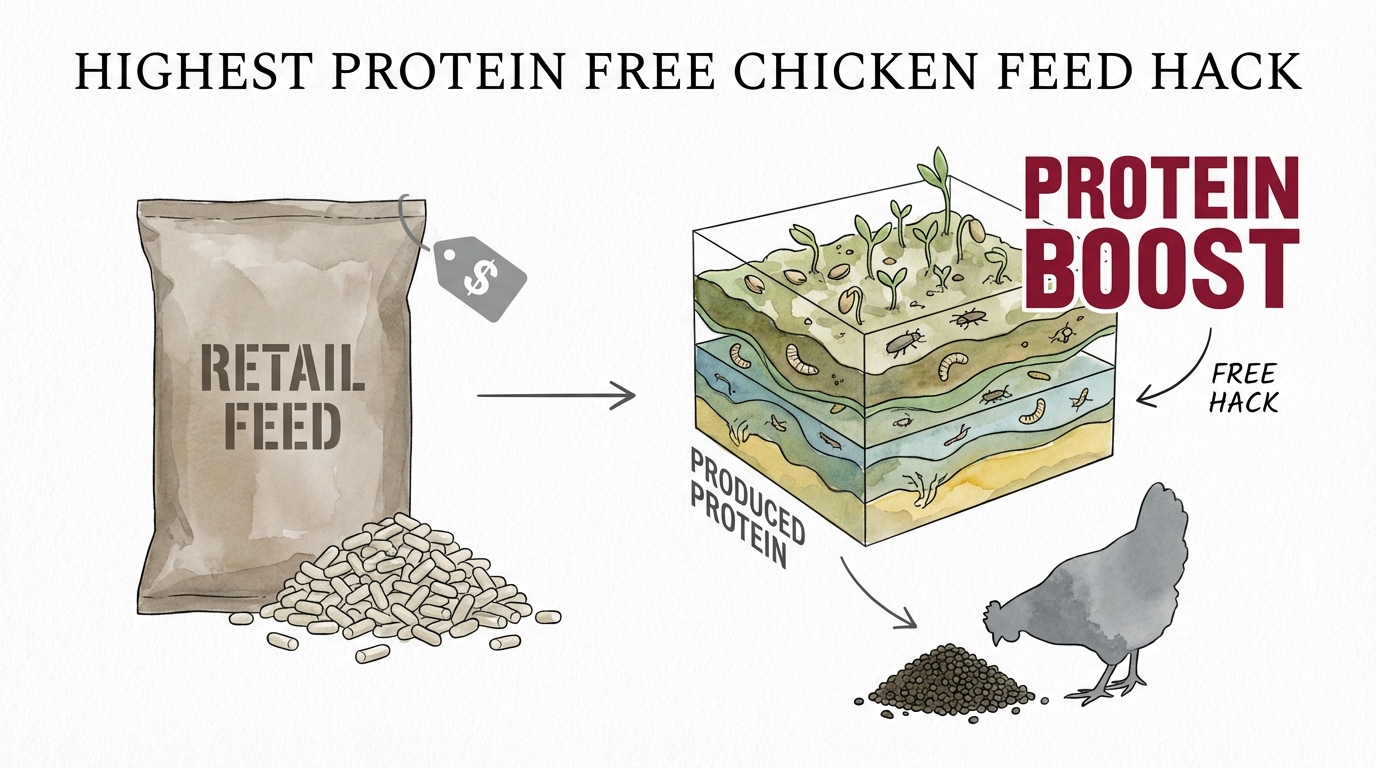
Highest Protein Free Chicken Feed Hack
When we talk about the “highest protein hack,” we are specifically referring to the cultivation of Black Soldier Fly Larvae (BSFL). These aren’t your typical houseflies that buzz around your head and land on your food. They are specialized workers that don’t even have mouths as adults, meaning they don’t carry diseases or bother humans.
The “hack” lies in their incredible biology. A single female Black Soldier Fly can lay hundreds of eggs. Once these eggs hatch, the larvae enter a feeding frenzy that can reduce a pile of food waste by 50-60% in a matter of days. As they eat, they concentrate nutrients into their bodies, becoming small, wiggly nuggets of pure energy.
Imagine your kitchen scraps—the melon rinds, the wilted lettuce, and the stale bread—being transformed into a 40% protein and 30% fat supplement. This isn’t just feed; it’s a superfood. For a laying hen, this translates to darker yolks, stronger shells, and a level of vitality that store-bought pellets simply cannot replicate.
This process is the definition of “closing the loop.” Instead of paying a garbage company to haul away organic matter, or letting it rot in a stagnant pile, you are using that energy to fuel your egg production. It is the ultimate expression of pioneer grit: nothing is wasted, and everything has a purpose.
How It Works: The Biological Engine
Understanding the life cycle of the Black Soldier Fly is essential for any serious producer. The adult fly looks more like a slender black wasp than a common fly. They only live for a few days, during which they mate, lay eggs near a food source, and then die. They do not eat, they do not bite, and they are not pests.
The magic happens in the larval stage. When the eggs hatch, the tiny larvae burrow into your compost or food scrap pile. They are voracious eaters, capable of consuming almost any organic matter, including meat and dairy which are usually “off-limits” for traditional composting. This makes them the perfect disposal unit for a busy kitchen.
Setting Up Your Cultivation Station
To begin, you need a dedicated bin. While you can buy commercial BSFL “factories,” a simple DIY setup is often more rewarding and fits the self-reliant spirit. You need a container with adequate drainage, ventilation, and most importantly, a “self-harvesting” ramp.
The genius of BSFL is that when they reach their final stage of development, they seek a high, dry place to pupate. If you provide a 30-to-40-degree ramp leading out of the feeding area, the larvae will literally walk themselves out of the bin and drop into a collection bucket. You don’t have to sift through the waste; the protein delivers itself to you.
Place your bin in a shaded, warm area. These flies love heat, typically thriving in temperatures between 80 and 95 degrees Fahrenheit. In the heat of summer, your bin will be a boiling pot of activity, processing pounds of waste every single day. The “pioneer” way is to observe the weather and adjust your bin’s location to capture the most thermal energy.
Benefits of Home-Grown Larvae
The advantages of producing your own protein extend far beyond the financial savings. While the reduction in your monthly feed bill is significant, the physiological benefits to your livestock are the real prize. We are talking about ancestral nutrition that builds a robust immune system.
- Unmatched Protein Content: BSFL contain roughly 40-50% protein, which is essential for feather regrowth during molting and consistent egg production.
- Essential Fatty Acids: The high fat content provides the caloric density needed for birds to stay warm in the winter and maintain glossy, healthy plumage.
- Calcium Bioavailability: Unlike other insects, BSFL are naturally high in calcium. This leads to thicker eggshells and prevents metabolic bone diseases in growing chicks.
- Waste Management: You effectively eliminate the smell and volume of kitchen waste. The “frass” (larvae droppings) left behind is a world-class fertilizer for your garden.
By producing this at home, you also gain total control over the “input” of your food chain. You know exactly what those larvae ate, which means you know exactly what is going into your chickens and, eventually, into your family. This transparency is something no commercial feed mill can offer.
Challenges and Common Mistakes
While the system is largely self-sustaining, it is not “set it and forget it.” The most common mistake is overfeeding. If you add more food than the larvae can process, the waste will turn anaerobic (oxygen-deprived) and begin to smell like a traditional garbage can. A healthy BSFL bin should smell slightly earthy or like fermented silage.
Another challenge is moisture control. If the bin becomes too wet, the larvae may struggle to breathe, and other pests like houseflies or gnats may move in. You want the consistency of a wrung-out sponge. Adding “brown” material like shredded cardboard or dry leaves can help balance a bin that has become too soggy from fruit scraps.
Temperature is the final hurdle. If the bin gets too cold (below 60 degrees), the larvae will slow down and eventually go dormant. In many climates, this means BSFL production is a seasonal endeavor. A true pioneer plans for this, drying or freezing a surplus of larvae during the summer months to provide a protein boost during the lean winter season.
Contextualizing Your Protein Sources
To understand why this “hack” is so transformative, we have to look at the reality of the retail feed industry. Most commercial feeds rely heavily on soy and corn. While these provide calories, they are often devoid of the complex micronutrients found in a diverse, insect-based diet.
| Feature | Retail Bagged Feed | Produced BSFL Protein |
|---|---|---|
| Cost per Pound | Rising (Market Dependent) | $0 (Waste Transformation) |
| Protein Quality | Plant-based (often Soy) | Animal-based (Bioavailable) |
| Environmental Impact | High (Shipping/Processing) | Negative (Waste Reduction) |
| Nutrient Density | Standardized/Minimums | High (Fat & Calcium Rich) |
The table above makes it clear: one is a commodity you consume, the other is a resource you cultivate. The “produced protein” model fits the ancestral wisdom of making the most of what you have on hand, rather than importing solutions from a thousand miles away.
Practical Tips and Best Practices
If you are ready to start your colony, keep these practical tips in mind to ensure success from day one. These are the “boots on the ground” insights that separate the successful producers from those who give up after a week.
- Prime the Pump: If you don’t see wild Black Soldier Flies in your area immediately, you can buy a small “starter” batch of larvae online to jumpstart your bin. Once they mature and pupate, they will attract others.
- Focus on Surface Area: BSFL feed from the bottom up but need air. Spread your food scraps out rather than dumping them in a deep pile.
- The “Cardboard Trick”: Tape a few pieces of corrugated cardboard to the inside of your bin, just above the food line. The flies love to lay their eggs in the “flutes” of the cardboard, keeping them safe from the moist food below.
- Avoid Too Much Citrus: While they can eat almost anything, excessive citrus peels can make the bin too acidic for the larvae to thrive. Balance it out with bread, grains, or vegetable scraps.
- Harvesting for Chicks: If you have young chicks, harvest the larvae while they are small. They are soft and easy to digest, providing the massive protein boost needed for rapid growth.
Always remember that your bin is a living ecosystem. Treat it with the same respect you give your garden or your coop. When the balance is right, the system hums with a quiet, industrious energy that is deeply satisfying to witness.
Managing the “Frass”
Don’t overlook the byproduct of this process. The residue left at the bottom of the bin, known as frass, is a concentrated fertilizer. It is rich in chitin from the discarded exoskeletons of the larvae, which actually triggers an immune response in plants, making them more resistant to pests and disease.
Apply this frass to your heavy feeders, like tomatoes or peppers. It is the final step in the cycle: kitchen waste feeds the larvae, larvae feed the chickens, and the larvae waste feeds the garden that grows the kitchen food. This is the “producer mindset” in its most perfect form.
Final Thoughts
Returning to a state of self-reliance doesn’t mean you have to work harder; it means you have to work smarter. By leveraging the natural instincts of the Black Soldier Fly, you are tapping into a biological engine that has existed for millions of years. You are turning a “problem” (waste) into a “solution” (high-quality protein).
The pioneer spirit is about more than just surviving; it’s about thriving through resourcefulness. When you see your hens rushing toward you, vibrant and healthy, because they know you have a bucket of “homestead gold,” you’ll realize that the bagged feed at the store was never the better option—it was just the easier one.
Start small, build your bin, and watch the transformation. You’ll save money, reduce your footprint, and most importantly, you’ll take one massive step toward true independence. The fuel for your flock is already in your kitchen; it’s time to stop throwing it away and start growing your own future.
