How To Become More Self-Sufficient Without Starting a Full-Blown Farm…
Want to start preserving your harvest, making your own soap, or building a backyard root cellar — but not sure where to begin? “Homesteading Advice” gives you instant lifetime access to 35+ practical homesteading books on food preservation, veggie gardening, DIY natural cleaning products (save over $250 per year with this skill alone), brewing, off-grid energy, and a whole lot more…
Click Here To Check It Out Now!
The Ancestral Art of Tallow Soap: Reclaiming Luxury from the Homestead
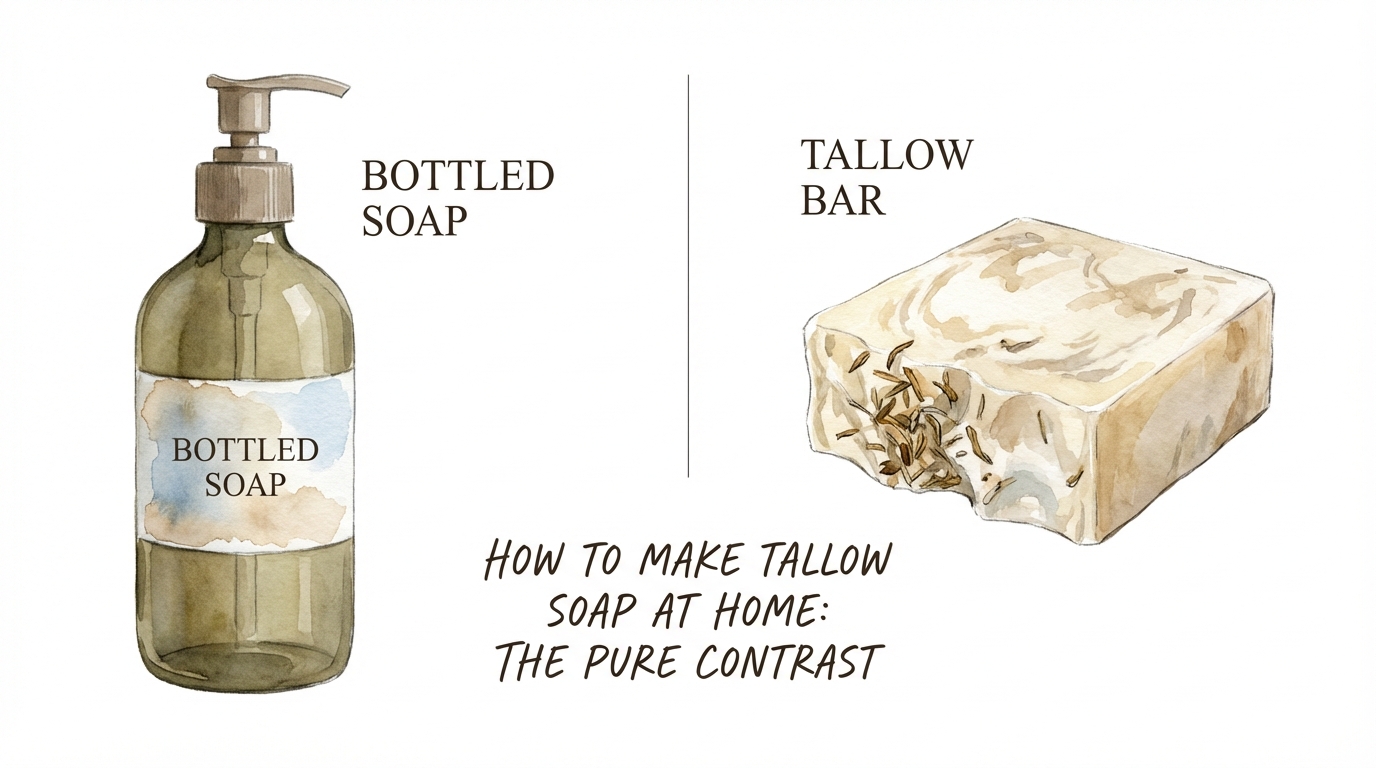
Your skin is absorbing everything in panel A, but panel B is what it actually needs. I used to spend $15 a bottle on ‘natural’ soaps that were mostly water and synthetic fragrance. Then I discovered the power of rendering local beef suet. Now, I have a lifetime supply of the most moisturizing soap I have ever used for pennies on the dollar. It is time to stop being a consumer of waste and start producing your own luxury.
The modern world has disconnected us from the sources of our sustenance and our self-care. We have been taught to fear animal fats while being sold petroleum-based detergents as “clean” alternatives. But our ancestors knew better. They understood that the waste of the harvest was the key to the health of the household. By rendering suet into tallow and transforming that tallow into soap, you are participating in a cycle of stewardship that is as old as civilization itself.
This isn’t just about cleaning your skin. It is about pioneer grit and self-reliance. It is about knowing exactly what goes onto your body and into your bloodstream. When you hold a bar of hand-rendered tallow soap, you aren’t just holding a cleanser; you are holding a piece of history, crafted with your own hands for the health of your family.
How To Make Tallow Soap At Home
Tallow soap is the ultimate expression of “nose-to-tail” living. It is created by combining rendered beef fat—specifically the hard, waxy fat around the kidneys known as suet—with water and sodium hydroxide (lye). Through a chemical process called saponification, these ingredients are transformed into a hard, long-lasting bar that cleanses without stripping the skin of its natural oils.
To the uninitiated, the idea of washing with beef fat might sound strange. However, the molecular structure of tallow is remarkably similar to the human skin’s sebum. This biocompatibility allows the soap to nourish the skin on a cellular level. Unlike vegetable oils that can feel “oily” or synthetic detergents that feel “squeaky,” tallow soap leaves a silky, protective finish that feels like a second skin.
Making this soap at home requires a shift in mindset. You are no longer just a shopper; you are a chemist and a craftsman. You will need to source high-quality suet, preferably from grass-fed cattle, as the nutrient profile—specifically the levels of Vitamin A, D, E, and K—is significantly higher in animals raised on pasture. This is the difference between a functional bar and a therapeutic one.
How It Works: The Process of Transformation
Creating tallow soap is a two-part journey: first, you must render the raw fat into pure tallow, and then you must guide that tallow through the saponification process. Each step requires patience and respect for the materials.
Step 1: Rendering the Suet
Rendering is the process of melting down raw fat to separate the pure lipids from the connective tissue and water. You begin by grinding or finely chopping the cold suet. The smaller the pieces, the more efficient the render. Place the fat in a heavy-bottomed pot or a slow cooker on the lowest possible heat. Slow and steady is the rule; you want to melt the fat without scorching it.
As the fat melts, you will see “cracklings” (bits of tissue) floating in a pool of golden liquid. Strain this liquid through several layers of cheesecloth or a fine mesh sieve. To achieve a truly odorless, “boutique-quality” soap, you must perform a “wet render” with salt. This involves boiling the rendered fat with water and salt, allowing it to cool until the fat hardens into a cake on top, and then scraping away the impurities from the bottom. Repeat this until the tallow is snow-white and scent-free.
Step 2: The Chemistry of Saponification
Once you have pure tallow, the soapmaking begins. This is a cold-process method, which is the gold standard for preserving the beneficial properties of the fat. You will need a digital scale, as soapmaking is a game of precision, not guesswork.
- The Lye Solution: Carefully weigh your distilled water and lye. Always add the lye to the water (never the water to the lye) in a well-ventilated area. The reaction will create heat and fumes; respect the process and wear your safety gear.
- Melting the Fats: Gently melt your tallow until it is liquid but not hot. Aim for both your lye solution and your tallow to be between 100°F and 110°F.
- The Emulsion: Pour the lye solution into the tallow. Use a stick blender to pulse and stir until the mixture reaches “trace.” Trace is the point where the mixture thickens to the consistency of pudding, and a spoonful drizzled across the surface leaves a visible trail.
- Molding and Curing: Pour the soap into a mold, cover it to keep the heat in, and let it sit for 24 to 48 hours. Once hardened, cut it into bars. Now comes the hardest part: the cure. The bars must sit in a cool, dry place for 4 to 6 weeks. This allows the water to evaporate, making the bar harder, gentler, and longer-lasting.
Benefits of Tallow Soap
The advantages of returning to tallow-based skincare are both practical and biological. In a world of complex ingredient lists, tallow offers a return to simplicity that yields superior results.
- Deep Biocompatibility: Tallow contains palmitoleic acid, which has antimicrobial properties, and stearic acid, which helps repair skin damage and improve flexibility. Because it mimics human sebum, it absorbs deeply rather than sitting on the surface.
- Economic Sovereignty: If you talk to a local butcher, suet is often considered a waste product. You can frequently acquire it for next to nothing. By turning this “waste” into a luxury item, you are opting out of the inflationary cycle of the beauty industry.
- Unrivaled Longevity: Tallow creates a naturally hard bar of soap. While vegetable-based soaps (like pure olive oil castile) can become “slimy” or dissolve quickly in the shower, a well-cured tallow bar remains firm and lasts for weeks of daily use.
- Vitamin Rich: Grass-fed tallow is a powerhouse of fat-soluble vitamins. These nutrients are stable in the soap and provide antioxidant benefits that synthetic cleansers cannot replicate.
Challenges and Common Mistakes
Even the most seasoned homesteaders can run into trouble if they rush the process. Soapmaking is an exercise in discipline. The most common pitfall is improper rendering. If your tallow still smells like “beef” or “taco night,” your soap will too. Do not skip the salt-water purification steps. Your goal is a neutral, clean base.
Another frequent error is inaccurate measurements. Using a measuring cup instead of a gram-scale is a recipe for failure. Too much lye will result in a “harsh” bar that can irritate or burn the skin. Too much fat (an excessive “superfat”) can lead to a bar that goes rancid or doesn’t cleanse effectively. Follow a trusted lye calculator for every single batch.
Finally, respect the cure time. It is tempting to use a bar after only a week, but the pH level stabilizes over time, and the crystalline structure of the soap matures. A rushed bar is a soft bar. Give your craft the time it deserves to reach its peak quality.
BOTTLED SOAP vs TALLOW BAR
To understand why this shift is necessary, we must look at what we are actually buying at the grocery store. Most “liquid soaps” are not soap at all; they are synthetic detergents made from petroleum derivatives and foaming agents like SLS (Sodium Lauryl Sulfate).
| Feature | Commercial Bottled Soap | Handcrafted Tallow Bar |
|---|---|---|
| Primary Ingredient | Water & Synthetic Surfactants | Saponified Animal Fats |
| Skin Impact | Strips natural oils; can disrupt microbiome | Nourishes with fat-soluble vitamins |
| Waste Factor | Plastic bottles & high carbon footprint | Zero-waste; biodegradable |
| Cost per Wash | High (paying for water and marketing) | Low (pennies per ounce) |
| Chemical Fragrance | Phthalates and parabens common | None or pure essential oils |
The choice becomes clear when you look at the labels. Panel A represents the industrial-complex solution: cheap to make, expensive to buy, and taxing on the body. Panel B represents the ancestral solution: labor-intensive to produce, nearly free to source, and profoundly healing for the skin.
Practical Tips for the Modern Soapmaker
If you are ready to start your first batch, keep these “pioneer” best practices in mind to ensure success from the very beginning.
- Source Locally: Build a relationship with a local regenerative farmer. The quality of the tallow is directly proportional to the life the cow led. Grass-fed, pasture-raised suet is the only choice for those seeking true luxury.
- Keep a Soap Log: Write down your temperatures, the exact weights used, and the weather conditions. This “homesteaders’ journal” will help you troubleshoot if a batch doesn’t turn out right or replicate a perfect batch in the future.
- Equipment Dedication: Once a pot or spatula has been used for lye and soap, it should stay in the soapmaking kit. Stainless steel and heat-resistant plastic are your friends; avoid aluminum, as lye will react with it and create dangerous fumes.
- Master the “Superfat”: For a moisturizing bar, use a 5% superfat. This means you use 5% more tallow than is required to react with the lye. This ensures there is “free fat” left in the bar to condition your skin.
Final Thoughts
Transitioning from a consumer of industrial products to a producer of ancestral goods is a profound shift. It starts with a simple bar of soap, but the mindset it fosters—one of self-reliance, quality, and respect for nature—tends to bleed into every other area of life. You begin to question what else you can provide for yourself, and you realize that the “luxury” sold in stores is often a pale imitation of what you can create in your own kitchen.
By rendering your own tallow and crafting your own soap, you are doing more than just cleaning your body. You are honoring the animal that provided the fat, you are protecting your family from unnecessary chemicals, and you are keeping a vital skill alive for the next generation. It is a quiet rebellion against a disposable culture.
The journey from “Panel A” to “Panel B” is one of education and effort, but the reward is a lifetime of health and the satisfaction of knowing that you are no longer a slave to the bottle. Start small, respect the lye, and enjoy the most moisturizing, nourishing lather you have ever experienced. Your skin, and your wallet, will thank you.
