How To Become More Self-Sufficient Without Starting a Full-Blown Farm…
Want to start preserving your harvest, making your own soap, or building a backyard root cellar — but not sure where to begin? “Homesteading Advice” gives you instant lifetime access to 35+ practical homesteading books on food preservation, veggie gardening, DIY natural cleaning products (save over $250 per year with this skill alone), brewing, off-grid energy, and a whole lot more…
Click Here To Check It Out Now!
Did you know you can pump thousands of gallons of water uphill every single day using absolutely zero electricity or fuel? Stop paying for electricity to move your water. The Hydraulic Ram Pump is a marvel of physics that uses the “water hammer” effect to turn the energy of a flowing stream into high-pressure lift. It works 24/7, has only two moving parts, and can provide all the water your livestock and garden need for the cost of a few plumbing fittings. It is the ultimate passive energy hack for the resilient homestead.
For the modern pioneer, self-reliance isn’t just a buzzword; it’s a way of life. We often look toward high-tech solar arrays and expensive lithium batteries to solve our problems, but sometimes the best solutions were perfected centuries ago. The hydraulic ram pump is exactly that—a rugged piece of ancestral wisdom that ignores the grid and works as long as the water flows.
If you have a spring, a creek, or a pond with even a few feet of “fall,” you have a power plant waiting to be tapped. In this guide, we will break down exactly how this “perpetual” machine works, how to size it for your land, and how you can build one yourself to secure your water independence forever.
How To Pump Water Uphill Without Electricity
At its core, a hydraulic ram pump is a device that uses the momentum of a large volume of water falling a short distance to push a small portion of that water up a much higher distance. It sounds like magic, or perhaps a violation of the laws of physics, but it is actually a clever redistribution of energy.
While a modern electric pump relies on a motor to create pressure, the ram pump relies on inertia. It takes the kinetic energy of a flowing column of water and “hammers” it into a spike of high pressure. This pressure spike is so intense that it can force water hundreds of feet into the air, far above its original source.
This technology is particularly vital for off-grid living because it eliminates the “stagnant water” problem. Instead of relying on a tank that only fills when the sun is out, a ram pump provides a constant, rhythmic pulse of water every second of every day. It is the heartbeat of a truly resilient homestead.
The Physics of the Water Hammer
To understand the ram pump, you have to understand the “water hammer” effect. You’ve likely heard it in your own home—that loud *thump* in the walls when you turn off a faucet too quickly. That sound is a shockwave.
When water is moving through a pipe, it has momentum. When that flow is suddenly stopped, all that energy has to go somewhere. In home plumbing, it vibrates the pipes. In a hydraulic ram pump, we capture that energy and use it to do work.
The Cycle of the Ram
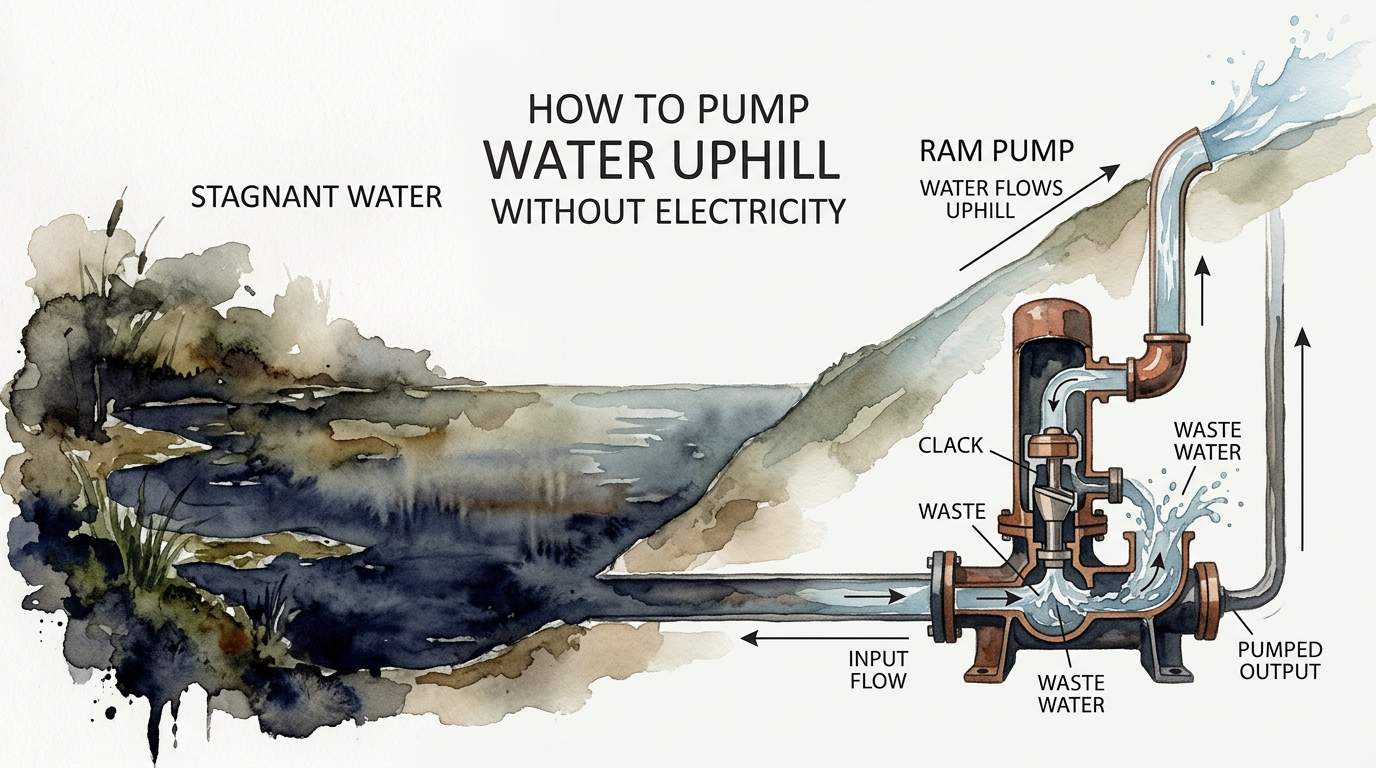
The operation of a ram pump happens in a continuous, four-stage cycle that repeats 40 to 90 times per minute.
- Acceleration: Water from your source flows down the “drive pipe” and escapes through an open “waste valve” (also called the impetus valve). As the water gains speed, it creates drag on the valve.
- The Hammer: Once the water reaches a critical velocity, the waste valve slams shut. The moving column of water in the drive pipe is suddenly halted, creating a massive pressure spike inside the pump body.
- Injection: This pressure spike forces open a second valve—the “check valve”—allowing a small burst of water to enter a pressure chamber and the delivery pipe.
- Recoil and Reset: As the energy dissipates, a small rebound or “recoil” happens in the water column. This drop in pressure allows the waste valve to drop back open, and the cycle begins again.
Anatomy of a Hydraulic Ram Pump
One of the reasons these pumps are so beloved by homesteaders is their simplicity. A typical unit consists of only five primary components.
1. The Drive Pipe
This is the most critical part of the system. It is the “engine” of the pump. It must be made of a rigid material like galvanized steel or thick-walled Schedule 80 PVC to prevent the “water hammer” energy from being absorbed by the pipe walls.
2. The Waste (Impetus) Valve
This is the valve that sits on the end of the pump and “clacks” during operation. It is weighted or spring-loaded to stay open until the water flow reaches enough speed to snap it shut.
3. The Check (Delivery) Valve
Located inside the pump, this one-way valve allows water to move into the pressure chamber but prevents it from flowing back toward the source when the pressure drops.
4. The Pressure Chamber
Usually a vertical pipe or a small tank filled with air. As the water is forced in, it compresses the air. This compressed air acts like a spring, smoothing out the pulses and providing a steady “push” to move water up the delivery pipe between strokes.
5. The Delivery Pipe
This is the smaller-diameter pipe that carries the pressurized water up the hill to your storage tank or garden.
Calculating Your Site Potential: The Rule of 1:10
Before you start buying fittings, you need to know if your site can support a ram pump. There are two numbers that matter: **Fall** and **Lift**.
Fall (Head): This is the vertical distance the water drops from the source to the pump.
Lift (Static Head): This is the vertical distance from the pump up to your delivery point.
A general rule of thumb for a well-tuned ram pump is a 1:10 ratio. For every 1 foot of vertical fall you have, you can lift water 10 feet into the air. If your creek drops 5 feet over a short distance, you can reliably pump water to a tank 50 feet up the hill.
The Delivery Formula
You won’t get all the water that flows into the pump; in fact, you’ll only keep about 10% to 20% of it. The rest is “wasted” out of the impetus valve. The formula for estimating your daily delivery is:
D = (S x F x E) / L
- D: Amount delivered (gallons per minute).
- S: Source flow available (gallons per minute).
- F: Vertical fall (feet).
- L: Vertical lift (feet).
- E: Efficiency (typically 0.6 for commercial, 0.3 for DIY).
Step-by-Step Installation Guide
Setting up a ram pump requires more sweat than science. Follow these steps to ensure a reliable system.
Step 1: Locate Your Source
Find a spot in your stream or spring where you can create a small pool. You need a “clean” intake. Use a screened box to prevent leaves and small fish from entering your drive pipe, as debris is the primary cause of pump failure.
Step 2: Install the Drive Pipe
The drive pipe should be as straight as possible. It generally needs to be 6 to 12 times the length of the vertical fall. For example, if you have a 5-foot drop, your drive pipe should be between 30 and 60 feet long. Secure it firmly so it doesn’t vibrate; if the pipe moves, you lose the “hammer” energy.
Step 3: Anchor the Pump
The pump itself should be mounted on a heavy base, like a concrete pad or a large timber. The vibration of the “clack” can move a light pump over time, leading to air leaks or pipe stress.
Step 4: Connect the Delivery Line
Run your delivery pipe (usually 1/2″ or 3/4″ poly tubing) up the hill to your tank. Ensure there are no “high spots” in this line where air can get trapped, which could cause an air lock.
Step 5: Start the Pump
To start the pump, you must manually depress the waste valve a few times. This clears out the air and builds initial pressure. Once the pressure in the chamber is high enough, the pump will begin to cycle on its own.
Challenges and Common Mistakes
While the ram pump is nearly “perpetual,” it is not “set and forget.” There are a few pitfalls that can stop your water flow.
| Problem | Likely Cause | Solution |
|---|---|---|
| Waste valve stays closed | Too much fall or drive pipe too long | Adjust the stroke length or add weights to the valve |
| Waste valve stays open | Not enough water flow or debris in valve | Clean the intake screen or shorten the stroke |
| Pump is “clacking” but no water reaches the top | Air leak in drive pipe or air chamber is waterlogged | Check all fittings; drain the air chamber and restart |
| Rapid, frantic clicking | Pressure chamber has lost its air cushion | Drain the pump to let air back into the chamber |
The “Waterlogged” Chamber
Over time, the air in your pressure chamber will be absorbed into the water. Without that air cushion, the pump will stop working or may even break due to the lack of shock absorption. Old-timers solved this by installing a “snifter valve”—a tiny hole that lets in a single bubble of air with every stroke.
Benefits of the Hydraulic Ram Pump
Why choose a 200-year-old technology over a modern solar pump?
- Zero Fuel Costs: Once installed, your water is free. You are shielded from rising energy prices.
- Continuous Operation: Unlike solar, which stops at dusk, the ram pump works through the night and during cloudy weeks.
- Longevity: A cast-iron ram pump can last 50 years or more. Even a PVC DIY version can run for several seasons with minor valve replacements.
- Silence (Mostly): While it makes a rhythmic clicking sound, it is far quieter than a gas-powered pump and more peaceful than a humming electric motor.
DIY vs. Commercial Pumps
If you are just starting, a DIY PVC ram pump is a fantastic weekend project. You can build one for under $100 using standard check valves and fittings from a local hardware store. It is a great way to learn the physics of your land.
However, if you are relying on this pump for your primary livestock water or household supply, consider a commercial cast-iron or brass pump. Companies like Landis or Papa Pump produce units designed for high efficiency and decades of use. Commercial pumps are more rigid, meaning they capture more “hammer” and can lift water significantly higher than their PVC counterparts.
Practical Tips for the Off-Grid Pioneer
- Winterize: If you live in a climate where the ground freezes, bury your drive and delivery pipes. The pump itself can be housed in a small insulated “pump house” or a pit below the frost line.
- Tuning the Stroke: You can adjust how much water you pump by changing how far the waste valve travels. A short stroke results in faster cycles (better for high lift), while a long stroke is better for moving more volume at lower heights.
- Recycle the Waste: The “waste” water is perfectly clean. Don’t just let it erode the soil. Pipe it into a duck pond, a secondary garden, or back into the main stream.
- Rigid Drive Pipe: Never use flexible hose for your drive pipe. It will expand under the pressure spike, acting like a shock absorber and killing your pump’s efficiency.
Final Thoughts
The hydraulic ram pump is more than just a tool; it is a symbol of the resilience and ingenuity of our ancestors. It proves that we don’t always need complex electronics or fossil fuels to thrive. By simply understanding the rhythm of falling water and the physics of the “hammer,” we can secure one of our most basic needs—water—without a single monthly bill.
If you have a flowing source on your property, the ram pump is arguably the most important investment you can make. It provides peace of mind, knowing that even if the grid goes down and the fuel runs dry, your water will continue to flow uphill, pulse by pulse, as long as the creek runs.
Start small, build a prototype, and listen for that steady “clack-clack” of independence. Once you see that first stream of water reaching the top of your hill, powered by nothing but gravity and grit, you’ll never look at a power bill the same way again.
Sources
1 hackaday.com | 2 renewable-world.org | 3 practical.engineering | 4 clemson.edu | 5 susana.org | 6 greenandcarter.com | 7 howstuffworks.com | 8 wikipedia.org | 9 youtube.com | 10 windows.net | 11 theramcompany.com | 12 echocommunity.org | 13 instructables.com | 14 supremeintegratedtechnology.com | 15 youtube.com | 16 aquatext.com
