How To Become More Self-Sufficient Without Starting a Full-Blown Farm…
Want to start preserving your harvest, making your own soap, or building a backyard root cellar — but not sure where to begin? “Homesteading Advice” gives you instant lifetime access to 35+ practical homesteading books on food preservation, veggie gardening, DIY natural cleaning products (save over $250 per year with this skill alone), brewing, off-grid energy, and a whole lot more…
Click Here To Check It Out Now!
This ancient stone structure creates ‘rain’ out of thin air while the grid sleeps. We have become obsessed with moving water using electricity, but what if you could generate it from the atmosphere for free? The Air Well is a passive permaculture marvel that uses the temperature difference of stacked stones to condense night air into liquid gold. No panels, no motors, and no monthly bill—just the physics of the earth providing for your plants every morning.
Modern homesteading often feels like a race to buy the latest gadget, but true self-reliance usually points us back toward the soil and the stone. We spend thousands on deep-well pumps and solar arrays to pull water from the ground, yet we ignore the rivers of moisture floating right above our heads. An air well is the ultimate exercise in pioneer grit—it is a structure built to outlast its creator, quietly working with the laws of thermodynamics to turn a dry garden into a self-watering oasis.
Passive Dew Harvesting For Gardens
Passive dew harvesting is the art of capturing atmospheric moisture without the use of mechanical energy. This technique relies on the natural cycle of heating and cooling to reach the “dew point,” the specific temperature at which air can no longer hold its water vapor. When warm, humid air touches a surface that is significantly cooler, it sheds its moisture in the form of liquid droplets.
History provides us with fascinating examples of this concept in action. In 1900, a Russian engineer named Friedrich Zibold discovered thirteen massive piles of stones near the ancient city of Feodosia in Crimea. These stone mounds, some reaching 10 meters in height, were surrounded by fragments of terracotta pipes leading to the city’s fountains. Zibold theorized that these were ancient air wells that supplied the city with fresh water.
Inspired by these findings, Zibold constructed a massive stone-pile condenser on Mount Tepe-Oba. He used large sea stones, roughly 10 to 40 centimeters in diameter, piled into a truncated cone. His experiment was a success, producing up to 360 liters of water per day through simple condensation. Although later archeological studies suggested the original mounds might have been burial sites, Zibold’s experiment proved that the principle of the “stone air well” was physically sound and practically useful for arid climates.
Today, permaculture practitioners use these principles to create drought-resilient gardens. In regions where rainfall is scarce but humidity is present, a well-designed air well can provide the consistent, supplemental hydration that keeps fruit trees and sensitive perennials alive during the hottest months. It is a slow-yield system, but its reliability is its greatest strength.
How the Air Well Breathes: The Physics of Condensation
Understanding the physics of an air well is essential for any serious practitioner. The system works because of three main factors: thermal mass, radiative cooling, and surface area. Every evening, as the sun sets, the earth begins to lose heat. Stones with high density—such as basalt or granite—radiate their stored heat into the clear night sky, cooling down much faster than the surrounding air.
When the morning sun rises, it brings warm, moisture-laden air. As this air is drawn into the gaps between the cool stones, it undergoes a rapid temperature drop. Because cool air cannot hold as much water vapor as warm air, the excess moisture condenses onto the surface of the stones. Gravity then pulls these droplets downward, where they can be collected in a basin or allowed to seep directly into the root zone of a nearby plant.
Thermal conductivity plays a major role in this process. Stones that transfer heat efficiently will cool down more thoroughly overnight. However, if the stones are packed too tightly, they will retain their internal heat for too long, preventing condensation. The “magic” of Zibold’s design was the use of large, irregularly shaped stones that allowed for maximum airflow and minimal thermal contact between individual rocks. This created thousands of small, cool surfaces for the air to touch.
Surface tension is the final piece of the puzzle. For an air well to be effective, the condensed water must be able to “run off” the stone and into the collection area. If the stones are too porous, like some types of soft sandstone, they may simply soak up the water rather than letting it drip. This is why selecting the right material is a non-negotiable step for the self-reliant builder.
Engineering the Perfect Stone Air Well
Building a functional air well requires more than just piling rocks in a corner of the yard. You must design the structure to facilitate airflow and maintain a temperature differential. The most common DIY design for a garden air well is a truncated cone or a “stone mound” with a hollow center or a collection pipe.
Start by digging a shallow pit about three feet in diameter. Line this pit with a heavy-duty, food-grade pond liner or a large concrete basin. This is your reservoir. Place a perforated pipe in the center of the basin, extending upward. This pipe will act as a “chimney,” helping to draw air through the stone pile as temperatures shift throughout the day.
Around this central pipe, begin stacking your stones. Use your largest, densest rocks at the base. As you build upward, keep the structure loose. You want “void space”—large gaps where air can circulate freely. If you pack the stones too tightly, the air will stall, and the interior of the pile will remain warm. Aim for a structure that looks like a rugged pyramid or a beehive.
The height of the structure is a balancing act. A taller pile creates more surface area for condensation, but if it becomes too massive, it will hold onto daytime heat and fail to reach the dew point at night. Most successful garden-scale air wells are between three and five feet tall. This size provides enough surface area for meaningful water collection while allowing the stones to cool down completely during the night.
Material Matters: Selecting Your Stones
The choice of stone can make or break your air well’s performance. You are looking for materials with high thermal mass and low porosity. Dense, volcanic rocks like basalt are often considered the gold standard. They are heavy, they cool down significantly at night, and their surfaces are typically smooth enough to allow water to run off easily.
Granite is another excellent choice. It is incredibly dense and has a high heat capacity, meaning it takes a lot of energy to change its temperature. Once a granite pile is cooled by the night air, it stays cool well into the morning, providing a long window for condensation to occur. Limestone can also work, but it is often more porous than granite; over time, it may absorb some of the water it collects, reducing the net yield.
Avoid using soft, crumbly stones like shale or highly porous volcanic rocks like pumice or scoria. While these rocks have a lot of surface area, their internal air pockets act as insulation. Insulated rocks will not cool down enough to trigger condensation. Furthermore, porous stones can trap dirt and organic matter, which may lead to bacterial growth in your water supply.
Cleanliness is also a factor. Before stacking your stones, scrub them to remove any moss, soil, or debris. You want the air to come into contact with the raw mineral surface. Any organic matter on the stones will act as a sponge, soaking up the tiny droplets of dew before they can reach your collection basin.
Benefits of the Passive Approach
The primary advantage of an air well is its complete independence from the power grid. In a world where water rights are becoming increasingly complex and electricity costs are rising, having a system that runs on nothing but physics is a major asset for the homestead. Once built, an air well requires almost zero maintenance beyond an occasional rinse to remove dust.
Beyond the water yield, an air well provides a powerful microclimate benefit. The large mass of stones acts as a “thermal battery” for your garden. During the day, the stones absorb heat, which can help protect nearby plants from extreme temperature spikes. At night, they slowly release that heat, which can stave off light frosts in the early spring or late fall.
Air wells are also a sustainable way to hydrate the soil in areas where digging a traditional well is impossible. If you live on a rocky hillside or in a region with a very deep water table, an air well allows you to pull moisture from the sky instead of the ground. This preserves local aquifers and ensures that you aren’t “mining” a finite resource to keep your garden green.
Finally, the water produced by an air well is remarkably pure. It is essentially distilled water, free from the heavy minerals or chlorine often found in well water or municipal supplies. This makes it ideal for sensitive plants like blueberries or certain species of ferns that struggle with high-calcium water.
Challenges and Common Mistakes
The most common mistake people make is building a “high-mass” structure with thick, solid walls. This was the downfall of the Belgian engineer Achille Knapen, who built a massive 14-meter-high “Aerial Well” in France in 1930. His design had walls nearly 3 meters thick. Because the structure was so massive, it never cooled down enough at night to reach the dew point. It remained a giant, warm radiator that actually repelled moisture.
Another pitfall is poor airflow. If the wind cannot pass through the stone pile, the air inside becomes stagnant. As condensation occurs, it releases latent heat. If this heat isn’t carried away by a gentle breeze or natural convection, the stones will warm up, and the process will stop. Always build your air well in a location that receives a steady breeze, and never “mortar” the stones together.
Location is also critical. If you build your air well in a deep, shaded hollow, it may never get warm enough during the day to hold high levels of humidity, or it may never get cold enough at night to radiate its heat effectively. The best location is usually an open, slightly elevated spot that has a clear view of the night sky. Radiative cooling works best when the stones can “see” the cold void of space.
Finally, do not expect a flood of water. An air well is a “sip” system, not a “gulp” system. It provides a steady, small amount of water every day. If you are expecting it to fill a swimming pool, you will be disappointed. It is designed to sustain a small cluster of plants or a single high-value tree through a dry spell, not to provide irrigation for an entire acre of corn.
Limitations and Environmental Constraints
Air wells are not universal solutions. Their effectiveness depends heavily on the relative humidity of your local climate. In a true “bone-dry” desert where the humidity stays below 20%, an air well will struggle to produce any measurable water. These systems work best in Mediterranean climates, coastal regions, or high-altitude areas where there is a significant temperature swing between day and night.
The yield is also seasonal. In many regions, the air well will be most productive in the late summer and early fall when the air is warm and humid, but the nights are beginning to get longer and cooler. During the winter, the temperature differential may not be high enough to trigger condensation, or the water may simply freeze on the stones.
Scale is another limitation. To produce enough water for a large-scale agricultural operation, you would need hundreds of these structures. This requires a massive amount of stone and labor. For most people, the air well is a supplemental tool—a way to ensure that a “survival garden” stays hydrated even if the main water pump fails.
Contamination can also be a concern if the water is intended for human consumption. Because the air well is open to the environment, it can collect dust, pollen, and even bird droppings. If you plan to drink the water, it must be filtered and treated just like rainwater. For garden use, however, these “impurities” often act as a mild, natural fertilizer.
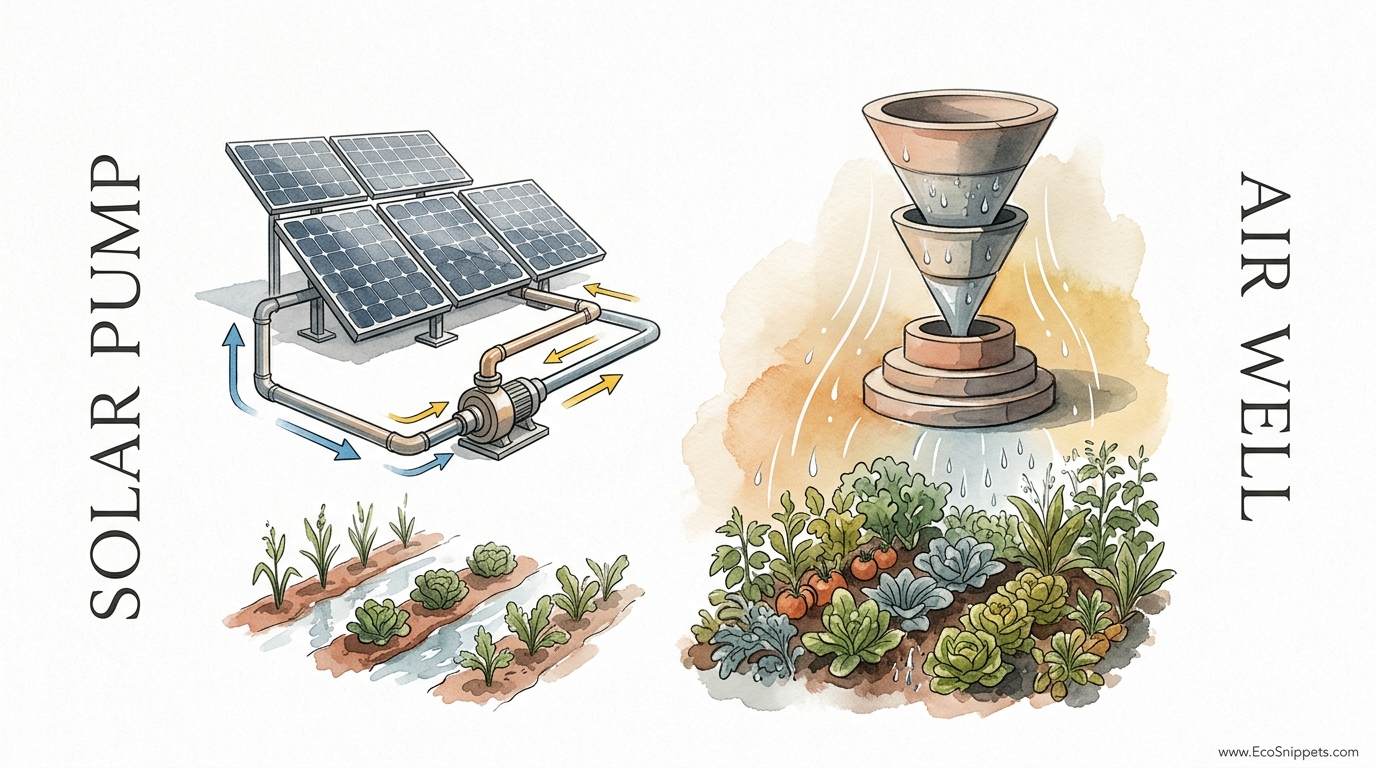
SOLAR PUMP vs AIR WELL: A Functional Comparison
When deciding how to water your homestead, it helps to compare the modern approach with the ancestral one. A solar-powered pump is highly efficient at moving large volumes of water, but it is a complex system with many points of failure. An air well is less efficient but nearly indestructible.
| Feature | Solar Pump System | Passive Stone Air Well |
|---|---|---|
| Initial Cost | High (Panels, pump, batteries) | Low (Raw stone, labor) |
| Maintenance | Regular (Cleaning panels, pump wear) | Minimal (Rinsing stones) |
| Water Source | Underground aquifer or tank | Atmospheric humidity |
| Lifespan | 10–20 years | Centuries |
| Yield | High (Gallons per minute) | Low (Ounces per hour) |
The solar pump is the tool for production; the air well is the tool for resilience. If the solar panel breaks or the battery dies, the pump stops. The air well, however, continues to work as long as the sun rises and the stars come out. For a truly self-sufficient homestead, a combination of both is the wisest path.
Practical Tips for the Homestead Builder
To get the most out of your air well, consider its surroundings. Planting a “shield” of taller vegetation to the west of the structure can provide afternoon shade. This allows the stones to start cooling down earlier in the evening, extending the time they spend at the dew point. However, make sure this shield doesn’t block the prevailing winds that bring in the humid air.
Use dark stones for the interior and lighter stones for the exterior if possible. The light-colored stones on the outside will reflect more of the morning sun, keeping the core of the pile cool for longer. The dark stones in the center will radiate heat more effectively at night. This “thermal gradient” can significantly increase the total condensation time.
Consider integrating a “wicking” system. Instead of collecting the water in a basin to be poured out later, you can use a cotton or hemp wick that leads from the bottom of the air well directly into the soil. This provides a slow, constant drip-irrigation effect that keeps the root zone of your plants consistently moist.
Mulching around the base of your air well is also essential. A thick layer of wood chips or straw will prevent the collected water from evaporating back into the air. It also helps keep the ground around the well cool, which can further enhance the temperature differential between the stones and the earth.
Advanced Considerations: The Hybrid Mesh Design
If you find that your stone air well isn’t producing enough water, you can “supercharge” it by adding a low-mass radiative element. Modern researchers have found that lightweight materials like mesh or specialized plastic foils cool down much faster than heavy stones. This is the principle behind the successful “Warka Water” towers used in Ethiopia.
You can create a hybrid system by draping a fine, food-grade polyester mesh over the top of your stone pile. The mesh will catch the early-morning fog and dew almost instantly, while the stone pile beneath it provides the structural support and a secondary cooling surface. As the mesh captures droplets, they will run down the fibers and drip onto the stones, eventually making their way to your collection basin.
This hybrid approach addresses the “high-mass trap” by providing a surface that reaches the dew point very quickly, while still utilizing the stone pile for its long-term thermal stability. It is an excellent way to adapt the ancient stone design for regions with lower humidity or shorter nights.
Another advanced technique involves the use of a “solar chimney.” By painting one side of the central air pipe black and exposing it to the sun, you can create a natural updraft. This draws more humid air into the base of the stone pile, increasing the volume of air that comes into contact with the cool stone surfaces.
Scenario: The Arid Garden Success
Imagine a homestead in the high desert of Arizona. The soil is sandy, and the summer sun is relentless. A gardener here might struggle to keep a small pomegranate tree alive during a three-month drought. By building a stone air well at the base of the tree’s planting mound, they create a safety net.
Every morning at 4:00 AM, the basalt stones in the air well are 20 degrees cooler than the air. As the first light hits the desert, the humidity—though low—begins to condense in the gaps between the rocks. By 8:00 AM, the stones are “sweating,” and a steady drip of water is making its way down into the mulch.
It might only be half a cup of water per day, but in the desert, half a cup of water is the difference between life and death for a young tree. Over the course of a week, that’s nearly a quart of pure, mineral-free water delivered directly to the roots. The gardener doesn’t have to carry a bucket, and they don’t have to worry about the power grid. The tree thrives, not because of high technology, but because of a pile of rocks and the cold of the night sky.
This is the power of the air well. It is a small, quiet victory over a harsh environment. It rewards the person who is willing to do the hard work of hauling stones and the patient work of observing the weather. It is a piece of pioneer wisdom that is just as relevant today as it was a thousand years ago.
Final Thoughts
The air well reminds us that the earth is constantly providing for us, even in the most subtle ways. By understanding the dance between temperature and moisture, we can build structures that turn the very air into a resource. It is a project that requires grit—literally, in the case of the stones—but the reward is a garden that feels a little more like a living, self-sustaining ecosystem.
Building an air well is an invitation to slow down and work with the rhythms of nature. It won’t replace a high-volume well for a commercial farm, but for the homesteader looking to deepen their self-reliance, it is an essential tool. It is a legacy project, a stone monument to the idea that we can live well by simply paying attention to the physics of the world around us.
Take the time to gather your stones. Study the wind and the stars. Build your well not just for the water it provides today, but for the resilience it offers for the decades to come. In the quiet hours of the morning, when the first droplets start to run down the face of a cool granite rock, you will understand the true value of this ancient, silent provider.
