How To Become More Self-Sufficient Without Starting a Full-Blown Farm…
Want to start preserving your harvest, making your own soap, or building a backyard root cellar — but not sure where to begin? “Homesteading Advice” gives you instant lifetime access to 35+ practical homesteading books on food preservation, veggie gardening, DIY natural cleaning products (save over $250 per year with this skill alone), brewing, off-grid energy, and a whole lot more…
Click Here To Check It Out Now!
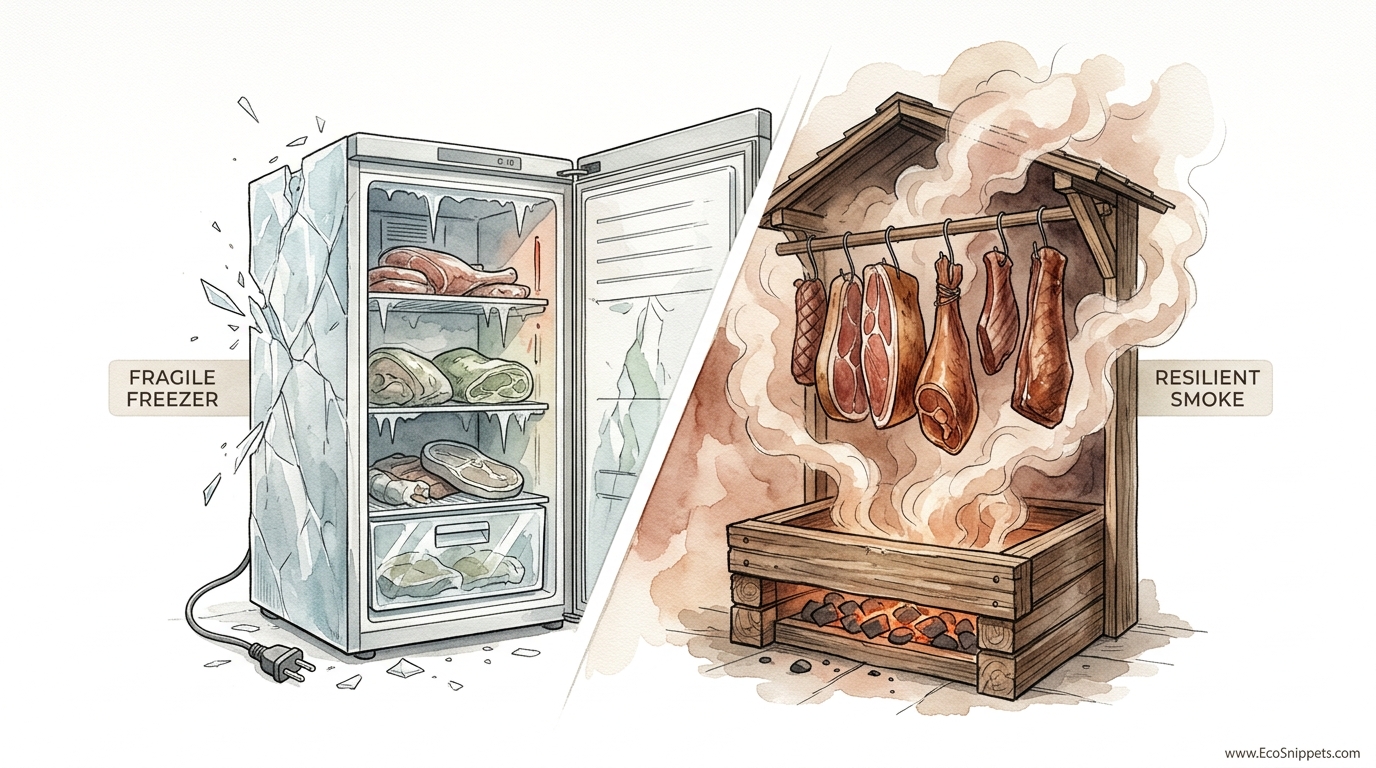
One power outage stands between your family and a total loss of your year’s meat harvest. If your food security depends on a wire, it isn’t security—it’s a gamble. A chest freezer is a miracle until the lights go out. Compare that to the smokehouse: an ancient technology that uses fire and salt to create meat that is delicious, portable, and completely immune to the grid.
Traditional meat preservation is more than a hobby for the self-reliant. It is a fundamental pillar of survival that has sustained human civilizations for millennia. When you master the art of the smoke and the cure, you stop being a consumer and start being a producer. You move from the fragile state of modern dependence to the resilient grit of our ancestors.
This guide will walk you through the grit and grease of preserving meat without a single watt of electricity. We will explore the chemistry of salt, the physics of wood smoke, and the construction of a smokehouse that will stand long after the local transformer has blown.
Preserving Meat Without Electricity
Preserving meat without electricity is the process of removing the conditions that allow bacteria to thrive. In a modern kitchen, we use extreme cold to pause biological decay. Without that cold, we must use alternative barriers: salt, smoke, acidity, and dehydration.
This practice exists because nature is relentless. Fresh meat is a concentrated source of protein and moisture, making it a prime target for spoilage bacteria and molds. Historically, the smokehouse was the heart of the homestead, especially in regions like Appalachia where pork was a staple of survival through the winter. According to historical records, pioneers would settle near freshwater springs and salt licks specifically because these two resources were non-negotiable for food security.
In a real-world scenario, preserving your own meat allows you to stabilize a large harvest—such as a whole hog or a downed deer—without needing a massive amount of freezer space. It transforms a perishable asset into a shelf-stable one. Think of it like a battery: instead of storing energy in lead-acid cells, you are storing calories in salted muscle fiber.
The Science of Salt and Smoke
Traditional preservation relies on a multi-layered defense system. The first and most critical layer is salt. Salt works through a process called osmosis. When you apply salt to meat, it draws moisture out of the muscle cells and into the surrounding environment. At the same time, salt enters the meat, creating a solute-rich environment that is toxic to most harmful microbes.
According to the National Center for Home Food Preservation, salt concentration is the primary factor in inhibiting the growth of pathogens like Clostridium botulinum. For long-term shelf stability at room temperature, a salt concentration of nearly 20% was traditionally used, though modern “curing” methods often use lower percentages in conjunction with other barriers.
Smoke provides the second layer of defense. Wood smoke contains hundreds of compounds, including phenols, aldehydes, and organic acids. Phenols act as powerful antioxidants and antimicrobials that coat the surface of the meat. These chemicals break down the cell walls of fungi and bacteria, effectively halting their growth. Additionally, the organic acids lower the surface pH of the meat, making it an inhospitable “no-fly zone” for spoilage organisms.
Building the Resilient Smokehouse
A smokehouse is not just a shed; it is a precision-engineered tool for managing airflow and temperature. Traditional designs vary, but the most resilient models separate the fire source from the smoking chamber. This setup allows for “cold smoking,” which is the gold standard for long-term preservation.
The Underground Pipe Design
One of the most effective traditional designs features a masonry firebox located several feet away from the smokehouse. A concrete or clay pipe connects the firebox to the center of the smokehouse floor. As the smoke travels through this underground pipe, it cools down significantly. By the time it reaches the meat, it provides the preservative benefits of wood fumes without the high heat that would “cook” and seal the exterior of the muscle.
Materials and Construction
Cedar and pine are common choices for the walls of a wooden smokehouse due to their durability and natural resistance to rot. The structure should be windowless and feature a tightly fitting door to keep out flies and vermin. According to builders of traditional smokehouses, the roof should be vented—often with a simple cupola or adjustable slats—to allow moisture-laden air to escape while keeping the smoke inside long enough to do its work.
Inside the smokehouse, you need sturdy racks and hooks. These are often made of stainless steel or rot-resistant hardwoods. Meat must be hung so that no two pieces touch, ensuring that smoke can circulate around every square inch of the surface.
Cold Smoking vs. Hot Smoking
Understanding the difference between these two methods is the difference between a meal for tonight and a harvest for next year.
Cold Smoking for Longevity
Cold smoking occurs at temperatures between 68°F and 86°F. This method does not cook the meat. Instead, it dries it slowly while infusing it with antimicrobial smoke compounds. Because the meat remains raw, it must be cured with salt before it ever enters the smokehouse. Cold smoking can take anywhere from a few days to several weeks. The goal is a deep, mahogany-colored exterior and a significant loss of total weight as moisture evaporates.
Hot Smoking for Consumption
Hot smoking involves temperatures between 126°F and 176°F. This process cooks the meat while adding flavor. While delicious, hot-smoked meat is not shelf-stable on its own. It still contains enough moisture for bacteria to grow if left at room temperature. Unless you plan to follow hot smoking with a secondary dehydration process, you should treat hot-smoked meat as a perishable item.
Benefits of the Traditional Smokehouse
The advantages of the smokehouse extend beyond simple survival.
- Grid Independence: You are no longer vulnerable to fuel shortages, rolling blackouts, or mechanical failures of refrigeration equipment.
- Flavor Profile: No commercial “liquid smoke” can replicate the complex, layered flavors of meat cured with hickory, applewood, or white oak.
- Portability: Salted and smoked meat is much lighter than fresh meat because the water has been removed. This makes it ideal for travel or trade.
- Nutrient Density: Cold smoking preserves heat-sensitive vitamins and fatty acids that are often destroyed by high-heat cooking or canning.
Challenges and Common Mistakes
Preserving meat without electricity requires discipline. The margin for error is slim, and mistakes can lead to foodborne illness.
One frequent error is skipping the curing step. Beginners often think smoke alone will preserve the meat. In reality, the “Danger Zone” for bacterial growth is between 40°F and 140°F. Since cold smoking happens right in this range, the salt cure is your only protection against botulism.
Another mistake is using the wrong type of wood. Resinous woods like pine, fir, or spruce should never be used for the fire itself. They contain terpenes and resins that produce a soot-heavy smoke, making the meat taste like turpentine and potentially causing digestive upset. Stick to hardwoods like hickory, oak, maple, or fruitwoods.
Failure to develop a “pellicle” is also common. After curing and rinsing your meat, it must be hung in a cool, breezy place until a tacky, thin skin forms on the surface. This is the pellicle. Without it, the smoke will not adhere properly to the meat, resulting in an uneven cure and poor flavor.
Limitations: When This May Not Be Ideal
Traditional smoking is a seasonal and environmental process. It is not always the best choice for every situation.
High humidity is the enemy of the smokehouse. If you live in an environment where the air is constantly saturated with moisture, the meat may mold before it can dry. In these cases, you must use a “hotter” smoke or rely more heavily on salt-cured “wet” brines in crocks.
Environmental temperature also matters. If the ambient temperature is too high (above 40°F) during the initial salt-curing phase, the meat can spoil from the inside out before the salt has a chance to penetrate the core. This is why “hog killing time” was traditionally in the late fall or early winter when the air was naturally cool.
Fragile Freezer vs. Resilient Smokehouse
| Feature | Modern Chest Freezer | Traditional Smokehouse |
|---|---|---|
| Energy Source | Continuous Electricity | Wood and Salt |
| Skill Level | Low (Plug and Play) | High (Requires Mastery) |
| Maintenance | Low (until it breaks) | Medium (Fire management) |
| Failure Mode | Catastrophic (Total loss) | Gradual (Visual cues) |
| Portability | None | High (Shelf-stable meat) |
Practical Tips for the Modern Pioneer
Applying these techniques requires a transition in how you view food. Start small. Do not attempt to preserve a 300-pound hog on your first try.
Use a digital thermometer to monitor the internal temperature of your smokehouse, even if you are building it with pioneer methods. While our ancestors used their hands to judge heat, a thermometer provides a safety net while you are learning.
Keep a meticulous log. Record the weight of the meat, the amount of salt used, the type of wood, and the duration of the smoke. This data will help you refine your process and identify what went right (or wrong) with a specific batch.
Always trim the fat. While fat carries flavor, it is the first part of the meat to go rancid. For long-term shelf stability, lean cuts are your best friend. If you want to preserve fat, look into “confit” methods where meat is submerged in rendered lard, creating an airtight seal.
Advanced Considerations: Nitrates and Nitrites
Serious practitioners eventually face the debate over curing salts—specifically Prague Powder #1 and #2. These contain sodium nitrite and sodium nitrate. While some modern homesteaders avoid them, they were historically present in the “impure” salts used by our ancestors.
Nitrites are specifically effective at preventing the growth of Clostridium botulinum spores. If you are cold-smoking large muscles like hams or making fermented sausages, these salts provide a critical layer of safety. According to food safety guidelines, Prague Powder #2 is used for long-term dry cures (weeks to months) because the nitrate slowly breaks down into nitrite over time, providing a sustained release of protection.
Example Scenario: The Five-Day Bacon
Imagine you have just harvested a hog. To preserve the belly without a freezer, you would first weigh the meat. Following the “equilibrium cure” method, you would apply exactly 2.5% of the meat’s weight in sea salt and 0.25% in Prague Powder #1.
Place the belly in a non-reactive container or a sealed bag in a cool cellar (below 40°F) for seven days. Flip it daily to ensure the salt penetrates evenly. After seven days, the meat will feel firm. Rinse it thoroughly and hang it in a cool area with a fan or a breeze for 24 hours to develop the pellicle.
Finally, move the belly to your smokehouse. Burn hickory at a low smolder, keeping the temperature inside the chamber at 75°F. Smoke the meat for 6 to 12 hours a day over the course of three days. The result is a slab of bacon that is profoundly flavorful and significantly more stable than anything found in a plastic grocery store package.
Final Thoughts
Mastering the smokehouse is a journey back to a time when food security was a personal responsibility rather than a corporate service. It requires a deep respect for the elements: the sting of the smoke, the bite of the salt, and the slow, steady passage of time.
By removing your dependence on the grid, you gain a level of freedom that few in the modern world understand. You are no longer at the mercy of a power line or a supply chain. You have the “pioneer grit” to turn a fresh harvest into a pantry full of sustenance that will last through the leanest of times.
Start with a simple box or a repurposed barrel. Learn the way of the wood and the grain of the meat. As you gain experience, build a permanent structure that will serve your family for generations. The path to true resilience is paved with salt and seasoned with smoke.
