How To Become More Self-Sufficient Without Starting a Full-Blown Farm…
Want to start preserving your harvest, making your own soap, or building a backyard root cellar — but not sure where to begin? “Homesteading Advice” gives you instant lifetime access to 35+ practical homesteading books on food preservation, veggie gardening, DIY natural cleaning products (save over $250 per year with this skill alone), brewing, off-grid energy, and a whole lot more…
Click Here To Check It Out Now!
Nature never leaves its young exposed to the full fury of the sun; why are you forcing your garden to struggle on its own? If you are fighting to keep your garden hydrated every afternoon, you might be missing a ‘mother’ plant. A multi-story canopy design allows your taller, sun-loving plants to create a microclimate for the delicate greens below. This reduces evaporation by 70% and prevents the sun from bleaching the nutrients out of your soil.
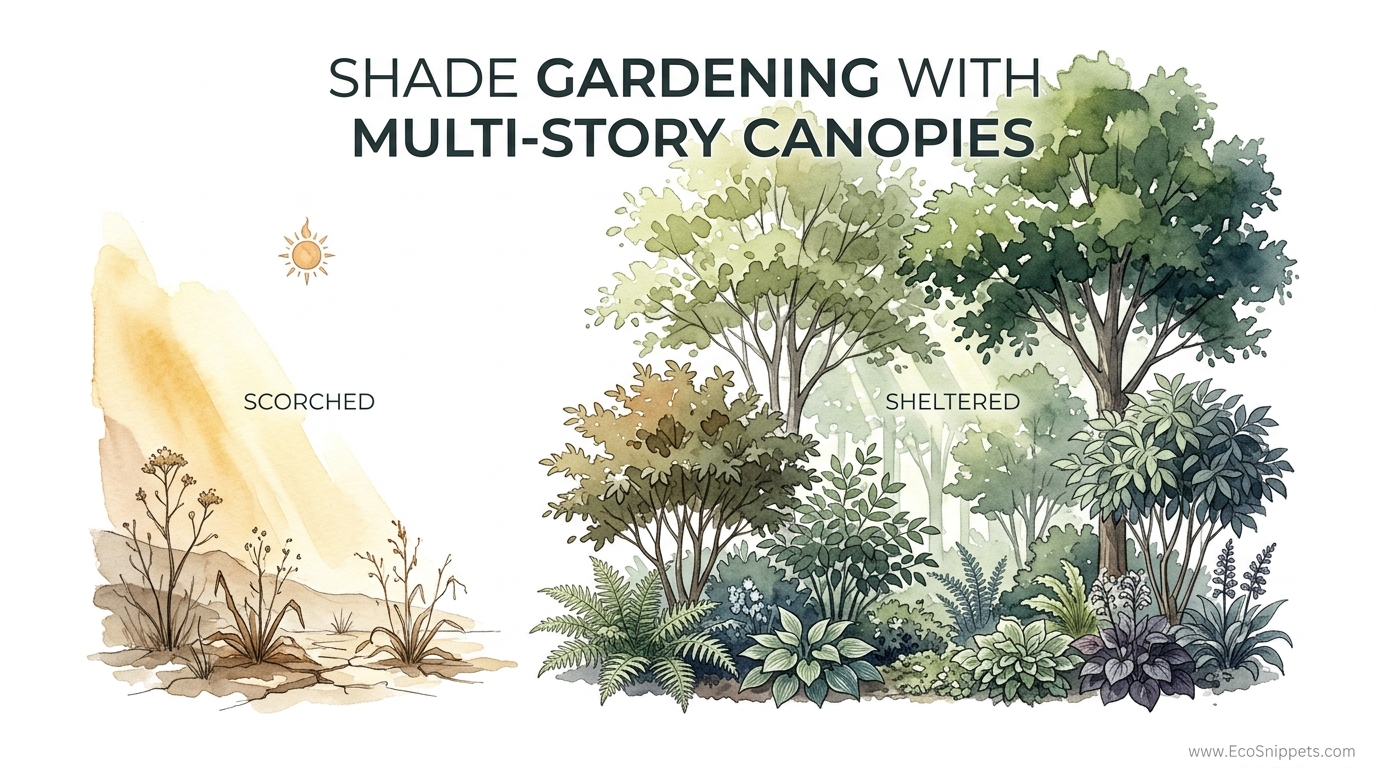
Stepping into a well-designed multi-story garden feels like stepping into a cool cellar on a blistering August day. The air is heavy with moisture, the soil remains dark and crumbly, and the plants look invigorated rather than exhausted. This isn’t just about shade; it is about architecture. Our ancestors didn’t plant in straight, exposed rows of a single crop because they knew the wind and sun would rob them of their harvest. Instead, they mimicked the forest. This article will guide you through the transition from a scorched, high-maintenance plot to a sheltered, self-sustaining ecosystem that honors the wisdom of the woods.
Shade Gardening With Multi-story Canopies
Shade gardening with multi-story canopies is the practice of stacking different types of plants vertically to maximize space and resource efficiency. This concept, often called a “food forest” or “forest garden,” moves away from the flat, two-dimensional layout of modern industrial agriculture. Instead, it utilizes every inch of height, from the deep roots underground to the vine-covered tips of the tallest trees.
In a natural forest, you rarely see bare dirt. Layers of vegetation overlap to capture every photon of light and every drop of rain. The tallest trees, the overstory, take the brunt of the weather. They shield the smaller understory trees, which in turn protect the shrubs. Beneath the shrubs, herbaceous plants, groundcovers, and root crops thrive in a stabilized environment. This system is used in real-world permaculture and agroforestry to grow high yields in small spaces while drastically reducing the need for external inputs like irrigation and synthetic fertilizer.
Visualizing this concept is easiest if you think of your garden as a house. The canopy is the roof that keeps out the heat; the shrubs and small trees are the walls that block the wind; and the groundcover is the carpet that keeps the floor cool. When these layers work in harmony, they create a “cool zone” that can be up to 12 degrees Celsius cooler than an open field. This structural diversity is the secret to a resilient homestead.
How the Vertical System Operates
The magic of a multi-story canopy happens through the intersection of light, water, and biology. Taller plants act as biological sunscreens. As sunlight hits the top layer, much of the intense UV radiation is absorbed or reflected. The light that filters through—known as “dappled light”—is much softer and perfect for many leafy greens and berries that would otherwise bolt or wither in direct afternoon sun.
Transpiration plays a massive role in this system. Plants “breathe” out water vapor through their leaves, a process that naturally cools the surrounding air. In a multi-story system, this moisture is trapped beneath the upper layers instead of being whisked away by the wind. This creates a pocket of high humidity. Moisture stays in the system longer, allowing the gardener to walk past the hose and spend their time on other chores.
Nutrient cycling is the second engine of the canopy. Deep-rooted canopy trees act as nutrient pumps. Their roots reach into the subsoil where shallow vegetables cannot go, drawing up minerals like potassium and calcium. When these trees shed their leaves in the autumn, they deposit those minerals onto the surface as “leaf mulch.” Smaller plants and soil organisms then break this down, turning it into rich, black gold. This constant rain of organic matter ensures the soil is always being built up, never depleted.
Designing Your Layers From the Ground Up
Building a multi-story garden requires a shift in how you select and place your plants. You cannot simply throw seeds into the wind; you must design for the mature size of every inhabitant. Start with the “Mother Tree” or the overstory. In a typical backyard, this might be a standard fruit tree like an apple or a nut tree like a walnut. This tree defines the boundaries of your microclimate.
The second layer consists of smaller, understory trees. These are often dwarf varieties of fruit trees, or nitrogen-fixing trees like alder or mountain ash. They fill the gap between 10 and 20 feet. Beneath them, you plant the shrub layer. This is the domain of currants, gooseberries, and blueberries. These woody perennials are the backbone of the system, providing structure and wind protection for the more delicate annuals.
The herbaceous layer and groundcovers come next. Comfrey, herbs, and perennial vegetables like rhubarb sit here. Groundcovers like strawberries or clover act as “living mulch,” blanketing the soil to prevent weeds and keep moisture in. Finally, the vertical layer includes climbers like grapes, hops, or vining beans that use the trunks of the taller trees as natural trellises. Every niche is filled, leaving no room for the sun to bake the earth.
The Measurable Benefits of Shelter
The primary advantage of this approach is water conservation. Shaded soil loses far less water to evaporation than exposed dirt. In many cases, a well-established forest garden requires only a fraction of the water a traditional row garden needs. This is a game-changer for those living in areas with watering restrictions or frequent droughts.
Soil health improves dramatically without the gardener ever lifting a spade. The lack of direct sun prevents the “baking” of the soil surface, which can kill beneficial bacteria and fungi. Protected soil remains aerated and loose, allowing roots to penetrate deeper. This leads to plants that are more resilient to pests and disease, as their root systems are robust and well-fed.
Yield diversity is another significant benefit. Instead of harvesting only tomatoes for a few weeks in summer, a multi-story garden provides a steady stream of food. You might get greens in early spring, berries in early summer, stone fruits in late summer, and nuts or root crops in the autumn. This variety ensures that if one crop fails due to a specific pest or weather event, the others are there to fill the larder.
Common Mistakes and How to Dodge Them
One frequent error is planting too densely too quickly. It is tempting to fill every gap immediately, but trees grow. If you plant your shrubs too close to a young sapling, the sapling will eventually shade them out entirely, or their roots will compete so fiercely that neither thrives. Always check the “mature width” of a plant before putting it in the ground. Use temporary annuals like sunflowers or corn to fill gaps while your permanent trees are still small.
Neglecting airflow is another pitfall. While humidity is good for moisture retention, a stagnant, damp environment is an invitation for powdery mildew and fungal rot. You must prune your canopy to allow for “the breath of the wind.” Thinning out the center of your fruit trees and keeping the lower branches of the overstory clear will ensure that air can circulate. If the air feels “heavy” and smells like old basement, you need to open up some space.
Forgetting the light needs of specific crops is a classic mistake. While many plants love dappled shade, “sun-worshippers” like peppers, tomatoes, and melons still need 6 to 8 hours of direct light to produce sweet fruit. Placing these deep under a thick oak tree is a recipe for leggy, fruit-less plants. Keep your sun-lovers on the southern edge of your canopy system where they can get the best of both worlds: full sun for their leaves and a cool root zone provided by the nearby shade.
Realistic Limitations of the Canopy Method
This method is not a “magic bullet” for every situation. Establishing a full multi-story canopy takes time—often five to ten years before the trees provide significant shade and yields. If you need a massive harvest of calories immediately to survive the winter, a traditional row garden or a “Three Sisters” mound might be more practical in the short term. The canopy is a long-term investment in the land.
Space is a genuine constraint. While you can create a miniature version of this on a suburban lot, you cannot fit a standard walnut tree and a dozen sub-layers in a tiny courtyard. You must scale your choices. In small spaces, use “espalier” techniques (training trees flat against a fence) or focus on the shrub and herbaceous layers rather than trying to force a massive overstory where it doesn’t fit.
Energy requirements for maintenance change rather than disappear. While you will spend less time watering and weeding, you will spend more time pruning and harvesting. Picking berries from a dense shrub layer requires more physical dexterity than walking down a clear row. You must be prepared to interact with your garden more intimately, getting your hands dirty and learning the specific needs of dozens of different species.
Pioneer Best Practices for Success
Start with the soil before you plant a single tree. Our ancestors knew that you don’t plant a ten-dollar tree in a ten-cent hole. Use “trench composting” or sheet mulching (cardboard and woodchips) to build up a thick layer of organic matter. This mimics the forest floor and gives your young canopy a head start.
Focus on native species for your structural layers. Native trees and shrubs have spent thousands of years adapting to your specific climate and pests. They require less fuss and provide better habitat for the birds and predatory insects that will act as your “organic pesticide.” Once the native skeleton of your garden is in place, you can intersperse your exotic fruit trees and vegetables with much higher success rates.
Observation is your most powerful tool. Spend a full season watching how the sun moves across your land before you plant permanent structures. Mark the spots that stay damp the longest and the areas that get baked the hardest. Plant your most water-hungry greens in the damp spots and use your hardiest, most drought-tolerant trees to shield the “hot spots.” Working with the land’s natural tendencies is the hallmark of the self-reliant gardener.
Advanced Wisdom: The Underground Mycelial Network
The real strength of a multi-story canopy isn’t visible to the eye. It exists in the “rhizosphere,” the area of soil surrounding plant roots. In a layered system, the roots of different species form a massive, interconnected web. This web is often facilitated by mycorrhizal fungi. These fungi attach to plant roots and act as an extension of the root system, reaching out to grab water and nutrients that the plant cannot reach on its own.
In exchange for these nutrients, the plants provide the fungi with sugars made during photosynthesis. This creates a “sentient network” where plants can actually communicate and share resources. Research has shown that a “mother tree” can send extra carbon and nutrients through the fungal network to smaller, shaded saplings to help them survive. By encouraging this fungal growth—through no-till practices and avoiding chemical fungicides—you are building a biological insurance policy for your garden.
This network also helps stabilize soil pH and prevents the leaching of nitrogen. When you have a diversity of roots at different depths, someone is always “awake” and eating. In a monoculture row garden, if the main crop isn’t actively growing, nutrients just wash away in the rain. In a multi-story canopy, the groundcovers and perennials keep the “lights on” year-round, ensuring that your soil biology never goes dormant.
The Orchard Forest: A Practical Example
Imagine a 20-foot by 20-foot plot. In the center, you plant a semi-dwarf Apple tree (the Overstory). Around its base, at the “drip line” where rain falls from its leaves, you plant three Hazelnut bushes (the Shrub layer). These bushes act as a windbreak. In the gaps between the hazelnuts, you plant Comfrey and Horseradish (the Herbaceous layer). These plants have deep taproots that bring up minerals and can be chopped down several times a year to provide mulch for the system.
On the sunny southern edge of this circle, you plant a row of Blueberries. Since blueberries need acidic soil, you can mulch this specific area with pine needles without affecting the rest of the garden. Underneath the blueberries, you plant Wild Strawberries (the Groundcover) to keep the weeds down. Finally, you train a Hardy Kiwi vine (the Vertical layer) to grow up a nearby fence or even up the trunk of the apple tree once it is mature enough.
In the first year, you might only get strawberries and a few herbs. By year three, the blueberries start to produce. By year five, the apple and hazelnut trees are providing shade and a substantial harvest. Because the ground is completely covered, you spend almost zero time weeding. Because the canopy is cooling the air, you water once a week instead of every evening. This is how you reclaim your time and your health.
Final Thoughts
Shade gardening with multi-story canopies is more than just a technique; it is a return to a more balanced way of living. It acknowledges that we are not the masters of nature, but participants in it. By creating a sheltered environment, we protect the very soil that feeds us and ensure that our gardens can withstand the unpredictable shifts of the modern climate.
The rewards of this system go beyond the basket of fruit or the reduction in the water bill. There is a deep, ancestral satisfaction in standing under a tree you planted, surrounded by a thriving, humming world of life that you helped initiate. It is a legacy of resilience that you can pass down to the next generation, showing them that even in a world of scorched earth, there is a way to build a sanctuary.
Do not feel overwhelmed by the complexity. Start with one “Mother Tree.” Plant a few herbs at its feet. Watch how the shadows fall. Every layer you add is a step toward self-reliance and away from the struggle of the scorched row. Nature is ready to help you; you only need to provide the structure.
