How To Become More Self-Sufficient Without Starting a Full-Blown Farm…
Want to start preserving your harvest, making your own soap, or building a backyard root cellar — but not sure where to begin? “Homesteading Advice” gives you instant lifetime access to 35+ practical homesteading books on food preservation, veggie gardening, DIY natural cleaning products (save over $250 per year with this skill alone), brewing, off-grid energy, and a whole lot more…
Click Here To Check It Out Now!
Your ‘protective’ plastic box is secretly the biggest threat to your tools. Plastic is waterproof, but it’s also vapor-proof. When temperature swings hit, moisture condenses inside your plastic toolboxes, creating a high-humidity oven that eats steel for breakfast. Waxed canvas repels the rain but allows the metal to breathe, wicking moisture away and keeping your legacy tools rust-free for decades.
There is a quiet tragedy happening in workshops and garages across the country. We buy fine chisels, heirloom saws, and precision wrenches, only to tuck them into molded plastic coffins, thinking we are doing them a favor. We see that “waterproof” seal and assume our gear is safe. But that seal is a double-edged sword that cuts deepest when the sun goes down and the temperature drops.
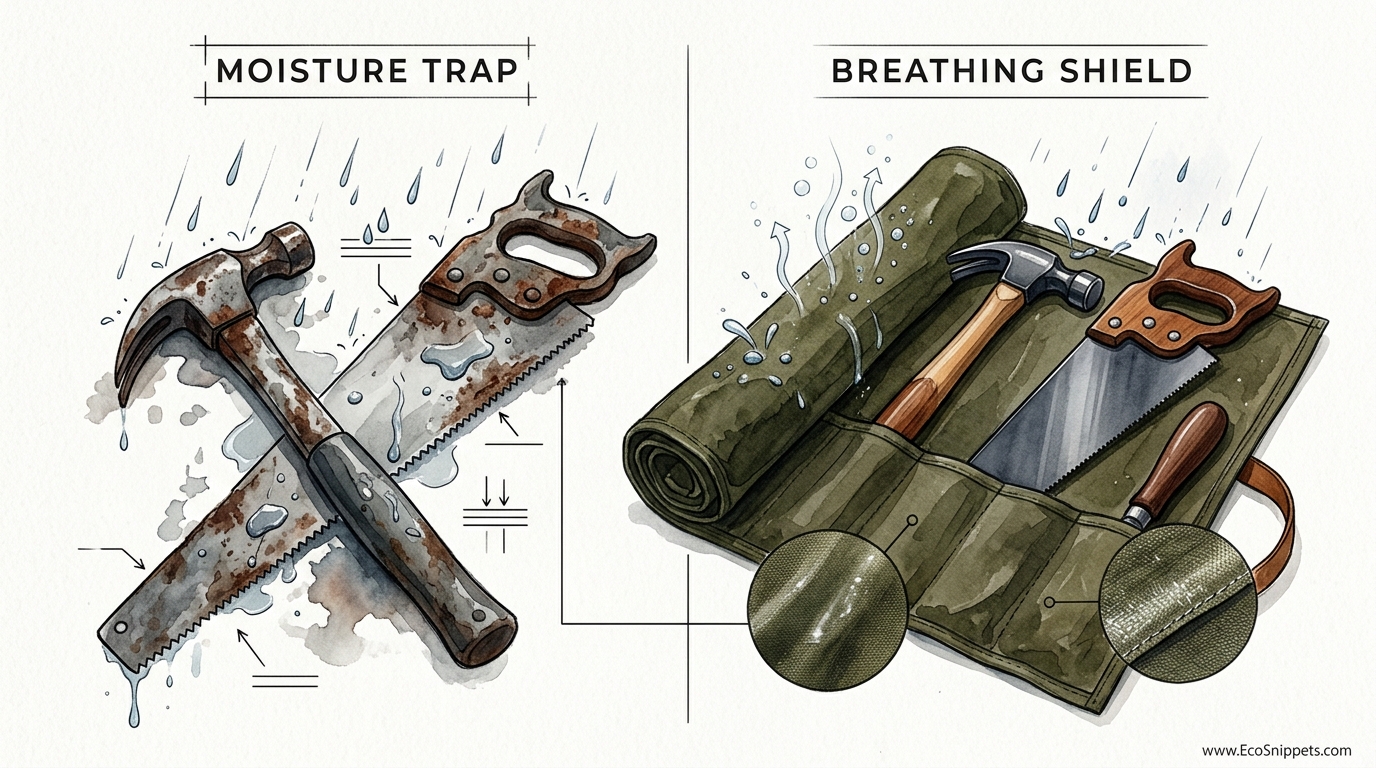
Steel is a living thing in a sense; it reacts to the air around it. When you lock it in a non-porous environment, you aren’t just keeping the world out—you are keeping the enemy in. Understanding the difference between a Moisture Trap and a Breathing Shield is the first step toward ensuring your tools survive long enough to be handed down to the next generation.
In this guide, we are going to look at why the old ways of the woodsman and the sailor still hold the crown for tool protection. We will explore the science of condensation, the history of waxed cotton, and why your gear deserves more than a plastic box.
Traditional Tool Protection With Waxed Canvas
Waxed canvas is not a new invention; it is a solution forged by necessity on the high seas. Centuries ago, sailors noticed that their heavy flax sails caught the wind better when they were wet, but the extra weight was a burden. They began treating the fabric with fish oils and grease to keep the water out while maintaining the sail’s integrity. Eventually, this evolved into the use of linseed oil and, by the 1920s, refined paraffin and beeswax blends.
This material was the original “high-performance” textile. Long before Gore-Tex or nylon existed, waxed canvas was the standard for anyone whose life depended on staying dry in the middle of a storm. It was used for the “oilskins” worn by fishermen and the rugged packs carried by pioneers pushing into the wilderness. It exists because it works where synthetic materials fail: it offers a balance of protection and permeability.
In the world of tool storage, waxed canvas usually takes the form of tool rolls, pouches, or duffels. It is a heavy-duty cotton duck fabric that has been impregnated with a proprietary blend of waxes. This creates a surface where water beads up and rolls off, yet the weave of the fabric remains microscopic enough to allow air molecules to pass through. It is the literal embodiment of “tough but fair” protection for your steel.
Think of it like a quality leather boot. It provides a rugged barrier against the mud and rain, but it doesn’t leave your foot swimming in its own sweat. When you wrap a high-carbon steel tool in waxed canvas, you are giving it a climate-controlled micro-environment that adjusts to the world around it.
The History of the Pioneer’s Choice
During the 19th and early 20th centuries, a craftsman’s tools were his most valuable possession. A carpenter or a shipwright wouldn’t dream of throwing their tools into a generic box. They used rolls made of heavy canvas, often treated with whatever waxes were available. These rolls allowed them to organize their kits while providing a physical cushion against impact and a chemical barrier against oxidation.
This tradition persisted because it was practical. If a sailor’s tool roll got sprayed with salt water, the wax kept the brine from reaching the metal. If the humidity rose in a damp workshop, the canvas allowed the moisture to move away from the tool rather than settling on it as dew. This is the “Breathing Shield” in action—a legacy of protection that plastic simply cannot replicate.
How the Breathing Shield Prevents the Rust Cycle
To understand why waxed canvas is superior, we have to look at the physics of the “Dew Point.” Every breath of air contains some amount of water vapor. In a sealed plastic container, that air is trapped. When the temperature outside the box drops—like it does every single night in a garage—the air inside the box cools down. Cold air cannot hold as much moisture as warm air.
The result is condensation. The water vapor turns into liquid droplets that form on the coolest surfaces available—usually the walls of the box and the cold steel of your tools. Because the plastic box is air-tight, that liquid has nowhere to go. It sits on your tools, reacting with the iron and oxygen to create iron oxide. This is the “high-humidity oven” that ruins legacy gear.
Waxed canvas breaks this cycle through three specific mechanisms:
- Vapor Permeability: Unlike plastic, the cotton fibers in canvas allow water vapor to escape. As the temperature drops, the moisture moves through the fabric instead of condensing on the tool.
- Hydrophobic Barrier: The wax coating prevents liquid water (like rain or a spill) from soaking into the fabric. It is a one-way street: liquid stays out, but vapor can leave.
- Oil Transfer: Over time, the waxes and oils in the canvas can actually transfer in trace amounts to the surface of the tool, providing an additional layer of molecular protection against the air.
When you use a tool roll, the fabric is in direct contact with the tool. This eliminates the “dead air space” found in toolboxes. Without a large volume of trapped air, there is less vapor available to condense in the first place. You are effectively “shrink-wrapping” your tools in a breathable, protective skin.
The Physics of the Micro-Environment
Consider the difference between a greenhouse and a shade tree. A plastic box is a greenhouse; it traps heat and moisture, creating a stagnant environment. Waxed canvas is like the shade tree; it provides a barrier against the sun and rain but allows the breeze to keep things dry and cool. This passive regulation is exactly what high-carbon steel needs to stay “bright” and free of pits.
Advantages of Waxed Canvas Tool Storage
The benefits of moving away from plastic go beyond just rust prevention. There is a tactile and practical superiority to waxed canvas that becomes more apparent the longer you use it.
Unmatched Durability: Waxed canvas is famous for being “heirloom-quality.” While plastic becomes brittle with age and cracks in the cold, canvas remains flexible. If you drop a plastic toolbox, the hinge snaps. If you drop a waxed canvas tool roll, it just bounces. It is built to take the abuse of a working jobsite without failing.
The Silence of Canvas: Anyone who has driven a truck with a plastic toolbox in the back knows the constant “clack-clack-clack” of tools hitting the sides. Canvas deadens sound. It keeps your tools tight and silent, preventing the small dings and scratches that happen when metal rattles against hard plastic.
A Developing Patina: Waxed canvas is one of the few materials that looks better as it ages. It records the history of your work in every scuff and fold. This “patina” isn’t just for looks; it represents the years of protection the fabric has provided. It becomes a personal piece of gear that tells a story, rather than a disposable piece of trash.
Space Efficiency: A plastic box takes up the same amount of space whether it is full or empty. A tool roll, however, is only as large as the tools inside it. It can be tucked into tight spaces, rolled up for travel, or expanded to hold more. It conforms to your needs, not the other way around.
Natural Repairability: When plastic breaks, it stays broken. When waxed canvas gets a small hole or the wax wears thin, you can fix it. You can stitch a tear with heavy thread or re-apply wax with a heat gun. This makes it a sustainable choice for those who value self-reliance over constant replacement.
Common Mistakes to Avoid With Waxed Gear
Even though waxed canvas is incredibly tough, it is not indestructible. Most “failures” of the material are actually failures of maintenance. If you treat it like nylon or polyester, you will ruin it.
The most common mistake is washing with detergent. Modern soaps are designed to break down oils and fats. Since the protection of waxed canvas is literally an oil/wax blend, detergent will strip it bare in a single cycle. This leaves you with nothing but a piece of heavy cotton that will soak up water like a sponge. Never put your waxed gear in a washing machine.
Another error is storing tools while they are soaking wet. While the canvas “breathes,” it is not a magic wand. If you put a dripping wet wrench into a roll and wrap it tight, you are still trapping liquid against the metal. Always give your tools a quick wipe with an oily rag before tucking them away for the night.
People also tend to over-wax. There is a temptation to slather on as much wax as possible, thinking it will provide “extra” protection. In reality, too much wax makes the fabric stiff and tacky. It can also clog the weave so much that you lose the breathability that makes the material valuable in the first place. A thin, even coat is all you need.
Finally, ignoring the seasons can be a pitfall. Waxed canvas behaves differently in extreme heat and extreme cold. In the heat of a summer truck bed, the wax can soften and migrate. In the dead of winter, it can become stiff. Understanding these transitions will help you handle your gear with the proper care.
Limitations: When This May Not Be Ideal
To give a balanced perspective, we must admit that waxed canvas isn’t the solution for every single scenario. There are times when a hard-sided, sealed container is necessary.
If your work involves total submersion—such as working on a boat where the bag might fall overboard—waxed canvas will eventually soak through. It is water-resistant, not a dry-bag. In cases where gear must be 100% waterproof under pressure, a gasket-sealed Pelican-style case is the only real option.
Weight is also a factor. Waxed canvas is heavy. If you are a technician who has to carry 50 pounds of tools up twelve flights of stairs every day, the added weight of the heavy-duty duck fabric might be a drawback compared to lightweight (though less durable) nylon. It is a trade-off between “protection for a lifetime” and “convenience for the moment.”
Cost is the final hurdle. A high-quality waxed canvas tool roll can cost three to four times as much as a mass-produced plastic box from a big-box store. For some, this is an investment in a legacy tool. For others on a tight budget, the entry price can be steep. However, when you calculate the cost of replacing rusted tools over a decade, the canvas usually pays for itself.
Comparing Tool Protection Methods
To see how these materials stack up in the real world, let’s look at the measurable factors that affect tool health and longevity.
| Feature | Waxed Canvas | Plastic Toolbox | Nylon/Poly Bag |
|---|---|---|---|
| Rust Prevention | High (Breathable) | Low (Traps Moisture) | Moderate (Absorbent) |
| Durability | Exceptional | Moderate (Brittle) | Low (Tears easily) |
| Repairability | Very High | None | Low |
| Sound Dampening | Excellent | Poor (Noisy) | Good |
| Eco-Friendly | Biodegradable/Natural | Petrochemical-based | Synthetic/Microplastics |
| Maintenance | Occasional Re-waxing | Cleaning only | Disposable |
As the table shows, while plastic is a convenient “set and forget” option, it falls short in the categories that matter most for long-term tool preservation and environmental impact. Waxed canvas requires a bit of “pioneer grit” to maintain, but it rewards you with superior performance.
Practical Tips for Maintaining the Shield
If you decide to make the switch to waxed canvas, you are now the steward of a high-performance material. Keeping it in top shape is a simple ritual that connects you to the craftsmen of the past.
The Sunlight Test: Every few months, hold your canvas gear up to the light. If you see “dry” spots where the fabric looks lighter or more porous, it’s time for a touch-up. These are the areas where water will eventually find a way in.
The Re-Waxing Ritual:
- Clean the surface with a stiff brush and cold water to remove dirt. Let it dry completely.
- Use a dedicated canvas wax (beeswax/paraffin blend). Avoid using pure beeswax as it can be too brittle.
- Apply the wax in thin, even strokes. You aren’t painting; you are rubbing the wax into the fibers.
- Use a hair dryer or heat gun on a low setting to melt the wax into the weave. You will see the fabric darken as it absorbs the protection.
- Let it “cure” in a warm, dry place for 24 hours before use.
The “Oil and Canvas” Synergy: For the ultimate protection, combine your canvas roll with a light coat of camellia oil or a dedicated tool wipe. The canvas will absorb some of this oil over time, creating a saturated environment that is fundamentally hostile to rust. It’s like creating a private, moisture-free sanctuary for your steel.
Advanced Considerations for the Serious Practitioner
For those who want to go deeper, the type of canvas and wax you choose matters. Not all “waxed canvas” is created equal. Most modern mass-market gear uses a light 10oz or 12oz canvas. For heavy tools like axes or pipe wrenches, you should look for “Number Duck” canvas—specifically #10 or #8 (which are roughly 15oz to 18oz per yard). These heavier weights provide the structural integrity needed to prevent tools from poking through the fabric.
Consider the pH balance of your wax. Some low-quality waxes use additives that can actually be slightly acidic, which is the last thing you want near your steel. Look for brands that use food-grade paraffin or natural beeswax blends. If you are feeling adventurous, you can even make your own “Pioneer Mix” using 60% beeswax and 40% paraffin, adjusting the ratio for your specific climate.
Think about stowage location. Even with waxed canvas, you shouldn’t store your tools in the wettest part of the shop. Place your rolls in a spot with decent airflow. The goal is to allow the “Breathing Shield” to do its job. If you bury a canvas roll under a pile of wet tarps, even the best wax in the world won’t be enough to stop the damp.
The Scenario: A Tale of Two Chisels
Imagine two identical sets of high-carbon steel chisels purchased on the same day. One set is placed into a brand-new, gasket-sealed plastic “pro” toolbox. The other is wrapped in a heavy waxed canvas tool roll. Both are stored in an unheated garage in a region that sees humid summers and freezing winters.
After three years, the plastic box is opened. Because of the “greenhouse effect,” the foam lining has held onto moisture from a particularly humid July. The chisels have developed deep pitting along the shanks and significant “spider-web” rust on the polished faces. The owner has to spend hours regrinding the edges, losing valuable steel in the process.
The waxed canvas roll is opened. The fabric feels a bit stiff from the cold, and it has a few new scuffs from being moved around. But when the chisels are unrolled, they are as bright as the day they were bought. The canvas allowed the seasonal humidity to pass through, and the trace oils from the wax kept the oxygen at bay. These tools aren’t just usable; they are pristine. This isn’t a theory; it’s the reality of how these materials interact with the environment over time.
Final Thoughts
We live in an age of plastic convenience, but convenience often comes at the cost of quality. A plastic toolbox is a disposable solution for a disposable world. It treats your tools like inventory rather than investments. If you view your gear as a legacy—as the tools that will build your home and perhaps your children’s homes—they deserve a better class of protection.
Waxed canvas is more than just a fabric. It is a philosophy of gear maintenance that values durability, breathability, and the long-term health of your steel. By choosing the Breathing Shield over the Moisture Trap, you are opting for a system that has been proven over centuries of maritime and wilderness use. It requires a little more attention, a little more “grit,” but the reward is tools that stay sharp, bright, and ready for work for decades.
Next time you look at that molded plastic box, ask yourself if you are protecting your tools or just hiding them. Embrace the traditional ways. Get yourself a quality roll, wax it well, and let your tools breathe. They will thank you for it with a lifetime of service.
