How To Become More Self-Sufficient Without Starting a Full-Blown Farm…
Want to start preserving your harvest, making your own soap, or building a backyard root cellar — but not sure where to begin? “Homesteading Advice” gives you instant lifetime access to 35+ practical homesteading books on food preservation, veggie gardening, DIY natural cleaning products (save over $250 per year with this skill alone), brewing, off-grid energy, and a whole lot more…
Click Here To Check It Out Now!
The Golden Waste of the Homestead
Most shepherds throw this ‘trash’ away, but it is actually a drought-proof fertilizer that lasts for years. On shearing day, the ‘skirtings’—the dirty, greasy wool from the belly and rear—are usually discarded. But for a homesteader, this is a secret weapon. Raw wool holds 20x its weight in water, releases slow-burning nitrogen, and its lanolin even deters slugs. Turn your shearing nuisance into your garden’s greatest asset.
The modern world has forgotten the value of what lies on the shearing floor. We have become a culture of disposal, looking for bottled solutions in plastic jugs at the big-box store. Meanwhile, the very sheep grazing our pastures are producing a biological miracle every single year. This isn’t just waste; it is concentrated solar energy and soil nutrition waiting to be unlocked.
If you have ever felt the weight of a rain-soaked fleece or smelled the earthy, musk scent of raw lanolin, you know there is power in those fibers. Wool is a complex protein fiber, primarily composed of keratin. When we tuck this “waste” into our garden beds, we are practicing an ancestral form of stewardship. We are closing the loop between the animal and the earth that feeds it.
Using Raw Wool As Garden Mulch
Using raw wool as a mulch is a practice that dates back centuries, though it has faded from common knowledge. At its simplest, it involves taking the unwashed, raw wool—specifically the dirty parts that aren’t suitable for spinning—and laying them over the soil. This is not the clean, white wool you see in craft stores. This is the “daggy” wool, filled with lanolin, sweat (suint), and bits of hay.
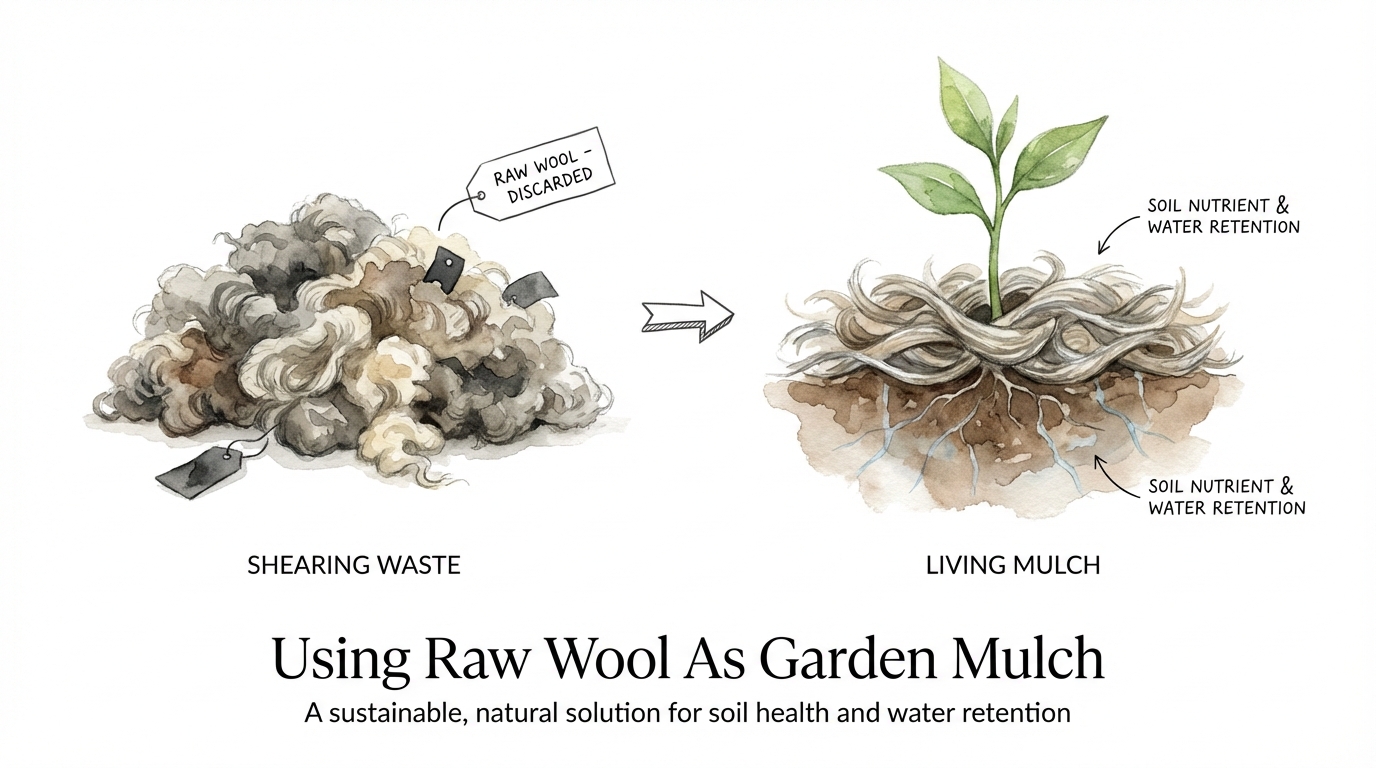
In the context of the homestead, we call this SHEARING WASTE vs LIVING MULCH. While straw or wood chips are common, wool offers a density and biological complexity they lack. It acts as a heavy blanket for the earth, protecting the delicate microbiome beneath from the searing sun and the drying wind. It is a thick, felted barrier that weeds find nearly impossible to penetrate.
Think of it as a biological armor for your plants. While most mulches eventually break down into carbon, wool provides a steady stream of nitrogen. It is a slow-motion feeding system. As the wool sits on the surface, the rain washes the nutrients out of the fibers and directly into the root zone of your vegetables.
How It Works / How to Do It
The process begins on shearing day. As the shearer works, the “skirtings” fall to the edges. These are the bits from the legs, the belly, and the breech area. They are often stained with manure or grease. Collect these in burlap sacks or old feed bags. You don’t need to wash them; in fact, the “dirtier” the better, as the manure adds an extra kick of nutrients.
To apply it in the garden, wait until your seedlings are at least four to six inches tall. You want the plant to have enough height so it won’t be smothered by the density of the wool. Gently pull a handful of wool apart—don’t cut it, just tease the fibers—and wrap it around the base of the plant. Aim for a thickness of about two inches.
The Layering Technique: If you are mulching a large area or a row of garlic, you can lay the fleeces down like a carpet. Overlap the edges of the wool clumps to ensure there are no gaps. Sunlight is the enemy of weed suppression; if the sun can’t reach the soil, the weeds can’t grow. Once the wool is down, give it a good soaking with a hose. This helps the fibers mat together and “set” against the soil.
You can also use wool in the bottom of pots or raised beds. A layer of raw wool at the bottom of a container acts as a reservoir. It holds onto water that would otherwise drain out, keeping the soil moist during the heat of July. As the wool eventually breaks down over several seasons, it improves the soil structure and aeration.
The Science of the Fiber
Wool is unique because it is hygroscopic. It doesn’t just hold water between the fibers; it actually absorbs moisture into the core of the fiber itself. This means it can regulate moisture levels. When the soil is too wet, the wool pulls some of that moisture away. When the soil is dry, the wool releases its stored reservoir back into the ground.
Furthermore, the nitrogen content in wool is impressive, often ranging from 9% to 17%. This is significantly higher than most composted manures. Because the nitrogen is bound in the keratin protein, it doesn’t leach away in a single rainstorm. It is a “slow-burn” fertilizer that can nourish a plant for two or three growing seasons before the fiber fully disappears.
Benefits / Advantages
The advantages of using raw wool extend far beyond simple weed suppression. It is a multi-functional tool that solves several garden problems simultaneously. For the self-reliant gardener, it is the ultimate “set it and forget it” mulch.
- Unrivaled Water Retention: In drought-prone areas, wool is a lifesaver. It acts like a sponge, holding 20 times its weight in water and preventing evaporation from the soil surface.
- Natural Slug and Snail Deterrent: The microscopic scales on wool fibers, combined with the residual lanolin, make it incredibly uncomfortable for soft-bodied pests to crawl over. It’s a natural barrier that doesn’t require chemicals.
- Temperature Regulation: Just as wool keeps a sheep warm in winter and cool in summer, it does the same for the soil. It insulates the roots against late spring frosts and keeps them cool during mid-summer heatwaves.
- Slow-Release Nutrition: It provides a steady supply of nitrogen, sulfur, and potassium as it slowly biodegrades, reducing the need for supplemental liquid fertilizers.
- Longevity: Unlike straw which might disappear in a single season, a thick layer of wool mulch can last for two or even three years depending on your climate and soil activity.
Challenges / Common Mistakes
While wool is a miracle mulch, there are a few pitfalls for the unwary homesteader. The most common mistake is applying it too thinly. If the wool isn’t thick enough to mat together, weeds will simply grow through it, and it won’t hold enough moisture to be effective. Think “quilt,” not “cobweb.”
The “Aroma” Factor: Raw, unwashed wool has a distinct smell. This is the scent of the flock—a mix of lanolin and sheep musk. In a backyard garden near a patio, this might be off-putting for the first few weeks. However, after a few heavy rains, the scent fades significantly. If the smell bothers you, cover the wool with a thin layer of wood chips or dried leaves to mask it.
Another challenge is the “bird theft” phenomenon. Birds love wool for their nests. If you don’t wet the wool down thoroughly or tuck it in well, you might find your garden mulch disappearing as the local robin population decides to upgrade their housing to luxury insulated suites. Simply weighting the wool with a bit of soil or a few stones can prevent this.
Finally, be aware of the source of your wool. If the sheep were recently treated with external chemical pesticides for ticks or lice, those residues may be present in the wool. Always ask the shepherd about their flock management practices if you aren’t using your own wool. For a truly organic garden, you want wool from “clean” sheep.
Comparing Mulch Options
To understand why wool is the “gold standard” for the pioneer-minded gardener, it helps to see how it stacks up against traditional materials. Many gardeners default to straw or wood chips without realizing the biological cost or the frequency of reapplication.
| Feature | Raw Wool Mulch | Wheat Straw | Wood Chips |
|---|---|---|---|
| Nutrient Content | High Nitrogen & Sulfur | Low / Carbon Heavy | Very Low / Nitrogen Tie-up |
| Water Retention | Exceptional (20x weight) | Moderate | Low |
| Decomposition Rate | Slow (1–3 years) | Fast (3–6 months) | Very Slow (2–4 years) |
| Pest Control | Deters slugs/snails | Can harbor slugs | Can harbor termites/ants |
| Cost | Free (if skirted) | $5–$15 per bale | Moderate to High |
As the table shows, wool outperforms straw in almost every category. While wood chips last a long time, they can actually pull nitrogen out of the soil as they break down, which can stunt the growth of young vegetable plants. Wool does the exact opposite: it feeds the soil as it protects it.
Practical Tips / Best Practices
If you are ready to implement this ancestral wisdom in your garden, follow these best practices to ensure success. Precision in application leads to abundance in the harvest. Don’t be afraid to get your hands dirty; the lanolin in the wool is actually excellent for your skin.
- Use the “Dirty” Bits: Don’t waste the prime fleece on the garden. Use the belly wool, the “tags” (the manure-caked bits), and the neck wool. These have the highest concentration of nitrogen and suint.
- The Tomato Trick: Tomatoes are heavy feeders and love consistent moisture. Wrap a thick donut of wool around each tomato plant. You will see less blossom end rot because the moisture levels stay stable.
- Potting Reservoir: When potting up perennials, place a 2-inch layer of wool at the bottom of the pot. It acts as a wick, pulling moisture up and providing long-term food for the plant.
- Winter Protection: Use wool to mulch your garlic beds in the fall. The insulation properties protect the cloves from extreme freeze-thaw cycles, and the wool will be perfectly primed to release nitrogen just as the garlic starts its spring growth spurt.
- Fall Cleanup: At the end of the season, don’t remove the wool. Simply pile more organic matter on top or leave it to continue breaking down. By the following spring, the underside of the wool will be teeming with earthworms.
The Role of Lanolin
Lanolin is the natural oil produced by sheep to protect their wool and skin. In the garden, this grease acts as a mild water repellent on the top of the fiber, while the inside of the fiber absorbs water. This creates a unique “dry top, wet bottom” environment. It keeps the soil moist while preventing the surface from becoming a soggy breeding ground for fungal gnats.
Furthermore, the lanolin has a waxy consistency that slugs simply cannot stand. It gums up their movement. By creating a wool barrier around your most prized hostas or lettuce, you are creating a physical and chemical deterrent that is 100% natural. It is a level of protection that straw or hay simply cannot provide.
Final Thoughts
The transition from viewing wool skirtings as “waste” to viewing them as “wealth” is a hallmark of the self-reliant homesteader. It is a return to a way of life where nothing is squandered and every byproduct of the farm serves a purpose. When you lay that wool down in your garden, you are connecting your livestock to your produce in a way that creates a truly resilient ecosystem.
This is more than just a gardening tip; it is a philosophy of stewardship. It’s about recognizing that the “trash” of today is the fertility of tomorrow. By utilizing raw wool, you reduce your reliance on external inputs, save money, and build soil health that will last for generations. The grit of the pioneer is found in these small, wise choices.
Next time shearing day rolls around, don’t let those bags of skirtings leave the farm. Carry them to your garden beds instead. Your plants will thank you with a lush, green abundance that only the ancient wisdom of the flock can provide. The earth remembers these old ways, and it rewards those who take the time to practice them.
