How To Become More Self-Sufficient Without Starting a Full-Blown Farm…
Want to start preserving your harvest, making your own soap, or building a backyard root cellar — but not sure where to begin? “Homesteading Advice” gives you instant lifetime access to 35+ practical homesteading books on food preservation, veggie gardening, DIY natural cleaning products (save over $250 per year with this skill alone), brewing, off-grid energy, and a whole lot more…
Click Here To Check It Out Now!
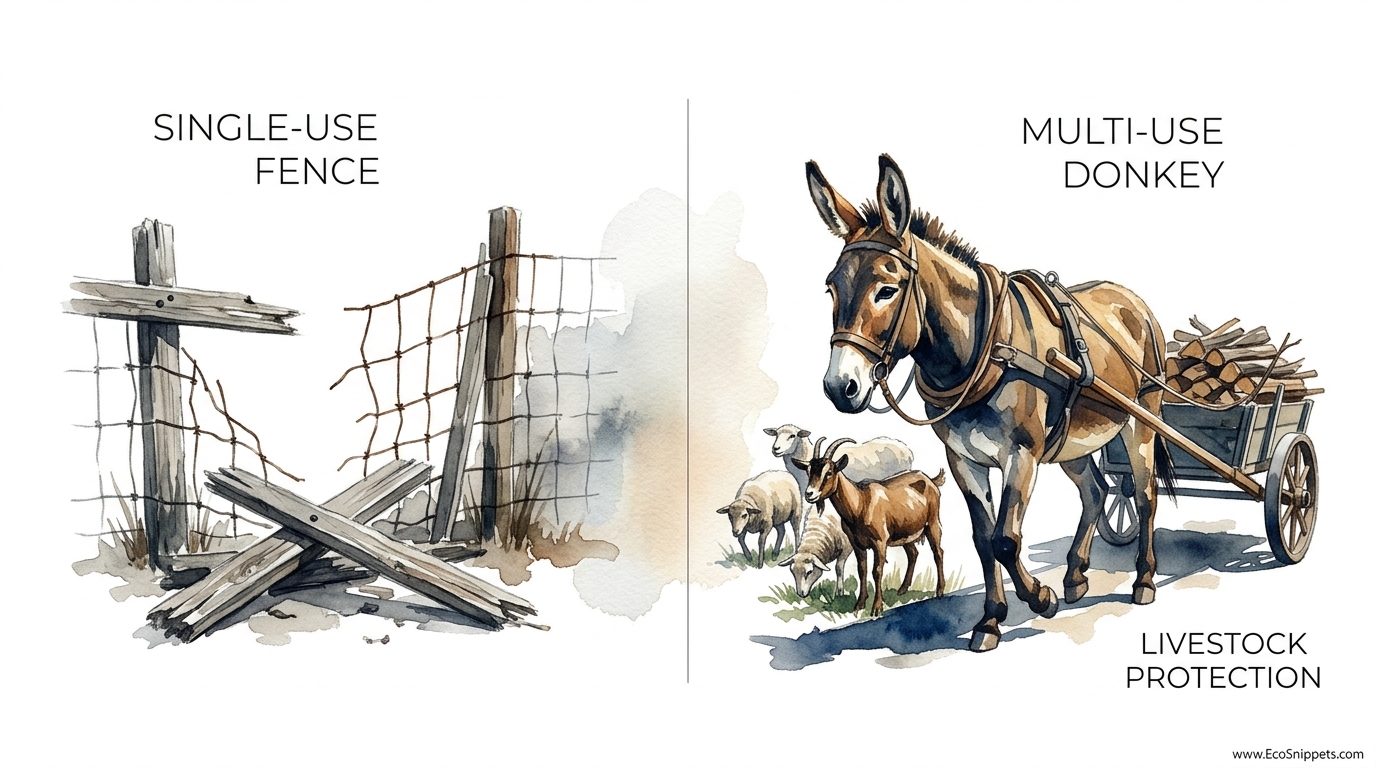
A fence just stands there and rusts, but this animal protects your flock, hauls your water, and clears your brush for the price of grass. Why pay for a fence that does nothing but rust? Meet the 3-in-1 animal that guards your goats, hauls your wood, and mows your grass without a drop of gasoline.
In an age of expensive machinery and high-tech security, we often overlook the simplest, most effective tools handed down by our ancestors. The donkey is a cornerstone of the self-reliant homestead. It is a creature that asks for very little—mostly just a bit of dry ground and some fibrous forage—and gives back in security, labor, and land management. If you are tired of the constant maintenance of single-use equipment, it is time to look at the multi-use donkey.
Using Donkeys For Livestock Protection And Draft Work
The working donkey is not merely a pet or a lawn ornament; it is a specialized biological tool with a history stretching back thousands of years. Unlike horses, which evolved to flee from danger, donkeys evolved in arid, rocky environments where running was not always an option. This shaped their psychology into one of “fight or stand ground.” When a canine predator enters their territory, a donkey does not typically run away. It squares its shoulders, lowers its head, and assesses the threat with a calculated intensity.
In a modern livestock setting, this instinctual behavior makes them formidable guardians. They possess an inherent, deep-seated dislike for canids, including coyotes, foxes, and stray dogs. While a fence is a passive barrier that a hungry coyote can eventually dig under or jump over, a donkey is an active deterrent. It uses its voice—a loud, piercing bray that can be heard for miles—as an alarm system and its hooves as weapons.
Beyond protection, the donkey serves as the “poor man’s tractor.” While they are smaller than most draft horses, pound-for-pound they are incredibly strong and have much higher endurance in heat. They can be trained to pull carts, haul water in panniers, or carry heavy loads of firewood through timber where no vehicle can fit. This dual-purpose nature is what makes them indispensable for anyone looking to increase their farm’s efficiency without increasing their fuel bill.
How the Guarding and Draft System Works
Integrating a donkey into your operation requires understanding two distinct skill sets: the social bonding required for guarding and the technical training required for draft work. These do not happen overnight, but the process is straightforward if you respect the animal’s intelligence.
The Bonding Process for Guardians
To turn a donkey into a successful livestock guardian, you must facilitate a “flerd”—a term used to describe a multi-species group that lives and moves as a single unit. The most effective guardians are usually introduced to the flock at a young age, ideally under one year old. This allows them to grow up identifying the sheep or goats as their “family.”
Start by placing the donkey in a pen adjacent to your livestock for two to four weeks. This “neighborly visit” allows both species to get used to each other’s smells and sounds without the risk of a panicked collision. Once they are calm at the fence line, you can move them into the same pasture. For the first few days, observe them closely during feeding times, as this is when social friction is most likely to occur.
Transitioning to Draft and Pack Work
Training a donkey for draft work is a lesson in patience. You cannot force a donkey to do something it perceives as dangerous. Their legendary “stubbornness” is actually a highly developed sense of self-preservation. If a donkey stops, it is usually because it is processing a potential threat or a mechanical issue with the harness.
Begin with “ground driving.” This involves putting a halter and long lines on the donkey and walking behind it, teaching it to respond to voice commands like “walk on,” “whoa,” “back,” and “gee” (right) or “haw” (left). Only after the donkey is 100% responsive to these commands should you introduce a harness or a pack saddle.
When hauling water or wood, weight distribution is the most critical factor. A single donkey can typically carry 20% to 25% of its body weight in a pack. For a standard donkey weighing 500 lbs (227 kg), this means a comfortable load of about 100 lbs (45 kg) to 125 lbs (57 kg). If you are using a cart, a well-conditioned donkey can pull significantly more—often up to its own body weight or more if the terrain is flat and the cart has well-greased bearings.
Benefits of the Multi-Purpose Donkey
The primary advantage of a donkey over other guardians, like dogs, is the “maintenance-to-output” ratio. A livestock guardian dog (LGD) requires expensive, high-protein kibble and frequent veterinary interventions. A donkey, however, thrives on the same grass and brush your sheep are already eating.
- Longevity: Donkeys regularly live 30 to 40 years, meaning a single investment provides decades of service.
- Low Feed Costs: They are “easy keepers” with a highly efficient metabolism designed for low-quality forage.
- Dual Utility: No other guardian animal can also haul a 50-gallon (190-liter) water tank or a cord of wood.
- Active Deterrence: Their bray alone is often enough to discourage a coyote from even entering the pasture.
In terms of land management, donkeys are excellent browsers. While sheep prefer grass and goats prefer broadleaf weeds, donkeys will happily munch on thistles, brambles, and even some woody brush that other livestock avoid. This helps maintain a balanced pasture and prevents invasive species from taking over.
Challenges and Common Mistakes
The most frequent mistake new owners make is treating a donkey like a small horse. Their nutritional and medical needs are vastly different. Feeding a donkey high-quality alfalfa or grain is essentially “loving them to death.”
Overfeeding: Donkeys are prone to obesity, which leads to a life-threatening condition called laminitis or “founder.” They do best on a diet of barley straw and mature grass hay. If you see “fat pads” forming on their neck or rump, they are being overfed and are at high risk for metabolic issues.
Isolation: While you generally want only one donkey per flock to ensure it bonds with the sheep, donkeys are highly social. If they do not have a “job” or a “family,” they can become depressed or destructive. A lone donkey in a field with no other animals will often spend its time trying to escape or braying incessantly out of loneliness.
Lack of Training: A 500-lb (227 kg) animal that hasn’t been taught to lift its feet for the farrier is a liability. You must handle your donkey daily. Even if it is “just” a guardian, it needs to be lead-rope trained and comfortable with human touch so you can provide medical care or move it between pastures.
Limitations: When a Donkey is Not the Ideal Choice
It is important to be realistic about what a donkey can and cannot do. They are not invincible, and they are not a substitute for a pack of trained dogs in every scenario.
A donkey is a “flight or fight” animal that works best against single or small groups of canine predators like coyotes or stray dogs. They are generally less effective against large packs of wolves or apex predators like mountain lions and bears. In those environments, the donkey itself may become the prey.
Environmental factors also play a role. Donkeys evolved in dry climates. Their hooves are more porous than horse hooves and are prone to “thrush” or “white line disease” if kept in perpetually muddy, wet conditions. If your homestead is in a swampy region, you will need to provide a dry, graveled area or a “sacrifice pad” where the donkey’s feet can dry out for several hours a day.
Comparison: Single-Use Fence vs. Multi-Use Donkey
To see the value of a working animal, one must look at the long-term investment. While a fence is necessary, it is a static cost. A donkey is a dynamic asset.
| Feature | Woven Wire Fence | Working Donkey |
|---|---|---|
| Initial Cost | High (materials + labor) | Moderate ($200–$800) |
| Maintenance | Periodic repair, clearing brush | Hoof trimming, basic forage |
| Predator Defense | Passive (can be bypassed) | Active (alarm and attack) |
| Secondary Utility | None | Hauling, packing, mowing |
| Life Span | 15–20 years (rust/wear) | 30–40 years |
Practical Tips for Success
If you are ready to bring a donkey onto your land, follow these best practices to ensure a smooth transition.
- Select the Right Gender: Jennies (females) and geldings (castrated males) make the best guardians. Intact males, or “jacks,” are often too aggressive and may accidentally kill the lambs or kids they are supposed to protect.
- Test the Instinct: Before buying, bring a dog (on a leash) near the donkey’s pen. A good guardian prospect will immediately alert, face the dog, and move toward it. If the donkey hides or ignores the dog, it likely lacks the necessary drive.
- Hoof Care is Non-Negotiable: Schedule a farrier every 6 to 8 weeks. Donkey hooves grow differently than horse hooves; they are more upright. Ensure your farrier is experienced with donkeys specifically.
- Watch for Lungworm: Donkeys can carry lungworm without showing many symptoms, but they can pass it to horses, where it causes severe respiratory distress. If you keep both species, ensure your deworming protocol (typically ivermectin or moxidectin) is strictly followed.
Advanced Considerations: Scaling and Efficiency
For those looking to move beyond basic homesteading, donkeys can be integrated into larger-scale regenerative agriculture systems. Using a donkey for “brush hogging” or targeted grazing can significantly reduce the need for mechanical mowing.
By using “strip grazing” with portable electric fencing, you can force the donkey to clear specific areas of dense brush. Because their digestive system is so efficient, they can process the tough cellulose of woody plants that would cause bloat in cattle.
If you are training multiple donkeys for draft work, consider the “swingle tree” setup. A swingle tree is a wooden bar that balances the pull of the harness. It allows the donkey to move its shoulders freely, preventing the sores and rub marks common with poorly designed equipment. For serious hauling, a full collar is superior to a breast strap, as it distributes the weight across the donkey’s skeletal structure rather than just the soft tissue of the chest.
Example Scenario: The 5-Acre Woodlot
Imagine a small homestead with 10 goats and a 5-acre woodlot that needs clearing. The owner has a choice: rent a mechanical brush cutter and buy a security camera, or buy a $300 gelded donkey.
The donkey is introduced to the goats over three weeks. Within a month, the donkey is not only patrolling the perimeter, keeping the local coyotes at bay, but is also spending its afternoons eating the invasive multiflora rose that the goats won’t touch.
On Saturdays, the owner fits the donkey with a simple wooden pack frame. They walk into the woodlot together, and the donkey carries 80 lbs (36 kg) of split oak back to the house in each trip. The owner saves on gasoline, reduces soil compaction from heavy machinery, and has a guardian that watches the flock while they sleep. This is the definition of homesteading efficiency.
Final Thoughts
The donkey is a testament to the wisdom of the past. It is an animal that fulfills multiple roles with a level of reliability that no machine can match. By choosing a multi-use animal over single-use technology, you are building a layer of resilience into your life that pays dividends in both security and labor.
Whether you are looking to protect a small flock of sheep or need a way to move water to remote pastures, the donkey is a solution that grows on the very grass beneath your feet. It requires patience and a willingness to understand a different kind of intelligence, but the reward is a loyal partner that works for the price of a little straw and a dry place to stand.
Take the time to find the right animal, invest in its training, and respect its unique needs. You will find that the “stubborn” donkey is actually the most hardworking and observant member of your farm team, standing watch when you cannot and carrying the loads that would break a lesser creature.
