How To Become More Self-Sufficient Without Starting a Full-Blown Farm…
Want to start preserving your harvest, making your own soap, or building a backyard root cellar — but not sure where to begin? “Homesteading Advice” gives you instant lifetime access to 35+ practical homesteading books on food preservation, veggie gardening, DIY natural cleaning products (save over $250 per year with this skill alone), brewing, off-grid energy, and a whole lot more…
Click Here To Check It Out Now!
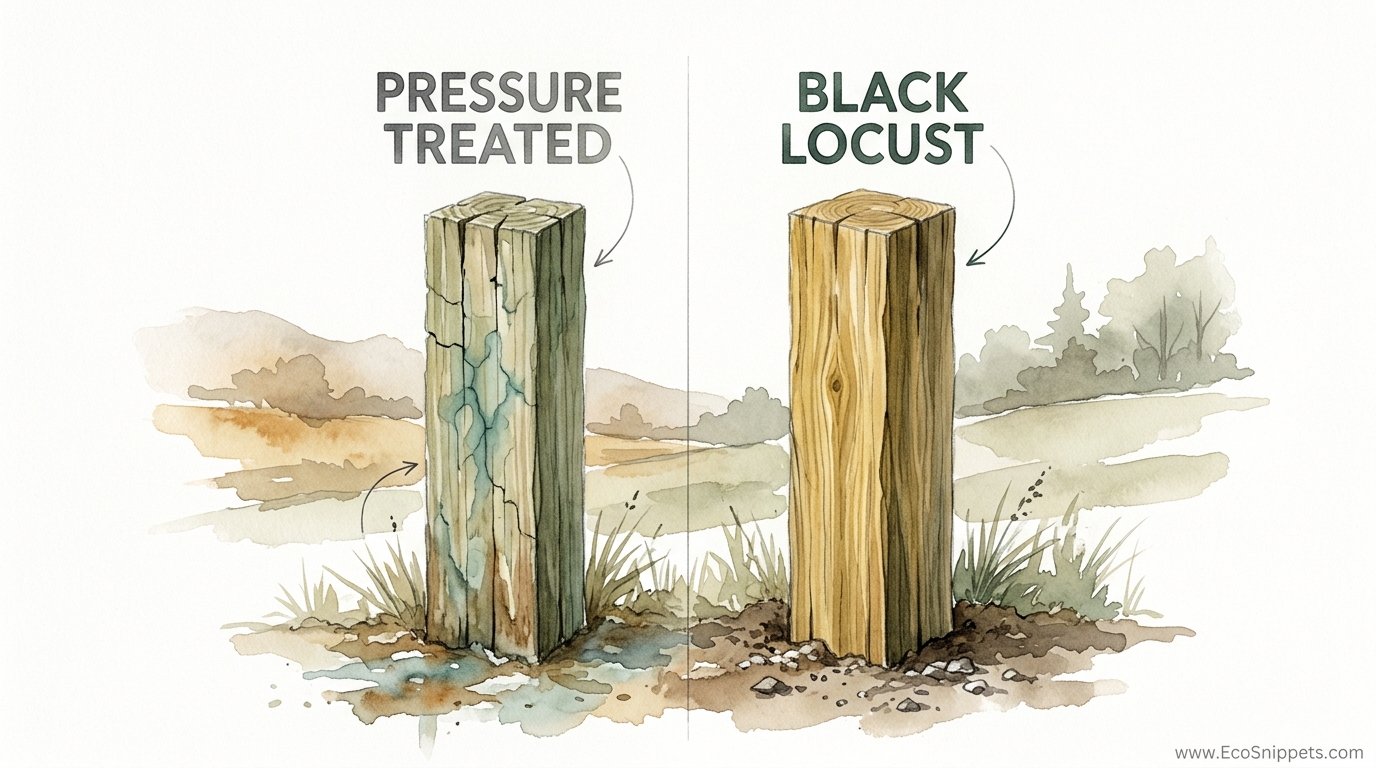
One of these posts is a ticking clock of toxic rot; the other will still be standing when your grandchildren take over the land. We were sold a lie that chemicals make wood “permanent.” The truth is, pressure-treated lumber often fails within 15 years, all while leaching toxins into your organic soil. Black Locust is nature’s answer – a wood so dense and rot-resistant it can stay in the ground for 100 years without a single drop of poison. Invest in timber that builds a legacy, not a landfill.
If you have ever pulled a “30-year” pressure-treated post out of the ground after just a decade only to find it snapped like a cracker, you know the frustration of modern materials. We are told that saturated softwoods are the pinnacle of agricultural engineering, yet the old-timers knew better. They looked to the hills for the tree that survives where others fail.
This guide explores the mechanics, the biology, and the practical application of the toughest timber on the continent. Whether you are fencing a small homestead or thousands of acres of pasture, understanding this material is the first step toward true self-reliance.
Black Locust Wood For Rot Resistant Fence Posts
Black Locust, known scientifically as Robinia pseudoacacia, is a hardwood native to the Appalachian and Ozark Mountains, though it has naturalized across much of North America and Europe. It is not just another tree; it is a biological fortress. While most woods rely on the bark for protection, Black Locust protects its very core through a unique combination of high density and natural chemical warfare.
This wood is frequently cited as the most rot-resistant timber in the temperate world. In real-world terms, a Black Locust post buried in moist, microbial-heavy soil can easily last 50 to 80 years, with many documented cases of posts reaching the century mark. For context, a standard pressure-treated pine post is considered “successful” if it reaches 20 years without structural failure.
The tree itself is a pioneer species, often the first to reclaim disturbed soil or old mining sites. It grows aggressively, putting on 2 to 4 feet (0.6 to 1.2 meters) of height per year when young. This rapid growth might lead you to believe the wood is soft or porous, but the opposite is true. The tree concentrates minerals and complex organic compounds into its heartwood, creating a material so hard it was historically used for ship-building “treenails” and police truncheons.
Farmers and homesteaders prize Black Locust because it eliminates the need for the “poison soup” found in industrial lumber. Pressure-treated wood is often infused with copper, micronized azoles, or, in older stocks, chromated copper arsenate (CCA). These chemicals are designed to kill the fungi and insects that eat wood, but they also leach into the surrounding soil, affecting the very earth you are trying to cultivate. Black Locust achieves the same result—and better—using only the chemistry provided by the sun and the soil.
How the Wood Resists Decay and Insects
To understand why Black Locust outlasts concrete and steel in some environments, you have to look at its microscopic structure. Most hardwoods have open “vessels” or tubes that transport water and nutrients. When a tree is cut, these tubes become open highways for moisture, fungus, and bacteria to enter the center of the wood and begin the rot process.
Black Locust employs a defensive mechanism called tyloses. These are balloon-like outgrowths of the wood’s cells that effectively “clog” the water-conducting vessels as the wood transitions from sapwood to heartwood. Imagine a plumbing system where every pipe is filled with high-strength epoxy once it is no longer needed. This makes the heartwood almost entirely waterproof from the inside out.
Beyond the physical blockage, the wood is saturated with flavonoids and robinin. These are natural anti-fungal and anti-insect compounds. When a subterranean termite or a wood-decay fungus attempts to bridge the gap into a Black Locust post, they encounter a toxic environment that is entirely organic but deadly to their metabolism.
In the workshop or the field, this manifests as extreme density. Black Locust has a Janka hardness rating of 1,700 lbf (7,560 N), making it significantly harder than White Oak (1,360 lbf) or Hickory. It weighs approximately 48 pounds per cubic foot (770 kg/m³) when dried. This density, combined with the vessel-clogging tyloses, means that even without paint, stain, or oil, the wood simply refuses to absorb the moisture required for rot to take hold.
How to Select and Install Black Locust Fence Posts
Working with a material this tough requires a different mindset than working with store-bought 4x4s. You cannot simply drive a staple into a dry Black Locust post and expect it to hold; you will more likely bend the staple or shatter the wood.
Sourcing the Posts:
The best posts come from “woods-grown” trees rather than those grown in open fields. Trees grown in a dense forest reach for the light, creating straight, clear trunks with minimal branches. If you are buying from a local sawmill or logger, look for “heartwood only” posts. The sapwood—the light-colored outer ring of the tree—is not rot-resistant. It will decay in 3 to 5 years, leaving the durable heartwood core intact but potentially loosening your fence wire.
Debarking:
Always remove the bark before putting a post in the ground. Bark holds moisture against the wood and provides a sanctuary for wood-boring beetles. If you harvest the trees in the spring when the “sap is up,” the bark will often peel off in long, satisfying strips with a simple spade or drawknife. If you harvest in the winter, you will need to put in more elbow grease.
Charring the Base (Optional):
A traditional technique involves lightly charring the bottom 3 feet (0.9 meters) of the post over a fire. This creates a layer of carbon (charcoal) that is even less attractive to microbes. While the heartwood is already rot-resistant, this “pioneer” method adds an extra layer of insurance for posts set in particularly swampy or acidic ground.
Setting the Post:
Avoid using concrete for Black Locust posts if possible. Concrete creates a “cup” that holds water against the base of the wood. Instead, use a gravel set. Dig your hole to a depth of at least 30 inches (76 cm), pour 4 inches (10 cm) of crushed stone or gravel at the bottom for drainage, and then backfill with more gravel, tamping it down every few inches. This allows water to drain away from the post, keeping the environment around the wood as dry as possible.
Benefits of Choosing Black Locust over Pressure-Treated Wood
The most immediate benefit is longevity. When you build a fence with Black Locust, you are likely building it for the last time in your life. In agricultural settings, the “cost per year” of a Black Locust post is significantly lower than pine, even if the upfront price is higher.
Soil Health and Safety:
For organic gardeners and livestock producers, the chemical-free nature of the wood is the primary draw. Pressure-treated wood can leach copper and other fungicides into the soil. If you are building raised beds or fencing a vegetable garden, those chemicals can be taken up by the roots of your plants. Black Locust is “food grade” by nature.
Structural Strength:
Because it is so dense, Black Locust has an incredible crushing strength of 10,200 psi (70.3 MPa). This makes it ideal for high-tension fences, such as those used for cattle or horses. It does not flex or “creep” over time like softwoods often do under the pressure of a strained wire.
Sustainability:
Black Locust is a nitrogen-fixing legume. As it grows, it actually improves the soil by pulling nitrogen from the air and storing it in root nodules. It is a renewable resource that can be “coppiced”—meaning you can cut the tree down, and it will regrow from the stump, providing a new crop of fence posts every 15 to 20 years without ever needing to replant.
Challenges and Common Mistakes
The biggest challenge is the hardness of the material. Attempting to use a standard hammer and nails on seasoned Black Locust is a recipe for frustration. The wood becomes increasingly “iron-like” as it dries.
The Fastener Problem:
If you wait until the posts are bone-dry to attach your fencing, you will find it nearly impossible to drive staples. The most common mistake is failing to pre-drill. If you are using screws, you must drill a pilot hole. If you are using fence staples, try to install them while the wood is still “green” (freshly cut). If the wood is already dry, use shorter, high-quality galvanized staples and a heavy fencing pliers.
Tool Wear:
This wood has a high silica content and extreme density, which means it will dull your chainsaw chains and circular saw blades faster than almost any other domestic species. Always keep a file handy and expect to sharpen your tools twice as often. Carbide-tipped blades are a necessity, not a luxury.
Thorns:
Young Black Locust trees are covered in sharp, brittle thorns. If you are harvesting your own timber, these can easily pierce heavy leather gloves or tractor tires. Handling the wood requires constant vigilance until the bark and branches are cleared.
Limitations: When Black Locust May Not Be Ideal
Despite its “super-wood” status, Black Locust is not the answer for every single project.
Availability and Cost:
Because the tree often grows with a “twist” or “crook,” it is difficult to mill into perfectly straight dimensional lumber (like a 2×4). This makes straight Black Locust posts more expensive and harder to find than mass-produced pine. If you live in the Pacific Northwest or the Deep South, you may have to pay significant shipping costs to get quality locust, which might offset the longevity benefits.
Locust Borer and Heart Rot:
In some regions, the Megacyllene robiniae (Locust Borer) beetle attacks living trees. These insects tunnel through the wood, creating pathways for a fungus called Fomes rimosus, which causes heart rot. If you are harvesting wild trees, you may find that some are already “hollow” or weakened at the core. You must inspect every post; a post with active heart rot will not provide the legendary 50-year lifespan.
Invasive Potential:
Because it spreads via root suckers and seeds, Black Locust can become invasive in certain ecosystems, particularly in the western United States or parts of Europe where it has no natural competition. Before planting a grove for future timber, check your local agricultural extension guidelines to ensure you aren’t introducing a problem for your neighbors.
Comparison Table: Black Locust vs. Alternatives
| Feature | Black Locust | Pressure-Treated Pine | Western Red Cedar |
|---|---|---|---|
| Lifespan (In-Ground) | 50–100 Years | 10–25 Years | 15–25 Years |
| Chemical Toxicity | None (All Natural) | High (Leaches Metals) | None (All Natural) |
| Hardness (Janka) | 1,700 lbf | ~690 lbf | ~350 lbf |
| Workability | Difficult (Requires Pre-drilling) | Easy | Very Easy |
| Environmental Impact | Positive (Nitrogen Fixing) | Negative (Landfill Hazard) | Neutral (Old Growth Issues) |
Practical Tips for Working with Locust
If you are committing to a Black Locust fence, follow these best practices to ensure success:
- Use Stainless Steel Fasteners: Black Locust contains natural tannic acids that can react with standard steel, causing black streaks and premature corrosion of the nail or screw. Stainless steel or high-quality ceramic-coated fasteners will last as long as the wood.
- Seal the End Grain: While the wood is rot-resistant, the ends are prone to “checking” or splitting as they dry. Applying a simple wax-based end-sealer to the top of your posts can prevent these cracks from widening.
- Orientation Matters: When setting the post, place the “butt end” (the part of the tree that was closest to the roots) in the ground. Traditional wisdom suggests this helps with the natural flow of moisture and keeps the post sound for longer.
- Handle with Care: Because the wood is so heavy, a 7-foot (2.1-meter) post can easily weigh twice as much as a pine equivalent. Use proper lifting techniques or mechanical help to avoid injury.
Advanced Considerations: The Permanent Timber Crop
For those looking toward the future, Black Locust offers an opportunity for silvopasture. This is the practice of integrating trees and livestock on the same land. Because Black Locust leaves are high in protein (comparable to alfalfa), they make excellent forage for sheep and goats.
Serious practitioners often plant “post plantations” using high-quality genetically selected clones. These clones are bred to grow straight as a flagpole, unlike the crooked wild varieties. By planting these on a 10-foot (3-meter) spacing, a landowner can harvest a “crop” of 400 straight fence posts per acre every 15 years.
Furthermore, the nitrogen-fixing properties of the roots mean you can grow high-quality pasture grass right up to the base of the tree. The light, dappled shade provided by the locust canopy prevents the grass from scorching in the summer while still allowing enough light for photosynthesis. It is a closed-loop system that provides shade for animals, fertility for the soil, and a perpetual supply of the world’s best fencing material.
Historical Scenarios: The Century Post
Consider the case of the Blue Ridge mountain farmers in the early 1900s. Faced with steep terrain and high rainfall, they couldn’t afford to replace fences every decade. They utilized Black Locust for everything from the foundations of their cabins to the stakes in their vineyards.
One documented example involves a farm in West Virginia where fence posts installed in 1922 were pulled up in 2015. While the sapwood had long since vanished, the heartwood was so sound that the farmer simply moved the posts to a new fenceline and re-stapled the wire. This isn’t just “good” lumber; it is a generational asset. In a world of planned obsolescence, Black Locust remains one of the few materials that respects the labor of the person who installed it.
Final Thoughts
Building with Black Locust is an act of defiance against a “throwaway” culture. It requires more effort to source, more strength to handle, and more patience to install, but the reward is a structure that outlives its creator. By choosing a wood that relies on its own natural defenses rather than toxic chemical infusions, you are protecting your soil, your livestock, and your legacy.
As you plan your next fencing project, ask yourself if you want to do the job once or if you want to do it every fifteen years. The answer is usually found in the dense, golden-brown grain of the locust tree. Whether you harvest it from your own woodlot or source it from a local sawyer, you are investing in a piece of the earth that stays where you put it.
The old ways weren’t just about tradition; they were about what worked. In the battle against rot and time, Black Locust remains the undisputed champion. Take the time to do it right, use the right fasteners, and let nature’s toughest timber stand guard over your land for the next century.
