How To Become More Self-Sufficient Without Starting a Full-Blown Farm…
Want to start preserving your harvest, making your own soap, or building a backyard root cellar — but not sure where to begin? “Homesteading Advice” gives you instant lifetime access to 35+ practical homesteading books on food preservation, veggie gardening, DIY natural cleaning products (save over $250 per year with this skill alone), brewing, off-grid energy, and a whole lot more…
Click Here To Check It Out Now!
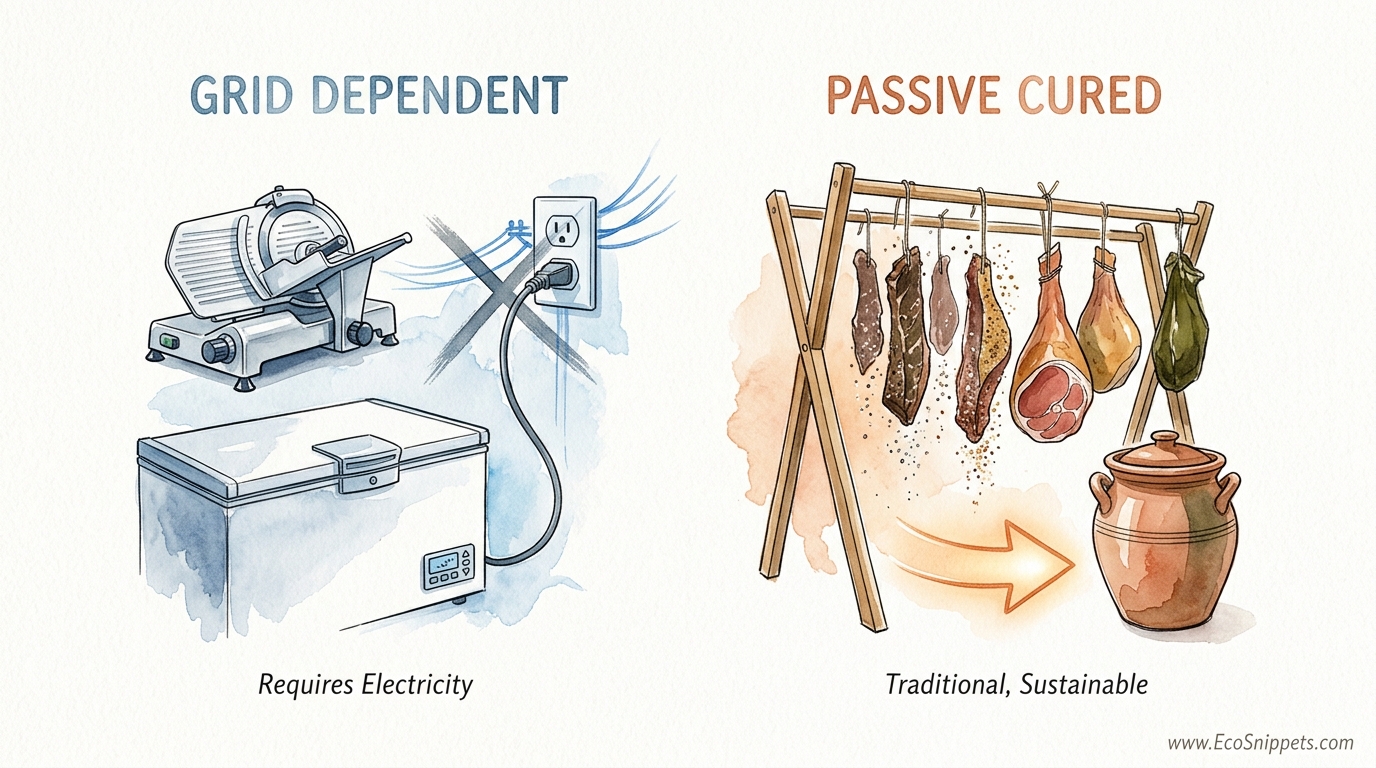
One costs $2.00 a day in electricity; the other uses the free movement of air and the rhythm of the seasons to create perfection. Industrial preservation wants you to believe you need ‘smart’ appliances to keep meat safe. But the world’s most prized hams—Prosciutto and Serrano—have been made for centuries using nothing but salt and air. Mastering passive airflow allows you to preserve an entire year’s harvest without spending a cent on the grid.
Traditional charcuterie is more than a culinary hobby; it is a masterclass in atmospheric management. Learning to work with nature rather than against it turns a perishable commodity into a shelf-stable treasure. This guide explores how you can harness the environment to transform raw muscle into artisanal delicacy.
Passive Meat Preservation Techniques
Passive meat preservation is the art of using environmental conditions—temperature, humidity, and airflow—to remove moisture from meat before spoilage can occur. This technique relies on the physical law of osmosis. When meat is coated in salt, the high concentration of minerals on the surface pulls liquid from the interior cells. This process effectively starves the bacteria that require moisture to survive.
Historically, cultures around the world developed these methods out of necessity. In the mountains of Spain, the dry, cold air of the Sierra Nevada creates the perfect conditions for Jamón Serrano. In the humid river valleys of Italy, the specific breezes of the Parma region allow Prosciutto to age for years without rotting. These regions do not use mechanical fans or compressors; they use the “architecture of the air.”
Common passive techniques include dry-curing whole muscles, such as the hind leg of a hog or the loin of a cow. Unlike modern industrial methods that inject brine to add weight, passive curing focuses on weight loss. The goal is a 30% to 35% reduction in total mass through evaporation. This concentration of proteins and fats creates a depth of flavor that a refrigerator simply cannot replicate.
The Biological Mechanics: How Salt and Air Preserve Meat
Successful preservation requires a fundamental understanding of water activity ($a_w$). Bacteria like Staphylococcus aureus and Clostridium botulinum thrive in environments where water is readily available. Salt acts as the primary defense by binding with water molecules, making them unavailable to pathogens.
Airflow serves as the secondary defense. As salt draws moisture to the surface, the movement of air must carry that moisture away. If the air is stagnant, the surface remains damp, which can invite “bad” molds or rot. Conversely, if the air moves too quickly, the surface hardens into a leathery crust that traps moisture inside—a dangerous condition known as case hardening.
Temperature control is the final pillar. Traditional curing begins in the cold months, usually between 1°C and 4°C (34°F to 39°F). This cold “winter” phase allows the salt to penetrate the core of the meat while the temperature remains too low for bacterial bloom. As the seasons transition into “spring,” the temperature rises to 10°C–15°C (50°F–59°F), which activates natural enzymes that break down fats into aromatic compounds.
The Role of Good vs. Bad Mold
Beginners often panic at the sight of mold, but a passive environment thrives on “good” flora. Beneficial molds, specifically Penicillium nalgiovense, appear as a white, powdery dusting. This mold protects the meat by consuming oxygen at the surface and outcompeting harmful pathogens. It also contributes to the signature “earthy” aroma found in premium salami.
Harmful molds are typically hairy, black, or neon green. These are often the result of poor airflow or excessive humidity above 85%. Wiping the surface with a 50/50 solution of apple cider vinegar and water can often save a piece if the infestation is caught early. Consistency in your environment is the best preventative measure against these unwanted invaders.
The Benefits of Passive Air Curing
Choosing passive methods over grid-dependent refrigeration offers more than just financial savings. The primary advantage is the development of complex flavor profiles. In a refrigerator, enzymes are essentially dormant. In a passive aging room or cellar, these enzymes work slowly over 12 to 24 months, transforming tough connective tissue into buttery, melt-on-the-tongue fat.
Self-reliance is another significant factor. A power outage that lasts a week can ruin a freezer full of meat, costing thousands of dollars in lost harvest. A properly cured ham hanging in a cellar is immune to grid failure. It is a biological battery—stored energy that remains safe to eat for years without a single watt of power.
Nutritionally, air-cured meats are incredibly dense. Because they lose more than a third of their weight in water, the remaining meat is packed with concentrated minerals and high-quality fats. When produced using traditional sea salt and high-quality pork, these hams contain no synthetic nitrates or “pink salts” often found in commercial deli meats.
Common Challenges and Pitfalls
The most frequent mistake for the modern practitioner is failing to manage humidity. Home environments are often too dry due to central heating. If the relative humidity (RH) drops below 60%, the exterior of the meat will dry too fast. This creates a hard shell that prevents the interior from drying, leading to “bone sour” or internal rot.
Pest management is the second-largest hurdle. In a passive setup, you are competing with nature. Flies, specifically “blowflies,” look for damp crevices in the meat to lay eggs. Traditionally, makers solved this by using muslin or linen bags. These breathable fabrics allow air to pass through while creating a physical barrier that insects cannot penetrate.
Fluctuating temperatures can also pose a risk. While traditional cellars are naturally stable, a shed or attic might experience 20-degree swings in a single day. These swings stress the meat and can cause the fat to oxidize and turn rancid. Stability is more important than achieving a “perfect” temperature; a steady 13°C (55°F) is far better than a room that bounces between 5°C and 25°C.
Limitations of the Passive Method
Climate is the ultimate boundary for passive curing. If you live in a tropical region where the temperature never drops below 20°C (68°F) and the humidity is constantly at 95%, true passive air-curing is nearly impossible without mechanical assistance. These methods were perfected in temperate and Mediterranean climates that offer distinct seasonal shifts.
Space is another consideration. An entire leg of pork can take up to two years to reach its peak. This requires a dedicated, clean, and dark area where the meat will not be disturbed. Modern apartments often lack the “passive architecture” like unheated basements or cool, ventilated larders that made this practice a staple in rural households.
Finally, the method requires patience that our modern “instant gratification” culture struggles with. You cannot rush the movement of air or the rhythm of the seasons. If you try to eat an air-cured ham after only three months, it will be salty and tough. True success in this field is measured in seasons, not days.
GRID DEPENDENT vs. PASSIVE CURED
Understanding the differences between modern refrigeration and passive curing helps in choosing the right path for your homestead.
| Feature | Grid-Dependent Fridge | Passive Air Curing |
|---|---|---|
| Operating Cost | High ($600 – $800 annually) | Zero |
| Maintenance | Mechanical parts, fans, sensors | Cleaning, seasonal window adjustments |
| Risk of Loss | High (Power failure/Mechanical breakdown) | Low (Built-in shelf stability) |
| Flavor Profile | Static, mild, industrial | Complex, umami-rich, artisanal |
| Skill Level | Beginner (Set and forget) | Intermediate (Requires atmospheric awareness) |
| Ingredients | Often requires nitrites/nitrates | Sea salt, air, and time |
Practical Tips for the Modern Practitioner
Successful passive curing begins with the calendar. Start your projects in the late autumn or early winter when the air is naturally cool. This “salt-cure” phase should happen when temperatures are between 1°C and 5°C (34°F to 41°F). Utilizing the natural cold of a garage or unheated porch during these months ensures the meat remains safe while the salt migrates to the bone.
Investing in a simple hygrometer is the best way to train your senses. These inexpensive devices measure temperature and humidity. Place one in your potential curing area and monitor it for a week before hanging meat. Look for a “sweet spot” of 12°C (54°F) and 70% humidity. If the room is too dry, placing a pan of salt water on the floor can naturally boost the humidity through evaporation.
Monitoring weight loss is the only way to know for certain when the meat is safe to eat. Always weigh your meat before you begin and write the date and “green weight” on a tag attached to the hook. Check the weight every month. Once the piece has lost 30% of its original weight, the water activity is low enough to prevent spoilage, and it can be moved to a cooler “aging” area for further flavor development.
The Traditional “Sugna” Technique
One of the best ways to prevent case hardening in hams is the use of sugna. This is a paste made from rendered lard, rice flour (or wheat flour), and black pepper. After the first 6 to 8 months of drying, the lean muscle of the ham can become too dry. Masters in Italy smear this paste over the exposed meat surfaces. The lard slows down evaporation, allowing the ham to age for another 12 months without turning into a rock.
Advanced Considerations for Long-Term Storage
Experienced practitioners often build a “meat safe” or a salumeria room. This structure uses “passive ventilation” by placing screened vents at the bottom and top of the room. Cool air enters from the bottom, warms slightly as it passes over the curing meat, and exits through the top vent. This creates a natural chimney effect, ensuring that the air is always being exchanged without the need for electric fans.
Scaling your production requires careful attention to “bio-load.” If you hang ten hams in a small room, they will release a massive amount of moisture into the air simultaneously. This can spike the humidity to dangerous levels. Always stagger your projects so that some hams are in the early “wet” phase while others are in the later “dry” phase. This naturally balances the environment of your curing space.
For those wanting to take their craft further, consider the “Equilibrium Cure” (EQ). Instead of burying the meat in a box of salt, you calculate exactly 3% of the meat’s weight in salt and vacuum seal it or wrap it tightly. This ensures the meat never becomes “too salty” and allows you to control the exact mineral content of your final product. Once the salt is fully absorbed, the meat is then hung for the passive air-drying phase.
Scenario: Curing a 10kg (22lb) Leg of Pork
Imagine you have just harvested a hog in late November. You have a fresh 10kg (22lb) hind leg. First, you trim the “hock” and shape the ham to encourage even drying. You coat the leg in sea salt, using roughly 50 grams of salt per kilogram of meat (0.8oz per pound).
Place the ham in a cool area (3°C/37°F) for approximately 25 days. During this time, the salt penetrates the meat and liquid pools in the bottom of your curing tray. After 25 days, you wash the excess salt off with a little wine or vinegar and hang the ham in your cellar.
Over the next six months, the ham hangs in the dark. The spring air moves through the vents, slowly wicking away moisture. By June, the ham weighs 7.5kg (16.5lb). It has lost 25% of its weight. You notice the surface is becoming firm, so you apply a thick layer of lard and pepper (sugna) to the exposed meat. You leave it to hang through the heat of the summer and the following autumn. By the second December—one year later—it weighs 6.5kg (14.3lb). You slice into it to find a deep ruby-red center with white, creamy fat. It is shelf-stable, delicious, and was made entirely with the power of the seasons.
Final Thoughts
Passive meat preservation is a return to a rhythm of life that most have forgotten. It requires us to pay attention to the wind, the rain, and the shifting temperatures of our local environment. While the industrial world relies on a fragile grid to keep food edible, the practitioner of salt and air relies on wisdom passed down through generations.
The transition from a consumer of industrial meat to a producer of artisanal charcuterie is profoundly empowering. It turns your cellar or larder into a place of active creation rather than just storage. You learn to trust your senses—your nose to detect the sweet smell of good mold, and your hands to feel the firmness of a perfectly cured loin.
Begin with a small project like a Coppa or a Bresaola. These smaller muscles cure quickly and will give you the confidence to move toward a full leg of ham. As you master the architecture of airflow, you will find that the highest quality food in the world isn’t bought in a store; it is grown in the rhythm of the seasons right in your own home.
