How To Become More Self-Sufficient Without Starting a Full-Blown Farm…
Want to start preserving your harvest, making your own soap, or building a backyard root cellar — but not sure where to begin? “Homesteading Advice” gives you instant lifetime access to 35+ practical homesteading books on food preservation, veggie gardening, DIY natural cleaning products (save over $250 per year with this skill alone), brewing, off-grid energy, and a whole lot more…
Click Here To Check It Out Now!
You are wasting 90% of your time in the orchard by using your fingers when you should be using a comb. Are you still spending four hours picking enough berries for a single jar of jam? Our ancestors didn’t have time for that, and neither do you. See how a simple ‘comb and catch’ strategy can turn a weekend chore into a 15-minute victory.
Every homesteader knows the feeling of a heavy harvest season. The sun is high, the bushes are sagging with weight, and the pressure to preserve before the rot sets in is immense. You might feel a sense of romanticism in picking each blueberry one by one, but that romance fades quickly when you realize you have 20 more bushes to go and the shadows are lengthening.
Efficiency in the orchard isn’t about laziness; it is about stewardship. When you streamline the harvest, you ensure that more of the food you grew actually makes it to the table rather than feeding the local bird population or feeding the soil. Transitioning from a manual grind to a strategic flow allows you to handle larger volumes of produce with less physical toll on your body.
Efficient Fruit Picking Hacks For Homesteaders
Efficient fruit picking is the art of maximizing your yield while minimizing the time and physical effort required for the harvest. At its core, this concept revolves around using mechanical advantages—simple tools like combs, rakes, and baskets—to replace the slow, repetitive motion of individual finger-picking. This strategy is most commonly associated with small, clustered fruits like blueberries, huckleberries, lingonberries, and currants.
The “comb and catch” method relies on the physics of plant biology. Most ripe berries develop an abscission layer, a small zone of cells at the base of the stem that weakens as the fruit matures. A well-designed harvesting comb has tines spaced perfectly to allow branches and leaves to pass through while catching the round, plump fruit and pulling it gently from its connection point. This tool effectively does the work of ten pairs of hands in a single sweep.
Historical evidence shows that these tools are not modern inventions. Scandinavian cultures have used the “Bärplockare” or berry picker for centuries to harvest wild lingonberries and bilberries across vast forest floors. These ancestral designs were often carved from wood or fashioned from wire, proving that even without modern plastics, the need for speed in the harvest was a universal priority for survival. Today, we use these same principles to manage home orchards and wild foraging patches with professional-grade speed.
How the Comb and Catch Method Works
Mastering the berry comb requires a blend of gentle movement and firm intention. You cannot simply rip a tool through a bush and expect high-quality results. The process begins with selecting a comb with tines appropriate for your fruit. For example, blueberries require slightly wider spacing (about 5-8 mm or 0.2-0.3 inches) than smaller wild huckleberries.
To begin the harvest, approach the bush from the bottom and work your way up. Hold the branch gently with one hand and slide the tines of the comb underneath a cluster of fruit. Tilt the head of the picker upward so the internal “catch” or reservoir is positioned to receive the fruit. With a smooth, upward flick of the wrist, pull the comb through the cluster. The ripe berries will detach and roll into the container, while the flexible branches should slide through the gaps without breaking.
Underlying this technique is the principle of “selective tension.” Ripe fruit provides enough resistance to be caught by the comb, whereas unripe green berries are often smaller and firmer, allowing them to sometimes slip through or remain attached to the plant. This built-in sorting mechanism is one of the primary reasons the comb is superior to shaking the bush, which often drops everything—ripe, rotten, and green—onto the ground.
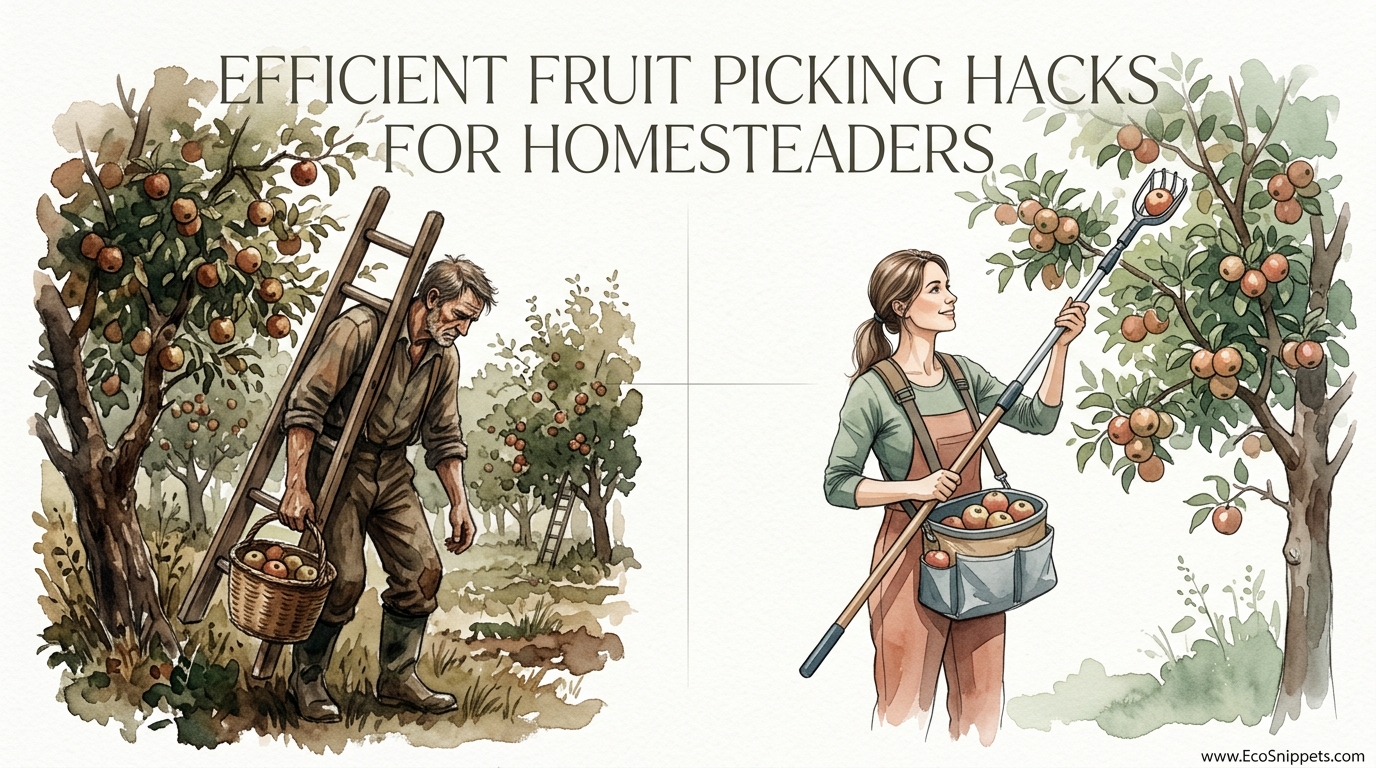
For tree fruits like apples or pears, the principle shifts from a comb to a “finger-and-basket” pole. These tools use a wire cage with rounded “fingers” at the top. You position the cage around the fruit and pull downward, allowing the fingers to snip the stem and drop the fruit into a padded bag. This avoids the use of ladders, which are the leading cause of injuries in the homestead orchard.
The Benefits of Strategic Harvesting
The most immediate advantage is the sheer volume of fruit you can process. A skilled picker using a comb can harvest between 5 and 10 kilograms (11 to 22 pounds) of blueberries in the time it takes a manual picker to gather a single liter (about 1 quart). This speed is critical during “peak ripeness” windows, which may only last a few days depending on the weather.
Ergonomics play a massive role in the long-term sustainability of a homestead. Manual picking involves thousands of repetitive pinching motions and hours of leaning over bushes. This leads to carpal tunnel issues and chronic back pain. Using a hand-held picker allows you to maintain a more neutral wrist position and complete the work faster, reducing the total time your body is under physical stress.
Yield quality also sees an improvement in a roundabout way. Because you can pick so much faster, you are more likely to harvest the entire crop at the perfect moment. Manual pickers often “triage” their harvest, leaving fruit on the back of the bush or at the top of the tree because they are too tired to continue. With efficient tools, no fruit is left behind to rot and attract pests like vinegar flies or wasps.
Challenges and Common Mistakes
The most frequent error beginners make is using too much force. If you find yourself pulling leaves and snapping twigs, you are likely moving too fast or the fruit isn’t actually ripe yet. A harvest comb is a precision tool, not a machete. Forcing the tines through a tangle of branches will damage the plant’s “fruiting wood,” which is the growth that will produce next year’s crop.
Managing debris is another significant challenge. Unlike hand-picking, where you carefully select only the berry, a comb will inevitably bring in some leaves, small twigs, and the occasional spider. If you aren’t prepared for the “cleaning phase” of the harvest, you may find the speed gains of picking are lost in the hours spent sorting at the kitchen table. You must treat the harvest and the cleaning as a single, unified system.
Unripe fruit collection is a secondary pitfall. While the comb is somewhat selective, it will always snag a few green berries. If your bushes have a very uneven ripening schedule, the comb might not be the best choice until the majority of the berries are blue or black. Using the tool too early in the season can result in a bitter batch of jam if those green berries aren’t sorted out carefully.
Limitations and When to Stick to Your Fingers
Some fruits are simply too delicate for mechanical assistance. Raspberries and blackberries are the primary examples. Because these fruits are “hollow” or have very thin skins, the pressure of a comb or even the weight of other berries sitting on top of them in a deep reservoir can cause them to collapse and bleed. For these, the “manual grind” is often the only way to ensure a high-quality fresh-eating product.
Environmental constraints also dictate tool use. In some wild-foraging regions, particularly for huckleberries on public lands, the use of combs or rakes is strictly regulated or even banned. This is due to concerns about “strip-picking” which can harm the slow-growing wild plants. Always check local regulations and respect the health of the wild patch; if a plant looks stressed or the tines are causing visible damage, put the tool away and return to hand-picking.
Scale is a final limitation. If you only have one small bush for snacking, the time spent cleaning a berry picker and sorting the debris might outweigh the time saved picking. These tools truly shine when you are dealing with “processing volumes”—quantities intended for canning, freezing, or drying.
Comparing Picking Methods
To help you decide which tool is right for your specific harvest, consider the following breakdown of efficiency versus precision.
| Method | Speed (Relative) | Precision | Best For… | Physical Strain |
|---|---|---|---|---|
| Manual (Finger-Picking) | Slow | Highest | Fresh Eating / Raspberries | High (Back/Hands) |
| Berry Comb / Rake | Very Fast | Medium | Blueberries / Currants | Low (Wrist only) |
| Pole Picker (Basket) | Moderate | High | Apples / Pears / Peaches | Medium (Arms) |
| Shaking / Tarping | Fastest | Lowest | Elderberries / Aronia | Low (Full Body) |
Practical Tips for a 15-Minute Victory
The secret to the “15-minute victory” is the post-harvest cleaning system. Do not sort berries one by one. Instead, use the “Winnowing and Gravity” method. Set up a large fan on a steady table outdoors. Place a clean bucket on the ground. Slowly pour your harvested berries from a height of about 1 meter (3 feet) into the bucket while the fan blows across the stream. The wind will carry away leaves and light debris, while the heavy, ripe berries fall straight into the pail.
For deeper cleaning, use a “Water Float” bath. Dump your winnowed berries into a large tub of cold water. Ripe berries will generally sink or stay neutral, while many green berries, hollow “mummy” berries, and remaining bits of leaf will float to the top. Use a skimmer to remove the surface debris, then drain the berries through a colander. This process cleans and sorts hundreds of berries in seconds.
Always keep your tools in good repair. If you are using a metal-tined comb, check for bends or sharp burrs that could slice the fruit. A quick sanding of wooden tines or a straightening of wire tines at the start of the season prevents unnecessary damage to your bushes. Store your pickers in a dry place to prevent rust or wood rot between seasons.
Advanced Considerations: The Abscission Layer
Serious practitioners should understand the “abscission layer” timing. This is the physiological “release valve” of the fruit. In some varieties, this layer doesn’t fully weaken until a few days after the fruit turns color. If you try to comb the bushes the moment they look blue, you will meet resistance. Waiting 48 to 72 hours after the fruit appears ripe can often result in a 20% increase in “ease of drop,” making your comb significantly more effective.
Consider the “field-to-fridge” timeline. Efficient picking creates a massive amount of produce all at once. If you pick 20 kilograms (44 pounds) of blueberries in an hour, you must have the freezer space or canning equipment ready to go. Rapid harvesting shifts the “bottleneck” of homesteading from the field to the kitchen. Plan your logistics accordingly to ensure your hard-won victory doesn’t sit in a warm bucket and ferment.
Example Scenario: The Blueberry Blitz
Imagine a homestead with 12 mature Highbush blueberry plants. In a standard year, each plant might yield 4 kilograms (about 9 pounds). Hand-picking this 48-kilogram (105-pound) harvest would take an experienced picker roughly 40 to 50 hours of labor spread over three weeks.
Using a comb and catch strategy, that same 48-kilogram harvest can be gathered in approximately 4 to 6 total hours of active picking time. Even adding 2 hours for winnowing and water-sorting, the homesteader saves nearly 40 hours of labor. That is an entire work week returned to the family, which can be spent on other critical tasks like wood-chopping, garden weeding, or simply resting before the late-summer heat.
Final Thoughts
Efficiency in the homestead is not a rejection of the “slow life,” but a mastery of it. By using tools like the berry comb, you are honoring the ancestral wisdom that sought to maximize the calories gathered for every drop of sweat spent. It allows you to scale your self-reliance without scaling your physical exhaustion.
Apply these strategies slowly at first. Experiment with the tension of the comb and the speed of the winnowing fan. Once you find the rhythm that works for your specific cultivars and climate, you will never look at manual picking the same way again. The orchard should be a place of abundance and joy, not a place where you watch your time disappear one berry at a time.
