How To Become More Self-Sufficient Without Starting a Full-Blown Farm…
Want to start preserving your harvest, making your own soap, or building a backyard root cellar — but not sure where to begin? “Homesteading Advice” gives you instant lifetime access to 35+ practical homesteading books on food preservation, veggie gardening, DIY natural cleaning products (save over $250 per year with this skill alone), brewing, off-grid energy, and a whole lot more…
Click Here To Check It Out Now!
The best ‘exotic’ spices aren’t shipped across an ocean – they are growing for free in your local hedgerow. Stop paying for five-year-old ‘lemon dust’ in a plastic jar. From the citrus-snap of wild sumac to the numbing heat of prickly ash, the wild landscape offers flavors more complex and nutrient-dense than anything in the grocery aisle.
Reconnecting with the land through flavor is one of the most rewarding skills you can develop. It turns a simple walk in the woods into a treasure hunt for culinary gold. Instead of relying on mass-produced seasonings that have lost their potency on a warehouse shelf, you can harvest vibrant, aromatic ingredients that speak of the season and the soil.
This guide will help you move past the basics of foraging and into the world of wild seasoning. You will learn to identify, harvest, and process plants that provide heat, acidity, earthiness, and sweetness. These are the tools of the self-reliant cook, the flavors that our ancestors used to make every meal a celebration of the harvest.
Whether you are looking to replace store-bought black pepper or seeking a local alternative to citrus, the wild world provides. Let’s explore how to stock your pantry with the true essence of the landscape.
Foraging For Wild Spices And Seasonings
Foraging for wild spices and seasonings is the practice of identifying and collecting parts of wild plants—such as seeds, berries, roots, bark, or leaves—that possess concentrated aromatic or flavorful compounds. Unlike wild greens, which are often eaten as bulk vegetables, wild spices are used in small quantities to enhance the flavor of a dish. These plants contain essential oils and phytochemicals that evolved to protect the plant, but for humans, they provide a sophisticated palette of tastes ranging from spicy and pungent to floral and sour.
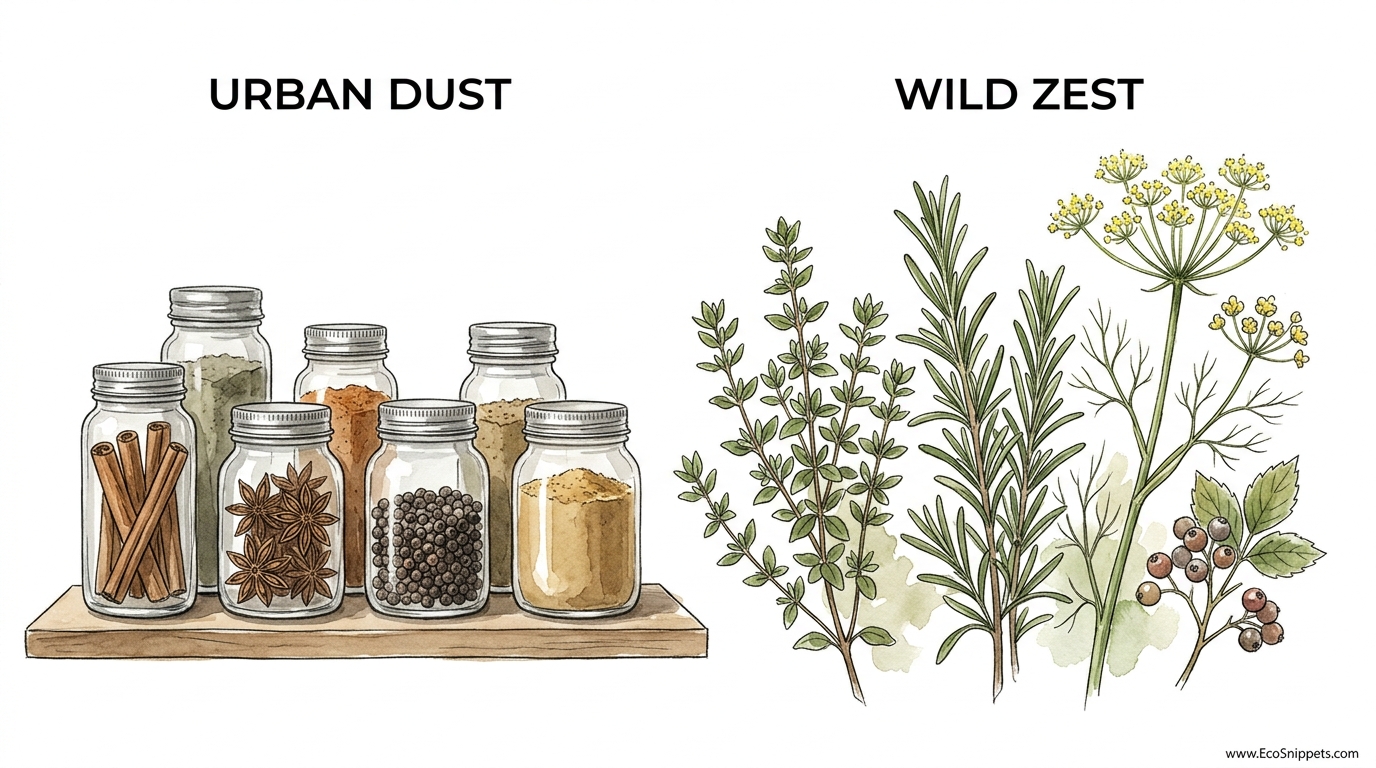
This practice exists because the modern food system has prioritized shelf-life and uniformity over complexity and nutrition. When you buy a jar of ground cinnamon or ginger at the store, you are often buying “urban dust”—a product that has been pulverized, irradiated, and stored for months or years. Wild zest, on the other hand, is harvested at the peak of its potency. It carries the “terroir” of your specific region, offering a flavor profile that cannot be replicated by industrial agriculture.
You can find wild spices in almost every environment, from deep forests to suburban edges. Some people use them to replace expensive imports, while others use them to create entirely new flavor profiles that don’t exist in commercial cooking. For example, the seeds of the spicebush (Lindera benzoin) offer a flavor that sits somewhere between allspice, black pepper, and orange peel. This is a complex, multi-dimensional seasoning that is found for free in many temperate woodlands but is virtually impossible to buy in a standard supermarket.
Using wild seasonings also connects you to the historical lineage of cooking. Long before global trade routes were established, people relied on what grew near their homes. Using these ingredients is a way of reclaiming ancestral wisdom and becoming a more resilient, observant participant in your local ecosystem.
How to Identify and Process Wild Seasonings
The process of turning a wild plant into a shelf-stable seasoning requires careful timing and specific techniques. Each part of the plant requires a different approach to unlock its maximum flavor potential.
Harvesting Seeds and Berries
Seeds and berries are the most common source of wild spice. Many of these should be harvested when they are fully ripe and have begun to dry on the plant. For instance, the red drupes of the Staghorn Sumac (Rhus typhina) should be harvested in late summer after a period of dry weather. If it rains, the tart malic acid on the surface of the berries can wash away, leaving them bland.
To harvest sumac, look for the deep red, fuzzy cones. Snip the entire cluster and bring it home. To process it, rub the berries off the stems and pulse them briefly in a blender to separate the red hairs (where the flavor is) from the hard seeds. Sift this through a fine-mesh strainer, and you are left with a vibrant, sour purple-red powder that rivals any lemon juice for acidity.
Utilizing Roots and Bark
Roots and bark often contain the most pungent oils in a plant. Wild Ginger (Asarum canadense) is a classic example. The rhizome grows just below the leaf litter in moist, shaded forests. When harvested, the root has a powerful, earthy heat. However, it is important to note that wild ginger contains aristolochic acid, a compound that can be harmful in large amounts. Traditional use often involves drying or using it sparingly as a flavoring rather than a main ingredient.
When harvesting bark, such as from the Sweet Birch (Betula lenta), never “girdle” a tree by cutting a ring around the trunk. This will kill the tree. Instead, harvest small twigs and scrape the outer bark to reach the green inner cambium, which smells strongly of wintergreen. These twigs can be dried and ground or infused directly into syrups and teas.
The Drying Process
Preserving the flavor of your wild finds is crucial. Most wild spices should be dried at low temperatures to prevent the volatile oils from evaporating. A food dehydrator set to 35°C to 45°C (95°F to 113°F) is ideal. If you do not have a dehydrator, you can hang bunches of herbs or seeds in a cool, dark place with good airflow.
Once the material is “cracker-dry,” meaning it snaps rather than bends, store it in airtight glass jars. Keep these jars in a dark cupboard. Light is the enemy of flavor and will bleach the color and potency out of your spices within weeks if left on a counter.
Benefits of Wild Seasonings
The advantages of sourcing your own seasonings go beyond mere cost savings. While saving money is a significant benefit, the nutritional and culinary upgrades are even more compelling.
- Unmatched Freshness: Commercial spices are often years old by the time they reach your kitchen. Wild spices are harvested and processed by you, ensuring the highest possible concentration of essential oils.
- Nutrient Density: Many wild spices are packed with antioxidants, vitamins, and minerals. For example, sumac is exceptionally high in Vitamin C and has one of the highest ORAC (Oxygen Radical Absorbance Capacity) scores of any food.
- Chemical-Free: Store-bought seasonings often contain anti-caking agents like silicon dioxide or sodium aluminosilicate. When you forage, you control the entire process, ensuring no additives or preservatives are present.
- Local Adaptability: Eating food from your local environment helps your body adapt to the specific allergens and microbes of your region. It creates a biological connection between you and the land.
- Flavor Complexity: Wild plants often have “wilder” and more intense flavor profiles than their domesticated cousins. They haven’t been bred for size or shelf-life, only for their own survival, which often results in more robust chemical defenses (our flavors).
Common Mistakes to Avoid
Foraging for seasonings is generally safe, but there are specific pitfalls that beginners often encounter. Avoiding these will keep your food tasting great and your body healthy.
One frequent error is harvesting too close to roads or industrial sites. Spices are often used in small amounts, but they can still accumulate heavy metals or chemical runoff from the soil. Always forage at least 15 to 30 meters (50 to 100 feet) away from busy roads to avoid lead and exhaust particulates.
Another mistake is failing to account for “look-alikes.” While many spices are easy to identify, some have dangerous doubles. For instance, Elderberries are a wonderful spice when dried, but they can be confused with Water Hemlock if you are not paying close attention to the leaf structure and stem. Never consume a wild plant unless you are 100% certain of its identity.
Over-processing is also a common issue. If you grind your spices too early, they lose their flavor quickly. It is much better to store wild seeds, berries, and bark whole and grind them only when you are ready to use them. This keeps the protective oils locked inside the cellular structure of the plant until the moment of cooking.
Finally, many foragers forget to label their jars. In the moment, you think you will remember the difference between ground Spicebush and ground Allspice, but six months later, many brown powders look the same. Always label your jars with the common name, scientific name, date, and location of harvest.
Limitations and Environmental Constraints
While wild spices are abundant, there are realistic limits to their use. Understanding these constraints will help you be a more responsible forager and a better cook.
Seasonality is the biggest limitation. Unlike a grocery store where everything is available year-round, wild spices have narrow harvest windows. If you miss the two-week window when the Prickly Ash berries are ripe, you have to wait an entire year. This requires the forager to be highly organized and in tune with the local climate.
Environmental impact is another critical consideration. Some wild spices, like Wild Leeks (Ramps), take years to reach maturity. Over-harvesting can wipe out a local population permanently. Always follow the “1-in-20” rule: only harvest one plant for every twenty you see. For seeds and berries, never take more than 10-20% of the total yield from a single patch to ensure the plants can reproduce and feed local wildlife.
The strength of wild spices can also be a limitation. Because they are not standardized, one batch of wild pepper might be twice as hot as the next. You cannot always follow a recipe exactly; you must taste your ingredients and adjust as you go. This requires more skill and intuition than using standardized commercial products.
Comparing Wild Spices to Commercial Seasonings
To understand why wild foraging is worth the effort, it helps to see how it stacks up against the “Urban Dust” found in stores.
| Feature | Commercial Spices | Wild Seasonings |
|---|---|---|
| Cost | High (per ounce/gram) | Free (plus your time) |
| Flavor Potency | Low to Moderate (fades over time) | High (volatile oils are intact) |
| Traceability | Low (often sourced globally) | Total (you know the exact tree) |
| Additives | Anti-caking agents common | Zero additives |
| Availability | Constant | Seasonal / Weather dependent |
| Nutritional Value | Variable (often depleted) | Superior (freshly harvested) |
Practical Tips for the Wild Spice Pantry
If you are ready to start building your collection, these best practices will help you get the best results from your efforts.
First, invest in a high-quality manual spice grinder or a dedicated electric coffee grinder. Having a tool specifically for your wild finds ensures you can get a fine powder without contaminating your daily coffee. For tough materials like dried roots or thick seeds, a heavy mortar and pestle is often more effective.
Second, try making “Wild Salts.” This is an excellent way to preserve flavors. Mix fresh, finely chopped wild herbs or ground berries with high-quality sea salt at a ratio of 1 part plant to 4 parts salt. Spread the mixture on a tray and let it dry. The salt draws out the moisture and absorbs the aromatic oils, creating a seasoned salt that lasts for years.
Third, use the “Steam Test” to check for potency. If you have an old jar of wild spice and aren’t sure if it’s still good, take a pinch and hold it over a steaming pot of water. The heat and moisture will release the remaining oils. If you don’t smell a strong aroma within seconds, it’s time to compost that batch and head back into the woods.
Lastly, pay attention to the soil. Plants grown in mineral-rich, undisturbed soil will always have more flavor than those grown in depleted or sandy soil. If you find a patch of a particular spice that tastes exceptional, make a note of the location and the surrounding trees. Often, the health of the entire ecosystem is reflected in the flavor of the individual plant.
Advanced Flavor Extraction Techniques
For the serious practitioner, simply drying and grinding is only the beginning. You can use advanced techniques to concentrate flavors even further.
Alcohol Tinctures and Bitters
Many wild seasonings have medicinal properties as well as flavor. By macerating wild spices in high-proof alcohol (such as 40% to 50% ABV vodka or brandy), you can create potent tinctures. This is particularly effective for “bitter” spices like Yarrow or Mugwort. These tinctures can be used by the drop to add depth to soups, stews, or even beverages.
Infused Oils and Vinegars
Fats and acids are excellent carriers for flavor. To make a wild spice oil, gently warm a neutral oil (like grapeseed or sunflower) with your dried spices to about 50°C (122°F) for several hours. Do not let it boil, or you will cook the flavor out. For vinegars, simply submerge the plant material in apple cider vinegar and let it sit in a cool, dark place for 4 to 6 weeks. This is a fantastic way to capture the essence of Wild Garlic or Spruce Tips.
Lacto-Fermentation
You can ferment certain wild seeds to create a “wild caper” or a pungent paste. The green, unripe seeds of Nasturtium or the seeds of Cow Parsnip (Heracleum maximum) can be packed in a 2-3% salt brine. Over a few weeks, beneficial bacteria will transform the sharp, biting flavors into something complex, tangy, and deeply savory. This process also increases the bioavailability of the nutrients in the spice.
Examples of Wild Spice Applications
Let’s look at how you can use these ingredients in a real-world kitchen scenario. Imagine you are preparing a simple roasted chicken or a hearty vegetable stew.
Instead of using store-bought black pepper and lemon juice, you use 5g (0.17oz) of ground **Northern Prickly Ash** husks and 10g (0.35oz) of **Staghorn Sumac** powder. The Prickly Ash provides a tingly, numbing sensation on the tongue similar to Szechuan peppercorns, which opens up the taste buds. The Sumac provides a bright, citrusy punch that cuts through the fat of the meat.
For a dessert, you might use the dried and ground berries of the **Spicebush**. About 2g (0.07oz) of this powder can replace cinnamon and nutmeg in a cookie recipe. Because Spicebush has a more resinous, pine-like undertone, the resulting cookies have a “forest-forward” flavor that feels much more sophisticated than a standard holiday treat.
Finally, consider a “Forest Rub” for grilled mushrooms or steak. You might mix:
- 2 parts dried, ground Wild Garlic bulbs
- 1 part ground Juniper berries (crushed to release oils)
- 1 part dried, ground Sweet Birch bark
- A pinch of dried, ground Yarrow leaves for a balanced bitterness
This combination creates an earthy, pungent, and slightly sweet crust that captures the essence of a northern woodland in every bite.
Final Thoughts
The transition from “Urban Dust” to “Wild Zest” is more than just a culinary choice; it is a shift in perspective. It requires you to slow down, observe the changing seasons, and appreciate the immense bounty that the natural world provides for free. By learning to forage for your own spices, you are taking a significant step toward self-reliance and culinary independence.
Start small by identifying one or two plants in your immediate area. Perhaps it is the sumac growing in the vacant lot down the street or the field garlic popping up in your backyard. Once you experience the vibrant, electric flavor of a freshly foraged seasoning, the dull, gray powders in the grocery store will never satisfy you again.
Experiment, stay curious, and always respect the land that feeds you. The landscape is not just a backdrop; it is a pantry filled with the most extraordinary flavors imaginable. All you have to do is step outside and start looking.
