How To Become More Self-Sufficient Without Starting a Full-Blown Farm…
Want to start preserving your harvest, making your own soap, or building a backyard root cellar — but not sure where to begin? “Homesteading Advice” gives you instant lifetime access to 35+ practical homesteading books on food preservation, veggie gardening, DIY natural cleaning products (save over $250 per year with this skill alone), brewing, off-grid energy, and a whole lot more…
Click Here To Check It Out Now!
Will you buy your tools once in a lifetime, or every two years until you retire? Modern power tools are designed for ‘planned obsolescence’—they break the moment the warranty expires. An ancestral hand saw doesn’t need batteries, won’t fail in a blackout, and can be sharpened indefinitely. Stop renting your equipment from the hardware store and start owning your legacy.
The shift toward permaculture and self-sufficiency often focuses on the land, yet the tools we use to manage that land are just as critical. Many modern practitioners find themselves stuck in a cycle of buying disposable equipment that cannot be repaired or maintained. A forged hand saw represents the antithesis of this consumerist loop, offering a level of precision and reliability that power tools simply cannot match in a long-term, off-grid setting.
This guide explores the deep world of heirloom-quality steel and traditional saw-making. You will learn why these tools are essential for the serious permaculturist and how to select, use, and maintain a tool that will outlive its owner. Understanding the mechanics of a manual saw is more than just a hobby; it is a fundamental step toward true independence from the industrial supply chain.
Why Every Permaculturist Needs A Forged Hand Saw
A forged hand saw is a tool crafted through the intentional application of heat and pressure to refine the grain structure of the steel. Unlike mass-produced saws stamped from cold sheets of metal, forged saws often involve traditional blacksmithing techniques that ensure the blade is both tough and flexible. This process aligns the carbon molecules within the steel, creating a tool that can hold a razor-sharp edge while resisting the brittle snaps common in cheaper alternatives.
In the context of permaculture, these saws serve as the primary bridge between the forest and the homestead. Whether you are thinning a woodlot for silviculture or crafting a timber-framed shed, the hand saw provides a level of control and silence that preserves the ecosystem’s peace. It allows you to work without the roar of an engine or the persistent vibration of a battery-powered motor.
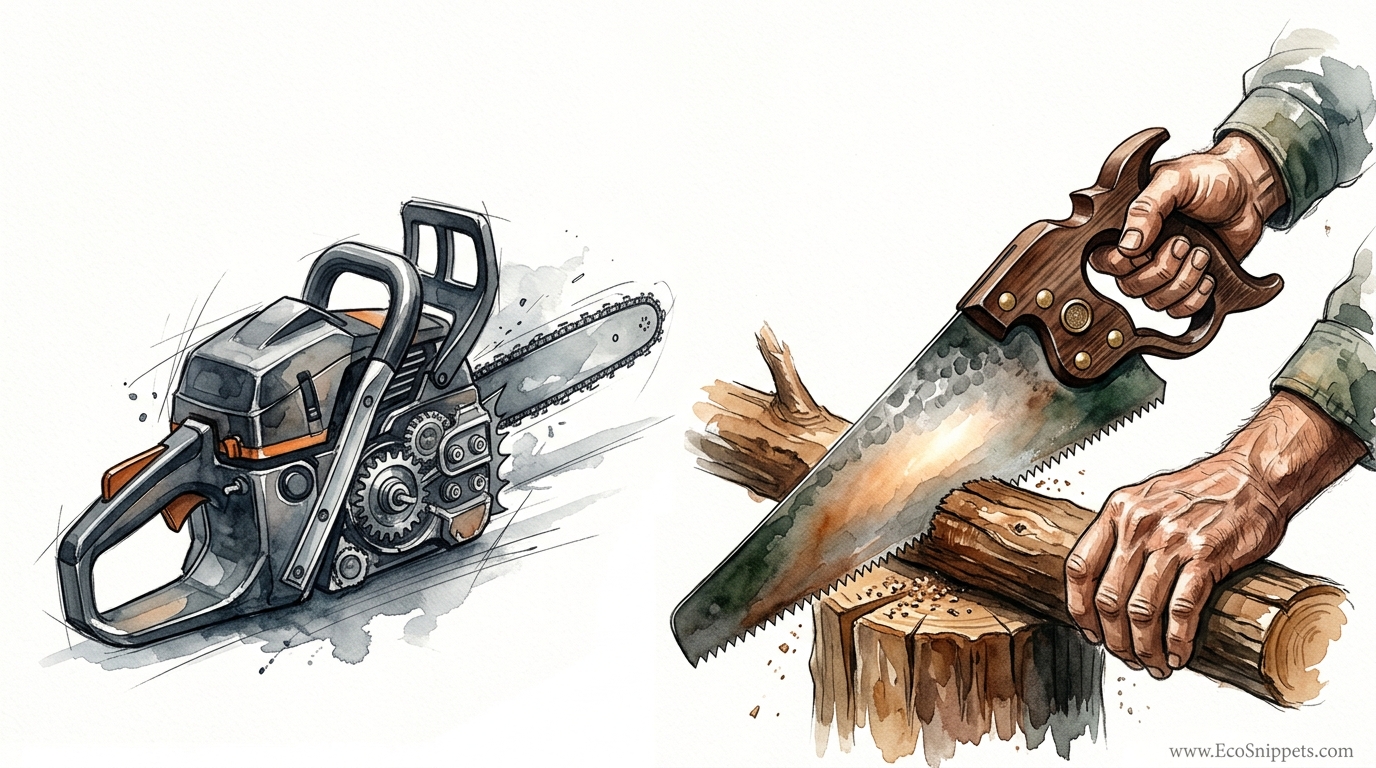
Reliability is the greatest asset of a high-carbon steel saw. When a chainsaw runs out of fuel or a lithium-ion battery loses its charge in the winter cold, the forged hand saw remains ready to work. It requires only the calories from your morning meal to function, making it the ultimate tool for a resilient lifestyle where external inputs are minimized.
How the Forged Hand Saw Works
The mechanics of a hand saw are governed by the relationship between the steel’s hardness and the geometry of its teeth. High-quality saws are often made from high-carbon spring steel, such as 1095 carbon steel, which is heat-treated to a specific Rockwell hardness (usually between 52 and 58 HRC). This balance ensures the teeth are hard enough to cut through dense hardwoods like oak or hickory but soft enough to be touched up with a common triangular file.
One of the most important technical features of a superior saw is taper grinding. This means the blade is thicker at the tooth line and gradually becomes thinner toward the back or top of the blade. This slight reduction in thickness, often measured in thousandths of an inch or fractions of a millimeter, creates clearance in the cut. Without taper grinding, the entire surface of the blade would rub against the wood, causing friction, heat, and eventually binding the saw in the timber.
The teeth themselves are filed into specific profiles based on the direction of the cut relative to the wood grain. Rip saws have teeth shaped like tiny chisels that “plow” out wood fibers when cutting with the grain. Crosscut saws have teeth filed at an angle to create sharp knife-points that sever wood fibers when cutting across the grain. A well-made saw uses these physics-based designs to maximize the efficiency of every push and pull stroke.
Benefits of Choosing Heirloom Steel
Investing in a forged hand saw offers immediate practical advantages for the homesteader. The most obvious benefit is the ability to resharpen the tool at home. Most modern hardware store saws use “impulse-hardened” teeth, which are heated with a high-frequency current to make them incredibly hard. While they stay sharp longer initially, they cannot be sharpened with a file once they dull; they are designed to be thrown into a landfill.
Physical health is another significant advantage of manual sawing. Using a hand saw engages the core, shoulders, and arms in a rhythmic, low-impact exercise that builds functional strength. Unlike the jarring vibration of power tools, which can lead to nerve damage or “white finger” syndrome over decades of use, the motion of a hand saw is natural and meditative. It encourages a deeper connection to the material you are working with, as you feel the density and moisture of the wood through the handle.
The longevity of heirloom steel transforms a simple purchase into a generational asset. A high-quality saw from a reputable maker or a well-restored vintage Disston or Simonds can easily last 100 years. This longevity reduces the lifetime cost of the tool significantly. While a professional-grade forged saw may cost $200 (£150) today, it replaces fifty disposable saws that would have cost $20 (£15) each over the same period.
Challenges and Common Mistakes
The primary challenge of adopting hand saws is the steep learning curve associated with sharpening. Many beginners find the prospect of filing 100 or more tiny teeth intimidating. It requires a steady hand, a good eye, and an understanding of rake and fleam angles. However, this is a skill that pays dividends for a lifetime once mastered.
A frequent mistake is applying too much downward pressure on the saw. New users often try to “force” the saw through the wood, which leads to fatigue and crooked cuts. The weight of the saw and the sharpness of the teeth should do the work. Your job is simply to move the blade back and forth with a relaxed grip, focusing on a long, smooth stroke that utilizes the full length of the blade.
Neglecting tool maintenance is another pitfall that ruins high-quality steel. Carbon steel is prone to oxidation, especially in humid environments or when used on green wood with high sap content. Leaving a saw in a damp shed or failing to oil the blade after use will result in surface rust and pitting. This rust increases friction and can eventually degrade the cutting edge, making the tool much harder to use.
Limitations of the Hand Saw
While the hand saw is a pinnacle of design, it is not the ideal tool for every scenario. Speed is the most obvious limitation. If you need to clear a three-acre (1.2-hectare) plot of dense timber in a weekend, a chainsaw or a large crosscut saw with a two-person team is a better choice. The single-handed saw is optimized for precision, joinery, and moderate land management, not industrial-scale logging.
Large-diameter logs also present a physical challenge for the single-handed saw. Once a log exceeds 12 inches (30 cm) in diameter, the physical effort required to move the blade through the kerf increases exponentially. While possible, it is often more efficient to use a bow saw or a dedicated felling saw for these tasks. The hand saw shines in tasks involving material between 1 inch (25 mm) and 8 inches (200 mm) in thickness.
Environmental conditions can also limit performance. Cutting extremely resinous woods like pine or spruce in the heat of summer can lead to sap buildup on the blade. This “gumming” increases friction and can stop a saw mid-cut. While you can mitigate this with lubricants, it remains a frustration that power tools with high-torque motors can sometimes blast through more easily.
Modern Power vs. Heirloom Steel
Comparing these two approaches reveals a fundamental difference in philosophy regarding land and labor. The following table highlights the trade-offs between a standard high-end battery-powered circular saw and a traditional forged hand saw.
| Feature | Modern Power Saw | Heirloom Forged Saw |
|---|---|---|
| Lifespan | 5–10 years (battery/motor life) | 100+ years (resharpenable) |
| Power Source | Lithium-ion / Grid Electricity | Manual Labor / Food Calories |
| Noise Level | High (90–105 dB) | Low (Ambient scraping) |
| Maintenance | Component replacement | Filing and oiling |
| Weight | 8–12 lbs (3.6–5.4 kg) | 1.5–2.5 lbs (0.7–1.1 kg) |
The choice depends on your goals. If you prioritize immediate speed and have a reliable power source, the modern tool is efficient. If you prioritize resilience, repairability, and a quiet working environment, the heirloom steel wins every time.
Practical Tips for Best Results
Using a hand saw effectively starts with the way you hold it. Most beginners grip the handle like a hammer, with all four fingers wrapped around the wood. Instead, try the “three-finger” grip: wrap your thumb and three fingers around the handle, but extend your index finger along the side of the blade. This pointing motion naturally aligns the saw with your forearm, significantly improving your accuracy and control over the line.
Starting the cut is where most mistakes happen. Do not try to cut on the first stroke. Place the heel of the saw on the wood and use your thumb as a guide against the side of the blade to keep it on your mark. Gently pull the saw toward you to create a small notch or “kerf.” Once this track is established, you can begin light push strokes until the saw is deep enough to guide itself.
Lubrication is a secret weapon for manual sawing. Keep a small block of beeswax or a candle in your tool kit. Periodically rubbing the wax along the sides of the blade reduces friction by up to 30 percent, making the work much easier. This is especially helpful when working with green wood or dense hardwoods like locust or oak.
Advanced Considerations: Tuning Your Saw
Serious practitioners often go beyond basic sharpening and learn to “tune” their saw for specific tasks. This involves adjusting the “set” of the teeth. The set refers to the distance the teeth are bent outward from the center of the blade. A saw with a wide set is better for green, wet wood because it creates a wider path that prevents the moist fibers from pinching the blade. A narrow set is ideal for dry furniture-grade timber where a clean, thin line is desired.
Tooth geometry can also be customized. For example, if you find yourself cutting mostly softwoods, you can increase the “rake” angle to make the saw more aggressive. Conversely, for very hard woods, a more relaxed rake angle will make the saw easier to start and prevent the teeth from “grabbing” and jumping out of the cut. These subtle adjustments allow the craftsman to optimize the tool for their specific local ecosystem.
Restoration of vintage saws is another advanced skill that saves significant money. Many high-quality blades from the early 20th century are found at estate sales for a few dollars. Learning to remove rust with electrolysis or chemical soaks, and then re-tensioning the blade by hammering, can return a $5 find to a tool worth $150. This practice of “re-homing” old steel is a core tenet of the permaculture mindset.
Scenario: Building a Hugelkultur Retaining Wall
Consider a practical scenario where you need to build a retaining wall for a hugelkultur bed using scavenged cedar logs. Using a forged hand saw, you can work directly in the garden without the need to haul heavy equipment or extension cords across the property. You select logs approximately 6 inches (150 mm) in diameter.
With a 26-inch (660 mm) crosscut saw, you can trim the logs to length in about 90 seconds each. The lack of noise allows you to hear the birds and observe the garden’s pollinators while you work. Because the saw is light, you can carry it in a simple leather scabbard on your belt, leaving your hands free for moving timber.
The resulting cuts are clean and precise, allowing the logs to sit flush against one another. This reduces gaps where soil might wash out, ensuring the longevity of your garden structure. Throughout the project, you stop only once to touch up the teeth with a file, a process that takes five minutes and requires no specialized workshop.
Final Thoughts
Owning a forged hand saw is an act of defiance against a culture of disposability. It is a commitment to quality over quantity and a recognition that the most sophisticated technology is often the simplest. By choosing a tool that can be maintained by your own hands, you take a significant step toward self-reliance and environmental stewardship.
These saws are more than just implements of labor; they are teachers of patience and precision. They require you to understand the wood, the steel, and the mechanics of your own body. As you develop the skill to file and set a blade, you gain a sense of mastery that no battery-powered device can provide.
Whether you are just starting your permaculture journey or are a seasoned homesteader, consider the legacy of your toolkit. A single, high-quality forged saw will serve you for decades and can be passed down to those who follow in your footsteps. Start today by seeking out the steel that will stand the test of time and learn the art of the manual cut.
