How To Become More Self-Sufficient Without Starting a Full-Blown Farm…
Want to start preserving your harvest, making your own soap, or building a backyard root cellar — but not sure where to begin? “Homesteading Advice” gives you instant lifetime access to 35+ practical homesteading books on food preservation, veggie gardening, DIY natural cleaning products (save over $250 per year with this skill alone), brewing, off-grid energy, and a whole lot more…
Click Here To Check It Out Now!
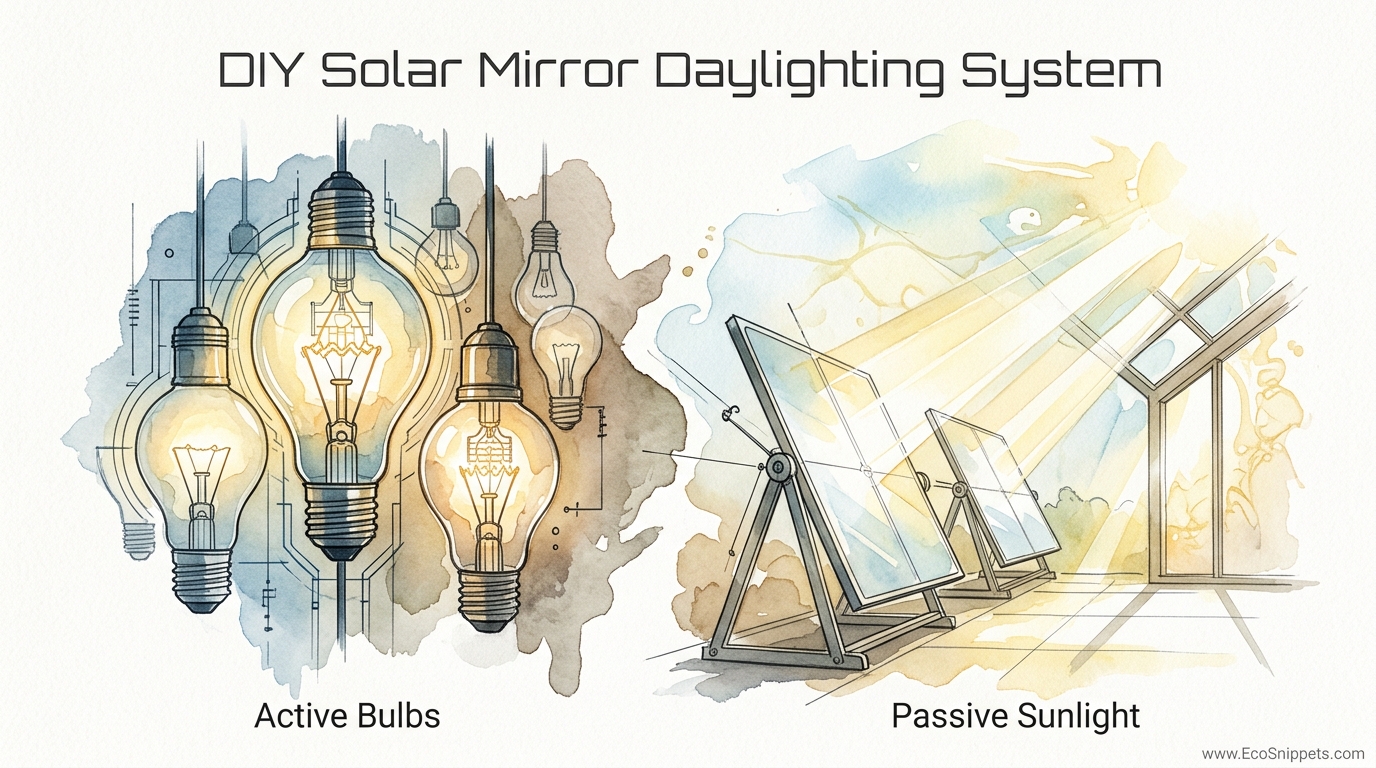
Why convert sunlight into electricity just to turn it back into light, when you can just move the sun indoors? The most efficient way to light your home isn’t high-tech LEDs—it’s the sun itself. With a simple parabolic tracker, we’re bringing 10,000 lumens into the center of our home for zero watts. It’s brighter, healthier, and never flickers during a blackout.
Harnessing the sun doesn’t always require silicon wafers and complex battery banks. Sometimes, the oldest tools are the most effective. Ancient builders understood that a well-placed reflection could transform a dark, damp room into a sanctuary of warmth and clarity.
Modern homes often fail this basic test of light. We build thick walls and small windows, then spend a fortune on electricity to fight the shadows we created. This article explores a more direct approach: the DIY solar mirror daylighting system. It is a solution born from necessity and refined by simple physics.
DIY Solar Mirror Daylighting System
A solar mirror daylighting system, often called a heliostat in industrial circles, is a device that tracks the sun and reflects its rays onto a fixed target. Unlike a standard wall mirror that only catches the sun for a few minutes, this system moves. It follows the sun’s arc across the sky, ensuring that a beam of pure, full-spectrum light stays focused on your window or skylight from dawn until dusk.
This technology exists because sunlight is the gold standard for human environments. Natural light provides a spectrum that LEDs can only hope to mimic. It regulates our circadian rhythms, boosts our mood, and reveals the true colors of our surroundings. In the real world, these systems are used in massive solar power plants to melt salt for energy, but the same principles apply to a single dark kitchen in a suburban house.
Think of it as a robotic sun-follower. If you have a room that faces north or is blocked by a neighboring tall building, you are living in a permanent twilight. A solar mirror acts as a bypass. It captures the light from a sunny patch of your yard or roof and “pipes” it through your window using nothing but geometry and a reflective surface.
How to Build Your Own Sun Tracker
Building a tracking system requires a marriage of mechanical stability and electronic logic. The core of the system is the heliostat mount. It must move on two axes: azimuth (left to right) and elevation (up and down). This allows the mirror to account for both the daily rotation of the earth and the seasonal shift of the sun’s height.
Start with a sturdy base. A heavy tripod or a wooden post anchored in the ground works best. For the movement, most builders use two NEMA 17 stepper motors or high-torque 12V DC linear actuators. Stepper motors are ideal for precision, as they can move in tiny increments of 1.8 degrees. You will need a microcontroller, such as an Arduino Uno or an ESP32, to serve as the “brain.”
The logic follows one of two paths: active or passive tracking. Active tracking uses Light Dependent Resistors (LDRs) separated by a small divider. If one sensor is in shadow, the brain tells the motors to turn until both sensors see equal light. Passive tracking is more robust; it uses a mathematical algorithm to calculate exactly where the sun should be based on your GPS coordinates and the time of day. This method is preferred because it won’t get “distracted” by a bright cloud or a porch light.
Finally, the mirror itself. For a 10,000-lumen output, you need a reflective surface roughly 12 inches by 12 inches (30 cm by 30 cm). Standard glass mirrors are heavy and can shatter. Many DIY enthusiasts prefer 0.04-inch (1 mm) thick polished aluminum or Mylar film glued to a rigid backing. These materials are lightweight, making them easier for small motors to move, and they offer high reflectivity without the risk of heavy glass falling from a height.
The Practical Benefits of Direct Light
The primary advantage of this approach is raw power. A typical 60-watt incandescent bulb produces about 800 lumens. High-end LEDs might hit 1,600 lumens. A small 1-square-foot (0.09 sq meter) mirror delivers roughly 10,000 lumens of light. This is an order of magnitude more light than a standard fixture can provide, and it costs nothing to operate after the initial build.
Visual comfort is another measurable benefit. Sunlight has a Color Rendering Index (CRI) of 100, meaning it shows colors exactly as they are. Most indoor lights struggle to reach a CRI of 90. When you move the sun indoors, your eyes don’t have to work as hard to distinguish textures and hues. This reduces eye strain and helps eliminate the “seasonal blues” often associated with dark interior spaces.
Energy independence is the quiet victory of the solar mirror. In a power outage, your home remains bright and functional as long as the sun is up. It requires no grid connection and no complicated battery storage. It is a mechanical solution to a modern problem, relying on the predictable clockwork of the solar system rather than the fragility of the local utility company.
Challenges and Common Pitfalls
Heat is the most dangerous variable in solar tracking. If you use a parabolic (curved) mirror, you are creating a focal point. This point can reach temperatures high enough to melt plastic or ignite wood in seconds. Beginners often make the mistake of over-concentrating the beam. For daylighting, a flat mirror or a very slightly “long-throw” curve is safer. The goal is to spread 10,000 lumens across a room, not to focus them into a 1-inch (2.5 cm) laser beam.
Mechanical wear is the second major challenge. These systems live outside. They must survive rain, snow, and high winds. A common error is using cheap plastic gears that strip under the weight of a mirror during a wind gust. Using metal hardware and a “park” feature in your code—which turns the mirror flat during high winds—is essential for longevity.
Dust and debris are the enemies of efficiency. A thin layer of pollen or dust on the mirror can reduce your 10,000 lumens to 5,000 in a matter of weeks. If you don’t design your tracker for easy access and cleaning, the system will eventually become a useless ornament. Always mount your tracker where you can reach it with a soft cloth or a garden hose.
When This Method May Not Be Ideal
Environmental limitations dictate the success of any solar project. If your property is heavily shaded by old-growth trees or tucked into a narrow canyon, a mirror tracker might never find enough clear sky to be useful. In these cases, traditional electric solar panels mounted high on a roof might be the only way to harvest energy.
Architectural constraints also play a role. A solar mirror needs a clear line of sight from the tracker to the window. If your only available mounting spot is at an extreme angle to your windows, the light will reflect off the glass rather than passing through it. This is known as the “angle of incidence” problem. In such scenarios, the complexity of adding secondary mirrors to “bounce” the light around corners often outweighs the benefits for a casual DIYer.
Weather patterns in your region must be considered. In locations with perpetual cloud cover or heavy fog, the 10,000-lumen promise remains unfulfilled. While the system still works on overcast days to a degree, the light becomes diffuse and loses its directional power. If you live in a place where the sun rarely shows its face, you may be better served by high-efficiency LED “sun lamps” powered by a standard battery bank.
Active Heliostats vs. Passive Sky Tubes
Choosing between an active tracking mirror and a passive system like a light tube (often called a SunTunnel or Solatube) depends on your home’s structure and your willingness to tinker. A passive sky tube is a fixed pipe that goes through your roof. It is simpler but provides less light and requires cutting a large hole in your ceiling.
| Factor | Active Heliostat Tracker | Passive Sky Tube |
|---|---|---|
| Light Output | High (10,000+ Lumens) | Moderate (1,000 – 4,000 Lumens) |
| Installation | External (Yard or Roof) | Structural (Roof & Ceiling) |
| Complexity | High (Motors & Code) | Low (Static Pipe) |
| Maintenance | Moderate (Mirror Cleaning) | Very Low |
| Blackout Reliability | Excellent | Excellent |
Best Practices for Peak Performance
Mirror selection is the most important decision for light quality. Avoid “second-surface” glass mirrors—the kind you find in a bathroom—for high-performance tracking. In these mirrors, light must travel through the glass, hit the silvering, and travel back out, losing about 10-15% of its energy and creating a “ghost” reflection. Use “first-surface” mirrors or high-reflectivity films where the silvering is on the very top of the material.
Thermal management inside the home is equally vital. 10,000 lumens of light also carry thermal energy. In the winter, this is a free heater. In the summer, it can overheat a small room. Installing a light-colored sheer curtain allows the light to pass through while diffusing the heat and preventing “hot spots” on your furniture.
Calibration of your tracking logic should be done seasonally. The sun’s path changes significantly between the summer solstice and the winter solstice. If you are using a sensor-based tracker, ensure the “dead zone” in your code is wide enough to prevent the motors from “hunting” back and forth, which wears out the gears and wastes energy.
Advanced Considerations for Serious Builders
Serious practitioners often look toward secondary reflection. By placing a second, stationary mirror inside the room, you can redirect the beam to a ceiling or a white wall. This transforms a harsh, direct beam into a soft, ambient glow that illuminates the entire space. It mimics the effect of a massive skylight without the structural risks of cutting into your roof.
Automation can be taken further by integrating an anemometer (wind speed sensor). High-quality trackers are programmed to move to a horizontal “stow” position when wind speeds exceed 30 mph (48 km/h). This reduces the surface area exposed to the wind and prevents the mirror from acting like a sail that could rip the entire mount out of the ground.
Scaling the system is another option. Rather than one large mirror, you can build a small array of three or four smaller trackers. This provides redundancy; if one motor fails, you still have 7,500 lumens coming in. Smaller mirrors are also less susceptible to wind load and can be easier to hide in a garden landscape or along a fence line.
Realistic Scenario: Lighting a North-Facing Kitchen
Imagine a kitchen that stays dark even at noon. It has one window, but it faces a steep hill or a thick grove of trees. The homeowner installs a 16-inch (40 cm) square mirror on a post 20 feet (6 meters) away in a sunny patch of the lawn. The tracker is programmed to hit the center of the kitchen window from 9:00 AM to 4:00 PM.
The result is a consistent 12,000-lumen beam that hits a white-painted ceiling inside the kitchen. This reflected light bounces off the ceiling, providing enough ambient light to read a cookbook or prep vegetables without turning on a single electric switch. Over the course of a year, this saves hundreds of kilowatt-hours and provides a space that feels connected to the outside world, regardless of the building’s orientation.
Measurement-wise, the tracker uses roughly 2 watts of power to run the microcontroller and occasionally pulse the motors. The “profit” is the 100+ watts of lighting power it replaces. This is a return on investment that no commercial solar panel can match because it skips the inefficient conversion from light to electricity and back again.
Final Thoughts
The most elegant solutions are often those that work with nature rather than trying to replicate it. Building a DIY solar mirror system is a return to a more sensible way of living. It requires a bit of grit to build and a bit of wisdom to maintain, but the reward is a home filled with the purest light available in the universe.
We have spent decades perfecting the light bulb, yet we often forget that the ultimate light bulb is already hanging in the sky. By using a few motors, a simple brain, and a reflective surface, we can reclaim our interior spaces from the shadows. It is a project that satisfies both the engineer and the inhabitant, proving that self-reliance is as much about cleverness as it is about hard work.
Experiment with your own designs. Start small with a manual mirror to see where the light lands, then graduate to a tracking system. Once you see the center of your home glowing with 10,000 lumens of free sunlight, you will wonder why we ever settled for the flicker of an LED in the first place.
