How To Become More Self-Sufficient Without Starting a Full-Blown Farm…
Want to start preserving your harvest, making your own soap, or building a backyard root cellar — but not sure where to begin? “Homesteading Advice” gives you instant lifetime access to 35+ practical homesteading books on food preservation, veggie gardening, DIY natural cleaning products (save over $250 per year with this skill alone), brewing, off-grid energy, and a whole lot more…
Click Here To Check It Out Now!
If your pasture looks like a parking lot, your livestock are living on a biological desert. Most homesteaders think ‘dirt’ is just something for animals to stand on. But when you kill the soil biology through overgrazing, you’re forced to buy the nutrition your land should be giving you for free. Learn how to flip the switch from a sterile, compacted wasteland to a thriving, microbe-rich engine that feeds your animals while you sleep.
Turning a degraded patch of land back into a lush ecosystem is one of the most rewarding parts of self-reliant living. It is not just about the grass you see above the ground. It is about the massive, invisible workforce beneath your boots. When you treat your paddocks like a living organism rather than a stage for your livestock, the entire health of your homestead shifts.
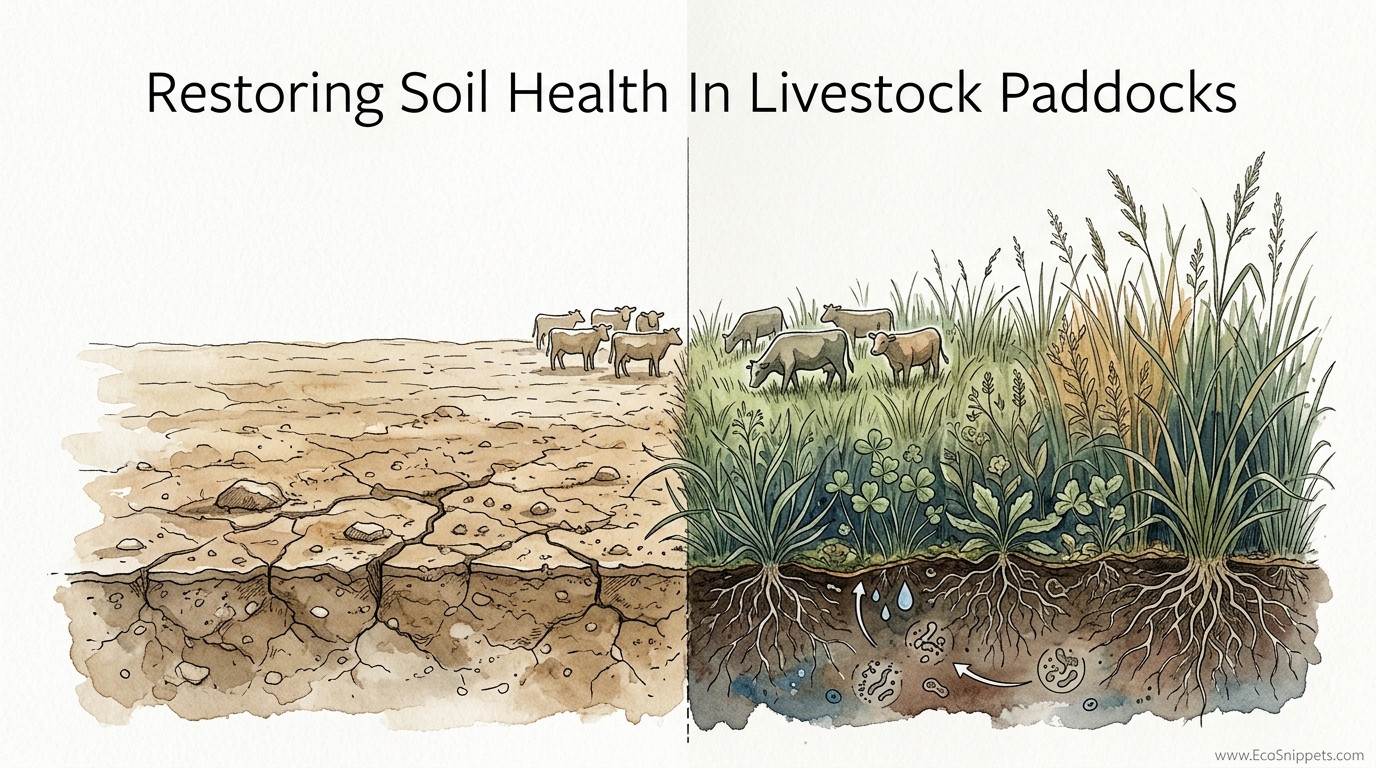
Restoring Soil Health In Livestock Paddocks
Restoring soil health is the intentional process of rebuilding the biological and physical integrity of the land after it has been damaged by overgrazing, compaction, or chemical use. In a healthy paddock, the soil is a “living sponge” filled with air pockets, fungal networks, and billions of microbes. In a degraded one, it is a “brick” that repels water and smothers life.
This restoration matters because healthy soil is the foundation of animal nutrition. When plants grow in microbe-rich soil, they can access a wider array of minerals. These minerals pass directly into your cattle, sheep, or poultry, leading to better weight gain and fewer visits from the vet. Real-world restoration is used by regenerative ranchers and homesteaders to eliminate the need for synthetic fertilizers and expensive grain supplements.
Imagine your soil as an underground city. In a sterile paddock, the buildings have collapsed, the roads are blocked, and the citizens have fled. Restoration is the act of rebuilding those roads (pore spaces) and inviting the citizens (microbes) back to work. Without this biological activity, your pasture is nothing more than a brown patch of “sterile dirt” waiting for a raindrop it can’t even absorb.
How the Restoration Process Works
Restoring soil requires a shift from “extraction” to “partnership.” You must work with the natural cycles of the earth to kickstart the engine of growth. The process typically follows a specific sequence of biological events that turn dust back into topsoil.
The most critical mechanism is the “liquid carbon pathway.” When a plant is healthy and growing, it performs photosynthesis, turning sunlight into sugars. It doesn’t keep all those sugars for itself. Instead, it pumps nearly half of them through its roots into the soil. This is a deliberate “trade” where the plant feeds carbon to the microbes in exchange for minerals like phosphorus and nitrogen that the plant cannot reach on its own.
To trigger this, you must use your livestock as tools. When an animal takes a bite of grass, the plant sends a distress signal to its roots, releasing a flush of those sugars into the rhizosphere. This feeding frenzy among the microbes builds soil structure. As long as the plant is not bitten a second time before it has recovered, this cycle builds inches of new topsoil over time.
Step-by-step restoration often begins with “Animal Impact.” This involves bunching animals together for a very short period—sometimes just hours—to trample old, dead grass into the ground. This “litter” acts as a mulch, protecting the soil from the sun and providing a feast for earthworms. Following this with a long rest period of 60 to 90 days allows the roots to dive deep, breaking up compaction without the need for a plow.
The Measurable Benefits of a Living Pasture
The primary advantage of restoring soil health is the creation of a “drought-proof” homestead. Healthy soil with high organic matter can hold an incredible amount of water. For every 1% increase in soil organic matter, an acre of land can hold an additional 20,000 gallons (75,700 liters) of water. This means your grass stays green for weeks after your neighbor’s pasture has turned brown and brittle.
Another benefit is the dramatic reduction in input costs. In a living system, the microbes provide the nitrogen. You no longer need to buy bags of urea or ammonium nitrate. The livestock provide the fertilizer in a slow-release, biological form. Over time, the cost of maintaining a thriving paddock drops toward zero, while the productivity of the land continues to rise.
Livestock performance also improves significantly. Animals grazing on diverse, healthy pastures have access to “secondary compounds” like tannins and essential oils found in deep-rooted herbs and forbs. These natural compounds act as internal dewormers and immune boosters. A healthy paddock doesn’t just feed the stomach; it acts as a pharmacy for the herd.
Challenges and Common Pitfalls to Avoid
The most common mistake homesteaders make is “set-stocking,” or leaving animals in the same field for weeks at a time. This is the fastest way to create a biological desert. Animals are selective eaters; they will eat the “ice cream” grasses down to the dirt while leaving the “broccoli” weeds alone. This eventually kills the best forage and allows the worst weeds to take over.
Another pitfall is grazing too early in the spring. When the ground is wet and the grass is just starting to wake up, livestock hooves act like a giant hammer, smashing the delicate pore spaces in the soil. This creates “pugging,” where the soil turns into a muddy slurry that dries into a concrete-hard surface. Waiting just two extra weeks for the soil to firm up and the grass to reach 8 to 10 inches (20 to 25 cm) can save a year’s worth of soil damage.
Many people also fail to account for the “rest period.” They see a bit of green and move the animals back in too soon. If the plant has not fully replenished its root reserves, it will eventually exhaust itself and die. Restoration requires patience. You are not just growing grass; you are growing a root system that may be twice as large as what you see above the ground.
Limitations and Environmental Boundaries
Restoring soil health is not an overnight miracle, and it is subject to regional constraints. In arid environments where rainfall is scarce, the biological processes happen much slower. In a desert climate, a paddock might need a full year of rest after a single grazing event to allow the soil crust to recover and the seeds to germinate.
There are also physical limitations based on the current state of the land. If your soil is severely compacted by decades of heavy machinery, biological restoration alone might take five to ten years to show results. In these extreme cases, a one-time mechanical intervention, such as using a “subsoiler” or “keyline plow,” might be necessary to crack the hardpan and let air and water back in.
Soil type also plays a role. Heavy clay soils are prone to compaction but hold nutrients well once restored. Sandy soils are easy to aerate but struggle to hold onto organic matter and moisture. Understanding your specific “context”—your climate, your soil type, and your available water—is essential before you begin a restoration plan.
Sterile Dirt vs. Living Pasture: A Comparison
| Feature | Sterile Dirt (Compacted) | Living Pasture (Restored) |
|---|---|---|
| Water Infiltration | High runoff; water sits on top or drains away. | Absorbs water like a sponge; minimal runoff. |
| Root Depth | Shallow (2–4 inches / 5–10 cm). | Deep (12–36 inches / 30–90 cm). |
| Microbial Life | Mostly dormant or dead; low fungal count. | Teeming with fungi, bacteria, and earthworms. |
| Fertilizer Needs | Requires synthetic inputs to grow anything. | Self-fertilizing through nutrient cycling. |
| Plant Diversity | Monoculture of weeds or “tough” grasses. | Diverse mix of grasses, legumes, and forbs. |
Practical Tips and Best Practices
The “Graze Half, Leave Half” rule is the most effective tool in your arsenal. Never let your livestock eat a plant down to the ground. Aim to remove 50% of the leaf volume and then move the animals. The remaining 50% provides the energy the plant needs to regrow quickly without “sloughing off” its roots.
Encourage your “underground livestock” by protecting dung beetles. These incredible insects are the janitors of the pasture. They take fresh manure and bury it deep in the soil, creating vertical tunnels that aerate the ground and deliver nutrients directly to the root zone. Avoid using “avermectin” based dewormers if possible, as the residue in the manure can kill the very beetles you need for soil restoration.
Use “Bale Grazing” during the dormant season to add organic matter to your poorest spots. Instead of feeding hay in a single ring, unroll the bales or place them across a degraded paddock. The animals will eat some, but they will also trample a large amount of hay and manure into the soil. This “carbon bomb” can jumpstart the biology of a sterile area in a single season.
Advanced Considerations: Multi-Species Grazing
For the serious practitioner, multi-species grazing is the ultimate way to accelerate soil health. Different animals have different “manure chemistry” and grazing styles. Cattle use their tongues to wrap around and pull grass, sheep nibble closely with their lips, and goats prefer woody browse and broadleaf weeds.
When you run these species together or in close succession, you create a more balanced plant community. Cattle manure is high in nitrogen and moist, which is perfect for earthworms. Sheep and goat manure is pelletized and slow-release, providing a different set of nutrients. This “biological stacking” creates a more diverse microbial population in the soil than any single-species system could ever achieve.
You might also consider “Frost Seeding” to increase diversity. During the late winter or early spring, as the ground freezes and thaws (the “honeycomb” effect), broadcast seeds of red clover or chicory onto the pasture. The movement of the soil will pull the seeds into the cracks, giving them a head start. These deep-rooted plants will then act as biological “drills,” punching through compaction and bringing minerals up from the subsoil.
The Five-Acre Restoration Scenario
Consider a five-acre (2-hectare) homestead with a single, overgrazed paddock. The soil is hard, and the grass is thin. To restore it, the owner divides the field into ten smaller paddocks using temporary electric fencing.
In the first week, the “herd” (perhaps three cows) is moved into Paddock 1. They are left there for only two days. They eat the tops of the grass and trample the rest. On day three, they move to Paddock 2. Paddock 1 is now “resting.” It will not see an animal again for at least 40 days.
By the time the animals finish the rotation and return to Paddock 1, the grass has grown back thicker and taller. Because the soil was never left bare, the microbes stayed alive. Over the course of one year, the “parking lot” begins to disappear, replaced by a dark, crumbly soil structure that holds moisture and smells like a forest floor.
Final Thoughts
Restoring soil health is the ultimate act of self-reliance. It is a quiet, steady rebellion against the “buy and apply” mentality of industrial agriculture. When you focus on the life beneath your feet, you are building a legacy of fertility that will outlast any bag of fertilizer.
True stewardship is about observing the land and responding to what it needs. Sometimes that means moving the fence, and sometimes it means doing nothing at all while the soil rests. Experiment with different rest periods and observe how the plants respond. Every homestead is a unique puzzle, and the soil is the key to solving it.
Start small, watch your animals, and trust the biology. The transition from a biological desert to a thriving engine of growth won’t happen in a week, but once the momentum of nature takes over, your land will begin to provide for you in ways you never thought possible. Encourage the life in your soil, and it will feed your family for generations.
