How To Become More Self-Sufficient Without Starting a Full-Blown Farm…
Want to start preserving your harvest, making your own soap, or building a backyard root cellar — but not sure where to begin? “Homesteading Advice” gives you instant lifetime access to 35+ practical homesteading books on food preservation, veggie gardening, DIY natural cleaning products (save over $250 per year with this skill alone), brewing, off-grid energy, and a whole lot more…
Click Here To Check It Out Now!
Did you know you can freeze water in the desert using nothing but the night sky? Most people see the cloudless night sky as a nuisance that lets heat escape their garden. Smart homesteaders see it as an infinite sink for thermal energy. Radiative cooling panels can actually drop below freezing on a summer night—no power required.
This phenomenon is not magic, nor is it a modern invention. It is a fundamental law of physics that humans have harnessed for thousands of years. By looking upward with the right tools, we can tap into the 3 Kelvin cold of deep space to chill our homes, preserve our harvests, and even manufacture ice in the middle of a heatwave. This guide will walk you through the science, history, and practical application of passive night sky cooling.
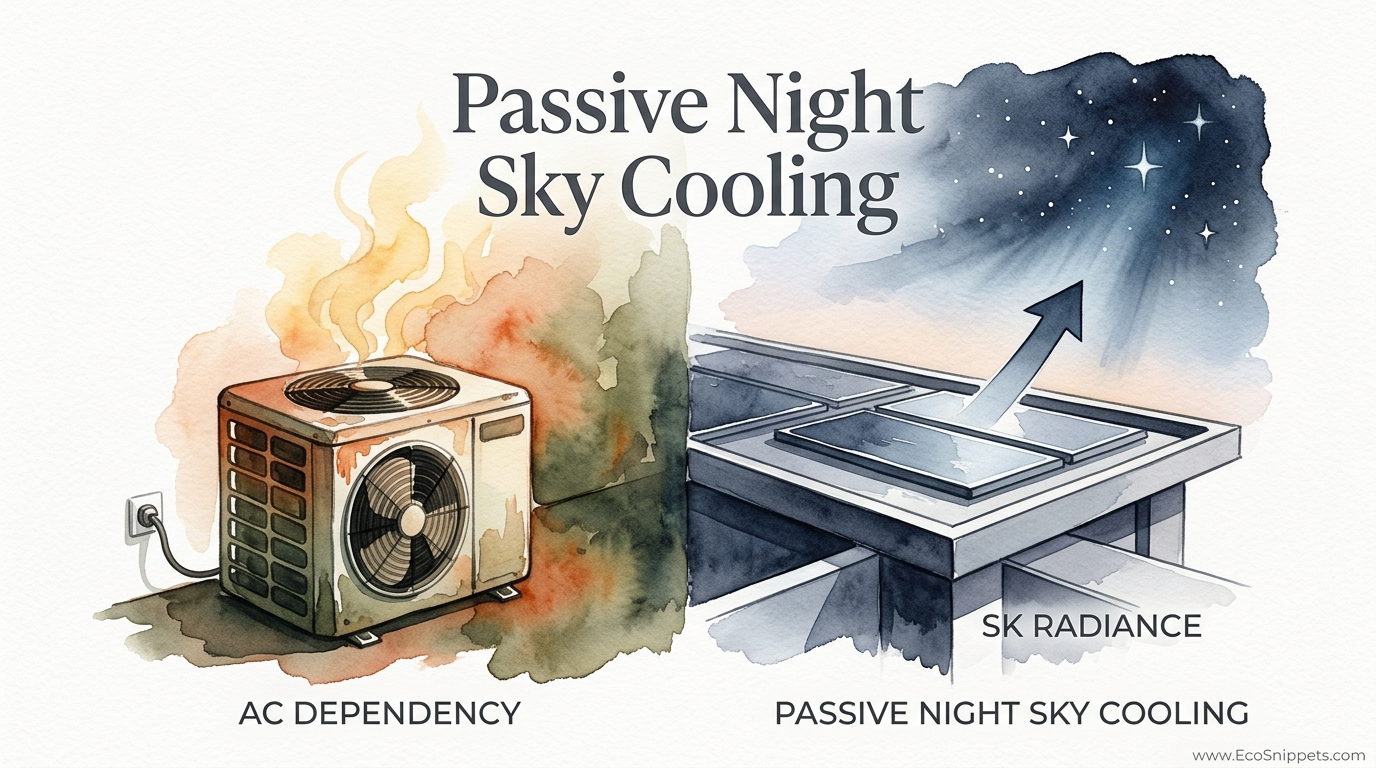
Passive Night Sky Cooling
Passive night sky cooling, often referred to as radiative cooling, is the process by which an object loses heat through thermal radiation toward the sky. Unlike convection, which requires air to carry heat away, or conduction, which requires physical contact, radiation travels as electromagnetic waves. On a clear night, your roof, your car, and your garden are all “shouting” their heat into the void of space.
Historically, this principle was the backbone of survival in arid regions. Ancient Persians, as early as 400 BCE, built massive structures called Yakhchals. These were beehive-shaped ice houses made of a specialized heat-resistant mortar called sarooj, composed of sand, clay, egg whites, lime, goat hair, and ash. During winter nights, they would divert water into shallow channels. Even when the air temperature was slightly above freezing, the water would lose so much heat to the night sky that it would turn to ice. This ice was then stored in deep, insulated pits to provide cooling and frozen treats through the blistering summer months.
In modern terms, we use the same principle but with more refined materials. Every object on Earth emits infrared radiation. However, our atmosphere acts like a blanket, trapping most of that heat. There is, however, a “hole” in that blanket. Between the wavelengths of 8 and 13 micrometers (µm), the atmosphere is nearly transparent. This is known as the atmospheric window. If we can build a surface that emits radiation specifically at those wavelengths, that heat passes straight through the clouds and the greenhouse gases, exiting the planet entirely.
How the Physics of the Void Works
To master this technology, you must understand the relationship between emissivity and reflectivity. Every material has a specific emissivity, which is a measure of how effectively it radiates heat. A perfect blackbody has an emissivity of 1.0. Most common building materials like brick, concrete, and standard white paint have high emissivity (often 0.9 or higher), meaning they are quite good at radiating heat at night.
The problem arises during the day. Standard materials absorb a massive amount of solar radiation. To achieve cooling when the sun is out, a surface must be a “selective emitter.” This means it must reflect over 95% of incoming sunlight (wavelengths of 0.3 to 2.5 µm) while simultaneously emitting heat at the 8–13 µm atmospheric window.
Recent breakthroughs from institutions like Purdue University have led to the development of ultra-white barium sulfate (BaSO4) paints. These coatings reflect up to 98.1% of sunlight and can keep surfaces up to 4.5°C (8°F) cooler than the surrounding air in direct noon sunlight. At night, without the sun’s interference, these same surfaces can drop 10°C to 15°C (18°F to 27°F) below the ambient air temperature.
Building a Passive Cooling System
If you want to experiment with this on your homestead, you don’t need a multi-million dollar lab. You can build a functional radiative cooling panel using common materials.
The Basic “Scotch Tape” Radiator
Research from UCLA has demonstrated that simple polypropylene tape (like standard Scotch tape) is an excellent selective emitter. It contains chemical bonds that naturally vibrate at the 8–13 µm frequency.
- The Base: Use a highly reflective material like aluminum foil or a polished aluminum plate. This acts as a “mirror” for thermal radiation.
- The Emitter: Apply two layers of clear Scotch tape over the aluminum. The aluminum reflects the sun, while the tape radiates heat into the sky.
- The Insulation: Place this assembly inside a box insulated with 50mm (2 inches) of rigid foam. This prevents the panel from being warmed by the surrounding air or the ground.
- The Wind Shield: Cover the top of the box with a thin sheet of Low-Density Polyethylene (LDPE), like a clear dry-cleaner bag or thin painters’ plastic. LDPE is transparent to the 8–13 µm window, allowing heat to escape while blocking wind from warming the panel through convection.
The Barium Sulfate Coating
For those who want a more permanent setup, you can create a high-performance cooling paint. Barium sulfate is a common pigment used in the paper and plastic industries.
- Mix Barium Sulfate powder with a clear acrylic binder at a 60% volume concentration.
- Apply this to a metal substrate in a layer at least 400 microns thick (about the thickness of four sheets of paper).
- Tests show this configuration can achieve a cooling power of approximately 117 Watts per square meter (W/m²).
The Practical Benefits of Sky Radiance
The most obvious advantage of this system is zero-energy operation. Once the panel is built and positioned, it cools itself without a single watt of electricity. For off-grid living, this is a game-changer. It allows for the creation of “cold boxes” for food storage or the pre-cooling of water for a larger HVAC system.
Another benefit is mechanical simplicity. Unlike traditional air conditioners that rely on compressors, refrigerants, and fans—all of which eventually break—a radiative panel has no moving parts. This makes it incredibly reliable for long-term self-sufficiency.
Furthermore, this technology is silent. There is no humming compressor or whirring fan to disturb the peace of a quiet rural night. It is a silent exchange between your home and the stars.
Challenges and Common Pitfalls
While the physics is sound, the environment can be a fickle partner. The most common enemy of passive cooling is convection. If a warm breeze blows over your cooling panel, it will immediately transfer heat back into the surface, nullifying the radiative loss. This is why a convection shield (the LDPE plastic mentioned earlier) is absolutely critical.
Another challenge is thermal mass. A thin panel will cool down very quickly, but it also has very little “cooling capacity.” To do real work, such as cooling a room, you need to transfer that “coldness” into a medium like water or a large thermal mass like stone.
Finally, dust and debris can degrade performance. If your highly reflective white paint gets covered in a layer of desert dust or pollen, its solar reflectance will drop, and the panel will begin to heat up during the day. Regular cleaning is a necessity for maintaining peak efficiency.
Limitations: When the Sky Closes
It is important to manage expectations. Passive night sky cooling is highly dependent on atmospheric conditions.
- Cloud Cover: Clouds are composed of water droplets that are opaque to the 8–13 µm window. On a cloudy night, the sky “shouts” back at your panel, and the cooling effect is drastically reduced or eliminated entirely.
- Humidity: Water vapor is a potent greenhouse gas. In high-humidity environments, the atmospheric window becomes “foggy” for infrared radiation. While you can still achieve cooling in the tropics, the potential is much lower (around 10–40 W/m²) compared to a dry desert (100+ W/m²).
- Orientation: Radiative panels must face the open sky. If they are placed under a tree canopy or near a tall wall, they will exchange heat with those objects rather than the cold of space.
Radiative Cooling vs. Traditional HVAC
Understanding where passive cooling fits into your thermal management strategy requires a comparison with modern active systems.
| Feature | Passive Radiative Cooling | Traditional Air Conditioning |
|---|---|---|
| Energy Source | None (Outer Space) | Electricity (Grid/Solar) |
| Moving Parts | None | Compressor, Fans, Pumps |
| Humidity Control | None (Sensible cooling only) | Excellent (Dehumidification) |
| Cooling Power | 50–150 W/m² | 3500+ W (per ton) |
| Ideal Climate | Arid, Clear skies | Any (with enough power) |
Passive cooling is not a direct replacement for AC in a modern, humid home, but it is an incredibly efficient **supplement**. By using radiative panels to pre-cool a water tank at night, you can reduce your AC’s daytime energy load by 30% or more.
Practical Tips for Maximum Performance
To get the most out of your passive cooling setup, follow these best practices.
First, tilt your panels. While pointing straight up offers the most “view” of the sky, tilting the panel toward the North (in the Northern Hemisphere) or South (in the Southern Hemisphere) can help minimize direct solar gain during the day while still maintaining a clear line of sight to the atmospheric window.
Second, manage your thermal storage. Use a closed-loop hydronic system. Circulate water through copper or PEX tubing attached to the back of your cooling panel at night. Store this chilled water (often 10°C to 15°C / 50°F to 60°F) in an insulated 200-liter (50-gallon) drum. During the day, pump this water through a radiant floor or a heat exchanger to cool your living space.
Third, stack your systems. Combine radiative cooling with evaporative cooling if you live in a dry climate. The Persians did this by placing their cooling channels in the path of wind towers (badgirs). The wind provided evaporative cooling, while the open exposure to the night sky provided radiative cooling.
Advanced Insights for Serious Practitioners
For those looking to scale this up, the next step is spectral selectivity tuning. Advanced practitioners use materials like Silicon Dioxide (SiO2) or Silicon Nitride (Si3N4) nanoparticles. These materials have molecular resonances that perfectly match the atmospheric window. By embedding these into a polymer matrix, you can create a film that is almost entirely “transparent” to its own heat, allowing for maximum emission.
Another advanced technique involves cascaded cooling. This uses the radiative panel to cool a secondary refrigerant or a phase-change material (PCM). PCMs, like specialized waxes or salts, can store a massive amount of “coolth” by changing from liquid to solid at a specific temperature (e.g., 18°C / 64°F). This allows you to maintain a steady cooling effect long after the sun has risen.
Scaling also requires considering aperture area. Since the cooling power is relatively low per square meter, you need significant surface area. A typical home might require 20 to 40 square meters (215 to 430 square feet) of paneling to offset a significant portion of its thermal gain.
Real-World Scenario: The Desert Ice Maker
Imagine a homestead in the high desert of Arizona or the outback of Australia. Summer daytime temperatures hit 43°C (110°F). At night, the temperature “drops” to a still-warm 24°C (75°F).
A homesteader sets out a shallow, insulated tray containing 2cm (0.8 inches) of water. The tray is lined with a highly reflective aluminum base and covered with a thin LDPE convection shield. Despite the air being 24°C (75°F), the water surface is radiating heat into the 3 Kelvin (-270°C / -454°F) void of space.
By 3:00 AM, the water temperature has dropped to 0°C (32°F) due to radiative loss. By dawn, the homesteader has a slab of ice. This ice is moved into an underground “cold cellar” (a modern yakhchal). This simple process, repeated nightly, provides a perpetual source of refrigeration for milk, meat, and medicine without a single solar panel or battery being used.
Final Thoughts
Passive night sky cooling is a reminder that the universe is full of “free” energy—sometimes in the form of a “cold sink” rather than a heat source. By understanding the atmospheric window and the basics of radiative heat transfer, we can build systems that work in harmony with the cosmos rather than fighting against it with loud, power-hungry machinery.
Whether you are building a simple “Scotch tape” experiment to teach your children about physics or installing a full hydronic radiative loop on your roof, the sky is literally the limit. It is a skill of the ancestors, refined by modern science, and essential for anyone looking to build a truly resilient, self-reliant lifestyle.
Experiment with different materials, monitor your local humidity, and keep your panels clean. You might be surprised at just how much cold you can pull down from a clear, starry night.
