How To Become More Self-Sufficient Without Starting a Full-Blown Farm…
Want to start preserving your harvest, making your own soap, or building a backyard root cellar — but not sure where to begin? “Homesteading Advice” gives you instant lifetime access to 35+ practical homesteading books on food preservation, veggie gardening, DIY natural cleaning products (save over $250 per year with this skill alone), brewing, off-grid energy, and a whole lot more…
Click Here To Check It Out Now!
You can harvest 100 eggs a week in a space no larger than a bookshelf. Think you don’t have room for poultry? Think again. Precision vertical quail systems allow you to raise a massive protein source in a fraction of the footprint. By moving your flock off the ground and into a managed stack, you reduce disease, simplify egg collection, and turn manure into a concentrated garden asset. It’s the highest yield per square foot on the homestead.
Most beginners believe that keeping birds requires a massive backyard and a sprawling wooden coop. This traditional mindset ignores the incredible efficiency of the Coturnix quail. These small, hardy birds thrive in structured environments where their needs are met with surgical precision. Traditional ground pens have their place for certain species, but the precision stack is the ultimate tool for the modern self-reliant household.
Raising a flock in a vertical system is about more than just saving space. It represents a shift toward a professional, hygienic, and highly productive method of food security. You are essentially creating a micro-farm that can sit on a balcony, in a garage, or against a shed wall. This article will guide you through the mechanics of high-yield quail systems and how to master the craft of small-scale egg production.
High-Yield Quail Raising For Small Backyards
High-yield quail raising refers to the practice of keeping Coturnix japonica, also known as Japanese Quail, in multi-tiered, vertical housing systems. This method maximizes egg and meat output while minimizing the physical labor and square footage required. Unlike chickens, which need significant room to roam and roost, quail are ground-dwelling game birds that adapt exceptionally well to high-density living when the environment is managed correctly.
Precision systems exist because traditional poultry methods often fail in urban or suburban settings. A standard chicken coop requires a minimum of 3 to 4 square feet (0.28 to 0.37 square meters) per bird. In contrast, a well-designed vertical quail cage allows for a density of about 3 birds per square foot (0.09 square meters). This means a single 2-foot by 3-foot (60 cm x 90 cm) footprint can comfortably house 18 to 20 birds across a single level. Stack that three or four tiers high, and you are looking at a powerhouse of production in the space of a kitchen pantry.
Real-world homesteaders use these systems to bypass zoning restrictions that often ban “livestock” like chickens but overlook “caged birds” like quail. These systems are used in cold northern climates where birds are moved into garages for the winter, and in hot tropical regions where airflow is the primary concern. The focus remains on two things: keeping the birds healthy and making the harvest as simple as possible for the keeper.
How the Precision Stack System Works
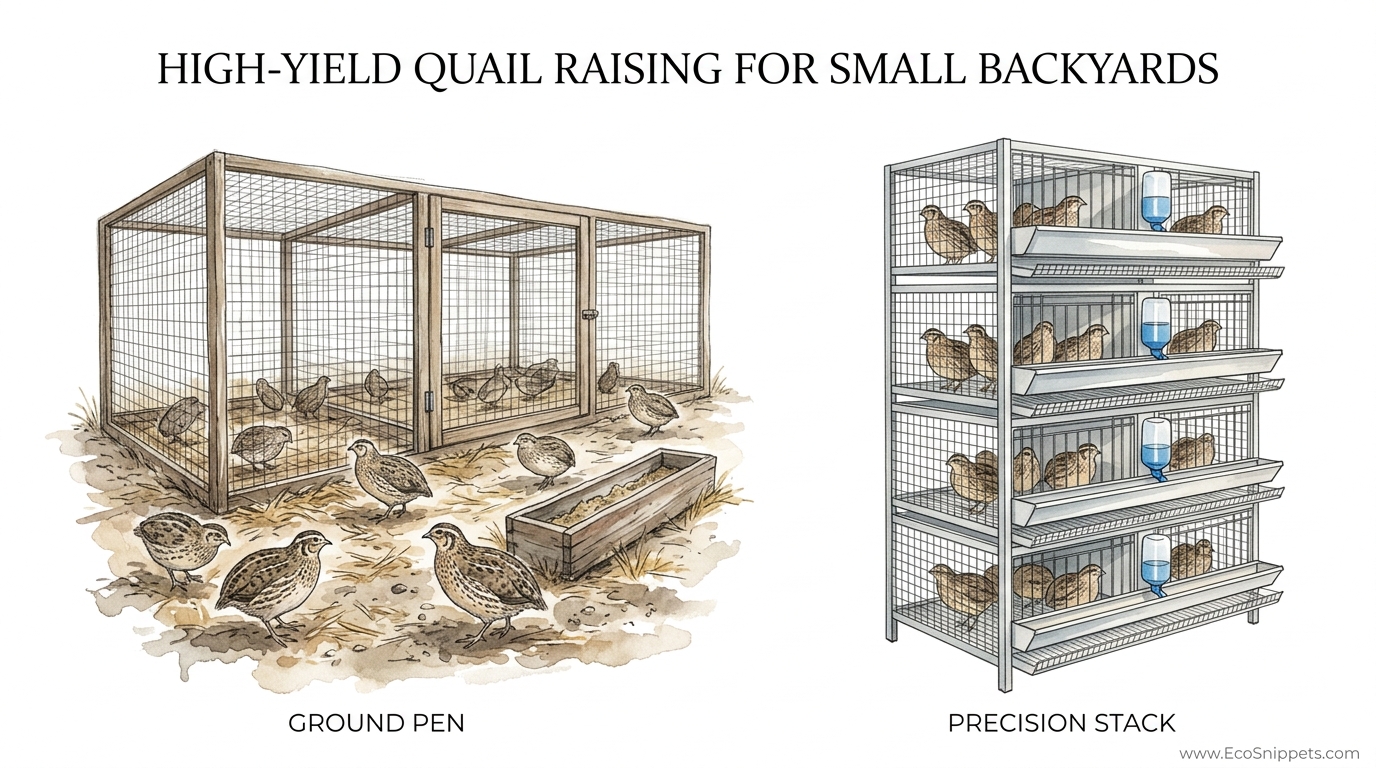
The mechanics of a vertical quail system are designed to automate the most tedious parts of bird keeping. The core of the system is the slanted wire floor. Typically, the floor consists of 1/2-inch by 1-inch (1.25 cm x 2.5 cm) PVC-coated wire, set at a 5 to 7-degree angle. When a hen lays an egg, it gently rolls forward out of the cage and into a collection trough. This prevents eggs from being stepped on, soiled, or eaten by the birds.
Manure management is handled through removable trays positioned beneath each wire floor. These trays catch droppings instantly, keeping the birds’ feet clean and preventing the spread of fecal-borne diseases like coccidiosis. Maintenance involves simply sliding the tray out, dumping the “garden gold” into a compost bin, and sliding it back in. This takes seconds compared to the hours spent shoveling out a traditional deep-litter coop.
Water and feed are delivered through external attachments. Gravity-fed troughs or nipple waterer systems ensure that the birds have constant access to resources without the ability to scratch dirt or manure into their supplies. High-protein feed—usually a 24% to 28% protein game bird starter for young birds and a 18% to 20% layer crumble for adults—is placed in external feeders to minimize waste. Because the birds cannot reach the feed to “flick” it with their beaks, your feed conversion ratio remains incredibly high.
Building or Buying Your Stack
A precision stack can be built from 2×2 lumber and hardware cloth, or purchased as a professional-grade plastic or galvanized metal unit. If you choose the DIY route, ensure the interior height of each cage is between 10 and 12 inches (25 to 30 cm). Quail have a “flush” reflex where they jump straight up when startled. A ceiling that is too high allows them to gain enough momentum to break their necks upon impact, while a lower ceiling keeps them safe.
Lighting for Maximum Yield
Egg production in quail is almost entirely driven by light. To maintain a yield of 100 eggs a week, your hens need 14 to 16 hours of light per day. In most regions, natural daylight is only sufficient for a few months of the year. Installing a simple LED strip or a low-wattage bulb on a timer ensures that the birds’ pituitary glands stay active, keeping production steady through the dark winter months. Avoid 24-hour lighting, as birds need a period of darkness to rest and recover.
Benefits of Vertical Precision Systems
The primary advantage of a vertical system is the incredible density of production. A household can become entirely self-sufficient in eggs using only a few square feet of space. Beyond space, however, the hygienic benefits are the real winner for the serious practitioner. Because the birds never walk in their own waste, respiratory issues and foot infections like bumblefoot are virtually non-existent.
Egg quality is significantly higher in these systems. Since the eggs roll away immediately, they remain pristine and free of manure or mud. This eliminates the need for washing eggs, which preserves the natural “bloom” and extends their shelf life at room temperature. For those living in areas with high predator pressure, a stacked system kept on a porch or in a secure shed is much easier to defend than an outdoor ground pen that can be breached by digging predators like rats or raccoons.
Manure collection is another overlooked benefit. Quail manure is significantly richer in nitrogen, phosphorus, and potassium than chicken manure. A vertical system allows you to collect this waste in its concentrated form without it being mixed with bedding like straw or wood shavings. This makes it much easier to “hot compost” or turn into a potent liquid fertilizer for your garden.
Challenges and Common Mistakes
The most frequent error in vertical quail raising is neglecting ventilation. While these systems are compact, 60 birds in a small shed will produce a significant amount of ammonia. If you can smell the waste, the concentration is already high enough to damage the birds’ sensitive respiratory systems. You must ensure that air is constantly moving through the stacks without creating a direct, chilling draft on the birds.
Another pitfall is using the wrong wire size for the floors. Wire that is too large will catch the birds’ legs, leading to breaks and infections. Wire that is too fine will not allow manure to fall through, causing a buildup that defeats the purpose of the system. The gold standard is 1/2-inch (1.25 cm) square or 1/2-inch by 1-inch (1.25 cm x 2.5 cm) mesh. Always use PVC-coated wire if possible, as it is much gentler on the birds’ feet than raw galvanized metal.
Feed protein levels are also a common point of failure. Many beginners try to feed quail standard chicken layer crumbles, which usually only contain 16% protein. Quail have a much higher metabolism and require at least 18% to 20% protein to sustain daily egg production. Cutting corners on feed will result in hens that stop laying or begin picking at each other’s feathers to compensate for the nutritional deficit.
Limitations and Realistic Constraints
Vertical systems are not a “set it and forget it” solution. Because the birds are in a managed environment, they are 100% dependent on you for their needs. If a water line clogs or a feeder runs empty, the birds have no way to forage for alternatives. This means daily checks are mandatory. A single day without water in a high-density system can lead to significant bird loss, especially in hot weather.
Noise and dust are also factors to consider. While female quail make only quiet chirping sounds, the males have a distinct crow that can be heard through walls. If you are in a high-density urban area, you may need to keep only hens to remain “invisible” to neighbors. Additionally, quail are incredibly dusty birds. They produce a fine dander that will coat every surface in an indoor room. A high-quality air filtration system or keeping the birds in a well-ventilated garage is necessary for indoor setups.
Finally, these systems do not allow for the “natural” foraging behaviors some homesteaders value. If your goal is to see birds scratching in the dirt and chasing grasshoppers, a vertical stack will feel clinical and restrictive. This system is designed for efficiency and production first. For many, the trade-off of having a massive egg supply in a tiny space is worth the lack of a “free-range” aesthetic.
GROUND PEN vs PRECISION STACK
Choosing between a ground pen and a precision stack depends on your goals, your available space, and the climate in your region. Ground pens are excellent for larger properties where the birds can be moved to fresh grass frequently. However, for most backyard setups, the precision stack offers more control and higher safety.
| Feature | Ground Pen (Colony) | Precision Stack (Vertical) |
|---|---|---|
| Space Required | 1.5 sq ft per bird (0.14 sq m) | 0.3 sq ft per bird (0.03 sq m) |
| Egg Cleanliness | Moderate (eggs laid in litter) | Excellent (automatic roll-out) |
| Disease Risk | Higher (contact with waste) | Lower (waste falls away) |
| Labor | Periodic deep cleaning | Daily/Weekly tray emptying |
| Predator Protection | Requires heavy ground mesh | Highly secure, often indoors |
| Cost to Build | Lower (simple materials) | Higher (specialized cages) |
Practical Tips for Success
Success with quail starts with the quality of your stock. Look for “Jumbo” Coturnix lines if you want larger eggs and more meat per bird. Standard lines are slightly more efficient on feed but produce smaller eggs. Whichever you choose, ensure you start with birds from a NPIP (National Poultry Improvement Plan) certified source to ensure they are free of major diseases from the start.
- Keep a backup water source: Nipple waterers can occasionally fail. Always have a secondary manual waterer available for emergencies.
- Use an egg-bound check: If a high-producing hen suddenly looks lethargic or “puffy,” she may be egg-bound. A warm water soak can often help her pass the egg safely.
- Supplement with calcium: High-production hens deplete their calcium stores quickly. Provide a small dish of crushed oyster shells or eggshells to ensure strong, crack-resistant shells.
- Manage the male ratio: For breeding groups, keep a ratio of one male to every five or six females. Too many males will lead to over-mating and injuries to the hens.
- Ferment your feed: For an advanced efficiency boost, try fermenting your quail crumbles. This increases nutrient bioavailability and reduces the amount of feed the birds consume.
Advanced Considerations for Scaling
Once you have mastered a single stack, scaling up is a matter of replication. Serious practitioners often move toward a “closed loop” system where they hatch their own replacements. An incubator like the Brinsea or a simple forced-draft unit can turn a handful of fertile eggs into a new generation of layers in just 17 or 18 days. This eliminates the cost and biosecurity risk of buying new birds from outside sources.
Scaling also requires a plan for the “spent” layers. Coturnix quail are most productive in their first year. After 12 to 18 months, their egg production will drop. At this point, many homesteaders transition these birds to the freezer. Quail meat is a gourmet delicacy, and “culling” your old layers provides a secondary protein source that ensures nothing on the farm goes to waste.
Advanced manure management involves using “black soldier fly” larvae to process the waste from the trays. The larvae consume the manure, reducing its volume and eliminating odor, while the larvae themselves can be harvested and fed back to the quail as a high-protein treat. This creates a highly efficient cycle that turns waste back into food.
Scenario: The 100-Egg-a-Week Setup
To produce 100 eggs per week, you need a reliable flock of approximately 15 to 18 hens. Coturnix hens at peak production lay about 5 to 6 eggs per week. A single three-tier stack measuring 3 feet wide by 2 feet deep (90 cm x 60 cm) provides 18 square feet (1.6 sq m) of floor space. At a density of 3 birds per square foot, this setup could technically hold 54 birds, but for a sustainable 100-egg yield, you only need to use the top two tiers for your 18 hens.
In this scenario, the bottom tier remains open for raising chicks or “grow-outs” for meat. Every morning, you spend three minutes checking water and feed. Every two days, you collect about 30 eggs from the roll-out trays. Once a week, you slide out the manure trays and empty them into the compost. The total footprint is smaller than a standard dresser, yet it provides more than enough eggs for a family of four to have a dozen “chicken-equivalent” eggs every single day.
Costs for this setup are minimal once established. 18 quail will consume roughly 15 to 20 pounds (7 to 9 kg) of feed per month. Given the price of high-quality organic eggs at the market, the system usually pays for itself within the first four to six months of operation. The self-reliance and peace of mind, however, are immediate.
Final Thoughts
High-yield quail raising is a masterclass in efficiency. It proves that self-reliance is not reserved for those with 40 acres and a tractor. By embracing the precision vertical system, you are taking control of your food supply with a method that is clean, quiet, and incredibly productive. It is a return to ancestral wisdom updated with modern engineering, allowing anyone to become a producer rather than just a consumer.
Start small with a single tier and five or six birds. As you learn their rhythms and master the nuances of lighting and nutrition, you will find it easy to expand. The grit required for this journey is minimal compared to the rewards waiting in those collection trays every morning. Whether you are in a high-rise apartment with a balcony or a suburban home with a tiny yard, the path to protein independence is right in front of you.
Take the first step by researching local breeders or ordering a set of hatching eggs. The learning curve is short, and the birds are forgiving. Within two months, you could be cracking open the first of many nutrient-dense eggs, knowing exactly where your food came from and the care that went into producing it. This is the new frontier of the modern homestead—vertical, precise, and profoundly effective.
