How To Become More Self-Sufficient Without Starting a Full-Blown Farm…
Want to start preserving your harvest, making your own soap, or building a backyard root cellar — but not sure where to begin? “Homesteading Advice” gives you instant lifetime access to 35+ practical homesteading books on food preservation, veggie gardening, DIY natural cleaning products (save over $250 per year with this skill alone), brewing, off-grid energy, and a whole lot more…
Click Here To Check It Out Now!
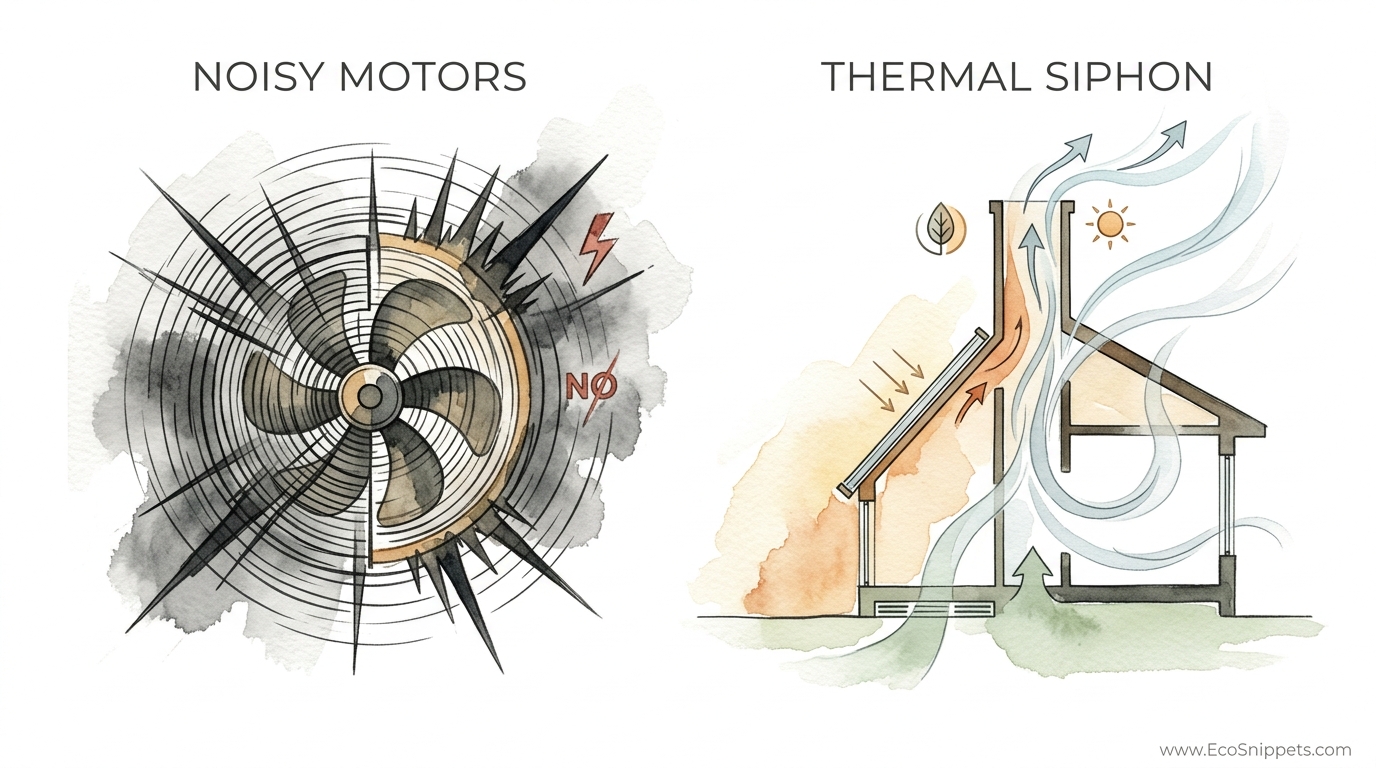
What if you could drop your home’s temperature by 15 degrees using nothing but the physics of rising air? Electric fans just move hot air around while draining your battery bank. A solar chimney uses the sun’s own energy to create a vacuum that pulls cool air through your home for free. No noise, no motors, and zero monthly cost.
Natural laws have always provided the tools for comfort, provided we are willing to listen to the rhythm of the seasons. Ancient builders understood that heat is not an enemy to be fought with brute force, but a resource to be redirected. Harnessing the thermal siphon allows you to turn the very sun that beats down on your roof into an engine for ventilation.
This guide will walk you through the mechanics of the solar chimney, from the basic stack effect to the practical construction of a system that breathes with the day. Whether you are living off-grid or simply looking to cut the cord from the local utility, these principles of self-reliance will serve you well.
How To Cool Your Home Without Electricity – Solar Chimneys
A solar chimney, often called a thermal chimney, is a passive cooling system that uses solar energy to move air. It consists of a vertical shaft, usually painted black on the interior, covered with a transparent glazing like glass or polycarbonate. As sunlight hits the dark surface, it converts to heat, warming the air trapped inside the shaft.
This warm air becomes less dense and rises naturally through the top of the chimney. As it escapes, it creates a low-pressure zone at the base. This vacuum pulls fresh, cooler air from the lowest parts of your home—or from an underground intake—through your living space. It is a constant, silent loop that requires no moving parts and zero input from the power grid.
While modern air conditioning relies on chemical refrigerants and noisy motors, the solar chimney relies on the “stack effect.” This is the same principle that draws smoke up a woodstove flue. In a home cooling context, we are simply using the sun as our fuel instead of a fire. Across the globe, from the sun-scorched plains of the Middle East to the traditional farmsteads of the American West, variations of this “thermal siphon” have kept interiors habitable for centuries.
The Science of the Stack Effect
The heart of the system is buoyancy-driven ventilation. Air is a fluid, and like all fluids, it reacts to changes in temperature and pressure. When you heat air inside a confined vertical space, the molecules move faster and spread out. This makes the air lighter than the surrounding atmosphere.
Gravitational forces pull the heavier, cooler air down, which pushes the lighter, warmer air upward. This creates a measurable pressure differential between the bottom and the top of the shaft. To maximize this effect, the chimney must be tall enough to create a significant “stack” of air. The taller the column of heated air, the stronger the draft.
Calculations for air change rates often focus on the temperature difference between the inside of the chimney and the outside air. A well-designed chimney can achieve air velocities of up to 0.8 meters per second (approx. 2.6 feet per second). In a standard 1,500 square foot home (140 square meters), a properly sized chimney can provide 5 to 15 air changes per hour (ACH), ensuring that the air never becomes stagnant or stifling.
Anatomy of a Solar Chimney
A functional solar chimney is composed of four primary components, each designed to maximize the conversion of light into air movement.
1. The Glazing (The Window)
The glazing is the transparent face of the chimney that faces the sun. Its job is to allow short-wave solar radiation to pass through while trapping long-wave infrared radiation (heat) inside. Tempered glass is the premium choice for longevity and clarity, but multi-wall polycarbonate is a rugged, lightweight alternative for DIY builders.
2. The Absorber Plate (The Engine)
Located behind the glazing, the absorber plate is usually a dark-colored metal or masonry surface. A matte black finish is essential because it absorbs the widest spectrum of solar energy. Heavy materials like brick or stone can act as a thermal battery, storing heat during the day to keep the air moving even after the sun sets.
3. The Air Cavity (The Flue)
The gap between the glazing and the absorber plate is where the magic happens. Research suggests an optimal cavity width of 0.2 to 0.3 meters (8 to 12 inches). If the gap is too narrow, friction slows down the airflow. If it is too wide, the air can develop “back-flow” or turbulence, which reduces the efficiency of the draw.
4. The Vents (The Inlets and Outlets)
The chimney must have an exhaust vent at the very top and an intake vent at the bottom that connects to the home’s interior. For the best results, the outlet area should be roughly equal to or slightly larger than the inlet area. This ensures there is no “bottleneck” in the system that might stall the thermal siphon.
How to Design and Build Your Own Solar Chimney
Building a solar chimney requires careful planning and a basic understanding of your local sun path. Follow these steps to ensure your structure provides the cooling you expect.
Step 1: Orientation and Sizing
Locate the chimney on a wall or roof section that receives maximum sun exposure during the hottest part of the day. In the Northern Hemisphere, this is the south or southwest face; in the Southern Hemisphere, target the north or northwest. Aim for an aspect ratio—the ratio of height to width—of roughly 10:1. A chimney that is 3 meters (10 feet) tall should have a cavity depth of about 0.3 meters (1 foot).
Step 2: Constructing the Frame
Build a rigid frame using rot-resistant timber or metal studs. Ensure the interior is well-insulated on the sides and back. You want all the captured heat to go into the air, not to leak out through the walls of the chimney. Use high-temperature insulation boards that can withstand the 65°C to 80°C (150°F to 175°F) temperatures that can build up inside the cavity.
Step 3: Installing the Absorber
Mount a sheet of corrugated metal or a layer of slate against the back wall of the frame. Paint this surface with a specialized solar-selective coating or a high-quality matte black paint. Corrugated metal is particularly effective because the ridges increase the surface area available for heat transfer to the air.
Step 4: Sealing the Glazing
Attach your glass or polycarbonate sheets to the front of the frame. Use EPDM rubber gaskets or high-grade silicone to create an airtight seal. Any leaks in the glazing will allow hot air to escape prematurely or cool air to enter from the wrong side, significantly weakening the draft.
Step 5: Managing the Airflow
Install dampers or adjustable louvers on both the interior intake and the exterior exhaust. During the winter, you will want to close these vents tightly to prevent your home’s heat from escaping. In the summer, keep them wide open during the day. Consider adding a fine insect screen to the exhaust to prevent pests from entering the system while it is active.
Benefits of Passive Solar Cooling
Choosing a solar chimney over mechanical cooling offers several long-term advantages for the self-reliant homeowner.
- Zero Operating Costs: Once constructed, the system runs entirely on free energy from the sun. You will never receive a bill for the breeze it creates.
- Silence: Unlike the constant hum of a box fan or the roar of a compressor, a solar chimney operates in total silence. It respects the quiet of a rural lifestyle.
- Durability: With no moving parts, motors to burn out, or bearings to grease, a well-built chimney can last as long as the house itself with minimal maintenance.
- Healthier Air: Passive ventilation focuses on air exchange rather than just recirculation. This constantly flushes out indoor pollutants, allergens, and carbon dioxide.
Challenges and Common Mistakes
Even the best-intentioned projects can fail if the physics are ignored. Pay attention to these common pitfalls.
Poor Insulation: If the back and sides of the chimney are not insulated, the heat will bleed out into the surrounding air or, worse, back into your home. This turns your cooling system into a giant radiator that fights against you. Always use at least R-10 (R-value) insulation on the non-transparent surfaces.
Shading Issues: A solar chimney that is shaded by a tree or a neighboring building for two hours in the afternoon will lose most of its effectiveness. Map the “sun path” for all seasons before you commit to a location.
Undersized Intakes: Your chimney can only pull as much air as your home allows in. If your windows and doors are all shut tight, the chimney will struggle to create a draft. You must provide a “source” of cool air—usually from a shaded north-side window or an underground earth tube—to complete the circuit.
Limitations and Environmental Constraints
Solar chimneys are not a universal solution for every climate and every day. Understanding their limits is part of mastering the technology.
Humidity is the primary enemy of passive cooling. In hot-humid environments, moving air helps with sweat evaporation, but it does not actually lower the air temperature. A solar chimney in the tropics will provide a refreshing breeze, but it won’t provide the “refrigerated” feel of an air conditioner.
Nighttime performance is another constraint. Without the sun to drive the siphon, the airflow will naturally taper off. To solve this, many practitioners integrate “thermal mass” (like heavy masonry) inside the chimney to store heat for several hours after dusk, or they use the chimney in conjunction with “night flushing,” where windows are opened to let cool night air reset the home’s temperature.
Comparing Solar Chimneys and Electric Fans
| Feature | Solar Chimney | Electric Fan |
|---|---|---|
| Power Source | Direct Solar Energy | Electricity (Grid/Battery) |
| Maintenance | Low (Cleaning Glazing) | Medium (Motors/Dust) |
| Noise Level | Silent (Thermal Siphon) | Noisy (Mechanical Blades) |
| Cost over 10 Years | Initial Materials Only | Purchase + Electricity + Replacement |
| Air Movement | Whole-House Exchange | Localized Circulation |
Practical Tips for Best Performance
Optimization is the difference between a lukewarm breeze and a transformative cooling system. Use these best practices to tune your setup.
- Use Selective Surfaces: If your budget allows, use a copper or aluminum absorber plate with a “black chrome” finish. These surfaces are designed for solar water heaters and are incredibly efficient at converting photons to heat.
- Tilt for Your Latitude: While vertical chimneys on walls are common, a roof-mounted chimney tilted at an angle equal to your latitude minus 10 or 15 degrees will capture more direct summer sun. A 45-degree tilt is a good “middle ground” for many temperate regions.
- Paint the Exterior White: While the inside of the chimney must be black, the exterior housing should be painted a bright, reflective white. This prevents the heat from the chimney’s structure from radiating back into your house through the mounting wall.
- Implement Night Flushing: Open your highest windows and your chimney dampers during the coolest part of the night. This “pre-cools” the thermal mass of your home, giving the solar chimney a better starting point the next morning.
Advanced Considerations: Integrating Earth Tubes
For those seeking the ultimate in passive cooling, the solar chimney can be paired with an Earth-to-Air Heat Exchanger (EAHE), also known as an earth tube. In this setup, the intake air for the house is not pulled from a window, but through a long pipe buried 2 to 3 meters (6 to 10 feet) underground.
At this depth, the soil stays at a constant temperature of roughly 12°C to 15°C (54°F to 59°F) year-round. As the solar chimney pulls air out of the top of the house, it sucks air through these buried tubes. The earth acts as a natural heat sink, cooling the incoming air before it ever reaches your living room. This combination can maintain a comfortable indoor temperature even when the outside air is a blistering 38°C (100°F).
Example Scenario: The 1,500 Sq Ft Cabin
Imagine a small cabin in a high-desert environment. The daytime temperatures regularly hit 35°C (95°F). The owner installs a 4-meter (13-foot) tall solar chimney on the southwest wall. The chimney has an absorber area of 2.5 square meters (27 square feet).
During peak sun, the air inside the chimney reaches 60°C (140°F). This creates enough buoyancy to pull air through the cabin at a rate of 0.5 cubic meters per second. In a cabin with a total volume of 400 cubic meters, this results in about 4.5 air changes every hour. By pulling air from a shaded porch on the north side, the interior temperature remains a steady 21°C (70°F), even as the sun beats down on the roof.
Final Thoughts
Relying on the physics of the stack effect is more than just a way to save money; it is a way to reconnect with the environment. A solar chimney transforms your home from a sealed box that fights nature into a living system that works with it. By using the sun to move the air, you are employing a technology that is as old as the wind and as reliable as the dawn.
Experimenting with these principles allows you to gain a deeper understanding of thermal dynamics and self-sufficiency. Start small, perhaps with a chimney for a workshop or a shed, and observe how the air moves. Once you see the power of the thermal siphon in action, you may never look at a mechanical air conditioner the same way again.
True comfort comes not from the flip of a switch, but from the intelligent application of ancestral wisdom. Build your cooling system with care, maintain it with pride, and enjoy the silent, cool breeze of a home powered by the sun.
