How To Become More Self-Sufficient Without Starting a Full-Blown Farm…
Want to start preserving your harvest, making your own soap, or building a backyard root cellar — but not sure where to begin? “Homesteading Advice” gives you instant lifetime access to 35+ practical homesteading books on food preservation, veggie gardening, DIY natural cleaning products (save over $250 per year with this skill alone), brewing, off-grid energy, and a whole lot more…
Click Here To Check It Out Now!
A single forgotten jar at the back of the shelf is food you worked for but will never get to eat. Most home preservers lose 15% of their harvest to ‘pantry amnesia.’ They spend all summer in the garden only to let the results rot because they can’t find what they need in a cluttered basement. Stop shoving jars in the dark and start building a system that treats your food like the investment it is.
Honoring the harvest requires more than just a successful canning day. It demands a commitment to stewardship that continues long after the jars have cooled. When you tuck a jar of peaches or venison stew into a dark corner, you are essentially burying a piece of your own labor. Without a clear organization strategy, that labor often goes to waste as seals fail unnoticed or food loses its nutritional value from years of neglect.
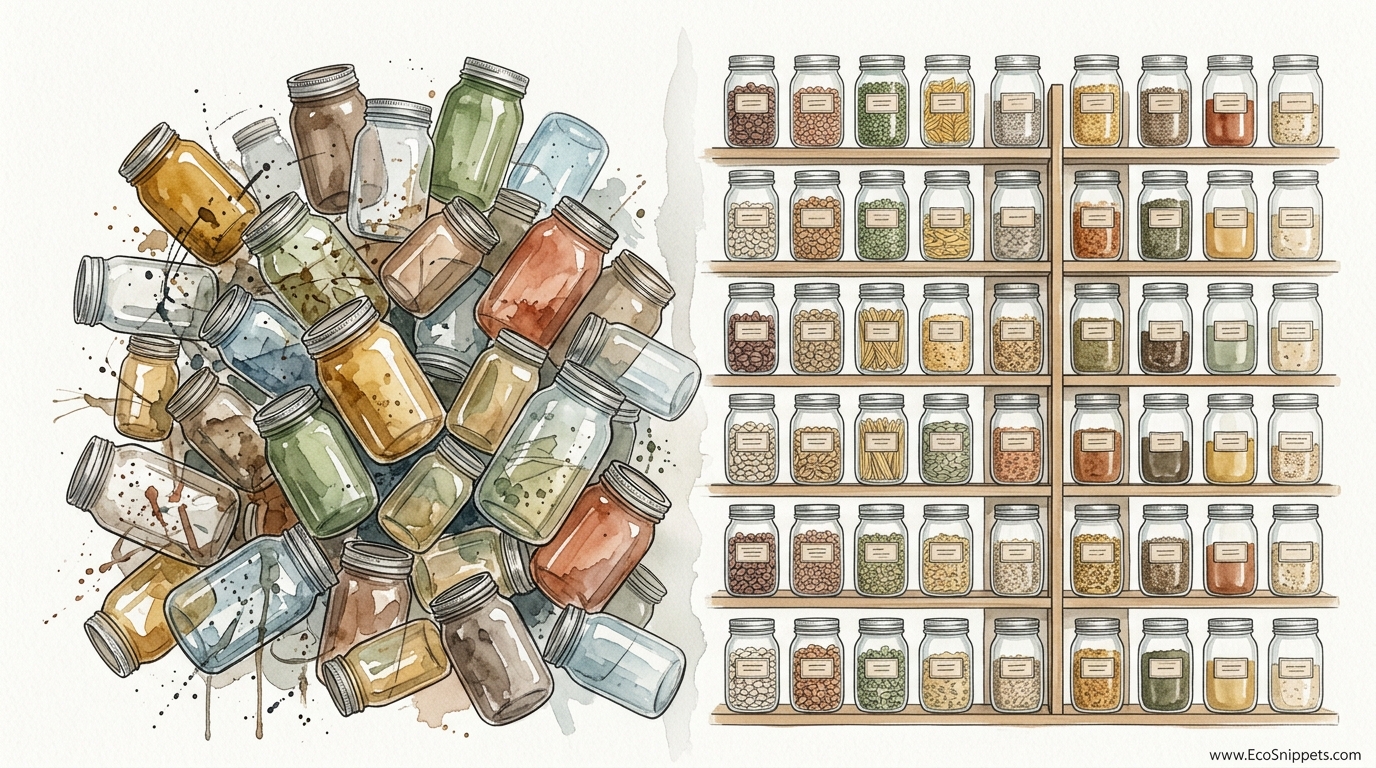
Transforming a chaotic pile of glass into a functional larder is a foundational skill for any self-reliant household. It is the difference between a hobby and a reliable food security system. This guide will walk you through the structural, environmental, and systematic steps needed to master the art of mason jar management.
Best Way To Organize Mason Jars
The most effective method for organizing mason jars is a system built on visibility, accessibility, and the principle of First-In, First-Out (FIFO). This approach treats the pantry like a living inventory rather than a static museum of glass. A truly organized system ensures that you can see every jar at a glance and reach the oldest items without moving ten newer ones out of the way.
Visibility is achieved through shallow shelving. Deep shelves are the primary cause of pantry amnesia, as they encourage jars to be shoved behind one another. Accessibility means jars are stored at heights that allow for easy lifting and inspection. Safety is maintained by removing the metal rings after the cooling period and avoiding excessive stacking.
In real-world terms, this system exists in the form of dedicated canning shelves, often built with custom heights for different jar sizes. Whether you are a small-scale gardener or a homesteader feeding a large family, the goal remains the same. You must create a map of your food stores that tells you exactly what you have, when it was made, and what needs to be eaten next.
Building the System: How to Organize Your Larder
Effective organization begins with a structural plan. Professional-grade home storage relies on shelves designed specifically for the weight and dimensions of glass jars. A standard quart (liter) jar is approximately 3.5 inches (9 cm) in diameter and 7 inches (18 cm) tall, while a pint (half-liter) jar is roughly 3 inches (7.6 cm) wide and 5 inches (12.7 cm) tall.
Building shelves with these specific heights in mind eliminates “dead air” and maximizes your storage capacity. Custom canning shelves often feature a 6.5-inch (16.5 cm) clearance for pints and an 8.5-inch (21.5 cm) clearance for quarts. This allows just enough room for your hand to reach in and grab a jar without wasting several inches of vertical space.
The First-In, First-Out (FIFO) rule is the heart of the operation. When you bring a fresh batch of salsa from the kitchen, you must place those jars at the very back of their designated row. This pushes the older jars to the front, ensuring they are used while their quality and nutritional content are at their peak.
Grouping by category is the final layer of the system. Divide your shelves into “zones” such as fruits, vegetables, meats, and pickles. Within those zones, keep like-items together. All your green beans should occupy the same row, making it immediately obvious when you are running low on a specific staple.
The Measurable Benefits of Precision Order
Precision order saves time every single day. Instead of rummaging through a dark basement with a flashlight, you can perform a five-second visual scan to decide on dinner. This efficiency reduces the mental load of meal planning and ensures that your hard-earned harvest actually makes it to the table.
Financial savings are a direct result of proper rotation. When jars are organized, you avoid the cost of “ghost inventory”—buying or growing more of a product you already have hidden in the back of the pantry. It also prevents the loss of food quality. Home-canned goods are best consumed within 12 to 18 months. An organized system ensures you hit that window for every single jar.
Structural order also improves safety. A shelf designed for the weight of glass (a full quart jar weighs about 3 pounds or 1.4 kg) is much less likely to collapse than a generic plastic unit from a big-box store. Knowing your shelf limits protects both your investment and your family.
Challenges and Common Mistakes to Avoid
Leaving the metal rings (bands) on the jars during storage is one of the most frequent errors in home preservation. While these bands are essential during the water bath or pressure canning process, they should be removed 12 to 24 hours after the jars have cooled. Storing jars with rings on can trap moisture, leading to rust and “false seals.”
A false seal occurs when a lid loses its vacuum, but the ring holds it down so firmly that the gases from spoilage cannot escape. This can lead to a jar resealing itself with dangerous bacteria inside. Removing the ring allows you to verify the integrity of the vacuum seal before you ever put the jar on the shelf.
Stacking jars directly on top of each other is another risky practice. The weight of the top jar can put pressure on the seal of the bottom jar, potentially causing it to fail or, worse, to false-seal. If space constraints force you to stack, never go more than two jars high. Place a piece of sturdy cardboard or a thin wooden board between the layers to distribute the weight and protect the lids.
Limitations and Environmental Constraints
Not every home has a perfect, cool, and dark root cellar. Modern homes often present challenges such as fluctuating temperatures and high humidity. Storing jars near heat sources like water heaters, furnaces, or kitchen ranges will significantly degrade the quality of the food over time.
Temperatures above 95°F (35°C) are particularly dangerous, as they can cause rapid spoilage. The ideal storage temperature is between 50°F and 70°F (10°C to 21°C). If your only storage space is a bright room, you must mitigate the light exposure. Light causes food to lose its vibrant color and essential vitamins. Covering open shelves with dark curtains or storing jars in their original cardboard boxes can solve this problem.
Humidity is a separate threat. In damp basements, metal lids can corrode, eventually compromising the seal. If you live in a coastal or humid region, consider using a dehumidifier in your storage area or applying a very light coating of food-grade oil to the outside of the lids to prevent rust.
Comparison: Manual Logs vs. Digital Inventory
Choosing how to track your food depends on your personal style and the size of your harvest. Both systems offer a path from TOTAL CHAOS to PRECISION ORDER, but they cater to different needs.
| Feature | Manual Paper Log | Digital Spreadsheet/App |
|---|---|---|
| Setup Complexity | Low – Just a notebook and pen. | Medium – Requires data entry and software. |
| Accessibility | High – Always stays in the pantry. | High – Accessible from a phone anywhere. |
| Searchability | Low – Must flip through pages. | High – Instant search and filters. |
| Maintenance | Requires discipline to write things down. | Requires regular updates to be accurate. |
A manual log is often preferred by those who enjoy the tactile nature of homesteading. It serves as a historical record of your garden’s successes and failures. A digital system, however, can alert you when a batch is approaching its one-year anniversary, helping you prioritize those jars for upcoming meals.
Practical Tips for Immediate Improvement
Labeling is the first line of defense against pantry amnesia. Every jar must be marked with the contents and the full date (month and year). Use a permanent marker directly on the lid. This avoids the sticky residue that adhesive labels leave on the glass, which can be difficult to clean during the next canning season.
Cleaning the jars before they hit the shelf is another essential step. During the canning process, food can often siphoned out of the jar and onto the rim. If this residue is not washed off with warm, soapy water, it will grow mold under the ring or attract pests. A clean jar is a safe jar.
Empty jar management is just as important as full jar storage. Store your empty jars upside down in their original boxes. This prevents dust, spiders, and debris from accumulating inside. It also makes it easy to see which sizes you have available when a surprise harvest of tomatoes arrives on your doorstep.
Advanced Considerations for Serious Practitioners
Serious preservers often implement a “Batch Tracking” system. By assigning a batch number to each canning session and recording it in a master log, you can track performance over time. If you notice a jar of pickles has gone soft, you can check the log to see what the processing time was or what specific vinegar acidity you used.
Weight distribution is a critical safety factor for large pantries. If you are building floor-to-ceiling shelves, place your heaviest items—like quart jars of meat or potatoes—on the lower levels. Keep lighter items like half-pints of jam or dried herbs at eye level. This lowers the center of gravity of the entire shelving unit and makes it less likely to tip during an earthquake or accidental impact.
Lighting can be a hidden enemy. If you use LED shop lights in your pantry, ensure they are only turned on when you are actually in the room. Even artificial light can cause “skunky” flavors in fats and oils over several months. Motion-sensor lights are an excellent investment for a larder, ensuring the food stays in total darkness unless you are actively retrieving a jar.
Examples of Organization in Practice
Consider the “Winter Stew” scenario. A family that cans 50 quarts of beef stew each autumn needs a reliable way to access them. In a chaotic pantry, these jars are scattered across three different shelves, mixed with jars of applesauce and green beans. By mid-February, the family thinks they are out of stew, so they buy expensive processed meals at the store.
In a precision-ordered pantry, those 50 jars occupy two dedicated rows. Because they were stored using the FIFO method, the jars from the previous year are sitting at the very front. The father can walk into the pantry, see exactly how many jars are left, and know that they have exactly six weeks of stew remaining. There is no guesswork, no wasted money, and no forgotten food.
Another example is the “Small Space” preserver living in an apartment. Lacking a basement, they utilize the “Under-Bed” system. They keep their jars in sturdy plastic totes with cardboard dividers to prevent clinking. Each tote is labeled on the side with a manifest of its contents. This turns unused floor space into a functional, dark, and temperature-stable larder.
Final Thoughts
Building a system for your mason jars is an act of respect for the time and energy you poured into your garden. It transforms a collection of glass into a strategic reserve that can sustain your family through any season. By focusing on visibility, removing rings, and strictly following the FIFO principle, you eliminate the waste that plagues so many home kitchens.
The transition from a cluttered shelf to a professional larder does not have to happen overnight. Start by clearing one shelf, cleaning your jars, and labeling them clearly. As your system grows, you will find a deep sense of satisfaction in seeing the fruits of your labor neatly lined up and ready for the table.
Remember that a pantry is not a vault; it is a revolving resource. Use what you have, track what you use, and always leave room for the next harvest. The grit of self-reliance is found in these small, daily habits of organization and care. Keep your jars clean, your rows straight, and your shelves sturdy.
