How To Become More Self-Sufficient Without Starting a Full-Blown Farm…
Want to start preserving your harvest, making your own soap, or building a backyard root cellar — but not sure where to begin? “Homesteading Advice” gives you instant lifetime access to 35+ practical homesteading books on food preservation, veggie gardening, DIY natural cleaning products (save over $250 per year with this skill alone), brewing, off-grid energy, and a whole lot more…
Click Here To Check It Out Now!
This 3,000-year-old architectural secret uses ‘order’ to defeat the desert heat without a single watt of electricity. We build boxes that trap heat and then pay to pump it out. The Nubian Vault uses a specific catenary arch and thermal mass to ensure the interior stays 70 degrees when the outside is 110. It’s the ultimate energy-saving architecture that you can build with the soil under your feet.
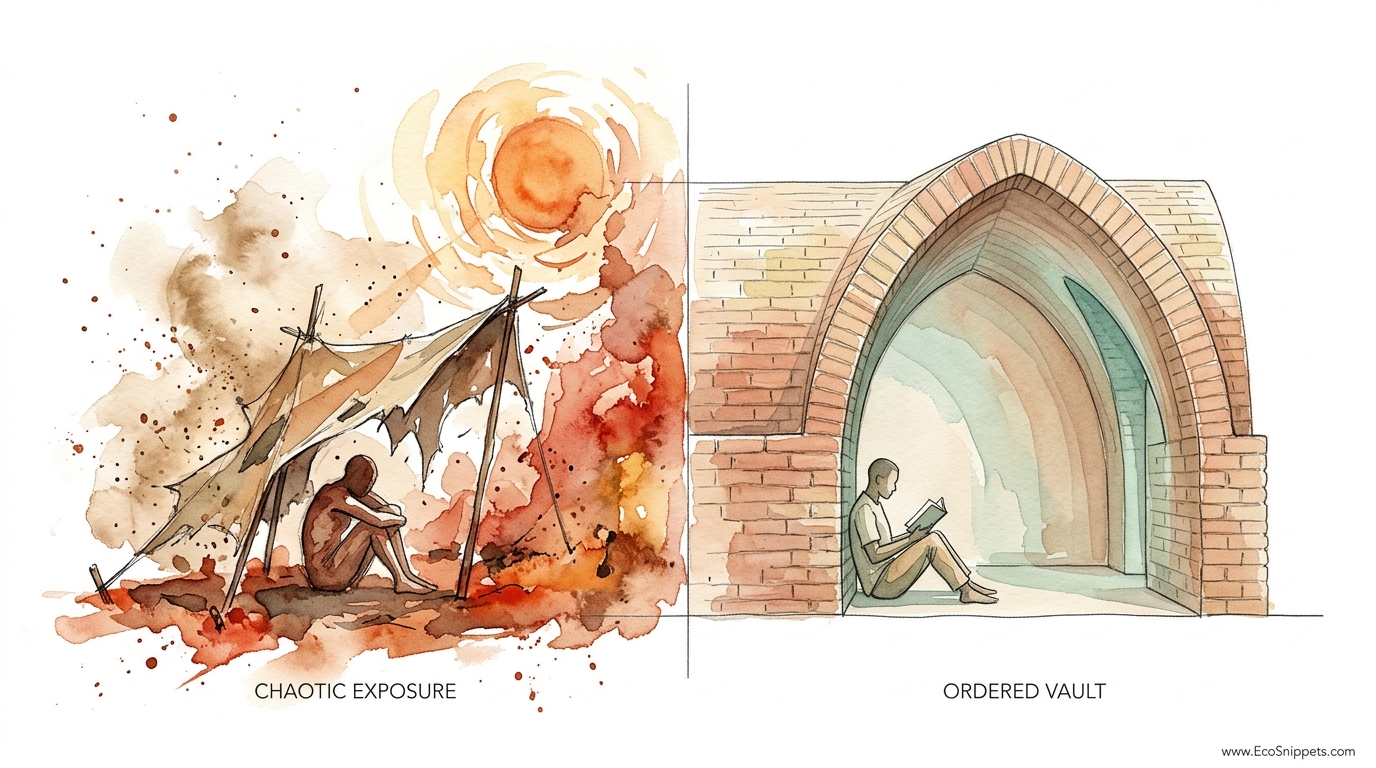
Modern homes often suffer from what we might call chaotic exposure. These thin-walled containers offer little protection from the sun’s relentless energy, forcing us to rely on complex, fragile mechanical systems just to survive. In contrast, the ordered vault relies on ancient geometry and the density of the earth itself to create a sanctuary. This is not just a building; it is a thermal battery and a structural masterpiece that has stood the test of time in some of the harshest environments on the planet.
Understanding this technique allows you to step away from the cycle of high-cost, high-maintenance construction. You are moving toward a method that prioritizes local materials and self-reliance. Whether you are looking to build a root cellar, a sustainable home, or a backyard studio, the principles of the Nubian Vault offer a path back to a more grounded way of living.
Building A Nubian Vault For Natural Temperature Control
The Nubian Vault is an ancient architectural technique that allows for the construction of a roof made entirely of sun-dried earth bricks. Unlike traditional European arches that require a wooden support structure during construction, the Nubian method allows builders to lay bricks in a self-supporting manner. This innovation was born in the arid regions of Upper Egypt and Sudan, where timber was a rare and precious resource.
The earliest surviving examples of this technique are the granaries at the Ramesseum, built around 1300 BC. These structures have survived for over three millennia, proving that earth, when shaped with correct geometry, can be more durable than modern industrial materials. The vault exists because of necessity and thrives because of its inherent efficiency. It uses the weight of the earth to hold itself together, creating a space that is as strong as it is beautiful.
In real-world terms, the Nubian Vault is a solution for anyone living in a climate with extreme temperature swings. It is particularly effective in arid and semi-arid regions where the daytime heat is punishing and the nights are surprisingly cold. Because the structure is made of thick mud-brick, it acts as a massive thermal regulator. It absorbs the sun’s energy throughout the day, preventing it from entering the living space, and then slowly releases that heat during the cool night hours.
The Geometry of the Inverted Chain: How the Arch Defies Gravity
The secret to building a roof out of mud without it collapsing lies in the catenary arch. If you take a heavy chain and hold it at both ends, it naturally sags into a specific U-shape. This shape is the physical expression of gravity acting on a flexible material. When you take that exact shape and flip it upside down, you create an arch where all the forces are perfectly in compression.
Mud bricks, known as adobes, have high compressive strength but almost no tensile strength. They can handle a massive amount of weight pushing down on them, but they will crack or pull apart if subjected to bending or stretching forces. The catenary curve ensures that every brick in the vault is pushing directly against its neighbor. There are no “weak” points where the arch wants to sag or pull away.
Construction happens through a “leaning” method. Builders start against a thick gable wall and lay the bricks at a 70-degree angle rather than perfectly vertical. Each new course of bricks leans back against the previous one. This creates enough friction and support that the bricks stay in place even as the arch reaches its highest point. You do not need a single piece of wood to hold the roof up while the mortar dries. This is a massive advantage in areas where lumber is expensive or unavailable.
Mastering the Earth: Soil Science and Brick Production
The success of your vault depends entirely on the quality of your soil. You cannot just use any dirt from the backyard; you need a specific balance of clay and sand. Clay acts as the glue that binds everything together, while sand provides the structural skeleton that prevents the bricks from shrinking and cracking as they dry in the sun.
A standard recipe for a high-quality adobe brick is 30% clay and 70% sand. If your soil has too much clay, the bricks will curl and crack like a dried-up lake bed. If there is too much sand, the bricks will crumble into dust under the slightest pressure. To test your soil, you can perform a simple “sausage test.” Dampen a handful of earth and roll it into a cylinder about 12 centimeters (5 inches) long. If it holds its shape when you dangle it from one end, the clay content is likely sufficient.
Brick production is a labor-intensive but straightforward process. You mix your soil with water and perhaps a small amount of straw to create a thick, workable mud. This mixture is pressed into wooden molds and then turned out onto a flat, cleared area to dry. In a hot desert climate, these bricks can be ready for use in as little as three to five days. The bricks for the vault itself are usually smaller and thinner—around 24 cm long, 12 cm wide, and 4.5 cm thick (9.5 x 4.7 x 1.8 inches)—to ensure they are light enough to stick to the mortar during the leaning process.
The Construction Process: A Step-by-Step Guide
Building the vault requires a steady hand and a clear understanding of the “leaning” technique. You must ensure your supporting walls are thick enough to handle the outward thrust of the arch. Typically, these walls should be at least 60 centimeters (24 inches) thick.
- Site Preparation and Foundation: Dig a trench and fill it with rocks and a strong earth mortar. The foundation must be perfectly level and solid enough to prevent any settling, which would cause the vault to crack.
- Erecting the Walls: Build the load-bearing walls using large adobe bricks. One end of the building must have a sturdy “gable” wall. This wall serves as the starting point and the structural anchor for the first courses of the vault.
- Tracing the Curve: Use a chain or a pre-made wooden guide to trace the catenary curve onto the gable wall. This guide ensures that every brick follows the correct mathematical path to maintain compression.
- Laying the First Courses: Begin at the base of the gable wall. Apply a layer of thick mud mortar and press the first vault brick against the wall at a 70-degree angle. The mortar must be sticky enough to hold the brick in place immediately.
- Building the “Leaning” Arches: Continue laying bricks upward, following the traced curve. Each successive row of bricks leans back against the gable or the previous arch. As you reach the top, the bricks become almost horizontal, held in place by the friction of the mortar and the weight of the bricks behind them.
- Closing the Vault: Repeat this process arch by arch until you reach the end of the building. The final arch is often locked into place with a second gable wall or a specialized finishing technique to ensure the entire structure remains rigid.
The Thermodynamics of Earth: Why You Stay Cool
The Nubian Vault uses thermal mass to achieve what modern air conditioners do with high-voltage electricity. Thermal mass is the ability of a material to store heat energy. Earth has a high “specific heat capacity,” meaning it takes a long time for a mud wall to change temperature. In a standard thin-walled house, the sun hits the wall, the heat transfers through almost immediately, and you are roasting by noon.
In a vault structure, the walls and roof are often 45 to 60 centimeters (18 to 24 inches) thick. When the 110-degree Fahrenheit (43°C) sun hits the exterior, the heat begins to travel through the brick. However, because the material is so dense, it takes about 8 to 12 hours for that heat to reach the interior surface. By the time the heat finally makes it through, the sun has gone down, the outside air has cooled, and the wall begins to release its heat back to the night sky instead of into your bedroom.
This “thermal lag” effectively averages out the temperature. While the outside fluctuates between a scorching 110°F and a chilly 50°F (10°C), the inside stays remarkably consistent, usually hovering around 70°F to 75°F (21-24°C). This is not a miracle; it is simply the result of aligning your living space with the natural physics of the environment.
Benefits of the Nubian Vault
The advantages of this construction method extend far beyond temperature control. It represents a shift toward a more sustainable and economically independent lifestyle.
- Zero Timber Requirement: Because the vault is self-supporting during construction, you do not need wood for rafters, beams, or shuttering. This makes it an ideal solution for regions suffering from deforestation or high lumber costs.
- Exceptional Durability: Structures built with this method can last for centuries. The Ramesseum granaries have survived since 1300 BC, whereas many modern concrete homes show signs of failure within 50 years.
- Carbon Neutrality: Building with earth has a tiny fraction of the carbon footprint associated with cement and steel. Research shows that a 25-square-meter (270 sq ft) Nubian Vault saves over 20 tons of carbon equivalent compared to a modern concrete block building over its lifecycle.
- Acoustic Comfort: The thick earth walls provide incredible sound insulation. During heavy rain or windstorms, the interior remains peaceful and quiet, unlike homes with corrugated metal roofs that can be deafening in a storm.
- Low Cost: If you have access to the right soil and a few helping hands, the materials for a vault are essentially free. The primary cost is labor, which keeps resources within the local community rather than sending them to industrial manufacturers.
Challenges and Common Mistakes
While the vault is structurally sound, it is not a “set it and forget it” system. Earth is a natural material, and it requires respect and understanding to function correctly.
One of the most frequent errors is using soil with the wrong clay-to-sand ratio. Beginners often assume more clay makes a stronger brick, but the opposite is true. Too much clay leads to massive shrinkage and cracking. Another common pitfall is neglecting the thickness of the load-bearing walls. If the walls are too thin, the outward “thrust” of the vault will eventually cause them to bow or fail. You must respect the weight of the earth roof.
Water is the ultimate enemy of unbaked earth. If rain is allowed to soak into the bricks, they will eventually return to their original state: mud. Many builders fail to provide an adequate exterior plaster or a waterproof cap. Without a protective “skin,” even the most perfectly engineered vault will erode over time. Regular maintenance of the exterior finish is the price you pay for the incredible thermal benefits of the interior.
Limitations: When the Vault May Not Be Ideal
The Nubian Vault is a masterpiece of arid-climate design, but it is not a universal solution for every environment. High-humidity and high-rainfall areas present significant challenges. In tropical regions where it rains daily, an adobe roof is under constant assault. While you can protect it with lime plasters or bitumen coatings, the maintenance required may become burdensome compared to other local building methods.
There are also physical constraints to consider. A standard Nubian Vault is usually limited to a width of about 3.3 meters (11 feet). While the length can be indefinite, the span of the arch is restricted by the compressive strength of the mud bricks. If you need a wider room, you must build multiple vaults side-by-side or incorporate expensive reinforcement like concrete beams.
Furthermore, this is not a fast building method. It requires patience and a high level of craftsmanship. If you are in a rush or looking for a standardized industrial solution, the slow, rhythmic process of laying vault bricks one by one may not suit your needs. It is a technique for those who value quality and longevity over speed and convenience.
Comparing Construction Methods
To understand the value of the Nubian Vault, it helps to look at how it stacks up against modern alternatives commonly found in similar climates.
| Feature | Nubian Vault (Adobe) | Modern Concrete / Metal | Traditional Timber Frame |
|---|---|---|---|
| Material Source | Local soil and water | Industrial / Imported | Forestry / High cost |
| Thermal Comfort | Excellent (Stable 70°F) | Poor (Heats up fast) | Moderate |
| Energy Use | Zero | High (AC required) | Moderate |
| Longevity | 1000+ years | 40-60 years | 20-50 years |
| Skill Required | High (Specialized) | Moderate | Moderate |
Practical Tips for the Modern Builder
If you are planning to experiment with vault construction, start small. Build a garden shed or a small storage cellar before attempting a full-sized living space. This allows you to get a feel for the mortar consistency and the “tackiness” required to hold the bricks in place.
Perform a “Jar Test” on your soil. Fill a glass jar one-third full of your soil and the rest with water. Shake it vigorously and let it settle for 24 hours. The sand will settle first, then the silt, and finally the clay on top. This gives you a clear visual representation of your soil’s composition. If you don’t have enough sand, you can easily buy masonry sand to balance the mix.
Always use a “compass” or a guide string. Even experienced masons use a fixed point in the center of the floor with a string cut to the radius of the arch. This ensures the curve remains consistent from the first brick to the last. Without a guide, the arch can easily become “lopsided,” which creates uneven forces and risks structural failure. Consistency is the key to safety.
Advanced Considerations: Hybrid Systems and Modern Scaling
Serious practitioners often look for ways to integrate the Nubian Vault into modern lifestyles. One approach is the “R+1” or two-story vault system. In this setup, the ground floor is a reinforced earth structure with a flat top, and the second story features the vaulted roof. This doubles the living space while maintaining the thermal benefits.
You can also combine the vault with passive ventilation techniques like “earth tubes.” These are pipes buried deep underground that pull outside air through the cool earth before releasing it into the house. When combined with the high thermal mass of the vault, this can create a home that feels like it has active air conditioning even in the peak of summer.
For those in slightly wetter climates, modern stabilizers can be added to the exterior bricks. Adding a small percentage of lime or cement to the outer layer of adobes can significantly increase their resistance to water. This creates a hybrid structure that maintains the ancestral wisdom of the vault while utilizing modern material science to overcome environmental limitations.
Scenario: Building a Desert Food Storage Unit
Imagine you need a place to store agricultural produce or sensitive equipment in a remote desert location. A standard metal shipping container would turn into an oven, reaching internal temperatures of 130°F (54°C) or higher. A concrete shed would be expensive to transport and would still require insulation.
By building a 3-meter by 5-meter Nubian Vault, you solve these problems. Using the soil on-site, you create walls and a roof that are 50 centimeters thick. You plaster the exterior with a mix of mud, sand, and a bit of natural stabilizer like lime or fermented cactus juice. Inside, the temperature remains at a steady 72°F (22°C) year-round. There are no moving parts to break, no filters to change, and no electricity bills to pay. This is the definition of “ordered” architecture—using geometry to solve a problem that most people try to solve with expensive machinery.
Final Thoughts
The Nubian Vault is more than just a roof; it is a testament to what humans can achieve when we work with the laws of physics rather than trying to overpower them. By choosing to build with the earth, you are embracing a legacy of self-reliance that stretches back thousands of years. You are trading the “chaotic exposure” of modern materials for the “ordered stability” of the catenary arch.
We have spent the last century moving away from these ancestral techniques in favor of industrial convenience, but we are now seeing the costs of that choice. High energy bills, unsustainable carbon footprints, and homes that fail within a single lifetime are the new norm. The Nubian Vault offers a different path. It proves that the most advanced solution is often the one that has been beneath our feet the entire time.
If you are interested in sustainable living or architectural independence, take the time to study this method. Start with a small pile of dirt, a bit of water, and the curiosity to see what you can create. The transition from building boxes to building vaults is a transition toward a more resilient and harmonious way of existing on this planet.
