How To Become More Self-Sufficient Without Starting a Full-Blown Farm…
Want to start preserving your harvest, making your own soap, or building a backyard root cellar — but not sure where to begin? “Homesteading Advice” gives you instant lifetime access to 35+ practical homesteading books on food preservation, veggie gardening, DIY natural cleaning products (save over $250 per year with this skill alone), brewing, off-grid energy, and a whole lot more…
Click Here To Check It Out Now!
Minnesota’s ‘Lawns to Legumes’ program pays locals $350 to rip out their lawns and plant pollinator-friendly habitats… and Minnesota’s ‘Lawns to Legumes’ program is proving that our obsession with sterile turf is costing us our most vital pollinators. We’ve traded biodiversity for a ‘neat’ look that is functionally dead. See why thousands of Minnesotans are ditching the mower for a living ecosystem that feeds the planet and are getting paid to do it.
The traditional American lawn is a relic of another time. While we were taught to value a flat, green carpet of Kentucky Bluegrass, this landscape is essentially a biological desert. It offers no food for the bees, no shelter for the butterflies, and requires an endless cycle of chemicals and water just to survive. In Minnesota, a revolutionary movement is taking root, led by the Board of Water and Soil Resources (BWSR).
This program is not just about aesthetics; it is about survival. By providing residents with the financial means and the technical knowledge to restore native plant life, the state is creating a corridor of hope for endangered species like the Rusty Patched Bumble Bee. You are being invited to participate in a grand restoration project that begins right at your doorstep.
If you have ever felt the urge to trade your Saturday morning mowing ritual for something more meaningful, you are in the right place. This guide will walk you through the specifics of the program, the ecological science behind it, and the practical steps you need to take to transform your property into a thriving, self-sustaining sanctuary.
Minnesota’s Lawns To Legumes Program Benefits
The Lawns to Legumes program exists to combat the steep decline of pollinators in the Upper Midwest. At its core, the program provides cost-share grants—typically between $350 and $400—to help homeowners, renters, and residents install native plantings. It is a direct response to the loss of habitat that has pushed species like the monarch butterfly and the Rusty Patched Bumble Bee toward the brink of extinction.
One of the primary benefits is the accessibility of the program. It isn’t reserved for large rural estates; even a small urban lot or a container garden on a balcony can qualify for support. By breaking down the financial barrier of purchasing native seeds and plants, the state encourages a “neighborhood effect” where restored patches of land link together to form a larger habitat corridor.
Beyond the direct financial incentive, participants gain access to a wealth of ancestral-style wisdom. The program provides workshops, coaching from master gardeners, and detailed planting guides. This ensures that even a novice can successfully establish a meadow that mimics the resilient prairies of Minnesota’s past. The benefit to the soil is also immense, as native roots reach deep into the earth, improving water filtration and carbon sequestration far beyond what any turf grass could achieve.
How It Works: From Application to Restoration
The process begins with an application through the Blue Thumb – Planting for Clean Water website. Because the program is popular, grants are often awarded via a lottery system, with priority given to residents living in “High Priority Areas” where at-risk pollinators are most active. However, even if you do not win a grant in the first round, the program offers “Habitat at Home” resources that anyone can use.
Once awarded, the grant operates on a reimbursement model. This means you will plan your project, purchase your materials, and then submit your receipts for a payout of up to $350-$400. You are required to provide a 25% match, which can be easily satisfied through your own labor. For instance, if you spend 10 hours preparing the site and planting, that time is credited toward your contribution at a rate of roughly $25 per hour.
Eligible projects are categorized into four main types:
- Native Pocket Gardens: Small, managed patches of wildflowers and grasses, perfect for front yards or boulevard strips.
- Pollinator Lawns (Bee Lawns): A mix of fine fescues and low-growing flowers like white clover and creeping thyme that can still be walked on.
- Pollinator Meadows: Larger restoration projects that replace significant portions of turf with a diverse prairie-like ecosystem.
- Trees and Shrubs: Planting native woody species like Serviceberry or Ninebark that provide early-season nectar and nesting sites.
The program emphasizes the use of true native species rather than cultivars or hybrids. A “native” plant is one that was documented in the region prior to European settlement. These plants have co-evolved with local insects for millennia, ensuring that their bloom times and pollen quality perfectly match the needs of the bees and butterflies.
Advantages of Choosing a Living Meadow
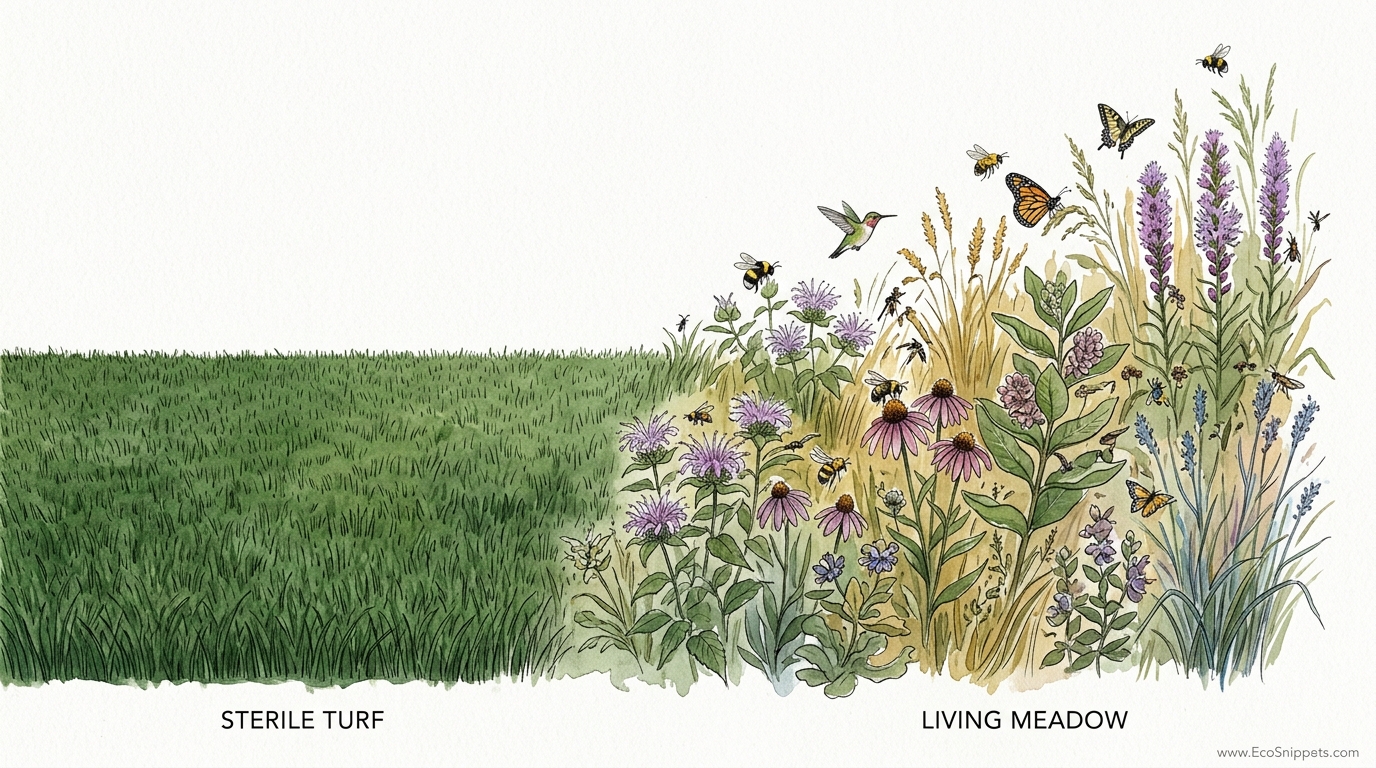
The transition from a STERILE TURF to a LIVING MEADOW offers rewards that go far beyond a one-time check from the state. From a maintenance perspective, a mature native garden is significantly less demanding than a lawn. Once the plants are established—usually by the third year—they require zero fertilizer, zero pesticides, and virtually no supplemental watering, even during Minnesota’s increasingly frequent summer droughts.
Environmentally, the impact is measurable. Turf grass has shallow roots, often only 2 to 4 inches (5 to 10 cm) deep. In contrast, native prairie plants like Leadplant or Big Bluestem can send roots 10 to 15 feet (3 to 4.5 meters) into the soil. These deep root systems act as biological pumps, pulling carbon into the ground and creating channels for rainwater to soak in. This reduces the runoff that carries lawn chemicals into our local lakes and rivers.
Psychologically, there is a profound sense of satisfaction in watching the return of life. You will begin to notice species you haven’t seen in years. The hum of the garden becomes a soundtrack of success. You are no longer fighting nature with a mower and a sprayer; you are collaborating with it. This shift fosters a sense of self-reliance as you learn to manage a piece of the earth the way our ancestors might have.
Challenges and Common Mistakes to Avoid
The biggest hurdle for most people is the “ugly phase” of establishment. Native plants operate on a specific rhythm: “Sleep, Creep, Leap.” In the first year, they sleep, focusing all their energy on building those deep roots. Above ground, things might look sparse or even messy. Many beginners make the mistake of getting discouraged and tilling the whole project under, thinking it has failed. Patience is your most important tool here.
Another common pitfall is poor site preparation. You cannot simply sprinkle native seeds over existing grass and expect them to win the fight. Turf grass is incredibly aggressive and will outcompete tiny native seedlings every time. You must completely remove the existing sod or “kill” the grass using methods like solarization (covering the area with clear plastic for several weeks) or sheet mulching (cardboard and wood chips).
Misidentifying weeds is also a frequent error. In the first year, opportunistic weeds will try to take over the bare soil. Learning to distinguish between a Canada Thistle and a native Blazing Star is a skill that takes time to develop. If you pull the wrong plant, you’re setting your habitat back. Use a high-quality field guide or a smartphone app to verify your “residents” before you evict them.
Limitations of the Program
While the Lawns to Legumes program is a fantastic catalyst, it is not a “set it and forget it” solution. In the first two years, you will need to spend time weeding and potentially watering during extreme dry spells to ensure the young plants take hold. If you are looking for a landscape that requires zero human intervention from day one, a native meadow is not it.
Local ordinances can also be a constraint. While state law in Minnesota has recently become more protective of pollinator habitats, some local weed inspectors or Homeowners Associations (HOAs) may still have rules regarding grass height. It is often necessary to use “cues of care”—such as a mowed edge, a small fence, or a “Pollinator Habitat” sign—to signal to your neighbors that the meadow is intentional and not a sign of neglect.
Furthermore, the lottery system means that funding is not guaranteed for everyone. If you have a very large property (multiple acres), the $350-$400 grant is only a “seed” payment; it will not cover the full cost of a massive restoration. In those cases, the grant is best used to create a “hub” of high-quality habitat from which you can expand over time using your own seed collection.
Comparison: Sterile Turf vs. Living Meadow
To understand the true value of this conversion, it helps to look at the cold, hard numbers and the functional differences between these two landscape philosophies.
| Feature | Sterile Turf (Kentucky Bluegrass) | Living Meadow (Native Plants) |
|---|---|---|
| Root Depth | 2–4 inches (5–10 cm) | 3–15 feet (0.9–4.5 m) |
| Weekly Labor | 1–3 hours (Mowing/Trimming) | 15–30 mins (Spot Weeding) |
| Chemical Inputs | High (Fertilizer, Herbicide) | None required |
| Water Needs | 1 inch (2.5 cm) per week | Drought-tolerant once established |
| Pollinator Value | Near Zero | Maximum (Food/Shelter) |
Practical Tips for a Successful Transition
When you are ready to begin, start by observing your yard. Note the areas of full sun (6+ hours) and the low spots where water collects. Different native plants thrive in different conditions. A Swamp Milkweed will love a soggy corner, while a Little Bluestem grass prefers the hottest, driest spot you have.
Use the “Sheet Mulching” method to kill your grass without chemicals. Lay down plain brown cardboard (remove all tape and staples) over your future garden bed. Wet it down thoroughly and cover it with 3 to 4 inches (7.5 to 10 cm) of wood chips or mulch. If you do this in the fall, by the following spring, the grass underneath will be dead, and you can plant your native plugs directly through the cardboard.
Source your plants from reputable native nurseries. Avoid “Big Box” stores that often sell cultivars treated with neonicotinoids—pesticides that are toxic to the very bees you are trying to save. Look for nurseries that specify “local ecotype” seeds. These plants are the genetic descendants of the ones that survived Minnesota winters for thousands of years; they have the grit required to thrive in your yard.
Advanced Considerations for the Serious Practitioner
Once you have mastered the basics, you can begin to think about the long-term ecology of your space. Consider “succession planting,” which involves selecting species that bloom at different times throughout the year. The endangered Rusty Patched Bumble Bee needs food from the moment it emerges in early spring until it goes into hibernation in late fall. Aim for at least three different species blooming in each season.
Soil health is another advanced topic. Avoid tilling your garden once it is established. Tilling destroys the delicate mycelial networks (fungal threads) in the soil that help native plants exchange nutrients. Instead, allow the fallen leaves and dead stalks to remain over the winter. These provide essential nesting sites for native bees, many of whom over-winter in hollow stems or just below the leaf litter.
You might also consider seed saving. Native plants produce an abundance of seeds that you can harvest in the fall. After a year or two, you will have enough “homegrown” seed to expand your habitat or share with neighbors, creating a local seed bank of resilient, adapted genetics. This is the ultimate form of self-reliance—growing your own future landscape from the bounty of your current one.
Example Scenario: The Suburban Front Yard
Imagine a typical quarter-acre lot in a Twin Cities suburb. The owner decides to convert a 10-by-10-foot (3-by-3-meter) section of the front lawn near the sidewalk into a “Native Pocket Garden.” They apply for the Lawns to Legumes grant and receive a $350 award.
They spend $100 on high-quality native plugs (young plants) including Purple Coneflower, Wild Bergamot, and Butterfly Milkweed. Another $50 goes toward mulch and $20 toward a “Pollinator Habitat” sign. Their total out-of-pocket material cost is $170. They spend 12 hours over a weekend preparing the site and planting. This labor easily covers their 25% match requirement.
Within two months, the Butterfly Milkweed is hosting monarch caterpillars. Within two years, the garden is a riot of color that requires only a few minutes of weeding once a month. The neighbors, initially skeptical, are now asking for seeds. The $350 reimbursement covers their entire financial investment, meaning they essentially built a permanent, beautiful ecosystem for free.
Final Thoughts
The Lawns to Legumes program is a rare example of a government initiative that matches the scale of an environmental problem with a practical, decentralized solution. By empowering thousands of individuals to manage their own land with an eye toward biodiversity, Minnesota is rewriting the script of what a “proper” yard should look like. We are moving away from the fragile, high-maintenance monocultures of the past and toward a future that is resilient, beautiful, and alive.
Choosing to participate in this program is an act of hope. It is a way to reconnect with the rhythms of the earth and to provide a tangible benefit to the creatures we share it with. Whether you are motivated by the financial incentive or a deeper desire for self-reliance, the result is the same: a healthier planet, one yard at a time.
Do not feel overwhelmed by the prospect of a full-scale restoration. Start small, be patient with the “sleep” year, and watch as your yard transforms into a living legacy. The bees are waiting, and the state is ready to help you help them. It’s time to put down the mower and pick up the trowel.
