How To Become More Self-Sufficient Without Starting a Full-Blown Farm…
Want to start preserving your harvest, making your own soap, or building a backyard root cellar — but not sure where to begin? “Homesteading Advice” gives you instant lifetime access to 35+ practical homesteading books on food preservation, veggie gardening, DIY natural cleaning products (save over $250 per year with this skill alone), brewing, off-grid energy, and a whole lot more…
Click Here To Check It Out Now!
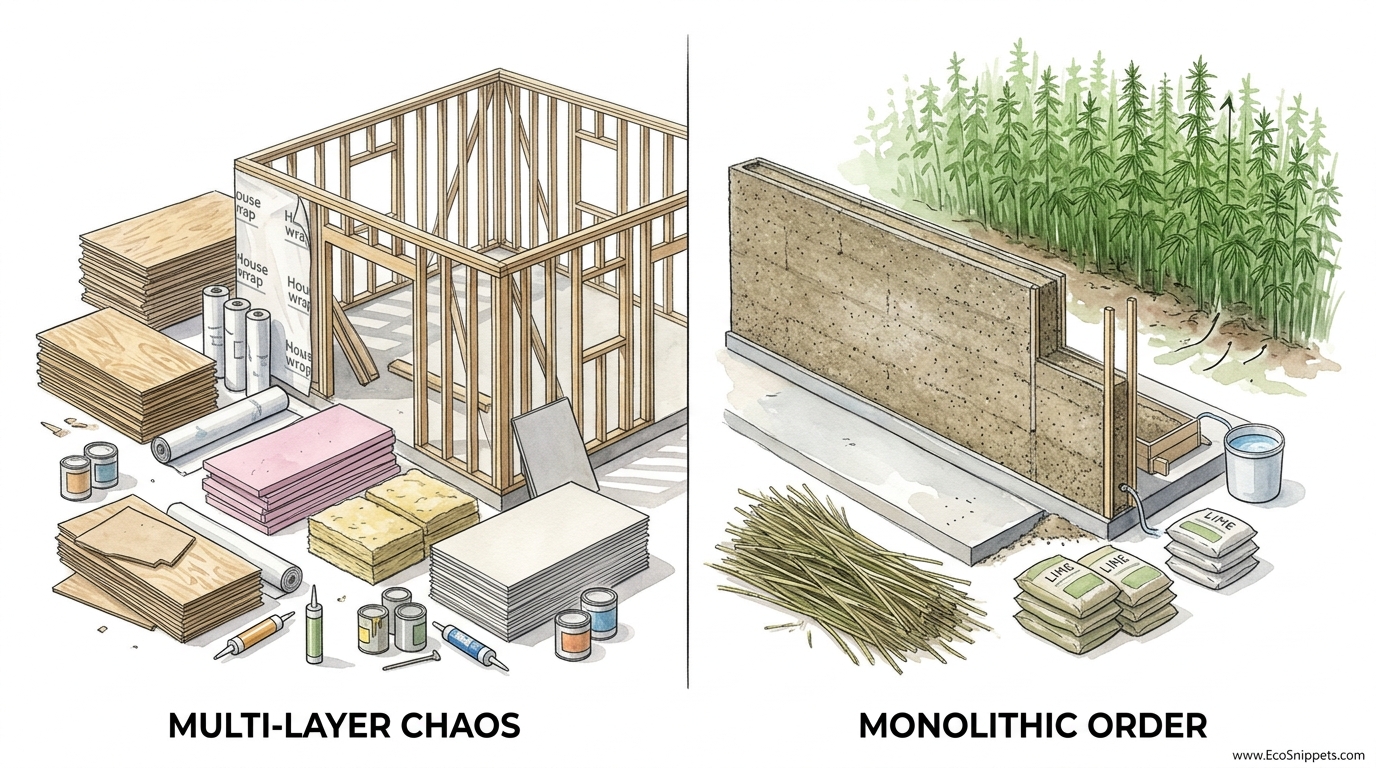
Why manage ten fragile supply chains when one plant can provide your insulation, structure, and finish in a single pour? Standard construction is a logistical nightmare of toxic, synthetic layers that all eventually fail. It relies on plastic wraps, fiberglass batts, and chemical retardants – all of which eventually sag, leak, or rot.
Hempcrete replaces the insulation, sheathing, and vapor barrier with a single, monolithic material. It’s the ultimate expression of “Order” for the self-sufficient builder. Less waste, fewer mistakes, and a building that petrifies into stone, lasting for centuries instead of decades.
Imagine a home that breathes with you, regulating its own humidity and staying warm with the same simple logic used by our ancestors. This isn’t just a building material; it’s a return to a way of life where the materials we use are as honest as the earth they grow from. For the modern builder seeking true independence, hemp-lime construction offers a clear way out of the “multi-layer chaos” of modern stick-framing and into a more resilient, monolithic order.
The Basic Ingredients
Hempcrete, or hemp-lime, is a bio-composite material made from the woody core of the industrial hemp plant mixed with a lime-based binder and water. It is not a structural weight-bearing material in the way standard concrete is. Instead, it is an “infill” material that wraps completely around a structural frame – usually timber – to provide a thick, insulating, and highly durable envelope.
Building with it is a physical, deeply rewarding process that transforms three pure ingredients into a wall that is fireproof, mold-proof, and carbon-negative. While the industry is moving toward pre-cast commercial blocks and spray-applied systems, the heart of this craft lies in the cast-in-place method.
- Hemp Hurd (The Shiv): The woody inner core of the hemp stalk left behind after the fiber is stripped. It must be clean, thoroughly de-dusted, and processed to a consistent size (usually 5mm to 25mm or 0.2 to 1 inch). High dust content is dangerous; it absorbs water too fast, stealing hydration from the lime and weakening the bond.
- Lime Binder: A formulated mixture of hydrated lime (calcium hydroxide) and a pozzolan (like volcanic ash, pumice, or metakaolin). The pozzolan creates an immediate hydraulic set so the wall holds its shape early, while the lime handles the long-term carbonation.
- Water: Clean, mineral-free water used to catalyze the chemical reaction.
How It Works: The Principles of Monolithic Order
Hempcrete works because of its unique cellular structure. The hemp hurd is incredibly porous, packed with microscopic cavities that hold significant amounts of air for insulation while also absorbing and releasing moisture without rotting. When mixed with lime, these organic particles are coated in a mineral shell that slowly petrifies over time.
This material does not rely on a plastic vapor barrier to keep the house dry. In fact, adding a vapor barrier would kill the system. Hempcrete is “vapor-open,” meaning it allows moisture to migrate freely through the wall. During high indoor humidity (cooking, bathing, breathing), the wall absorbs moisture safely into its cellular core; during dry spells, it releases it back into the room. This “hygroscopic” behavior keeps indoor relative humidity at a near-constant 40% to 60%, naturally preventing the growth of toxic mold and creating an incredibly healthy living environment.
Thermal performance is another area where standard modern metrics fail to tell the whole story. While a 300mm (12-inch) hempcrete wall has a nominal R-value of about R-28 (roughly 2.4 per inch), its high thermal mass means it stores ambient heat energy and releases it slowly. This creates a “thermal fly-wheel” effect that consistently outperforms lightweight modern insulation with much higher R-ratings by dampening outdoor temperature spikes.
Benefits of the Hemp-Lime System
Choosing hempcrete over a traditional multi-layer wall assembly offers measurable advantages that extend far beyond simple aesthetics or ethics. It is a calculated choice for structural longevity and human health.
- Fire Resistance: Hempcrete is naturally fireproof. During testing, it consistently achieves a 1-hour or 2-hour fire rating, often receiving a perfect “0” for flame spread and smoke development. Because the lime binder is a mineral, the wall simply chars under a direct torch rather than burning, melting, or releasing toxic chemical fumes.
- Carbon Sequestration: This is one of the few building materials on earth that is actively carbon-negative. Industrial hemp grows faster than standard timber and sucks massive amounts of $CO_2$ from the atmosphere during its growth cycle. Once mixed into a wall, the lime binder continues to “carbonate,” absorbing even more $CO_2$ from the air over decades as it turns back into solid limestone. A typical cubic meter of hempcrete sequesters between 130kg and 470kg of $CO_2$.
- Longevity and Resilience: Unlike fiberglass batts or spray foam, which sag, break down, or off-gas over time, hempcrete grows stronger as it ages. There are examples of ancient hemp-lime mortars in Roman bridges and French pillars that have survived for over 1,500 years. It is a “monolithic” build, meaning there are no hollow wall cavities for rodents to nest in and no hidden internal layers for dry rot to fester.
How To Build With Hempcrete Step By Step
Once your structural timber framing is stood, squared, and roofed, you are ready to begin the monolithic infill. Follow this sequence exactly; skipping steps or misordering them invites structural weakness.
1. Infrastructure Prep: Day 1: Rough-In.
Run all electrical conduits and plumbing lines through the center of your timber framing before closing the cavity. Use heavy-duty, schedule 40 PVC or flexible conduit. Do not run bare wires directly through hempcrete; the highly alkaline lime can degrade certain wire jackets over time. Secure all pipes firmly to the framing so they do not shift or rattle during the tamping process.
2. Construct the Lift Forms: Day 1-2: Formwork.
Cut standard 18mm (3/4 inch) plywood or OSB sheets into horizontal strips exactly 600mm (2 feet) high. Screw these panels directly into your timber studs using temporary spacer blocks to fix your wall thickness. Ensure the forms project at least 50mm past the framing on both sides so the timber studs end up fully buried inside the protective insulation. Lightly spray the inside faces of the plywood with an eco-release agent or a thin lime wash to prevent sticking.
3. The Precise Mix Sequence: Continuous Execution.
Do not use a standard rotating drum cement mixer; hemp is too light and will simply spin in place. Use a vertical pan mixer or a forced-action paddle mixer.
- Charge: Dump 2 parts clean hemp hurd into the dry mixer and start the paddles.
- Coat: Add 1 part formulated lime binder. Let it run dry for 30 seconds until every piece of hurd is dusted white.
- Hydrate: Slowly stream in 1 part water.
- Test: Run for 2 minutes, then perform the Snowball Test. Grab a handful of the mix and squeeze. It must hold its shape perfectly like a firm snowball, but your hand should remain relatively dry. If it crumbles, add a splash of water. If water drips between your fingers, it is dangerously wet—dump in a handful of dry hurd and binder immediately to save the batch.
4. The Pour and Fill: Continuous Execution.
Work in manageable, small batches. Hempcrete starts its initial chemical set within 30 minutes of hydration. Bucket or shovel the loose, wet mix directly into the open cavity between your plywood forms. Pour in steady, even layers roughly 100mm to 150mm (4 to 6 inches) deep at a time. Never dump a massive pile into one corner, or the density of the wall will be completely uneven.
5. The Strategic Tamp: Continuous Execution.
This is where most modern builders fail. Do not pack hempcrete tight like standard concrete.
- The Edges: Take a small wooden 2×4 offcut and firmly tap the material only along the faces of the plywood forms and tightly around the timber framing studs. This ensures a clean, flat wall face with zero structural voids when the forms are removed.
- The Core: Leave the middle of the wall loose and airy. Simply step on it lightly or smooth it over with your hand. Packing the center tight destroys the delicate air pockets, turning your high-performance insulation into a dense, cold block of heavy stone.
6. Slipping the Forms: Daily Cycle.
Because the lime binder creates immediate physical cohesion, you do not need to wait days for a full chemical cure before moving your forms. Once your pour reaches the top of the 600mm plywood lift, you can immediately back out the screws and slide the panels up to start the next lift. Always leave the bottom 100mm of the plywood overlapping the previous day’s hardened pour to act as a guide, keeping your vertical walls perfectly plumb and seamless.
Challenges and Common Mistakes
While the process is simple, it is not effortless. Most failures in hempcrete construction come from trying to treat it like standard Portland concrete or rushing the critical drying phase.
- Over-Tamping: The most frequent mistake beginners make is packing the material too hard in the center of the forms. If you pack hempcrete like you’re making a dense sandcastle, you squeeze out the vital air pockets that provide your insulation. The goal is always to “tamp firmly to the edges” for a clean finish while leaving the interior core light and airy.
- Improper Water Ratios: Adding too much water is a recipe for disaster. It extends the drying time by weeks and causes the heavy lime binder to separate and settle at the bottom of the form, leaving the top of the pour weak and crumbly. Always trust the snowball test over guesswork.
- Poor Airflow During Curing: Hempcrete needs to “breathe” to dry and carbonate. If you seal a building with permanent plastic windows or tarps before the walls have dried, the trapped moisture will have nowhere to go, potentially leading to surface mold or deep tannin staining from the hemp plant.
Limitations: When Hempcrete May Not Be Ideal
Hempcrete is a specialized tool, and like any tool, it has absolute physical limits. It is not a “plug-and-play” replacement for every component of a building.
- Below-Grade Foundations: The most critical limitation is that hempcrete cannot be used for foundations or in direct contact with the ground. Because it is highly porous and vapor-open, it will relentlessly wick moisture from the bare earth via capillary action, leading to the rapid degradation of the lime binder. You must build on a dense, non-porous “stem wall” of concrete, stone, or brick that sits at least 200mm to 300mm (8 to 12 inches) above the final outdoor grade.
- Wall Thickness and Interior Footprint: To achieve modern energy codes, you generally need walls that are 300mm to 400mm (12 to 16 inches) thick. This reduces the usable interior square footage compared to a thin stud wall. For tight urban lots with strict setback limits, this thickness can be a deal-breaker—though the absolute comfort provided by those deep walls usually makes the trade-off worth it for the self-sufficient homestead.
- Load-Bearing Capacity: Because it has low compressive strength, you cannot eliminate the timber frame. Hempcrete cannot support structural rafters or roof loads directly.
Hempcrete vs. Traditional Stud Walls
| Feature | Hempcrete Monolithic System | Traditional Multi-Layer Assembly |
| Components | Timber Frame + Hemp-Lime + Breathable Plaster | Frame + OSB Sheathing + Housewrap + Fiberglass + Poly Barrier + Drywall |
| Lifespan | 100+ Years (Continues to petrify and harden with age) | 30–50 Years (Fiberglass sags, plastic wraps degrade) |
| Vapor Strategy | Vapor-Open (Hygroscopic buffer manages moisture) | Vapor-Closed (Relies on plastic traps; minor leaks cause rot) |
| Fire Performance | Class A Fire Rating (Mineral coating chars, cannot burn) | Requires synthetic chemical retardants; releases toxic smoke |
| Carbon Footprint | Carbon Negative (Stores ~130-470kg of $CO_2$ per $m^3$) | High Carbon Footprint (Manufacture of foam, plastic, and glue) |
Practical Tips for the Self-Sufficient Builder
For those ready to get their hands dirty, success lies entirely in your preparation and machinery setup. This is a labor-intensive process, but it can be managed efficiently with the right toolkit.
- Rent a Forced-Action Mixer: Do not attempt to use a standard rotating drum cement mixer. Hempcrete is incredibly light; it will simply ride the rotation of the drum and ball up without mixing properly. A vertical “pan” or forced-action mixer with robust mechanical paddles is essential to coat every single bit of hurd evenly with lime binder.
- Use Slip-Forms Efficiently: Standard 18mm plywood or OSB boards make excellent temporary forms. By fastening them directly to your timber frame with removable star-drive wood screws, you can complete a lift, back the screws out, and slide them up the next day. This creates a beautiful, seamless monolithic wall face.
- Protect the Structural Timber: While the high alkalinity of the lime protects wood from rot over the long term, the high moisture content during the initial pour can cause thin framing studs to swell. Using larger, stable structural timbers (like 50x150mm / 2×6 or 50x200mm / 2×8) and ensuring they are well-braced will prevent “bowing” as the wall dries.
- Timing the Build: Because a cast-in-place hempcrete wall requires roughly 6 to 10 weeks to dry before it can be sealed with its final plaster coat, you must plan your build for the drier, warmer months of the year. In high-humidity climates, you should run heavy industrial fans through the rough-openings to keep air moving.
Advanced Considerations: Ratios and Customization
The baseline mix ratio by volume is typically cited as 2 parts hemp hurd to 1 part binder to 1 part water, but experienced builders adjust these metrics based on where the material is being placed in the structure:
- Roof and Ceiling Insulative Mix: Where structural stability and density are less important than maximum thermal resistance, you can use a “leaner” mix with more hemp hurd and less lime binder. This drastically reduces the weight load on your roof rafters and increases the overall R-value.
- Floor Slabs and High-Load Walls: Conversely, for a floor slab or a section of a wall that will receive heavy structural shelving, a “richer” mix with a higher binder-to-hemp ratio is required to provide better compressive strength and density.
In North America, code compliance has taken a massive step forward. The inclusion of hemp-lime in the International Residential Code (IRC) Appendix BL has changed the regulatory landscape. Independent builders can now reference a standardized, legal set of rules for wall thickness, testing, and framing layout, making it significantly easier to secure permits from hesitant local building departments.
Examples of Hempcrete in Practice
Consider a 28-square-meter (300-square-foot) tiny home or independent studio built in a cold, maritime climate. A traditional stick-built structure in this damp environment would require a complex, mechanical air-exchange system (like an HRV) to prevent the interior from becoming a stagnant, toxic “mold box.”
By using a 300mm (12-inch) monolithic hempcrete wall, the builder completely eliminates the need for mechanical ventilation. The hygroscopic walls themselves automatically manage the interior moisture generated by cooking, showering, and breathing.
During a severe winter cold snap, the massive thermal mass of the hempcrete walls holds the ambient heat from a small wood-burning stove for hours after the fire has completely gone out. In the hot summer months, that same thermal mass keeps the interior cool by absorbing the day’s radiant heat and releasing it safely to the outside during the night. This is what we mean by “Order”—a simple, elegant building system that works in complete harmony with the laws of physics rather than trying to fight them with plastic tapes, chemicals, and glues.
Final Thoughts
Building with hempcrete is a deliberate act of defiance against a modern construction industry that consistently prioritizes corporate speed and rapid profit over human health and generational longevity. It is a return to a time when a man’s home was built to last for his grandchildren, using honest, raw materials that came directly from the fields he walked.
While your initial material investment and manual labor will be higher than throwing up cheap fiberglass and OSB, the long-term dividends in energy savings, zero structural maintenance, and absolute health are incomparable. You aren’t just building a physical shelter; you are creating a living, breathing ecosystem that protects you.
Start small. Build a tool shed, a small root cellar, or an independent studio to get a true feel for the material. Learn how the wet lime feels on your hands and how the hemp smells as it cures. Once you experience the quiet, solid comfort of a hemp-lime building, the multi-layer chaos of modern construction will never make sense to you again.
