How To Become More Self-Sufficient Without Starting a Full-Blown Farm…
Want to start preserving your harvest, making your own soap, or building a backyard root cellar — but not sure where to begin? “Homesteading Advice” gives you instant lifetime access to 35+ practical homesteading books on food preservation, veggie gardening, DIY natural cleaning products (save over $250 per year with this skill alone), brewing, off-grid energy, and a whole lot more…
Click Here To Check It Out Now!
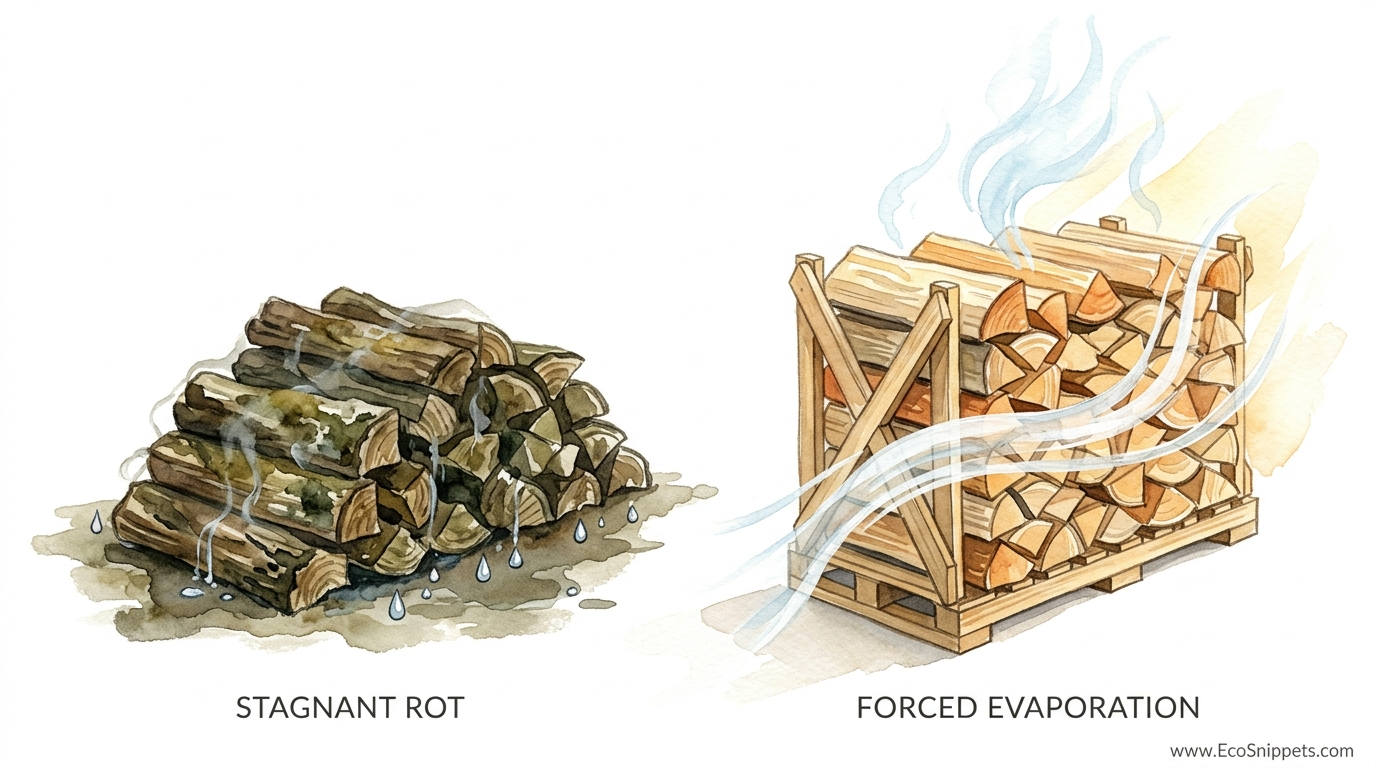
A wood pile that doesn’t breathe is just a slow-motion compost heap. If you just stack your wood in a pile, you’re fighting moisture and rot for two years. Building a dynamic seasoning shed that utilizes the chimney effect can turn green wood into high-BTU fuel in a single season. Stop burning ‘wet’ energy and start using the wind.
Understanding how to manage the moisture in your fuel is the difference between a struggling, smoky fire and a roaring hearth that heats your home efficiently. Seasoning firewood is more than just waiting; it is an active process of engineering natural forces. Natural evaporation is the key, but standard stacking methods often leave the center of the pile stagnant, inviting fungus and decay.
This guide explores the mechanics of airflow and thermal dynamics to help you master the art of wood seasoning. Using the same principles that draw smoke up a chimney, you can create a drying environment that pulls water from the heart of a log and carries it away on the breeze.
How To Season Firewood Faster With Passive Airflow
Seasoning firewood faster with passive airflow is the practice of using natural air movement and temperature differentials to accelerate the evaporation of water from split wood. This method replaces the passive “wait and see” approach with a deliberate system designed to move air through every layer of a wood stack. Instead of relying solely on the sun to bake the outside of a pile, passive airflow systems create a pressure differential that forces fresh, dry air into the gaps between logs.
Real-world application of this concept is seen in the “dynamic seasoning shed” or “passive solar kiln.” Traditional woodsheds often have three solid walls and a roof, which provides protection from rain but can trap humid air inside. A dynamic shed uses slats, raised floors, and specific roof angles to encourage the chimney effect. This effect occurs when warm air inside the stack rises and escapes through vents at the top, creating a low-pressure zone that sucks in cooler, drier air from the bottom.
Imagine a wet sponge sitting in a sealed plastic bag versus one sitting on a wire rack in front of a window. The sponge on the rack dries because air is constantly moving past its surface, stripping away water molecules. Wood is essentially a bundle of microscopic straws (tracheids and vessels) that hold water. To dry it, you must move air across the ends of those “straws” where the moisture escapes most easily.
How the Chimney Effect Drives Moisture Removal
The underlying principle of a high-efficiency seasoning shed is the chimney effect, also known as the stack effect. This physical phenomenon relies on the fact that warm air is less dense than cold air. When air inside a wood stack is heated by the sun—especially if the shed has a clear or dark-colored roof—it begins to rise.
Natural buoyancy forces this warm, moist air upward. As it exits through the ridge of the roof or high-side vents, it creates a vacuum at the base of the pile. Air from the surrounding environment is then pulled into the bottom of the stack to fill the void. This creates a continuous, self-sustaining loop of airflow that does not require electric fans or mechanical assistance.
To make this work, the design must follow specific parameters. The wood must be elevated at least 15 cm (6 inches) off the ground to allow an intake of air. The flooring should be slatted or made of pallets to ensure the air can enter the bottom of the stack. Without this bottom-up movement, the air simply swirls around the perimeter, leaving the core of the wood pile damp and prone to “stagnant rot.”
Internal wood temperatures can rise significantly in a well-oriented shed. Even a 5-degree Celsius (9-degree Fahrenheit) difference between the inside of the shed and the outside air is enough to trigger a meaningful draft. This constant movement prevents the “boundary layer” of humid air from sitting on the surface of the wood, which is the primary reason why wood in a standard pile seasons so slowly.
Designing a Dynamic Seasoning Shed for Maximum Efficiency
Constructing a shed that truly utilizes passive airflow requires moving away from the “four walls and a roof” mindset. The structure itself must function as a machine. Start with the foundation. Using heavy-duty skids or concrete blocks to support a slatted floor ensures that the wood never touches the soil. Soil is a reservoir of moisture and home to wood-boring insects.
The walls of the shed should be at least 20% open. Horizontal slats with 2.5 cm to 5 cm (1 to 2 inch) gaps provide structural stability while allowing cross-breezes to penetrate. Some practitioners prefer using heavy-gauge wire mesh or “cattle panels” for the sides to maximize exposure. This level of openness ensures that the wind can assist the chimney effect, especially during the breezy months of spring and autumn.
Roof design is perhaps the most critical element for generating the chimney effect. A steep pitch helps the air move upward more rapidly. Using clear polycarbonate or corrugated fiberglass panels for the roof turns the shed into a solar collector. Sunlight hits the top of the wood stack, heating the air and the wood itself. This heat increases the vapor pressure inside the wood, pushing moisture out toward the surface where the airflow can whisk it away.
Orienting the shed is the final step in the design. The long side of the structure should face the path of the sun to maximize solar gain. If possible, align the shed so that the prevailing winds hit the structure at an angle, which helps push air through the slats. This combination of solar heating and wind-driven ventilation creates an environment where wood can dry twice as fast as it would in a traditional outdoor stack.
Benefits of Enhanced Airflow Seasoning
Higher BTU output is the most immediate benefit of using a dynamic seasoning shed. Green wood can have a moisture content of 50% or higher, meaning half the weight of the log is water. When you burn wet wood, the fire must first boil off that water before the wood can actually release heat. This consumes energy that should be heating your home. Seasoning wood down to 15% or 20% moisture content ensures that almost all the chemical energy in the wood is converted into usable heat.
Creosote reduction is another vital advantage. Wet wood burns at a lower temperature, which leads to incomplete combustion. This results in heavy smoke and the accumulation of creosote—a highly flammable, tar-like substance—inside your chimney. Properly seasoned wood burns hot and clean, significantly reducing the risk of chimney fires and the need for frequent professional cleanings.
Weight reduction makes the labor of heating with wood much more manageable. A cord of green Red Oak can weigh over 2,200 kg (4,800 lbs). Once seasoned to 20% moisture, that same cord weighs approximately 1,700 kg (3,700 lbs). Moving, stacking, and carrying dried wood is easier on the back and the equipment.
Pest prevention is often overlooked but equally important. Damp, rotting wood piles are magnets for termites, carpenter ants, and powderpost beetles. These insects require moisture to thrive. By using airflow to dry the wood quickly and keeping it off the ground, you create an environment that is inhospitable to these pests, protecting both your fuel and your home.
Challenges and Common Mistakes
The “Greenhouse Trap” is a frequent error made by those trying to use solar heat. Many people wrap their entire wood pile in clear plastic, thinking the heat will dry the wood. Without ventilation, the plastic simply traps the evaporating moisture. This creates a high-humidity sauna that accelerates the growth of mold and fungi. Clear coverings should only be used on the roof, never the sides, to ensure the moisture has an escape path.
Ground contact remains the leading cause of failed seasoning. Even a well-ventilated shed will struggle if the bottom layer of wood is sitting in the mud. Moisture will wick up through the logs via capillary action, keeping the bottom third of the pile permanently damp. Always use a barrier of stone, concrete, or pressure-treated timber to separate the wood from the earth.
Overcrowding the shed can also stifle the chimney effect. Stacking wood too tightly, especially “face-cord to face-cord” with no gaps, prevents air from moving between the rows. Leaving 5 cm to 10 cm (2 to 4 inches) of space between vertical rows of wood allows the air to circulate around the entire surface of each log. Think of the air as a fluid; it needs a clear channel to flow through.
Ignoring the prevailing winds is a missed opportunity for free energy. Placing a shed in a “dead zone” behind a garage or in a dense thicket of trees removes the wind component from the seasoning equation. While the chimney effect will still work to some degree, the lack of a cross-breeze will significantly slow the process, especially during humid weather.
Limitations of Passive Airflow Systems
Environmental humidity is the primary constraint. In regions with extremely high year-round humidity, such as coastal rainforests or tropical areas, passive airflow can only do so much. Wood is hygroscopic, meaning it will eventually reach an “equilibrium moisture content” (EMC) with the surrounding air. In a very humid climate, your wood may never naturally drop below 20% without supplemental heat or mechanical dehumidification.
Wood density also dictates the speed of the process. Softwoods like Pine or Spruce have a loose cellular structure and can often season in 4 to 6 months using these techniques. Dense hardwoods, particularly White Oak or Hickory, have tight grain and high initial moisture. Even with a perfect dynamic shed, these species may still require a full year or more to reach the ideal 15% moisture mark.
Spatial constraints may limit the effectiveness of a seasoning shed. To work properly, a shed needs a certain amount of vertical height to generate a strong draft. A low-profile rack that is only 1 meter (3 feet) tall will not produce nearly as much “stack effect” as a shed that is 2.5 meters (8 feet) tall. Those with limited vertical space may need to rely more on wind exposure than the chimney effect.
Comparison: Traditional Stacking vs. Dynamic Seasoning Shed
| Feature | Traditional Outdoor Stack | Dynamic Seasoning Shed |
|---|---|---|
| Drying Time | 12 to 24 Months | 6 to 10 Months |
| Moisture Control | Highly dependent on weather | Controlled via airflow & solar gain |
| Protection | Requires tarps (which can trap moisture) | Permanent roof protects from rain/snow |
| Rot Risk | High (due to ground contact/rain) | Very Low (elevated and ventilated) |
| Initial Cost | Zero to Low | Moderate (lumber, roofing, site prep) |
| Maintenance | High (adjusting tarps, restacking) | Low (set and forget) |
Practical Tips and Best Practices
Splitting the wood to the right size is the first step in successful seasoning. Smaller splits have a higher surface-area-to-volume ratio, which allows moisture to escape faster. Aim for splits that are roughly 10 cm to 15 cm (4 to 6 inches) across. If you are seasoning particularly stubborn hardwoods like Oak, splitting them even smaller will drastically reduce the time they spend in the shed.
Stacking patterns can make or break your airflow. The “criss-cross” or “log cabin” pattern at the ends of your rows provides stability, but the interior wood should be stacked in parallel rows with air gaps. Some people swear by the “Holz Hausen” or circular stack, which naturally creates a central chimney. If you use a rectangular shed, ensure that the logs are stacked so the cut ends—the primary exit points for moisture—are facing the direction of the airflow.
Orientation of the bark can influence drying in specific scenarios. Stacking wood “bark-side up” is a traditional rule for outdoor piles because the bark acts as a natural shingle, shedding rainwater. In a covered shed, however, stacking some wood “bark-side down” can actually help moisture evaporate from the split faces more easily. In a dynamic shed with a roof, the orientation matters less than the air gaps between the pieces.
Using a moisture meter is the only way to be certain your wood is ready. Do not guess based on the “clink” sound or the presence of cracks (checking). Split a fresh piece of wood from the middle of the pile and test the center of the newly exposed face. If the reading is below 20%, the wood is ready for the stove. This small investment prevents the frustration of trying to light a fire with wood that is still “green” on the inside.
Advanced Considerations for the Serious Practitioner
Thermal mass can be integrated into a seasoning shed to maintain the chimney effect through the night. Placing dark stones or concrete pavers at the base of the shed, where they can be hit by the sun, allows the structure to store heat. As the air cools in the evening, these stones release heat, keeping the air inside the shed warmer than the outside air and maintaining a gentle draft long after sunset.
Incorporating a “solar collector” wall is another advanced technique. By painting the back wall of the shed matte black and covering it with a layer of clear polycarbonate, you create a heat trap. The air behind the plastic heats up rapidly and is piped into the bottom of the wood stack. This “forced-passive” system uses no electricity but significantly increases the temperature differential, further accelerating the drying process.
Air bypass prevention is critical in larger structures. Air will always take the path of least resistance. If there are large empty spaces in your shed, the air will move through those gaps rather than through the wood stack. Using baffles or simply ensuring the shed is kept relatively full helps “force” the air through the pile, maximizing the efficiency of every cubic meter of air movement.
Example: Seasoning a Cord of Mixed Hardwood
A homeowner in a temperate climate (average summer temperature 24°C / 75°F) harvests one cord (3.62 cubic meters) of fresh Ash and Maple in late March. Ash is naturally low in moisture (around 30%), while Maple is higher (around 45%). Using a traditional outdoor stack covered with a tarp, this wood might not be ready until the following year, as the humid spring and summer rains frequently soak the pile.
The homeowner instead builds a dynamic seasoning shed. The shed is elevated 20 cm (8 inches) on concrete blocks with a slatted floor of 2×4 timbers. The roof is clear corrugated polycarbonate with a 30-degree pitch. The sides are open lattice. By mid-July, the Ash has already dropped to 18% moisture content due to the constant solar heating and the chimney effect pulling dry air through the base.
The Maple, being denser and wetter, takes longer. However, the consistent airflow prevents any surface mold from forming during a particularly humid August. By late September, the Maple reaches 19% moisture. Because the wood was kept dry and ventilated throughout the season, the homeowner has a full cord of premium fuel ready for the first frost in October—all in less than seven months.
Final Thoughts
Mastering the environment where your firewood rests is just as important as the act of cutting and splitting it. A well-designed system that utilizes the chimney effect respects the physics of nature rather than fighting against them. Moving air is the most powerful tool in your kit for turning raw timber into efficient, high-heat fuel.
Building a structure that encourages passive airflow requires an initial investment of time and materials, but the rewards are measured in decades of warmer homes and cleaner chimneys. The self-reliance that comes from knowing your fuel is perfectly seasoned is a fundamental part of the wood-burning lifestyle.
Experiment with your stacking techniques and monitor your results with a moisture meter. Every woodlot and climate is different, and finding the perfect balance of sun and wind for your specific location is a rewarding pursuit. Start using the wind to your advantage and stop letting your hard-earned wood turn into compost.
