How To Become More Self-Sufficient Without Starting a Full-Blown Farm…
Want to start preserving your harvest, making your own soap, or building a backyard root cellar — but not sure where to begin? “Homesteading Advice” gives you instant lifetime access to 35+ practical homesteading books on food preservation, veggie gardening, DIY natural cleaning products (save over $250 per year with this skill alone), brewing, off-grid energy, and a whole lot more…
Click Here To Check It Out Now!
Your high-tech gear is only as reliable as its last charge, but the forest floor has been storing energy for decades. We’ve traded self-sufficiency for ‘smart’ bulbs that fail when the Wi-Fi drops. Our ancestors didn’t need a factory; they understood the high-density energy of resin-soaked wood. Fatwood is nature’s 100-watt bulb – waterproof, wind-resistant, and free. Learn to identify and harvest this concentrated energy source for lighting that never needs a battery.
The reliance on modern technology often leaves us vulnerable in the dark. When the power grid falters or the batteries in your flashlight leak, the forest offers a solution that has lit human homes for centuries. Fatwood, also known as “lighter wood” or “candlewood,” is a remarkable substance formed within the heart of pine trees through a natural process of resin concentration.
This isn’t just wood; it is a biological battery of flammable terpenes. Understanding how to locate and use this resource is a foundational skill for anyone interested in true self-reliance. It transforms a simple walk in the woods into an energy-harvesting mission, ensuring you are never truly left in the dark.
How To Find Fatwood For Emergency Light
Fatwood is essentially pine wood that has been heavily impregnated with resin. This happens most frequently in the stumps and roots of dead pine trees. When a pine dies—whether from age, storm damage, or being felled—the gravity and internal pressure of the tree’s vascular system drive the remaining sap downward. This resin settles in the heartwood, particularly at the base and the joints of the branches, where it eventually hardens into a dense, rot-resistant material.
To find this resource, you must first identify the right trees. While many conifers produce resin, pines (genus Pinus) are the primary source of high-quality fatwood. Species such as the Longleaf Pine (Pinus palustris) in the Southeastern United States, the Scotch Pine (Pinus sylvestris) in Europe, and the Montezuma Pine (Pinus montezumae) in Mexico are renowned for their high resin content. Look for stands of pine trees that show signs of age or recent clearing.
The most common place to locate a “gold mine” of fatwood is an old, decomposing pine stump. As the softer sapwood on the outside rots away, the resin-saturated heartwood remains. You may see a stump that looks like a jagged, weathered pillar; if you kick it and it feels as solid as a rock despite years of exposure, you have likely found fatwood. Another reliable spot is the “crotch” of a fallen pine—the point where a large branch intersects the main trunk. These joints often act as reservoirs for resin during the tree’s final days.
Visual and Scent Identification
Once you have located a potential source, look for specific visual cues. High-grade fatwood often has a translucent, amber, or deep reddish-brown color that looks almost like hardened honey. It is significantly heavier and denser than standard seasoned pine because the resin has filled every cellular pocket of the wood. If you shave a piece with a knife, it should release a powerful, pleasant scent of turpentine or balsamic pine. This scent is the volatile terpenes reacting with the air, a sure sign of its flammable potential.
How the Resin Battery Works
The science behind fatwood is a fascinating look at plant defense mechanisms. Pine resin is a complex mixture of volatile hydrocarbons called terpenes and solid resin acids. In a living tree, this resin acts as a healing agent, sealing wounds against fungi and insects. When the tree dies, the volatile components—like turpentine—partially evaporate, leaving behind a concentrated, solidified fuel source that is nearly 80% resin by weight in high-quality samples.
This high resin concentration makes fatwood a superior light source compared to regular wood. Standard timber burns by first evaporating moisture and then consuming the cellulose and lignin. Fatwood bypasses much of this struggle; the resin acts as a natural accelerant that allows the wood to ignite even when soaking wet. It burns with a bright, yellow-orange flame that can reach temperatures exceeding 1,000°F (538°C), providing significant light even in windy conditions.
To utilize fatwood for light, you can process it into various forms. For a quick signal or a brief light source, “feather sticks” or thin shavings work well. For sustained lighting, “candles” or torches are made by splitting the fatwood into long, thin slivers approximately 6 to 12 inches (15 to 30 cm) long. Historically, these were called “candlewood” and were often placed in wall brackets or simple floor stands to illuminate colonial homes during the long nights of winter.
Steps to Harvest and Prepare Your Natural Light
Harvesting fatwood requires minimal tools but significant physical effort. A small hatchet or a sturdy bushcraft knife is usually enough to test a stump, but a full-sized axe or a saw is better for major extraction. Always ensure you have permission to harvest on the land, as fatwood is a prized resource in the survival community.
- Step 1: The Test Cut. Use your knife or hatchet to chip away the outer layer of a dead pine stump. If the wood underneath is soft, white, or punky, move on. If the wood is hard, dark, and smells strongly of pine, you’ve struck resin.
- Step 2: Extraction. Use an axe to split chunks off the stump. Focus on the core and the root-ball junction. In many cases, you can pull “pine knots”—the hard, resin-dense cores of branches—directly out of a rotting log with your hands or a pry bar.
- Step 3: Cleaning. Scrape away any remaining dirt, bark, or rotten sapwood. You want the pure, resin-soaked heartwood. It should feel heavy for its size, almost like a piece of plastic or stone.
- Step 4: Splitting. For use as torches or candles, split the wood into uniform sticks about 0.5 inches (1.25 cm) thick. These “lights” are easy to store and transport in a survival kit.
Benefits of Fatwood Over Modern Alternatives
Why would a modern practitioner choose resin-soaked wood over a high-end LED flashlight? The answer lies in reliability and multi-functionality. Fatwood doesn’t have a shelf life. While a lithium-ion battery will eventually lose its charge and a chemical light stick will expire, fatwood harvested today will still be ready to burn fifty years from now if kept in a dry place.
Furthermore, fatwood is entirely waterproof. Because the wood is saturated with oil-based resin, moisture cannot penetrate the fibers. You can pull a piece of fatwood out of a puddle, shave off the surface layer, and light it with a single spark from a ferrocerium rod. It also provides heat and a means to cook, something no flashlight can offer. In a true emergency, the ability to generate both light and fire from a single natural resource is a massive advantage for survival and morale.
Challenges and Common Mistakes
One of the most frequent errors beginners make is confusing “punky” wood with fatwood. Punky wood is simply rotting wood that is soft and spongy; it may look dark if it’s wet, but it lacks the density and smell of resin. Attempting to use punky wood for light will result in a smoldering, smoky mess that provides no illumination. Always use the scent and hardness tests to confirm your find.
Another challenge is the smoke production. Because fatwood is so rich in hydrocarbons, it produces a thick, black, sooty smoke. This soot is actually unburned carbon (lampblack). While this is fine for outdoor use, burning fatwood torches indoors without a massive hearth and proper ventilation will quickly coat your ceiling and lungs in soot. Our ancestors mitigated this by burning candlewood in the corners of their fireplaces on flat stones to catch the dripping tar.
Limitations and Environmental Constraints
Fatwood is not a “magic” solution for every environment. It is geographically limited to regions with significant coniferous forests. If you are in a tropical rainforest or a deciduous hardwood forest with no pines, you will not find fatwood. While some other trees like Cedar or Eucalyptus produce resinous wood, it rarely achieves the high-density “fat” concentration found in pines.
There is also the trade-off of “burn rate.” Because it burns so hot and contains volatile oils, a thin sliver of fatwood does not last as long as a wax candle of the same thickness. To get hours of light, you must use larger pieces or bundles of sticks, which increases the amount of smoke and soot produced. It is best used as a high-intensity, short-term emergency light or a reliable way to transition to a more permanent lantern or fire.
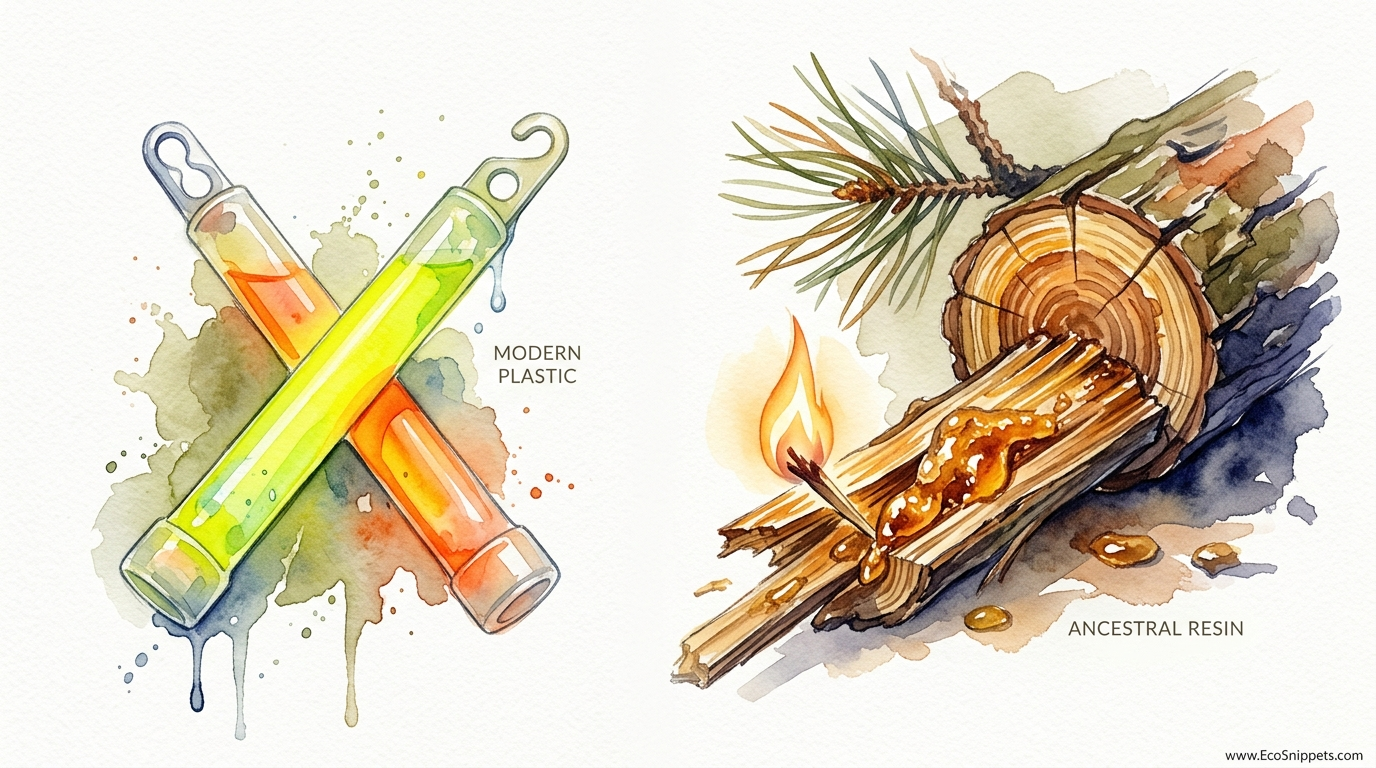
Comparison: Fatwood vs. Modern Light Sticks
When preparing an emergency kit, it’s helpful to see how ancestral resin stacks up against modern chemical solutions.
| Feature | Fatwood Torch | Chemical Light Stick |
|---|---|---|
| Energy Source | Natural Pine Resin | Chemical Reaction |
| Shelf Life | Infinite (Decades) | 2–5 Years |
| Waterproof | Yes (Surface only) | Yes (Submersible) |
| Heat Output | Very High | None |
| Reusability | Renewable from Nature | Single Use (Landfill) |
Practical Best Practices for Storage and Use
To maximize the efficiency of your fatwood, store it in a cool, dry place. While it is rot-resistant, keeping it away from direct sunlight prevents the very outer layers of volatile terpenes from slowly evaporating over years. Many practitioners keep a small “fatwood kit” consisting of several 6-inch (15 cm) sticks and a small tin of shavings for immediate ignition.
When using fatwood for light, don’t just light a large chunk. Shave the end of your torch into a “feather stick” pattern. By creating thin curls of wood that remain attached to the stick, you increase the surface area, making it much easier to catch a spark or a small flame. Once the feathers are roaring, the heat will liquefy the resin in the main body of the stick, feeding a steady, bright flame.
Advanced Techniques: Making a Fatwood Lantern
For those who want to move beyond simple torches, you can create a primitive fatwood lantern. This involves hollowing out a piece of soft wood or using a stone with a natural depression. Place small, matchstick-sized slivers of fatwood vertically in the depression and surround them with a bit of dry moss. As the fatwood burns, the resin will melt and pool at the bottom, creating a “reservoir” of fuel similar to an oil lamp. The moss acts as a secondary wick, drawing up the molten resin and extending the burn time significantly.
Another advanced method is the “bundle torch.” By tying several thin strips of fatwood together with a natural cordage (like willow bark or spruce roots), you can create a much larger, brighter flame capable of lighting a large area for signaling. This method consumes fuel faster but is indispensable for moving through difficult terrain at night where a wide field of vision is required for safety.
Scenario: The Powerless Cabin
Imagine a scenario where a heavy ice storm has brought down power lines across a rural county. Your modern LED lanterns are dead because you forgot to recharge them after the last camping trip. The temperature is dropping, and the sun is setting at 4:30 PM. You have no flashlights, but you have a wood stove and a supply of fatwood you harvested in the fall.
By splitting your fatwood into 8-inch (20 cm) “candles,” you can place them in a safe, non-combustible holder near the hearth. Each stick provides a bright, steady light for about 15 to 20 minutes—long enough to find your tools, prep a meal, or read by the fire. Because you know where to find more in the stumps behind the cabin, you have an infinite supply of lighting that isn’t dependent on a functioning supply chain or a working battery charger.
Final Thoughts
Fatwood represents the perfect intersection of botanical science and ancestral wisdom. It is a reminder that nature provides for our most basic needs if we have the eyes to see and the skills to harvest. In an age of fragile technology, mastering the use of resin-soaked wood is more than just a hobby; it is a step toward true independence.
Start small. The next time you are in a pine forest, look for an old stump or a fallen branch. Practice the scent and hardness tests. Harvest a few pieces and try lighting them in your backyard during a rainstorm. Once you see the fierce, golden flame of fatwood defying the wind and water, you will never look at a “dead” stump the same way again.
By learning to identify this concentrated energy source, you are securing a light that never needs a battery. Whether you use it as a primary survival tool or a reliable backup for your modern gear, fatwood remains nature’s most reliable 100-watt bulb.
