How To Become More Self-Sufficient Without Starting a Full-Blown Farm…
Want to start preserving your harvest, making your own soap, or building a backyard root cellar — but not sure where to begin? “Homesteading Advice” gives you instant lifetime access to 35+ practical homesteading books on food preservation, veggie gardening, DIY natural cleaning products (save over $250 per year with this skill alone), brewing, off-grid energy, and a whole lot more…
Click Here To Check It Out Now!
Don’t haul those ‘dead’ solar batteries to the scrap yard until you see what a simple electronic pulse can do to the lead plates. Most solar batteries don’t ‘die’; they just get ‘suffocated’ by sulfur crystals. You can manually haul them to the dump and spend $3,000 on a new bank, or you can strategically pulse them back to life. This DIY electronic hack dissolves the crust and restores capacity for pennies on the dollar.
Living off the grid or relying on a solar backup system teaches you one thing very quickly: batteries are the heart of your independence. When that heart stops beating, it usually isn’t because the lead is gone. It is because a layer of stubborn, non-conductive lead sulfate has turned your high-capacity storage into a heavy paperweight.
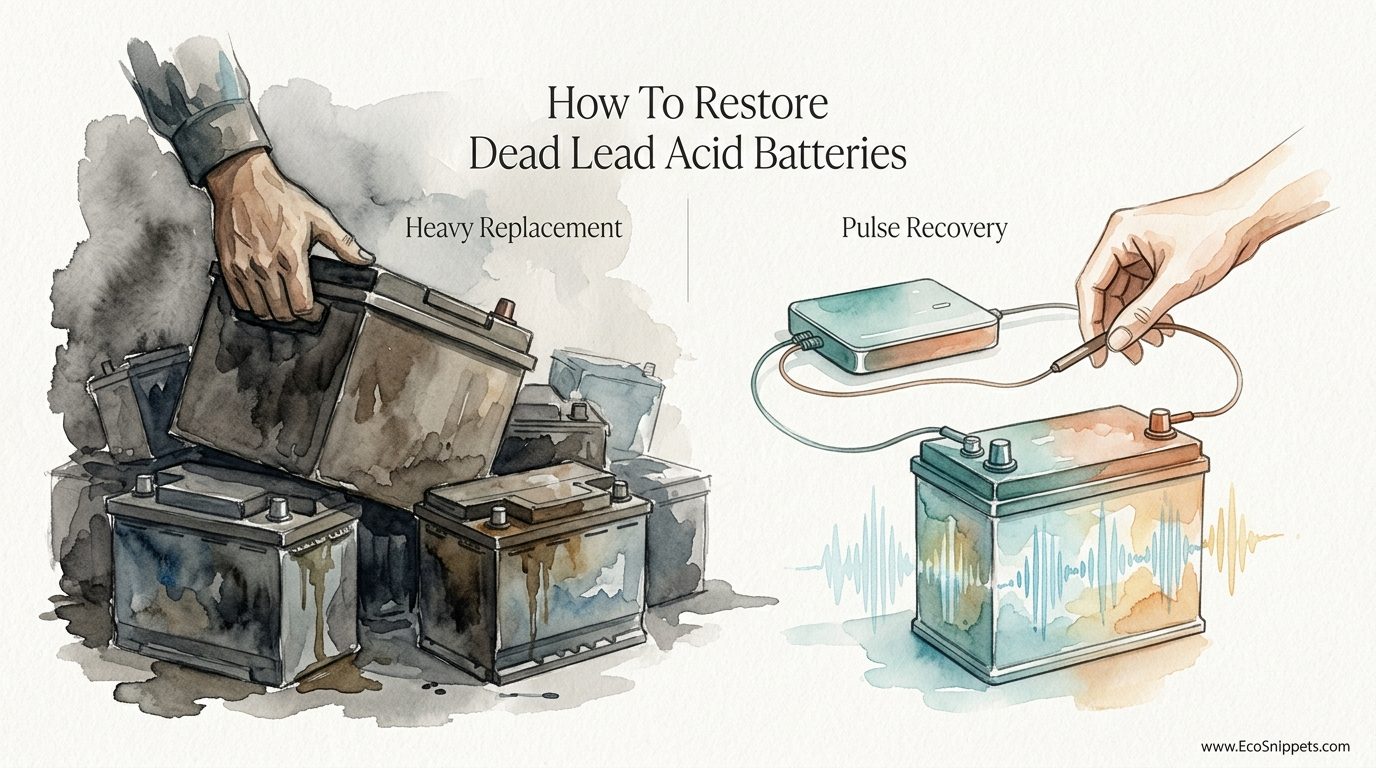
Most folks see a battery that won’t hold a charge and assume it is time for a heavy replacement. They look at the $3,000 price tag for a new bank and wince. But if you understand the chemistry of what is happening inside those plastic cases, you can use a pulse recovery method to reclaim that lost power. It is about working smarter, not harder, and using a little bit of electronic grit to save a lot of hard-earned money.
How To Restore Dead Lead Acid Batteries
Restoring a dead lead acid battery starts with understanding that “dead” is often a temporary state caused by a process called sulfation. In a healthy lead acid battery, lead and lead dioxide plates react with sulfuric acid to create electricity. During discharge, lead sulfate forms on the plates as a natural part of the cycle. When you recharge the battery, this sulfate is supposed to dissolve back into the electrolyte solution.
However, if a battery sits partially discharged for too long, or if it is never quite topped off to 100%, those “soft” sulfate crystals harden. They form a crusty, white insulation layer over the lead plates. This layer increases internal resistance and prevents the chemical reaction from happening. Eventually, the battery appears dead because the “doors” to the energy storage are effectively locked shut by crystals.
This situation is incredibly common in solar setups where a week of cloudy weather keeps the bank at a low state of charge. It also happens in seasonal vehicles, like a tractor or a boat that sits through the winter. In the real world, these batteries are often discarded prematurely. Restoration is the process of using controlled electrical energy to break those crystal bonds and return the sulfur to the acid, clear the plates, and restore the battery’s ability to hold a charge.
The Science of the Electronic Pulse
The most effective way to tackle hardened sulfation is through high-frequency electronic pulsing. This isn’t just about “blasting” the battery with high voltage, which can actually warp the plates and cause permanent damage. Instead, pulse desulfation uses carefully tuned frequencies—typically between 2 and 6 MHz—to hit the resonant frequency of the lead sulfate crystals.
Think of it like a singer hitting a specific note to shatter a wine glass. When the pulse hits that resonant frequency, it causes the crystalline structure of the sulfate to vibrate and break apart. As the crystals disintegrate, the sulfur ions are released back into the electrolyte, increasing the specific gravity (the “strength”) of the acid. This mechanical-chemical vibration allows the battery to “breathe” again without the heat and risk of traditional overcharging.
Modern electronic desulfators or “smart” chargers with a repair mode automate this process. They send short, high-voltage spikes (often 20V to 100V) that are so fast (measured in microseconds) they don’t have enough total energy to overheat the battery. This “pioneer-grit” electronic hack is the difference between a battery that lasts three years and one that serves you for a decade.
Step-by-Step: How to Pulse Your Batteries Back to Life
If you have a bank of solar batteries that are underperforming, follow this process to attempt a recovery. You will need a multimeter, a hydrometer (for flooded batteries), and a dedicated pulse desulfator or a smart charger with a “repair” or “recondition” mode.
Step 1: Physical Inspection and Safety. Wear goggles and acid-resistant gloves. Look for bulging cases or leaking acid. If the case is swollen, the plates have likely warped and touched each other, creating an internal short. These batteries are generally beyond saving. If the battery looks physically sound, move to the next step.
Step 2: Check Electrolyte Levels. For flooded (wet cell) batteries, pop the caps and ensure the liquid covers the plates. If the plates are exposed to air, they will oxidize and fail. Top them off with distilled water only—never use tap water, as the minerals will poison the battery. If you are working with a Sealed Lead Acid (SLA) or AGM battery, you cannot easily add water, though some enthusiasts carefully pry the caps to add a few milliliters of distilled water to dry cells.
Step 3: Initial Voltage Test. Use your multimeter to check the resting voltage. A “dead” 12V battery might read 10.5V or lower. If it reads 0V, it likely has a broken internal connection and is a lost cause. Most desulfators need at least 2V to 6V of “residual life” to even turn on and begin the pulsing process.
Step 4: The Pulse Phase. Connect your pulse desulfator or smart charger. If you are using a standalone desulfator, you often need to keep a standard “dumb” charger connected as well to provide the baseline current. Let the device run. This is not a fast process. Hardened crystals took months to form, and they can take 48 hours to two weeks of constant pulsing to fully dissolve. Check the battery temperature regularly; it should be warm to the touch but never hot (above 110°F / 43°C).
Step 5: Load Testing. Once the pulsing cycle is complete and the battery is fully charged, let it sit for 24 hours to stabilize. Then, use a load tester to see how it performs under stress. If the voltage stays above 9.6V (for a 12V battery) under a heavy load for 10 seconds, your restoration was a success.
Benefits of Pulse Recovery
Choosing to pulse your batteries rather than replacing them offers several measurable advantages that go beyond just saving money.
- Massive Cost Savings: A standalone desulfator costs about $30 to $60. A new deep-cycle solar battery can cost $300 to $800 each. For a bank of eight batteries, the savings are astronomical.
- Environmental Stewardship: Lead acid batteries are highly recyclable, but the “greenest” battery is the one you don’t have to manufacture. Keeping your current bank out of the waste stream for another 3–5 years significantly reduces your carbon footprint.
- Increased System Efficiency: Desulfated plates have lower internal resistance. This means your solar panels can charge the bank faster and your inverter can pull power more efficiently during the night.
- Nostalgic Self-Reliance: There is a profound sense of satisfaction in fixing what others would throw away. It reinforces the mindset of a practitioner who understands their tools rather than just consuming them.
Common Mistakes to Avoid
Even with the best intentions, a few common errors can ruin your chances of a successful battery recovery.
One of the most frequent mistakes is rushing the process. Many people run a “repair” cycle for two hours and give up when the battery doesn’t instantly jump back to full capacity. Desulfation is a slow, molecular process. You are literally vibrating crystals back into a liquid state; give it at least three to five days before judging the results.
Another pitfall is neglecting the fluid levels. High-voltage pulses or “equalization” charges can cause the electrolyte to bubble and release gas (hydrogen and oxygen). This “gassing” is good for mixing the acid, but it also consumes water. If you don’t monitor and top off the cells with distilled water, you will dry out the plates and kill the battery permanently.
Finally, forgetting to clean the terminals can lead to false readings. Corrosion on the posts creates resistance that can mimic the symptoms of sulfation. Always scrub the terminals with a baking soda and water mixture until they are bright and shiny before starting your tests.
Limitations: When the Battery is Truly Dead
While electronic pulsing is a powerful tool, it is not a magic wand. There are realistic constraints where the chemistry simply cannot be reversed. If the lead plates have physically crumbled—a process called “shedding”—the material sits at the bottom of the case. This “sludge” can eventually build up high enough to touch the bottom of the plates, creating a permanent internal short circuit. Pulsing cannot fix missing lead.
Environmental factors also play a role. Batteries that have been frozen while discharged often have cracked cases or buckled plates. If a battery has sat for five years in a hot shed, the plates may be so “sulfated-shut” that the internal resistance is effectively infinite; no amount of pulsing will penetrate that wall. Generally, if a 12V battery cannot hold at least 10V after a week of pulsing, it has reached its practical boundary and belongs at the recycler.
Comparison: Pulse Recovery vs. Heavy Replacement
If you are on the fence about whether to try a recovery or just buy new, consider this breakdown of the two approaches.
| Factor | Pulse Recovery (DIY Hack) | Heavy Replacement (New Bank) |
|---|---|---|
| Upfront Cost | Low ($30 – $100 for equipment) | High ($300 – $3,000+) |
| Time Required | High (Days to Weeks of monitoring) | Low (Hours for install) |
| Success Rate | Moderate (60% – 80% on younger batteries) | Guaranteed 100% |
| Lifespan Extension | 1 – 5 Years | Full 5 – 10 Year cycle |
| Required Skill | Intermediate (Safety/Testing) | Basic (Lifting/Wiring) |
Practical Tips for Solar Bank Maintenance
Once you have restored your batteries, or if you have a new bank you want to protect, follow these best practices to ensure they never “suffocate” again.
- Program an Equalization Charge: Most high-quality solar charge controllers have an “Equalize” setting. Set this to run once every 30 days. It raises the voltage slightly to “boil” the batteries, which prevents acid stratification and breaks down soft sulfation before it hardens.
- Keep Them Cool: Heat is the number one killer of lead acid chemistry. For every 10°F (approx. 5.5°C) increase above 77°F (25°C), the internal self-discharge rate and sulfation rate double. Ensure your battery box is ventilated or semi-buried to maintain stable temperatures.
- Monitor Specific Gravity: Don’t just trust the voltage. Use a hydrometer to check the state of the acid in each cell. If one cell is lower than the others, that battery needs a targeted pulse session before the whole bank is dragged down.
- Install Permanent Desulfators: Some practitioners choose to leave small, low-draw electronic desulfators permanently wired to their solar bank. These devices pulse 24/7, preventing any crystals from ever taking hold.
Advanced Considerations: Circuit Design Basics
For the serious practitioner who wants to go beyond the basics, you might consider building your own pulse circuit. Most DIY desulfators are based on the “555 Timer” integrated circuit. This chip can be configured to trigger a MOSFET (a high-speed switch) that dumps energy from a capacitor into an inductor. When the switch opens, the inductor creates a “flyback” voltage spike—a high-voltage, low-current pulse that travels into the battery.
When scaling these systems for a large 48V solar bank, you have to be careful. A single 12V desulfator won’t work on a 48V system unless the batteries are disconnected and treated individually. However, treating them individually is often better anyway, as it prevents the “bad” battery from absorbing all the pulse energy while the “good” ones get nothing. If you are tuning your own circuit, aiming for a pulse width of 50 to 100 microseconds is generally considered the “sweet spot” for breaking down lead sulfate without causing excessive heat.
Restoration Scenario: The Abandoned Cabin Bank
Imagine a set of four 6V Trojan T-105 batteries left at an off-grid cabin for two years. They were completely discharged, reading only 4.2V each. A standard charger wouldn’t even recognize them. By connecting two batteries in series to get to 8.4V (giving the charger enough “juice” to start), the owner applied a pulse desulfator for 10 days.
Initially, the hydrometer showed “white zone” (dead) in all cells. By day four, the specific gravity began to climb. By day ten, the batteries were reading 6.4V at rest and the acid was back in the “green zone.” For the cost of a few days of electricity and a $40 device, a $1,200 battery bank was saved from the scrap heap and returned to service, powering the cabin’s lights and water pump for another three seasons.
Final Thoughts
Restoring a dead solar battery is more than just a money-saving trick; it is an exercise in self-reliance and technical understanding. Most of our modern world is built on a “throw-away” culture that encourages us to scrap anything that doesn’t work perfectly. By learning the art of the electronic pulse, you are stepping back into a tradition of stewardship where tools are maintained, not just consumed.
It takes a bit of patience and a willing eye to monitor the process, but the results speak for themselves. Whether you are reviving a single car battery or an entire off-grid solar bank, the principles of desulfation remain the same. Dissolve the crystals, clear the plates, and let the chemistry work the way it was designed to. Once you see a “dead” battery spring back to life, you’ll never look at a scrap yard the same way again.
Take what you have learned here and apply it to your own systems. Start small, stay safe, and don’t be afraid to experiment with your older batteries. There is a world of energy hidden behind those sulfate crystals—you just need the right pulse to set it free. If you enjoy this kind of hands-on recovery, you might also look into secondary systems like lithium-ion cell harvesting or manual wind-turbine maintenance to further deepen your off-grid expertise.
