How To Become More Self-Sufficient Without Starting a Full-Blown Farm…
Want to start preserving your harvest, making your own soap, or building a backyard root cellar — but not sure where to begin? “Homesteading Advice” gives you instant lifetime access to 35+ practical homesteading books on food preservation, veggie gardening, DIY natural cleaning products (save over $250 per year with this skill alone), brewing, off-grid energy, and a whole lot more…
Click Here To Check It Out Now!
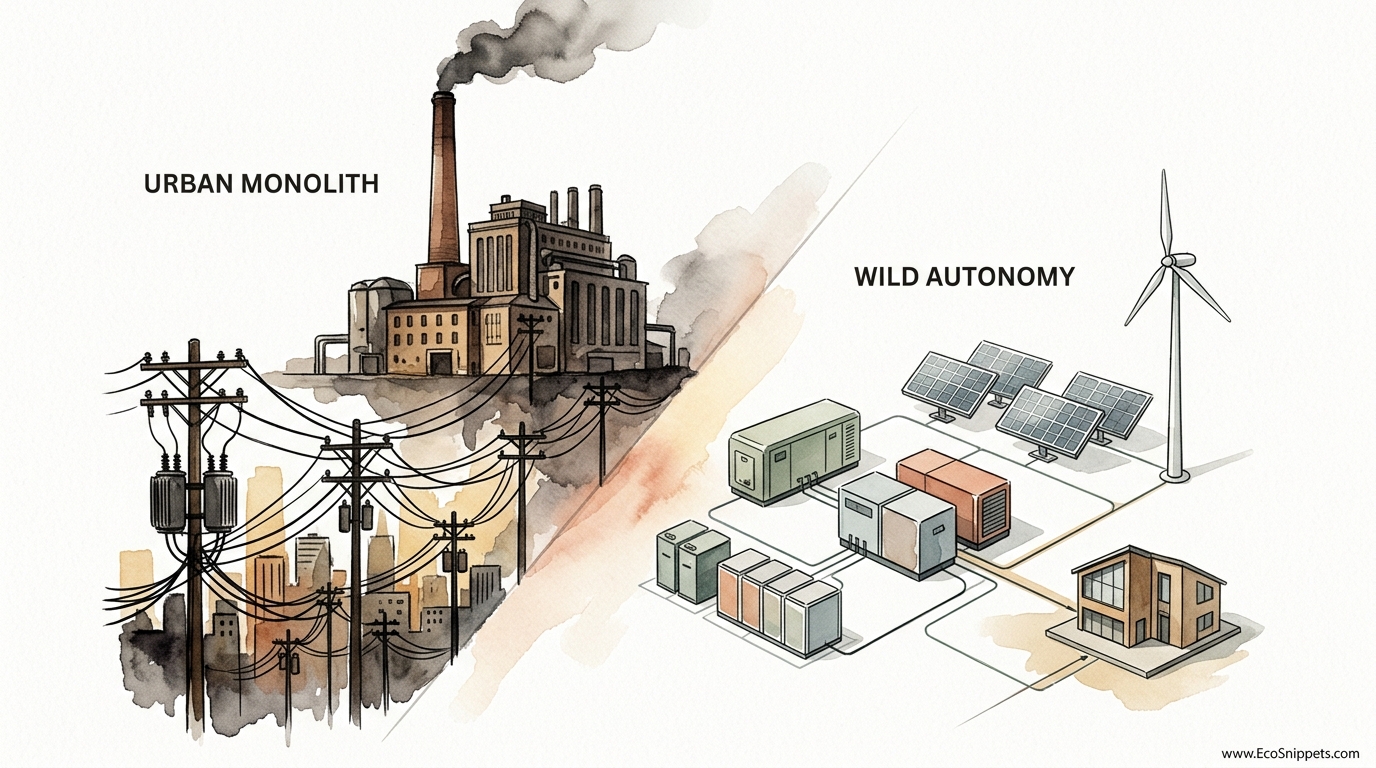
Why rely on a billion-dollar machine miles away when the ‘wild’ energy of your own land is waiting to be harvested? Urban power is a monolith: if one substation fails, the whole city goes dark. Homestead autonomy is about building a decentralized microgrid. By integrating diverse energy sources – sun, wind, and biomass you create a system that doesn’t just survive the ‘wild,’ it thrives on it.
Building a homestead power system is more than just buying a few panels and a battery. It is an act of defiance against a fragile infrastructure. A modular microgrid is a living, breathing machine that you can scale as your needs grow, ensuring that your lights stay on even when the rest of the world is in the dark. This guide will walk you through the grit and the gear needed to tame the electrons on your own acreage.
Building A Modular Power Microgrid
A modular power microgrid is a localized, independent energy system that generates, stores, and manages electricity for a specific area, like a family farm or a remote cabin. Unlike a centralized grid, which relies on high-voltage lines stretching across hundreds of kilometers (miles), a microgrid keeps everything close to home. The “modular” aspect is vital because it allows a homesteader to start small—perhaps with enough power for basic lighting—and add more generation or storage as their budget or family grows.
Most modern microgrids consist of four primary pillars: generation, storage, inversion, and distribution. Generation involves harvesting energy from the sun, wind, or biomass. Storage is the battery bank that holds that energy for a rainy day. Inversion converts the raw Direct Current (DC) from the batteries into the Alternating Current (AC) used by your toaster or table saw. Distribution is the wiring and protection that moves that power safely through your home.
These systems are used in diverse real-world situations, from remote research stations in Antarctica to sustainable farms in the Appalachian Mountains. They exist because they offer a level of reliability that the “urban monolith” simply cannot match. If a tree falls on a power line five miles (eight kilometers) away, your neighbor’s house might go dark, but your microgrid keeps humming because the source of your power is right outside your back door.
How to Design Your Modular System
Planning starts with a ruthless assessment of your energy needs. Every lightbulb, pump, and tool must be accounted for in a “load assessment.” You calculate this by multiplying the wattage of each device by the number of hours it runs daily. For example, a 10-watt LED bulb running for 5 hours consumes 50 watt-hours (Wh) per day. Summing these figures gives you the total daily energy requirement, which is the baseline for sizing your entire system.
Voltage selection is the next critical decision. While small 12V systems are common for vans and campers, a serious homestead microgrid should almost always operate at 48V. Higher voltage reduces the current (amperage) flowing through your wires. Lower current means you can use thinner, less expensive copper wire while minimizing energy loss over long distances. A 4,000-watt load at 12V requires massive cables to avoid melting, but at 48V, that same load is much easier to manage.
Solar arrays should be sized to cover your daily usage even during the shortest days of winter. In regions where winter sun is scarce, you might only get 2 to 3 “peak sun hours” per day. If your homestead needs 10,000 watt-hours (10kWh) daily, a 5,000-watt solar array is a safe bet, accounting for efficiency losses and overcast weather. Mounting these panels on a ground-based rack allows for easy cleaning and seasonal angle adjustments to catch every possible photon.
The Generation Mix: Sun, Wind, and Wood
Solar energy is the backbone of most systems because it has no moving parts and requires very little maintenance. However, relying solely on the sun can be risky during a week-long storm. Integrating a wind turbine can provide power during the night or on blustery, cloudy days. A small turbine mounted on a 20-meter (65-foot) tower can catch the more stable “laminar” winds found above the tree line, providing a steady trickle of charge to the batteries.
Biomass gasification is the “secret weapon” of the self-reliant homesteader. This technology involves heating wood chips or corn cobs in a low-oxygen environment to produce “syngas,” which can run a standard gasoline generator with minor modifications. This provides a reliable backup source of power that doesn’t depend on a diesel delivery truck. One kilogram (2.2 pounds) of dry wood can produce roughly one kilowatt-hour of electricity when run through a well-tuned gasifier.
The Heart of the System: Battery Chemistry
Choosing the right battery is the difference between a system that lasts three years and one that lasts twenty. For decades, deep-cycle lead-acid batteries were the only affordable option. They are heavy, toxic, and fragile. You can only safely discharge them to 50% of their capacity; draining them further causes permanent damage known as sulfation. If you have a 10kWh lead-acid bank, you effectively only have 5kWh of usable energy.
Lithium Iron Phosphate (LiFePO4 or LFP) has changed the game for modern autonomy. These batteries are lighter, safer, and can be discharged to 90% or 100% without significant harm. While the upfront cost is higher, the “cost per cycle” is significantly lower because an LFP battery can last for 3,000 to 5,000 cycles, compared to the 500 to 800 cycles of lead-acid. LFP batteries also charge much faster, which is critical when you only have a few hours of sunlight between clouds.
| Feature | Lead-Acid (AGM/Flooded) | Lithium (LiFePO4) |
|---|---|---|
| Usable Capacity (DoD) | 50% | 90% – 100% |
| Cycle Life | 500 – 1,000 cycles | 3,000 – 6,000 cycles |
| Maintenance | High (Watering/Cleaning) | Zero (Internal BMS) |
| Efficiency | 80% – 85% | 95% – 98% |
| Weight | Heavy (45kg/kWh) | Light (12kg/kWh) |
Benefits of Homestead Microgrids
True resilience is the primary advantage. When the centralized grid fails due to weather, cyberattacks, or aging infrastructure, the homesteader with a microgrid doesn’t even notice. The peace of mind that comes from knowing your food won’t spoil in the freezer and your well pump will keep providing water is worth every penny of the investment. You are the master of your own utilities, and no utility company can send you a bill or shut off your service.
Financial predictability is another major factor. While the initial capital outlay is significant, the “fuel” (sunlight and wind) is free. Once the system is paid for, your monthly energy cost drops to near zero. Over a 20-year period, a well-designed microgrid is often cheaper than paying a utility company, especially as energy prices continue to rise globally. You are essentially pre-paying for twenty years of energy at a fixed price.
Modular systems also allow for incremental growth. You do not need to build a $50,000 system on day one. Starting with a single inverter/charger and a small battery bank allows you to power your basic necessities. As you clear more land or build more structures, you can simply add more panels and another battery module. This flexibility ensures the system evolves with your lifestyle.
Challenges and Common Mistakes
Undersizing the battery bank is the most frequent error made by beginners. Many people size their batteries for one day of usage, but weather is unpredictable. Aiming for at least three days of “autonomy”—the ability to run the house without any incoming power—is the standard for a reliable homestead. Without this buffer, you will find yourself starting a noisy backup generator every time there is a heavy rainstorm.
Neglecting safety and grounding is a dangerous oversight. A microgrid is a high-power electrical plant. Fuses and circuit breakers are mandatory between every major component: panels to controller, battery to inverter, and controller to battery. Without proper grounding, a lightning strike nearby can fry every expensive electronic component in your system. Installing a dedicated ground rod and Surge Protective Devices (SPDs) is non-negotiable for protecting your investment.
Shading is a silent killer of solar efficiency. If even 10% of a solar panel is covered by a tree branch’s shadow, the output of the entire string of panels can drop by 50% or more. Many new homesteaders underestimate how much a tree will grow or how long its shadow will be in the winter when the sun is lower in the sky. Clearing a wide “solar window” is essential for maximizing your energy harvest.
Limitations to Consider
Geography plays a massive role in system viability. If you live in a deep valley or a region with constant heavy cloud cover, solar may not be your best primary source. In these cases, you might need to lean more heavily on micro-hydro (if you have a stream) or wind. Every site has its own “wild” energy profile, and trying to force a solar-only system in a rainy rainforest is an exercise in frustration.
Seasonal variability is another hurdle. In the northern or southern extremes, winter days are short and the sun is weak. A system that provides plenty of power in the summer may struggle to keep the lights on in June or December. This requires a “hybrid” approach, where you supplement your renewables with a gasifier or a backup generator during the darkest months of the year.
Practical Tips and Best Practices
Passive monitoring is the key to longevity. Installing a smart monitor that connects to your phone or a wall display allows you to see exactly how much power is coming in and going out. Knowing that your batteries are at 60% might prompt you to wait until tomorrow to run the laundry. This “energy consciousness” becomes second nature over time and prevents you from ever reaching a critical low-voltage shutdown.
Wiring for the future saves time and money. When you install your first conduit from the solar array to the power shed, use a larger pipe than you currently need. Adding more wires later is a breeze if you have the space, but digging a new trench is a chore no one wants to repeat. Similarly, choose an inverter that can be “stacked” or run in parallel with another unit to increase your power capacity down the line.
- Clean your solar panels at least twice a year to remove dust, pollen, and bird droppings.
- Check all electrical connections annually for tightness; temperature changes can cause metal to expand and contract, loosening screw terminals.
- Ensure your batteries are kept in a temperature-controlled environment; LFP batteries should not be charged below freezing (0°C / 32°F).
- Keep a detailed log of your system’s performance to help troubleshoot any future issues.
Advanced Considerations: Automation and EMP Hardening
Serious practitioners often look into “load shedding” automation. Using a Programmable Logic Controller (PLC) or a smart home system, you can program the microgrid to automatically turn off non-essential loads—like a water heater or an air conditioner—when the battery level drops below a certain threshold. This ensures that the most critical systems, like the refrigerator and security lights, stay powered for as long as possible.
Electromagnetic Pulse (EMP) hardening is a consideration for those focused on extreme preparedness. Storing spare components, like a charge controller and an inverter, in a Faraday cage can provide a “seed” to rebuild your grid if a catastrophic event occurs. Using shielded cables and high-quality surge arrestors also helps protect the system from the massive voltage spikes caused by nearby lightning or solar flares.
A Realistic Scenario: The 5-Acre Homestead
Consider a family of four living on five acres (two hectares) in a temperate climate. They need to power a well pump, a refrigerator, a chest freezer, LED lighting, and internet. Their daily load assessment comes to 8kWh. To be truly independent, they install a 6,000-watt solar array on a ground mount. This array produces enough energy even on a cloudy day to cover the essentials.
They pair this with a 30kWh LFP battery bank (six 5kWh modules). This provides nearly four days of autonomy if the sun disappears completely. A 5,000-watt pure sine wave inverter handles the surge of the well pump starting up. For the long, dark winter weeks, they have a small wood gasifier that can run their backup 5kW generator for four hours an evening, topping off the batteries while they use the excess heat to warm the workshop.
Final Thoughts
Transitioning to a modular power microgrid is a journey of reclaiming your independence. It requires a shift in mindset—from being a passive consumer of energy to being an active manager of a resource. The technical hurdles may seem daunting at first, but the grit required to build and maintain such a system is the same grit that our ancestors used to tame the land itself.
Start small, buy the best batteries you can afford, and always respect the power of the electron. As you add each new panel and each new battery module, you are building a legacy of self-reliance. Your microgrid is more than just a collection of wires and glass; it is the heartbeat of a truly autonomous homestead.
Experimenting with different energy sources will deepen your understanding of your land. Whether you are catching the wind on a ridge or harvesting the sun in a clearing, you are tapping into the ancient, wild energy of the earth. Embrace the challenge, and you will find that the rewards of autonomy are far brighter than anything the urban monolith can offer.
