How To Become More Self-Sufficient Without Starting a Full-Blown Farm…
Want to start preserving your harvest, making your own soap, or building a backyard root cellar — but not sure where to begin? “Homesteading Advice” gives you instant lifetime access to 35+ practical homesteading books on food preservation, veggie gardening, DIY natural cleaning products (save over $250 per year with this skill alone), brewing, off-grid energy, and a whole lot more…
Click Here To Check It Out Now!
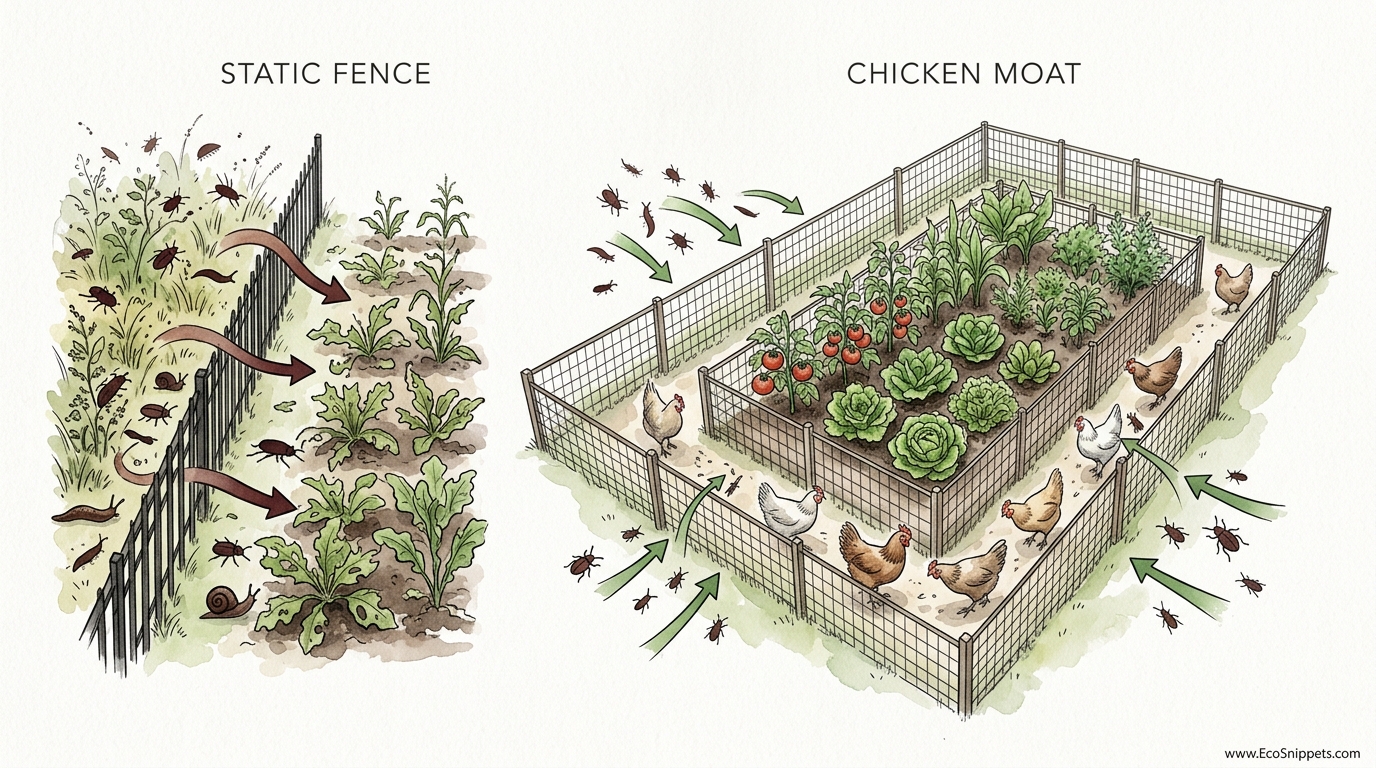
Most fences just stand there, but this one actually works for its keep by hunting pests 24/7. Are you tired of battling squash bugs and grasshoppers? Instead of a static barrier that does nothing, discover the dynamic power of the chicken moat—a double-fenced run that encircles your garden. Your birds get a secure patrol zone, your soil gets a barrier against crawling pests, and you get more eggs. It’s the ultimate backyard farming upgrade.
For generations, the gardener’s primary defense was a simple wall. We built high and we built strong, yet the smallest enemies—the beetles, the slugs, and the grasshoppers—always found a way through. A traditional static fence might keep out a hungry stray dog, but it does little to stop the slow, relentless march of insects that see your prize tomatoes as a buffet.
The chicken moat turns this old-fashioned defensive thinking on its head. By creating a perimeter patrol zone, you are enlisting a team of highly motivated, feathered workers who are biologically programmed to find and devour exactly what you want gone. It is a system built on ancestral wisdom and modern permaculture, where every element performs multiple jobs at once.
How To Build A Chicken Moat For Pest Control
A chicken moat is essentially a specialized enclosure consisting of two parallel fences that wrap around the entire perimeter of a garden or orchard. This creates a “lane” or “hallway” where chickens spend their day. Think of it as a protective ring that creates a biological barrier between the wild world and your cultivated beds.
This design is rooted in the concept of “function stacking.” In the real world, it serves as a fence, a feeder, a fertilizer delivery system, and a pest control service. While the inner fence keeps the chickens from devouring your crops, the outer fence protects the birds from predators. The space between—the moat itself—is the work zone where the magic happens.
In practice, a chicken moat is used to intercept pests before they ever reach your plants. As insects crawl toward your garden, they must cross the moat. To a chicken, a crawling grasshopper is a high-protein snack. By the time a bug makes it through the first fence and across several feet of bare ground or short grass, it is almost certain to be spotted and consumed.
Designing the Perfect Moat Layout
The layout of your moat depends largely on your garden’s shape. Most homesteaders choose a width of 3 to 6 feet (0.9 to 1.8 meters). This width is narrow enough that chickens can spot a bug from one side to the other, but wide enough to prevent deer from jumping over. Deer have excellent vertical leap but poor depth perception; a double fence with a 5-foot (1.5-meter) gap is a psychological and physical barrier they rarely attempt to clear.
Your moat should ideally connect directly to your main chicken coop. This allows the birds to leave their secure sleeping area and head straight into the patrol zone at sunrise without you having to manually move them. If your garden is distant from the coop, you can use “chicken tunnels”—small, wire-enclosed walkways—to bridge the gap.
The Mechanics: Why the Moat Outperforms the Wall
To understand why this system is so effective, you have to look at it through the eyes of a predator. A static fence is a passive obstacle. Once an insect clears it, the feast begins. A chicken moat is an active, living ecosystem. It works because it forces pests to enter a high-risk environment where their natural camouflage fails them.
As chickens scratch and peck throughout the day, they keep the grass in the moat extremely short or non-existent. This lack of cover makes it impossible for slugs, snails, and beetles to hide. Furthermore, the birds naturally till the soil as they hunt for grubs and larvae, interrupting the life cycle of pests like Japanese beetles before they ever emerge from the ground.
The nutrient cycle is another mechanical advantage. When rain falls, it washes the nitrogen-rich manure from the moat directly toward the root zones of the plants growing just inside the inner fence. You are essentially creating a self-fertilizing garden border that pays for itself in reduced feed costs and higher vegetable yields.
Step-by-Step Construction Guide
Building a moat requires more planning than a standard run, but the grit you put in now pays off for decades. Start by marking your perimeters with stakes and string to ensure your lines are straight and your width is consistent throughout the entire loop.
1. Setting the Outer Fence
The outer fence is your first line of defense against predators like foxes, coyotes, and neighborhood dogs. Use a heavy-gauge welded wire or “no-climb” horse fencing rather than flimsy chicken wire. For height, 5 to 6 feet (1.5 to 1.8 meters) is standard. To stop burrowing predators, bury the bottom 12 inches (30 centimeters) of the wire in a trench or flare it outward in an “L” shape and secure it with landscape staples.
2. Installing the Inner Fence
The inner fence only needs to keep the chickens in, so it can be slightly lighter. However, it still needs to be at least 4 to 5 feet (1.2 to 1.5 meters) high to prevent flighty breeds from jumping into your vegetable beds. If you are growing tall crops like corn or climbing beans near the fence, ensure the chickens cannot reach through the mesh to peck at the leaves.
3. Managing Gateways and Tunnels
You will need at least one large gate to get your garden cart or tiller into the main garden. This is a common weak point. The best solution is to build a “chicken tunnel” or a small bridge over the gateway area. Alternatively, you can use a culvert pipe or a concrete block tunnel buried under the garden entrance, allowing the birds to pass underneath your walking path so the moat remains an unbroken loop.
4. Cornering and Flow
Avoid sharp 90-degree internal corners if possible. Chickens can sometimes get “trapped” in tight corners when panicked by a predator or simply confused by the fence line at dusk. Rounding the corners slightly or using a convex design helps the birds navigate back to the coop more naturally as the sun goes down.
Choosing the Right Patrol: Best Chicken Breeds
Not every chicken is a natural-born hunter. To get the most out of your moat, you want birds with high energy, excellent foraging instincts, and a bit of “pioneer spirit.” Avoid the heavy, docile “ornamental” breeds that prefer to wait by the feeder for a handout.
- Rhode Island Reds: These are the workhorses of the homestead. They are hardy, aggressive foragers that will hunt from dawn until dusk.
- Plymouth Rocks (Barred Rocks): Extremely smart and alert, these birds are great at spotting movement in the grass and are heavy enough to deter smaller aerial predators.
- Leghorns: If your moat is long and you want birds that cover a lot of ground, Leghorns are unmatched. They are lightweight, fast, and highly motivated by insects.
- Egyptian Fayoumis: These are prized in permaculture circles for their “landrace” qualities. They are incredibly predator-savvy, heat-tolerant, and possess an almost wild instinct for finding their own food.
- Brahmas: If you live in a cold climate and have high pressure from hawks, the massive size of a Brahma can be a deterrent, though they forage more slowly than the lighter breeds.
Practical Benefits of the Moat System
The primary benefit is, of course, a massive reduction in garden pests. Many moat owners report a 70% to 90% decrease in grasshopper populations within the first season. Because the chickens are confined to the moat, they cannot scratch up your delicate seedlings or peck holes in your ripening tomatoes, which is the main drawback of letting them free-range directly in the garden.
Beyond pest control, you will notice a significant drop in your feed bill. During the peak of the growing season, a well-managed moat can provide up to 40% of a flock’s nutritional needs through forage alone. The diversity of their diet—comprising insects, weed seeds, and fresh greens—results in eggs with deep orange yolks and superior nutritional profiles.
The moat also acts as a “weed barrier.” Chickens are relentless in their search for seeds. Any weed that attempts to establish itself on the perimeter of your garden will be scratched up and eaten before it can go to seed and blow into your beds. This keeps the “creeping” grasses like Bermuda or Couch grass from invading your growing space.
Challenges and Common Mistakes
The most frequent error is making the moat too narrow. If a moat is only 2 feet (0.6 meters) wide, the chickens will quickly turn it into a muddy, compacted trench where nothing can live. A narrow moat also makes the birds more vulnerable to “reach-through” predators like raccoons. Aim for a minimum of 3 feet (0.9 meters) for functionality and 5 feet (1.5 meters) for optimal deer protection.
Another mistake is failing to provide shade and water within the moat itself. Because the moat is a long, thin corridor, a single waterer at the coop might be too far away on a hot day. Place small water stations and “shade hubs” (using scrap wood or living vines) at various points along the loop to ensure the birds stay hydrated and cool while they work.
Neglecting the ground surface can also lead to trouble. If your soil is heavy clay, the moat can become a muddy mess after a rain. Using a “deep litter” approach—adding wood chips, straw, or fallen leaves to the moat—helps manage moisture, prevents smells, and provides even more habitat for the beneficial grubs the chickens love to find.
Limitations and Trade-offs
A chicken moat is not a “set it and forget it” system. It requires a higher initial investment in fencing materials than a standard garden fence. You are essentially buying double the wire and double the posts. If you are on a tight budget, this may be a significant barrier to entry.
Environmental factors also play a role. In extremely arid regions, a moat may struggle to produce enough forage to sustain the birds, requiring you to supplement their diet more heavily. Conversely, in very wet climates, the high traffic in a confined space can lead to soil compaction and “poultry sick” ground if not managed with plenty of carbon-rich bedding like wood chips.
Finally, there is the issue of aerial predators. While a moat protects against ground attacks, the long, open lanes are a clear runway for hawks and owls. If you have high raptor pressure, you may need to “roof” portions of the moat with inexpensive bird netting or plant fast-growing vines over the top to provide a leafy canopy for the birds to hide under.
Static Fence vs. Chicken Moat
| Feature | Static Fence | Chicken Moat |
|---|---|---|
| Pest Control | Passive barrier only | Active hunting 24/7 |
| Cost | Lower (single fence) | Higher (double fence) |
| Maintenance | Low | Moderate (bird care) |
| Soil Health | Neutral | High (fertilizer runoff) |
| Deer Protection | Limited (unless 8ft+) | Excellent (depth barrier) |
Practical Tips and Best Practices
To get the best performance from your “feathered moat patrol,” consider these field-tested strategies:
- The “Old Board” Trick: Leave a few scrap pieces of 2×4 or plywood in the moat. Flip them over every morning. Slugs and snails congregate under the cool, damp wood overnight, providing a concentrated breakfast for your birds.
- Trap Crops: Plant things like nasturtiums or sunflowers just outside the outer fence. These attract aphids and beetles, which then have to run the “gauntlet” of the moat to get toward your main garden.
- Seasonal Rotation: In the late autumn, once your harvest is finished, open the inner gates. Let the chickens spend the winter directly in the garden beds. They will clear out the spent vines, eat the remaining weed seeds, and fertilize the soil for spring.
- Vining Shade: Grow grapes, hops, or passionfruit on the inner fence. The chickens will eat any leaves that grow within their reach (pruning the bottom for you), while the higher fruit remains yours. The vines provide essential shade and protection from hawks.
Advanced Considerations for the Serious Practitioner
For those looking to truly master the moat, consider integrating a “compost station.” Designate one section of the moat as a drop zone for your kitchen scraps and lawn clippings. The chickens will spend hours turning and aerating this material, accelerating the composting process and creating a “hot spot” for worms and grubs. Every few months, you can shovel this high-grade compost directly over the inner fence into your garden.
If you have a very large orchard, you can use the moat as a “laneway” for multi-species grazing. By using temporary cross-fencing, you can move birds to specific sections of the moat where pest pressure is highest. This prevents “over-grazing” in any one area and keeps the birds interested in their surroundings.
Water management is another advanced step. If your garden is on a slight slope, ensure the moat is on the uphill side. This allows the nutrient-dense rainwater to gravity-feed into your vegetable beds. You can even install a simple greywater system from your house that empties into a “mulch basin” in the moat, providing a constant source of moisture for the bugs that chickens love to hunt.
Example Scenario: The Grasshopper Siege
Imagine a standard 40×50 foot (12×15 meter) vegetable garden. In a “static fence” setup, during a dry summer, grasshoppers will migrate from the surrounding fields in the thousands. Even a tall fence won’t stop them; they simply fly over or crawl through the mesh. Within days, your kale is skeletonized and your pepper plants are nubs.
Now, consider that same garden with a 4-foot (1.2-meter) wide chicken moat. As the grasshoppers move toward the green oasis of your garden, they hit the “dead zone” of the moat. There is no tall grass for them to hide in. The ten hens on patrol spot the movement instantly. Because chickens have a high metabolic rate, they can consume dozens of grasshoppers each per day. The “siege” is broken not by chemicals, but by the natural appetite of your birds. Your feed costs drop to near zero for a month, and your peppers remain untouched.
Final Thoughts
The chicken moat is more than just a clever way to keep birds; it is a return to a more integrated, sensible way of farming. It recognizes that in nature, there is no such thing as “waste” or “pests”—only unused resources. By positioning your chickens where they can do the most good, you transform them from a chore into a partner.
Building this system requires some sweat and a bit of a financial investment in wire and posts, but the dividends are paid out in every pest-free tomato and every golden yolk. It is a structure that honors the pioneer spirit of self-reliance while embracing the sophisticated cycles of the natural world.
If you are ready to stop fighting your environment and start working with it, pick up a shovel and start staking out your perimeter. Your garden—and your birds—will thank you for it. Once you see the moat in action, you’ll wonder how you ever managed a garden with a fence that just stood there doing nothing.
