How To Become More Self-Sufficient Without Starting a Full-Blown Farm…
Want to start preserving your harvest, making your own soap, or building a backyard root cellar — but not sure where to begin? “Homesteading Advice” gives you instant lifetime access to 35+ practical homesteading books on food preservation, veggie gardening, DIY natural cleaning products (save over $250 per year with this skill alone), brewing, off-grid energy, and a whole lot more…
Click Here To Check It Out Now!
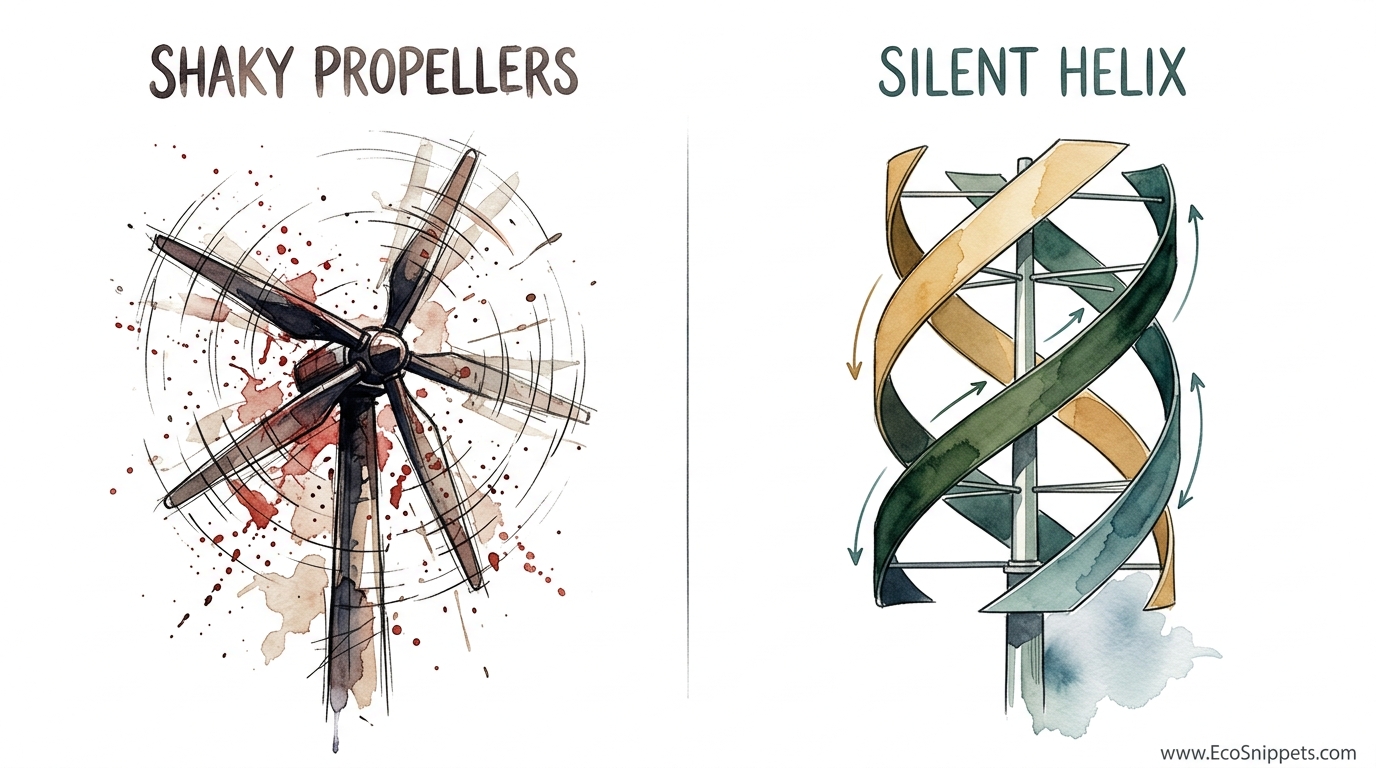
The very wind that rattles your windows and destroys standard turbines could be powering your entire home silently. Most people think wind power is only for flat plains and giant propellers. But in the city, wind doesn’t blow straight — it swirls, gusts, and breaks traditional equipment. While your neighbor’s turbine is vibrating itself to pieces, this helical design turns ‘bad’ wind into a steady stream of free energy.
Harnessing the elements has always required a bit of grit and a lot of common sense. Our ancestors didn’t fight the weather; they built structures that worked with it. In the modern urban homestead, that same logic applies to energy. Traditional horizontal wind turbines — those “shaky propellers” we see on hillsides — are designed for the open ocean or vast prairies where the air moves like a river. In a neighborhood, the air moves more like a washing machine. This turbulence is the enemy of standard blades but the fuel for a vertical design.
Choosing to generate your own power is an act of self-reliance. It is about looking at the resources already hitting your roof and deciding they shouldn’t go to waste. Whether you are looking to supplement a solar array or find a way to keep the lights on during a storm, understanding the silent strength of the helix is the first step toward true energy independence.
Vertical Axis Wind Turbines For Urban Homes
A Vertical Axis Wind Turbine, or VAWT, is a device that captures the kinetic energy of the wind using blades that rotate around a central vertical mast. Unlike the horizontal turbines that resemble airplane propellers, these units often look like eggbeaters, DNA strands, or spinning cylinders. The fundamental difference lies in their orientation: because the shaft stands upright, the turbine can accept wind from any direction—north, south, east, or west —without needing a tail or a computer-controlled “yaw” motor to turn it.
In the tight confines of a city or a suburban backyard, wind is rarely a steady, predictable flow. Buildings, trees, and fences create what engineers call “turbulent flow.” This “bad” wind hits a traditional turbine and causes it to hunt for the right direction, putting massive stress on the bearings and reducing efficiency to almost nothing. VAWTs, however, are omnidirectional. They don’t care where the gust comes from; they simply spin.
These machines exist because they solve the primary problem of decentralized power: space. You don’t need a 30-meter (100-foot) tower to find usable wind with a vertical design. By sitting lower to the ground or directly on a roof peak, they catch the localized acceleration of wind as it pushes over the edge of a structure. This makes them the most practical choice for a resident who doesn’t own a 40-acre (16-hectare) field.
How the Vertical Helix Operates
Understanding how these turbines work requires looking at two primary forces: drag and lift. Early designs, such as the Savonius rotor, relied entirely on drag. Think of a series of cups or halves of a 208-liter (55-gallon) drum catching the wind. The wind pushes the cup, the mast turns, and power is generated. While these are incredibly sturdy and can start spinning in a light breeze of only 2 meters per second (4.5 mph), they are inherently limited because the blades moving back into the wind create resistance.
Modern helical designs utilize aerodynamic lift, the same principle that allows an airplane to fly. These blades are shaped like airfoils. As the wind passes over the curved surface, it creates a pressure difference that pulls the blade forward. By twisting these lift-based blades into a helix—a design often credited to engineer Alexander Gorlov—the turbine ensures that at least one part of the blade is always at the optimal angle to catch the wind. This eliminates the “chopping” vibration found in straight-bladed vertical turbines and results in a smooth, silent rotation.
The energy captured by the spinning blades travels down the vertical shaft to a generator. In most residential setups, this is a permanent magnet generator (PMG). Because the generator is located at the base of the unit rather than 15 meters (50 feet) in the air, the center of gravity remains low, which is vital for structural stability on a residential roof. From there, the alternating current (AC) is usually converted to direct current (DC) to charge a battery bank or sent through an inverter to power the home’s electrical panel.
The Practical Benefits of Going Vertical
The most immediate advantage of a helical turbine is the sound—or lack thereof. Traditional turbines produce a characteristic “whooshing” sound as the blade tips slice through the air at high speeds. In a quiet neighborhood, this can be an annoyance to neighbors and a violation of local noise ordinances. Helical VAWTs produce a broadband, low-frequency hum that often blends into the natural background noise of the wind itself. Studies have shown that these units typically operate well below the 40-decibel limit often cited in residential zoning.
Maintenance is another area where the “pioneer-grit” approach pays off. With a horizontal turbine, if a bearing fails or the generator needs service, you are looking at a dangerous climb or the rental of a bucket truck. With a VAWT, the heavy components—the generator and the braking system—are located at the bottom of the mast. This makes it possible for a homeowner to perform routine inspections and repairs without specialized climbing gear or a fear of heights.
Safety is a frequent concern for those living in populated areas. Because VAWTs spin at lower tip-speed ratios than their horizontal cousins, they are significantly less likely to experience a catastrophic blade failure. Furthermore, they are more visible to birds and bats. The solid profile of a spinning helical turbine is easily detected by wildlife, unlike the “invisible” blur of high-speed propeller tips, making them a more environmentally responsible choice for suburban energy.
Challenges and Common Pitfalls
Despite their advantages, vertical turbines are not a “set it and forget it” solution. One of the most common mistakes is poor placement. Homeowners often assume that if they feel a breeze on their porch, there is enough energy to power a house. In reality, wind power is cubic—meaning if you double the wind speed, you get eight times the power. Placing a turbine in the “wind shadow” of a large tree or a neighbor’s two-story house will result in almost zero energy production.
Another challenge is the start-up speed. Lift-based turbines (Darrieus types) sometimes struggle to start spinning from a dead stop if the wind is light. They are incredibly efficient once they are moving, but they need a “kick” to get going. High-quality modern units often solve this by using a hybrid design that incorporates small Savonius-style drag “starter” blades or by using the generator itself as a motor for a few seconds to initiate rotation when sensors detect sufficient wind.
Structural resonance is a technical pitfall that can ruin an installation. Every building and Every turbine has a natural vibration frequency. If the turbine’s rotation matches the building’s resonance, it can create a vibration that rattles dishes in the kitchen or, worse, weakens the roof rafters. Professional installers use vibration isolation mounts—heavy-duty rubber or spring-based dampeners—to ensure the turbine’s energy stays in the wires and out of the walls.
Environmental and Physical Limitations
Nature has a way of reminding us of our limits. Even the best helical turbine cannot produce energy if the air isn’t moving. For most residential wind systems to be economically viable, you need an average annual wind speed of at least 4.5 to 5.4 meters per second (10 to 12 mph). If you live in a valley or a heavily forested area where the air is stagnant, a wind turbine will be more of a garden ornament than a power plant.
The physics of height is another unyielding constraint. Wind speed increases as you move away from the ground and its friction-inducing obstacles. A turbine mounted 5 meters (16.4 feet) above a roofline will perform significantly better than one mounted on a 2-meter (6.5-foot) pole in the yard. However, many urban areas have strict height restrictions on residential structures. You must balance the need for height with the reality of local zoning laws and the structural capacity of your roof to handle the “overturning moment”—the force of the wind trying to push the mast over.
Efficiency is a trade-off. While a large horizontal turbine can achieve a power coefficient of nearly 50%, most residential VAWTs hover between 30% and 40%. You are trading peak efficiency for consistency. In an urban environment, a turbine that produces 300 watts of power consistently through turbulent gusts is far more valuable than a turbine that could produce 1,000 watts in a perfect stream but spends all day vibrating and realigning itself.
Comparing the Shaky Propeller to the Silent Helix
To help visualize the differences between Horizontal Axis Wind Turbines (HAWT) and Vertical Axis Wind Turbines (VAWT) in a residential context, consider the following comparison of measurable factors:
| Feature | HAWT (Propeller Style) | VAWT (Helical Style) |
|---|---|---|
| Wind Acceptance | Unidirectional (requires yaw) | Omnidirectional (360 degrees) |
| Noise Level | High (High-pitched whoosh) | Low (Low-frequency hum) |
| Turbulence Tolerance | Poor (Causes fatigue and failure) | High (Thrives in gusty air) |
| Maintenance Difficulty | High (Climbing required) | Low (Ground-level access) |
| Space Requirement | Large (Requires wide clearance) | Small (Compact footprint) |
Practical Tips for the Urban Wind Pioneer
Before spending a single cent on hardware, you must perform a site assessment. Do not rely on general wind maps provided by the government; these usually measure wind at 10 to 50 meters (33 to 164 feet) in the air, far higher than your turbine will sit. Instead, invest in a portable anemometer and mount it at the exact height where you plan to install your turbine. Collect data for at least 30 days to see the reality of your local wind resource.
When it comes to mounting, the peak of a gabled roof is often the sweet spot. As wind hits the side of a house, it is forced upward, accelerating as it crosses the peak. This “compression” effect can actually give you higher wind speeds than you would find in an open field at the same height. However, ensure your mounting hardware is anchored directly into the primary structural members of the house—the rafters or the ridge beam—and use high-grade lag bolts with waterproof flashing.
Consider a hybrid system. Wind and solar are natural partners. In many regions, the wind blows strongest in the winter and at night, exactly when your solar panels are least effective. By connecting both a VAWT and a solar array to the same battery bank, you create a more resilient, year-round power supply. Make sure your charge controller is designed for a hybrid input, as wind turbines require a “dump load”—a way to safely dissipate excess energy when the batteries are full and the wind is still blowing.
Advanced Considerations: Materials and Control
For those looking to push the boundaries of their setup, material choice is paramount. Cheaper turbines use injection-molded plastics that can become brittle under UV exposure and cold temperatures. Serious practitioners look for blades made of carbon fiber or aircraft-grade aluminum. These materials offer the best strength-to-weight ratio, allowing the turbine to react quickly to changes in wind speed while resisting the centrifugal forces generated during a gale.
The braking system is another critical advanced component. In extreme weather, a wind turbine can spin fast enough to destroy its own bearings or overheat the generator. There are two main types of braking: mechanical and electromagnetic. Electromagnetic braking is the more “elegant” solution; it works by shorting the generator phases, creating a massive magnetic resistance that slows the blades. Having a manual “emergency stop” switch inside your home is a non-negotiable safety feature for any urban wind installation.
Inverters and power conditioning also require attention. The power coming off a wind turbine is highly variable. Unlike the steady output of a battery, turbine AC frequency and voltage fluctuate with every gust. High-end systems use a “maximum power point tracking” (MPPT) controller specifically tuned for wind. This device constantly adjusts the electrical load on the turbine to keep the blades spinning at their most efficient speed for any given wind velocity.
Example Scenario: The Suburban 1.5kW Setup
Imagine a homeowner in a gusty coastal suburb. They install a 1.5-kilowatt (kW) helical turbine on a 3-meter (10-foot) mast attached to their chimney stack. The total height of the turbine is approximately 2 meters (6.5 feet) with a diameter of 1.2 meters (4 feet).
During a typical autumn day with average gusts of 8 meters per second (18 mph), this turbine might produce 400 to 600 watts of power. Over a 24-hour period, even with the lulls in the wind, it could contribute 8 to 10 kilowatt-hours (kWh) to the home’s battery bank. For a household that has optimized its efficiency with LED lighting and energy-star appliances, this single turbine could cover 30% to 50% of their daily electrical needs.
In a storm where solar panels are obscured by heavy clouds and rain, the wind turbine hits its “rated power” of 1,500 watts. While the rest of the neighborhood is plunged into darkness due to a grid failure, this homeowner’s system continues to trickle-charge the batteries, providing enough energy for the refrigerator, the internet router, and emergency lighting. This is the practical application of self-reliance.
Final Thoughts
The transition to a decentralized energy future is not just about high-tech gadgets; it is about reclaiming the wisdom of working with the environment. Vertical Axis Wind Turbines represent a bridge between ancient Persian designs and modern aerospace engineering. They acknowledge that in the places we live, the wind is chaotic, and they offer a way to turn that chaos into a quiet, steady stream of power.
Investing in a helical turbine requires a balanced understanding of physics, local geography, and structural engineering. It is a path for the “advanced beginner”—someone who is willing to do the research, measure the wind, and build a system that lasts. While it may not replace the grid entirely for every home, it offers a layer of resilience that solar alone cannot provide.
As you look at the trees swaying outside your window or hear the wind whistling through the eaves, remember that those sounds are the vibrations of untapped energy. With the right tools and a bit of determination, you can capture that energy and turn your home into a silent, spinning powerhouse. Whether you are building for the next storm or the next generation, the silent helix is a testament to the power of thinking vertically.
