How To Become More Self-Sufficient Without Starting a Full-Blown Farm…
Want to start preserving your harvest, making your own soap, or building a backyard root cellar — but not sure where to begin? “Homesteading Advice” gives you instant lifetime access to 35+ practical homesteading books on food preservation, veggie gardening, DIY natural cleaning products (save over $250 per year with this skill alone), brewing, off-grid energy, and a whole lot more…
Click Here To Check It Out Now!
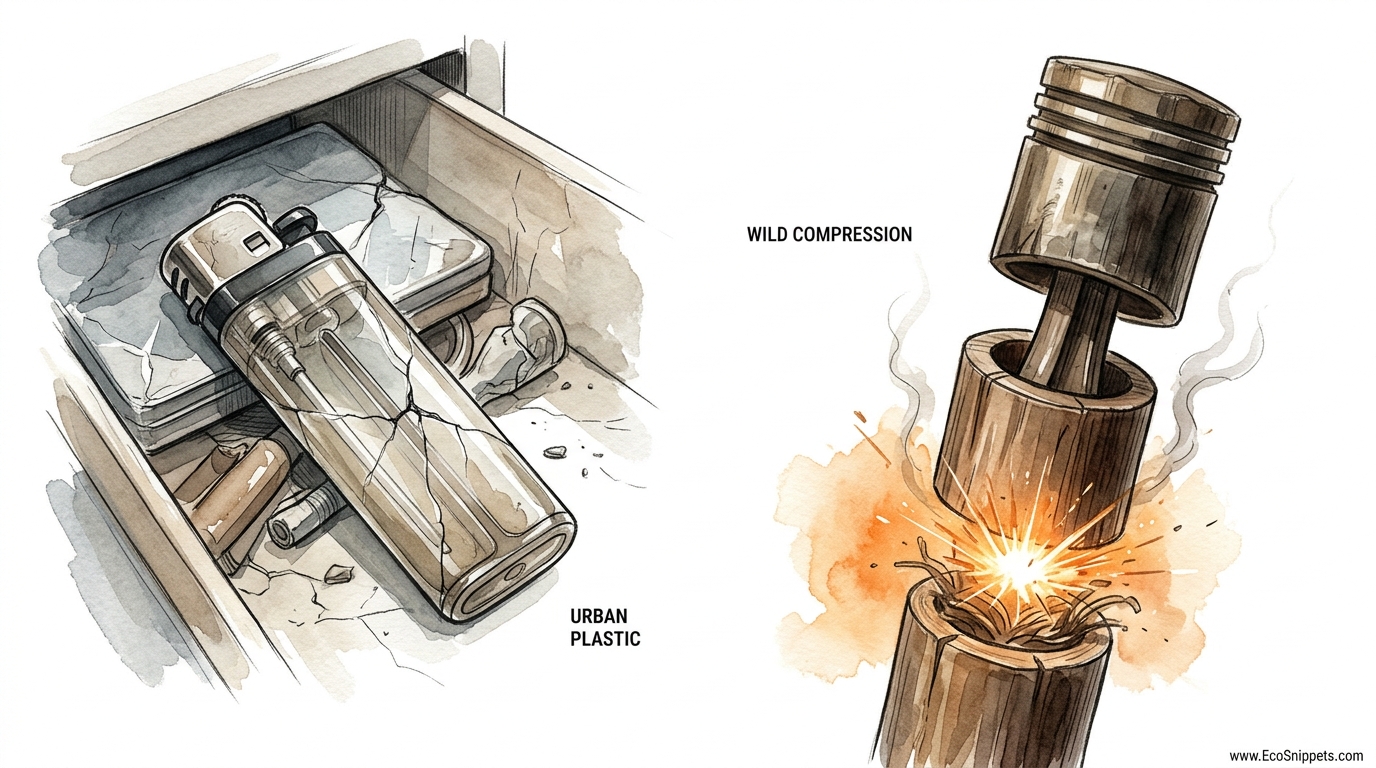
This hand-held tool uses the same physics as a diesel engine to create fire out of thin air. In the urban world, we rely on pressurized butane and plastic gears. In the wild, the ancients discovered that rapid air compression creates a flash of 500-degree heat. The fire piston is a masterpiece of physics—slam the plunger, and the air molecules move so fast they ignite the tinder. No fuel, no flint, no failure.
Mastering this tool is a rite of passage for any serious woodsman. It is one of the few fire-starting methods that feels like magic even when you understand the science behind it. While a lighter might run out of fuel or a ferrocerium rod might wear down over thousands of strikes, the fire piston relies on the very atmosphere around you. It is a closed system of pure mechanical advantage.
In the sections below, we will explore the mechanics of adiabatic compression, the history of this Southeast Asian marvel, and how you can build or maintain your own. Whether you are looking for a reliable backup for your bug-out bag or you simply want to connect with a more mechanical form of self-reliance, the fire piston offers a level of satisfaction that modern plastic gadgets cannot match.
How To Start A Fire Using Air Compression
The fire piston works through a process known as adiabatic compression. This is a fancy way of saying that when you squeeze a gas very quickly, it gets hot. Because the compression happens in a fraction of a second, the heat has no time to dissipate into the walls of the cylinder. Instead, the energy is concentrated entirely into the air molecules, causing their temperature to spike instantly.
In a standard fire piston, you are compressing the air to about 1/20th or 1/25th of its original volume. This rapid reduction in space forces the molecules to collide with such frequency and intensity that the temperature inside the chamber flashes to over 500 degrees Fahrenheit (approximately 260 degrees Celsius). In high-performance models, these temperatures can even reach 800 degrees Fahrenheit (425 degrees Celsius).
This is the exact same principle that allows a diesel engine to function without spark plugs. In a diesel engine, the piston compresses the air-fuel mixture until it reaches its auto-ignition temperature. The fire piston does the same, using a small piece of charred material as the “fuel” that catches the flash. It is a beautifully simple application of thermodynamics that predates modern internal combustion engines by centuries.
The Mechanics of the Perfect Strike
Operating a fire piston is less about brute force and more about explosive speed. You are not trying to push the piston down; you are trying to slam it. A slow push allows the heat to bleed off into the cylinder walls, leaving your tinder cold and charred but not ignited.
To begin, you must ensure your seal is airtight. Most modern fire pistons use a rubber O-ring, while traditional versions used a wrapping of lubricated thread or leather. If you can pull the piston out and hear a distinct “pop,” or if the piston bounces back like a spring when pushed against a sealed end, your compression is good.
Once you have confirmed the seal, place a small piece of char cloth or tinder fungus into the “tinder well” at the end of the rod. Insert the rod just far enough to engage the seal, then place the cylinder on a hard, stable surface like a flat rock or a fallen log. Strike the top of the handle with a sharp, palm-down blow. Immediately after the strike, pull the piston back out. This “pull-back” is vital because it introduces oxygen to the newly born ember, preventing it from suffocating in the carbon dioxide created by the flash.
The Anatomy of a Fire Piston
A fire piston consists of two primary components: the cylinder and the piston rod. While they look simple, the tolerances required for them to work are remarkably tight.
The cylinder, also called the barrel, must have a perfectly smooth internal bore. Any scratches or “chatter marks” from a drill bit will allow air to escape, ruining the compression. In the ancient world, these were crafted from dense hardwoods, bamboo, or even animal horn. Today, we often use aircraft-grade aluminum, brass, or thick-walled copper pipe for their durability and heat-sinking properties.
The piston rod is the plunger that fits inside the cylinder. It features a handle on one end—shaped to fit comfortably in the palm—and a small cavity on the other. This cavity, or tinder well, holds your char cloth. Near the tip of the rod is a groove for the gasket. Whether it is a modern O-ring or a traditional thread wrap, this gasket is the heart of the tool. It must be lubricated with a tiny amount of silicone grease or petroleum jelly to ensure it slides freely while maintaining a vacuum-tight seal.
Benefits of Adding a Fire Piston to Your Kit
The most significant advantage of a fire piston is its sustainability. Unlike a lighter, it has no fuel to leak or evaporate. Unlike matches, it is not a “one-and-done” resource. As long as you have a way to make char cloth—which you can do using the remains of your last fire—you have an infinite source of ignition.
Reliability in wet conditions is another major factor. While you must keep your tinder dry, the fire piston itself is essentially waterproof. If you drop it in a river, you can simply wipe it dry, re-lubricate the O-ring, and it will function perfectly. The ignition happens in a sealed environment, protected from wind and rain.
Furthermore, the fire piston requires very little physical exertion compared to friction fire methods like the bow drill or hand drill. While a bow drill might take minutes of heavy cardio and perfect technique to produce an ember, a fire piston produces one in a single second. It is a low-energy solution for high-stress survival situations where conserving calories is a priority.
Challenges and Common Mistakes
The most frequent reason a fire piston fails is a lack of speed during the strike. Beginners often try to “push” the tool, but the air must be compressed faster than the heat can escape. Think of it as a “slap” rather than a “press.” If you find yourself pushing the piston and feeling it resist without a flash, you are likely moving too slowly.
Another common pitfall is over-lubrication. While the O-ring needs to be slick, too much grease can clog the tinder well or contaminate the char cloth. If your tinder gets oily, it will not ignite, no matter how hot the air gets. Use just enough lubricant to make the O-ring look “wet,” and keep the tinder well itself bone-dry.
Finally, many users forget to pull the piston out immediately. The combustion inside the chamber consumes the available oxygen instantly. If you leave the piston seated at the bottom of the cylinder for even a second too long, the ember will die before you ever see it. The motion should be one fluid “hit and pull” sequence.
Limitations and Environmental Constraints
Despite its brilliance, the fire piston is not a universal solution. Its biggest limitation is its reliance on specialized tinder. While some experts can ignite natural materials like milkweed floss or certain fungi, most users will struggle without char cloth or Chaga. This means you must have the foresight to prepare your tinder in advance.
Temperature and altitude can also play a role. In extremely cold environments, the metal of the cylinder can act as a massive heat sink, sucking the thermal energy away before it can ignite the tinder. You may need to warm the tool in your pocket or perform several “dry strikes” (without tinder) to warm the internal air and the cylinder walls before attempting a real light.
At very high altitudes, the air is thinner, meaning there are fewer molecules to compress. While the fire piston will still work, it requires more force and a faster strike to achieve the same temperature spike. This is a situation where a ferrocerium rod or a specialized high-altitude lighter might be a more practical primary tool, keeping the fire piston as a secondary backup.
Comparing Fire Starting Methods
To understand where the fire piston fits in your gear loadout, it helps to compare it to other common tools. The table below breaks down the key differences.
| Feature | Fire Piston | Ferrocerium Rod | Flint and Steel |
|---|---|---|---|
| Mechanism | Air Compression | Pyrophoric Sparks | Shaved Steel Fragments |
| Skill Level | Medium | Low | High |
| Lifespan | Infinite (with lube) | Limited (strikes) | Very High |
| Wet Reliability | Excellent | Excellent | Moderate |
Practical Tips and Best Practices
If you are struggling to get a light, start by checking your compression. A simple way to do this is to remove the tinder, lubricate the O-ring, and push the piston in. It should spring back forcefully. If it stays down or moves sluggishly, your seal is leaking. Check the O-ring for nicks or debris and clean the inside of the cylinder with a soft cloth.
Always use the smallest piece of char cloth possible. A piece the size of a pencil eraser is usually more than enough. If you pack the tinder well too tightly, air cannot circulate around the fibers, and the heat will only char the surface rather than igniting the core. A “fluffy” piece of char cloth provides more surface area for the flash to catch.
When transferring the ember to your tinder bundle, do not rush. The ember in the char cloth is much more durable than a spark from flint and steel. You have several seconds to carefully place it into your bird’s nest. Once it is tucked in, blow with long, steady breaths. If you blow too hard too fast, you risk blowing the ember out or breaking the char cloth into useless pieces.
Advanced Considerations for the Woodsman
For those who want to take their fire piston skills to the next level, experiment with natural tinders. The “True Tinder Fungus” (Fomes fomentarius), also known as Amadou or Horse Hoof Fungus, is the traditional choice for fire pistons. You want the velvety inner layer, which must be dried completely. Some practitioners even boil it in wood ash lye to increase its “fluffiness” and lower its ignition point.
Another advanced technique is the “one-handed strike.” This is done by holding the cylinder against your thigh and using your dominant hand to slam the piston. This is useful if you are injured or need to maintain control over a tinder bundle with your other hand. It requires a high-quality, well-lubricated piston to execute safely and effectively.
Consider the material of your piston’s O-ring. While standard nitrile rings work well, Viton O-rings offer much higher heat resistance and chemical durability. If you are building your own or looking to upgrade a commercial model, switching to Viton can significantly extend the time between maintenance cycles and improve the consistency of your strikes in high-heat scenarios.
Example Scenario: The Wet Woods Fire
Imagine you are deep in the backcountry and a sudden downpour has soaked everything. Your matches are damp, and your lighter’s flint is acting up. You pull your fire piston from its dry pouch. Even though the air is humid, the char cloth inside your tinder kit is still dry.
You apply a fresh dab of silicone grease to the piston. You load a small piece of char cloth and brace the cylinder against a dry spot on the underside of a leaning cedar. One sharp strike, and you pull back the rod to find a tiny, glowing red eye looking back at you.
You transfer that ember into a bird’s nest of cedar bark that you’ve kept dry inside your jacket. With a few steady breaths, the smoke turns from white to gray to thick yellow, and then—flame. In a situation where other tools failed, the mechanical certainty of compression saved the day.
Final Thoughts
The fire piston is more than just a tool; it is a bridge to a time when human ingenuity was the only thing standing between a cold night and a warm hearth. It reminds us that the laws of physics are the most reliable gear we carry. While we may live in a world of urban plastic and digital shortcuts, there is profound value in mastering a device that requires nothing but air and a well-timed strike.
By understanding the relationship between pressure, volume, and temperature, you gain a level of self-reliance that transcends brand names and retail price tags. Whether you buy a precision-machined brass model or craft one from a piece of copper pipe and a wooden dowel, the result is the same: a flash of heat that connects you to the ancient traditions of the Pacific Islands and the industrial breakthroughs of Europe.
Keep your seals clean, your tinder dry, and your strikes fast. The fire piston is a lifetime tool that will never let you down as long as you respect the physics that power it. Practice in the backyard until the motion is muscle memory, and then carry it with the confidence that you can create fire out of the very air you breathe.
