How To Become More Self-Sufficient Without Starting a Full-Blown Farm…
Want to start preserving your harvest, making your own soap, or building a backyard root cellar — but not sure where to begin? “Homesteading Advice” gives you instant lifetime access to 35+ practical homesteading books on food preservation, veggie gardening, DIY natural cleaning products (save over $250 per year with this skill alone), brewing, off-grid energy, and a whole lot more…
Click Here To Check It Out Now!
What if your solar panels followed the sun like a sunflower, using nothing but the heat of the light itself? Electronic trackers fail. Motors burn out. Sensors get confused. But the laws of thermal expansion are forever. Discover how bimetallic strips can boost your energy harvest by 40% using the sun’s own heat to steer your panels.
Imagine a technology so simple it requires no circuit boards, no batteries, and no complex lines of code. You are looking at the marriage of metallurgy and geometry, a solution born from the same principles that kept 18th-century maritime clocks accurate across the oceans. Instead of forcing a panel to move with expensive electricity, we can let the sun’s own radiance provide the mechanical force needed to turn the array. This is the essence of self-reliance: using the environment to master the environment.
The transition from a fixed system to a tracking one is often viewed through the lens of high-tech sensors. However, for those living off the grid or seeking true energy independence, the most reliable systems are those you can fix with a wrench, not a laptop. Understanding how to harness the physical expansion of metals allows you to squeeze every possible watt out of your solar investment without adding a single point of electronic failure.
Passive Solar Tracking Without Electronics
Passive solar tracking is a method of orienting photovoltaic panels toward the sun using only natural physical phenomena, such as thermal expansion or fluid pressure. Unlike active trackers that use light-dependent resistors (LDRs) and electric motors, passive systems are “powered” by the temperature differential created by sunlight. They exist as a testament to elegant engineering, where the problem (heat) becomes the solution (movement).
In the real world, you might see these systems on remote weather stations, high-altitude water pumping stations, or resilient off-grid homesteads. They are particularly favored in environments where maintenance is difficult or where electronic components would succumb to extreme temperatures and humidity. A passive tracker doesn’t “know” where the sun is in a digital sense; it simply reacts to the sun’s energy until it reaches a state of thermal equilibrium.
One common analogy is the thermostat in an old home. Inside that dial, a coiled strip of metal expands and contracts to tilt a mercury switch. A bimetallic solar tracker operates on the same logic but at a much larger scale. It turns the entire mounting structure into a giant, heat-sensitive spring that unwinds as the morning sun hits it, pulling the panels into the light.
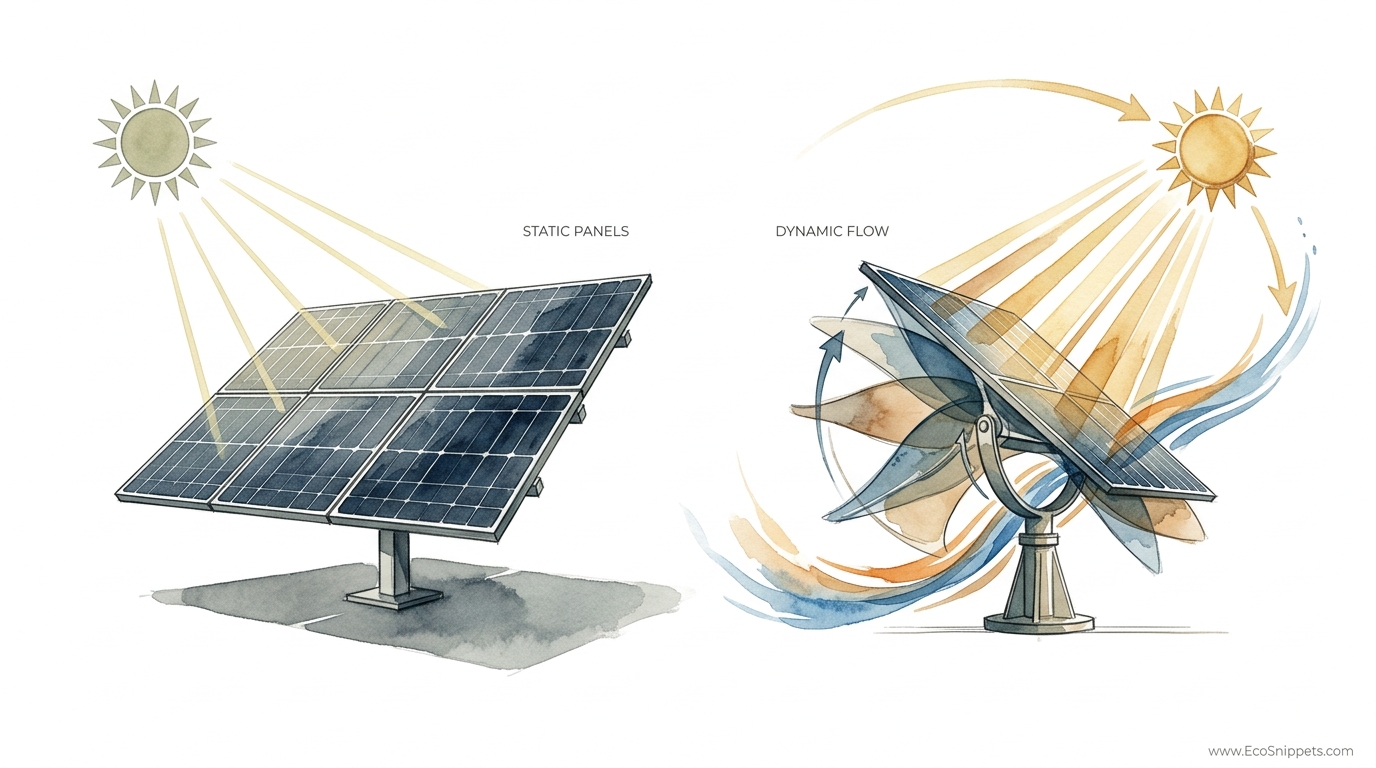
This technology represents a shift from the rigid mindset of STATIC PANELS to the efficient philosophy of DYNAMIC FLOW. While static panels sit idle for most of the day, missing the peak intensity of the morning and evening sun, a passive tracker is always working to maintain a perpendicular relationship with the light.
How It Works: The Magic of Thermal Expansion
The heart of this system is the bimetallic strip, a component made by bonding two different metals together along their entire length. Every metal has a specific “Coefficient of Thermal Expansion” (CTE), which is a measure of how much it grows when heated. By choosing two metals with vastly different expansion rates—typically brass and an iron-nickel alloy called Invar—we create a material that must bend when the temperature changes.
When sunlight hits the bimetallic actuator, the brass side wants to grow significantly, while the Invar side remains nearly the same length. Because they are fused together, the strip is forced to curve toward the Invar side. This mechanical displacement is then amplified through a series of levers or gears to rotate the solar array. It is a direct conversion of thermal energy into mechanical work.
To make the system “track,” designers often use a shading mechanism. Two bimetallic actuators are placed on either side of a central shadow plate. If the panel is not facing the sun directly, one actuator is shaded while the other is exposed to full light. The exposed side heats up, expands, and pushes the panel until both sides are equally shaded, which happens only when the panel is perfectly aligned with the sun.
This process happens slowly and smoothly throughout the day. It requires no sudden jerks of a motor and produces no electrical noise. In some advanced designs, bimetallic coils are used instead of flat strips. These coils act like a thermal spring, providing a rotational force (torque) that can turn a single-axis array from east to west as the ambient temperature and direct solar radiation fluctuate.
The Practical Benefits of Going Passive
Choosing a bimetallic tracking system offers a measurable boost in energy production, often cited at up to 40% for dual-axis configurations and 20% to 30% for single-axis setups. This “harvest boost” occurs because the panels capture the sun’s rays at a 90-degree angle for a much longer portion of the day. In the early morning and late afternoon, when a fixed panel is essentially useless, a tracker is already facing the horizon, pulling in significant power.
Reliability is the primary reason serious practitioners choose this over electronic alternatives. Electronics are vulnerable to lightning strikes, power surges, and the inevitable decay of capacitors and sensors. A bimetallic strip has no “mind” to lose; it will react to heat exactly the same way in fifty years as it does today. This longevity makes the long-term Return on Investment (ROI) much more attractive for permanent installations.
Maintenance is significantly reduced in these systems. Since there are no brushes to replace in a motor and no firmware to update, the only real upkeep involves occasional lubrication of the pivot bearings and cleaning the reflectors or shadow plates. For someone living 50 miles (80 km) from the nearest hardware store, a system that doesn’t need spare parts is worth its weight in gold.
Challenges and Common Pitfalls
Designing a system that moves a 100-pound (45 kg) solar array using only the force of expanding metal is not without its difficulties. The most common mistake is failing to account for the “Center of Gravity” (CoG). For a passive tracker to work, the array must be perfectly balanced on its axis. If the panels are top-heavy, the bimetallic strip won’t have enough torque to overcome the weight, and the system will stall.
Friction is another silent enemy of passive tracking. Because the forces generated by thermal expansion are relatively small, even a slight amount of rust or grit in the bearings can prevent the tracker from moving. Many beginners use standard ball bearings which eventually seize; experienced builders often prefer high-quality sleeve bearings or bushings made of self-lubricating materials like bronze or PTFE.
The “Morning Reset” is perhaps the most famous challenge in the world of passive tracking. At sunset, the tracker is facing west. For it to work the next day, it must return to the east overnight. In bimetallic systems, this usually relies on the cool night air to contract the metal, but if the night is particularly warm, the reset might be sluggish. Some designs use a small counterweight or a “return fin” that catches the very first rays of the morning sun to jump-start the movement.
Limitations: When This May Not Be Ideal
Passive trackers are essentially giant weather vanes. In areas prone to high winds or frequent storms, a tracking array acts like a sail. Without the rigid hold of a heavy-duty electric actuator, a passive system can be “blown off course” or even damaged by the wind. If you live in a hurricane-prone region or a high-desert wind corridor, the structural requirements to keep the tracker stable often outweigh the energy gains.
Environmental temperature extremes can also limit performance. In extremely cold climates, where temperatures drop below -10°F (-23°C), the metal may become less responsive, or the grease in the bearings may thicken so much that the system freezes in place. Conversely, in tropical environments where the ambient temperature is always high, the differential between “hot” and “shaded” is smaller, reducing the tracking accuracy.
Scale is a final constraint. While it is relatively easy to build a bimetallic tracker for a single 300-watt panel, the physics become exponentially harder as you add more weight. Large utility-scale arrays almost always use active tracking because the sheer mass of the panels requires high-torque motors that bimetallic strips simply cannot provide without becoming prohibitively large.
Comparing Static vs. Dynamic Approaches
| Feature | Static Fixed Array | Passive Bimetallic Tracker | Active Electronic Tracker |
|---|---|---|---|
| Energy Gain | Baseline (0%) | 20% – 40% | 25% – 45% |
| Maintenance | Virtually zero | Low (Lubrication) | High (Electronics/Motors) |
| Complexity | Very Low | Medium (Mechanical) | Very High (Electronic) |
| Power Source | None | Solar Heat (Free) | Stored Electricity |
| Failure Points | Structural only | Mechanical friction | Sensors, Motors, Logic |
This comparison highlights why the passive approach is often the “sweet spot” for self-reliant energy. You gain nearly the same efficiency as a high-tech active system but with a maintenance profile that is closer to a static mount. It is the ultimate expression of DYNAMIC FLOW, allowing your energy system to breathe and move with the day.
Practical Tips for Implementation
Building or installing a bimetallic tracker requires a focus on mechanical precision. If you are constructing your own, ensure that the metals you choose for the strip have a wide gap in their expansion coefficients. A common DIY combination is brass and steel, but using Invar (a nickel-iron alloy) in place of steel will significantly increase the bending force and accuracy.
Always include a manual “Stow Mode.” In the event of a predicted storm or high winds, you should be able to lock the tracker in a horizontal position using a simple pin or latch. This prevents the “sail effect” from destroying your structure. Adding a small shock absorber or viscous damper—similar to the ones used on screen doors—can help prevent the array from fluttering in light breezes.
Optimization often comes down to “Tuning” the shadow plates. These are the aluminum fins that determine when the bimetallic strips are in the sun or shade. By adjusting the angle of these plates, you can make the tracker more or less sensitive. A tighter angle results in more accurate tracking but may cause the system to “hunt” back and forth, while a wider angle is more stable but less efficient.
Advanced Considerations for Serious Practitioners
For those looking to scale this technology, the concept of “Modular Arrays” is vital. Instead of trying to build one massive tracker for six panels, it is often better to build three smaller trackers for two panels each. This distributes the mechanical load and ensures that if one mechanical pivot fails, the rest of the system continues to operate.
Seasonal adjustments are another layer of optimization. While a single-axis tracker follows the sun from east to west, the sun’s path also moves north to south throughout the year. Incorporating a manual tilt adjustment for the main axis allows you to “set and forget” the system for each season. You might tilt it at 20 degrees in the summer and 50 degrees in the winter to account for the sun’s lower position in the sky.
Advanced metallurgy can further refine the actuator’s response. Some practitioners experiment with “Shape Memory Alloys” (SMAs) like Nitinol, which can undergo much larger deformations than standard bimetallic strips. While more expensive, these materials can provide the torque necessary for heavier arrays, bridging the gap between passive simplicity and high-performance needs.
Real-World Scenario: The Remote Water Pump
Consider a rancher in the high plains who needs to pump water for livestock. The nearest power line is miles away, and the wind is constant. An active solar tracker with sensors would likely fail within a year due to dust and lightning. A fixed array, however, wouldn’t provide enough power in the morning to start the heavy pump motor.
By installing a passive tracker using bimetallic coils and a rugged steel frame, the rancher ensures the panels are facing the sunrise. As the sun hits the actuator, the metal warms and the array rotates. By 8:00 AM, the panels are generating 90% of their rated capacity, starting the pump two hours earlier than a fixed system would.
The system uses a viscous damper to prevent wind damage and a simple mechanical stop to prevent over-rotation. Even during a mid-summer heatwave, the tracker maintains its alignment because it reacts to the relative heat differential between the east and west canisters, not just the ambient air. The result is a reliable, automated water supply that requires a visit only once a year for a few drops of oil.
Final Thoughts
Embracing passive solar tracking is more than just a technical choice; it is an endorsement of a specific way of living. It favors the permanent over the temporary and the mechanical over the electronic. By using bimetallic strips to guide your solar panels, you are tapping into a lineage of engineering that values resilience and self-correction above all else.
The 40% boost in energy is a powerful incentive, but the true reward is the peace of mind that comes from a silent, moving system that requires no intervention. It serves as a reminder that we don’t always need more “smart” devices; sometimes, we just need smarter materials. Whether you are building a small-scale prototype or a full off-grid power plant, the laws of thermal expansion are a partner you can trust.
Experiment with these principles. Start by building a small bimetallic coil and watching it respond to a desk lamp. Once you see the raw power of expanding metal in your own hands, you’ll never look at a static solar panel the same way again. The sun provides the energy; let it also provide the direction.
