How To Become More Self-Sufficient Without Starting a Full-Blown Farm…
Want to start preserving your harvest, making your own soap, or building a backyard root cellar — but not sure where to begin? “Homesteading Advice” gives you instant lifetime access to 35+ practical homesteading books on food preservation, veggie gardening, DIY natural cleaning products (save over $250 per year with this skill alone), brewing, off-grid energy, and a whole lot more…
Click Here To Check It Out Now!
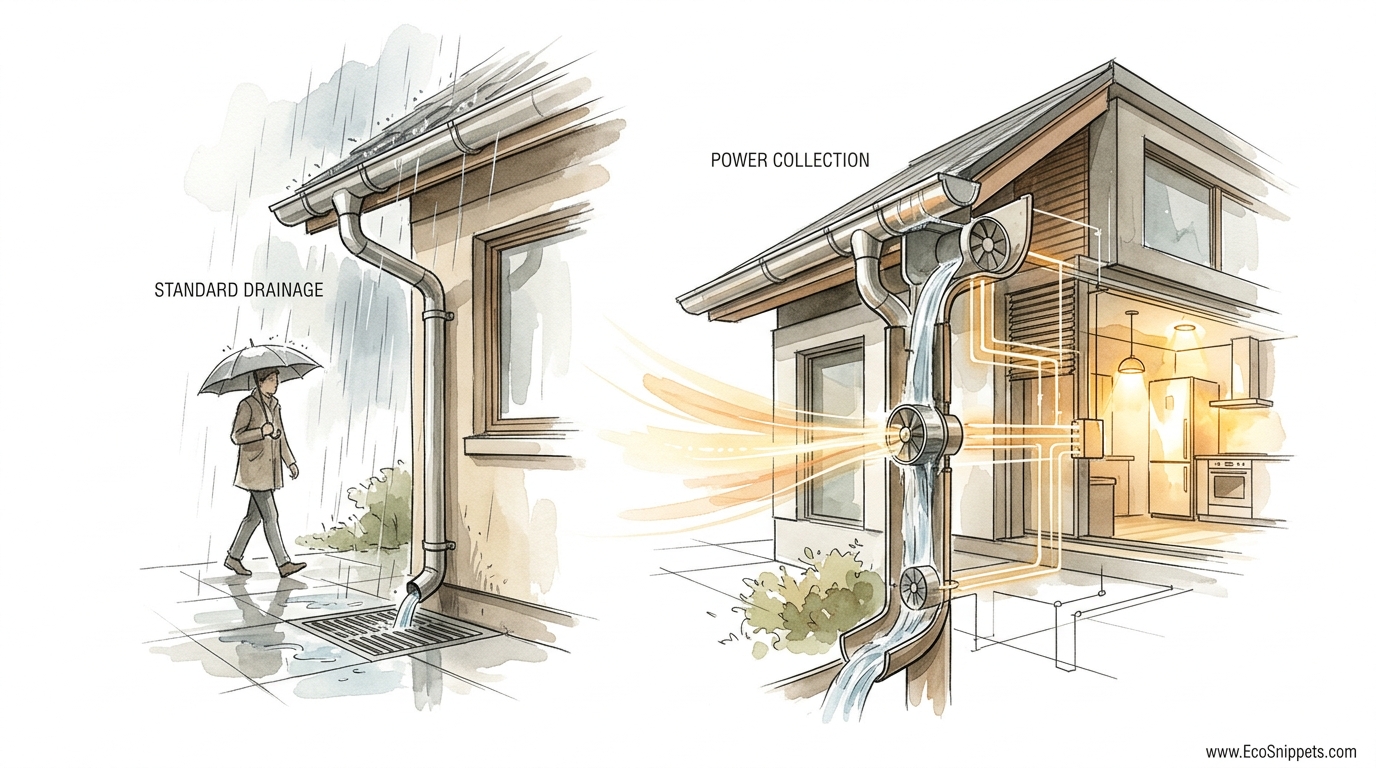
Your gutters are currently just moving water; here is how to make them move your electric meter too. On a rainy homestead, the roof is a massive energy collector. We swapped our single-use drainage pipes for a micro-hydro drop system. Now, every autumn storm doesn’t just fill our tanks—it tops off our batteries while we sleep.
Rainfall is often viewed merely as a burden to be diverted or a resource for the garden. However, if you look at your roof as a raised platform of potential energy, you see a power plant waiting to be tapped. The concept of micro-hydro energy harvesting from downspouts is a return to fundamental self-reliance. It utilizes the same physics that powered the grain mills of our ancestors, just scaled down to fit the modern home.
Whether you live in a region with consistent drizzle or heavy tropical downpours, the mechanics of gravity remain constant. Moving water has mass, and falling mass creates force. Capturing that force requires a shift in mindset from simple drainage to active power collection. This guide will walk you through the transition from being a passive observer of the weather to an active harvester of its power.
Generate Electricity From Rain Gutters
Generating electricity from rain gutters is the practice of installing a micro-hydroelectric system within the vertical downspouts of a building to capture the kinetic energy of falling rainwater. This system transforms the vertical drop (the “head”) and the volume of water (the “flow”) into rotational energy using a small turbine, which then drives a generator to produce a direct current (DC) charge.
In the real world, this technology is a subset of micro-hydropower, typically designed for “ultra-low head” applications. While a massive dam relies on hundreds of meters of drop, a two-story home offers a modest 6 to 9 meters (20 to 30 feet) of potential energy. This is sufficient to trickle-charge battery banks, power outdoor LED lighting, or maintain remote sensors without relying on the grid.
Think of your roof as a giant funnel. A typical 1,000-square-foot (93-square-meter) roof can shed hundreds of gallons (thousands of liters) of water during a single inch (2.5 cm) of rainfall. Instead of letting that water crash into the soil or a storm drain, we channel it through a narrow aperture to strike the blades of a turbine. It is a quiet, rhythmic process that turns a stormy night into a productive one.
How It Works: The Physics and the Hardware
The transition from falling rain to flowing current happens in four distinct stages: collection, conveyance, conversion, and storage. Understanding each stage is vital for building a system that doesn’t just look good but actually performs when the clouds break.
The Collection and Conveyance Phase
The journey starts at the roof. The surface area of your roof determines your “catchment” potential. A larger roof collects more water per minute, which translates to a higher flow rate (Q). To maximize this, all gutters must be clean and pitched toward a single high-capacity downspout.
Once the water enters the downspout, it becomes a “penstock”—a pressurized pipe. In traditional hydro systems, the penstock is where the water gains velocity. For a rain gutter system, we often replace the standard rectangular downspout with 3-inch or 4-inch (75mm or 100mm) PVC pipe. This circular profile reduces friction and allows the water to form a solid column, increasing the pressure at the bottom.
The Conversion Phase: The Turbine
At the base of the downspout, the water reaches the “nozzle.” This is a tapered section that accelerates the water into a high-speed jet. This jet strikes the turbine. For residential rain gutters, two types of impulse turbines are common:
- Pelton Wheels: These feature split buckets that catch the water and flip it 180 degrees. They are incredibly efficient for high-head (tall building) and low-flow situations.
- Turgo Turbines: These strike the blades at an angle and allow the water to exit the other side. They can handle higher volumes of water than a Pelton wheel of the same size, making them ideal for shorter buildings with high-intensity rainfall.
The Electrical Phase: The Generator
The turbine is coupled to a permanent magnet DC motor or a specialized hydro-alternator. As the turbine spins, the magnets rotate around copper coils, inducing an electrical current. Because the speed of the turbine varies with the intensity of the rain, the voltage produced is inconsistent.
To make this energy useful, the raw output passes through a bridge rectifier (to ensure the current flows in one direction) and a charge controller. The charge controller regulates the voltage to safely feed a 12V or 24V battery bank. From there, the energy is stored for later use, much like water in a cistern.
Benefits of Rainwater Power
The primary advantage of this approach is the diversification of your energy portfolio. Most homesteaders rely heavily on solar power, which is notoriously absent during the very rainstorms that this system craves. Rain gutter hydro provides a “counter-cyclical” energy source that fills the gaps left by sun-dependent systems.
Consistent maintenance is the hidden benefit. Because you are now relying on your gutters for power, you are far more likely to keep them clear of debris. This prevents the rot, foundation damage, and basement flooding that occurs when traditional gutters fail. You are essentially being paid in kilowatt-hours to be a better steward of your home’s infrastructure.
There is also the matter of resilience. In a long-term grid-down scenario, having multiple independent ways to generate power is essential. A rain gutter system is mechanically simple and can be repaired with basic tools and spare parts. It doesn’t require complex electronics or rare-earth components to function at a basic level, making it a true survivalist technology.
Challenges and Common Pitfalls
The most frequent mistake beginners make is overestimating the power density of rainwater. While water is heavy, a single downspout on a single-story home rarely produces more than 10 to 50 watts of continuous power during a storm. This is a “trickle” technology, not a replacement for a main power line.
Debris management is the second major challenge. Roofs are dirty places. Leaves, twigs, bird droppings, and asphalt shingle granules will quickly clog a small hydro turbine. Without a robust, multi-stage filtration system—starting at the gutter and ending with a fine mesh screen before the nozzle—the system will seize within the first hour of a heavy storm.
Mechanical friction also kills efficiency. Using cheap bearings or misaligning the turbine shaft can eat up 50% of your potential power. Every point where the water changes direction or the shaft meets a seal is a point of energy loss. Serious practitioners use high-quality stainless steel bearings and precision-balanced turbines to ensure the smallest drizzle can still overcome the “start-up torque” of the generator.
Limitations and Environmental Constraints
Geography dictates the success of this system more than any other factor. If you live in an arid climate where it only rains three times a year, the return on investment for a gutter-hydro system is virtually zero. This technology is designed for the Pacific Northwest, the tropical belt, or the soggy highlands where “gray days” are the norm.
Height is the other non-negotiable limit. Potential energy is a product of mass, gravity, and height ($PE = mgh$). A single-story bungalow with a 3-meter (10-foot) drop has exactly half the potential energy of a two-story home with a 6-meter (20-foot) drop, assuming the same amount of rain. If your roof is low, you must compensate with a massive catchment area to increase the flow rate.
Seasonal freezing presents a significant boundary. In northern latitudes, water turns to ice, and ice expands. A micro-hydro system left active in sub-zero temperatures will crack its PVC housing and destroy the turbine. These systems must be designed for easy “winterization,” allowing the homeowner to bypass the turbine and revert to standard drainage during the coldest months.
Comparing Turbine Types
Choosing the right turbine is the difference between a spinning generator and a stalled one. The following table compares the two most common designs for residential gutter systems.
| Feature | Pelton Wheel | Turgo Turbine |
|---|---|---|
| Ideal Head | High (2+ stories / 6m+) | Medium (1-2 stories / 3-6m) |
| Flow Requirement | Low to Moderate | Moderate to High |
| Efficiency | Up to 90% in ideal jets | 80-85% but more versatile |
| Complexity | Simple; easy to 3D print | Moderate; blade angles are critical |
| Clog Resistance | Low (narrow nozzles) | Medium (larger openings) |
Practical Tips for Efficiency
To get the most out of your setup, focus on the “nozzle velocity.” The power produced is proportional to the square of the water’s velocity. Use a smooth, tapered nozzle rather than a simple pipe reduction. A 3D-printed nozzle with a parabolic interior curve will minimize turbulence and maximize the force of the jet hitting the turbine.
Install a “vortex breaker” at the top of your downspout. When water enters a pipe, it naturally wants to swirl, which traps air in the center. This air reduces the effective mass of the water column. A simple cross-shaped baffle at the intake prevents the swirl, ensuring a “solid” column of water falls down the pipe, which maximizes the pressure at the turbine.
Consider the wiring. Since most of these systems produce low-voltage DC, “line loss” is a major enemy. If your battery bank is 50 feet (15 meters) away from the turbine, use heavy-gauge copper wire to prevent the electricity from bleeding off as heat before it reaches the charger. If the distance is significant, it may be more efficient to use a step-up transformer and transmit the power at a higher voltage.
Advanced Considerations: The Buffer Tank
For those who want to move beyond “real-time” rain harvesting, the addition of a header tank (or buffer tank) is a game-changer. Instead of the water going straight from the gutter to the turbine, it first fills a large barrel or tank situated at the highest point possible.
This buffer tank acts like a battery for water. When the tank is full, you open a valve and release the water through the turbine at a controlled, optimal flow rate. This allows you to generate a steady 100 watts for an hour rather than a flickering 5 watts for twenty hours. It also allows the sediment to settle at the bottom of the tank, providing much cleaner water to the delicate turbine blades.
Automating this with a float switch and an electric solenoid valve can turn your system into a “pulsed” power plant. The system waits until it has enough “fuel” (water) to run at peak efficiency, then engages the generator until the tank is empty. This prevents the wear and tear associated with running a turbine at sub-optimal speeds during a light mist.
Scenario: A Two-Story Homestead Example
Let’s look at the math for a standard setup. Imagine a two-story house with a roof catchment area of 1,000 square feet (93 square meters) and a total drop of 20 feet (6 meters). During a heavy storm, it rains at a rate of 1 inch (25mm) per hour.
First, we calculate the flow rate. One inch of rain on 1,000 square feet equals roughly 623 gallons (2,358 liters) of water per hour, or about 10.4 gallons (39 liters) per minute. In metric, that is roughly 0.65 liters per second.
Using the standard hydro formula ($Watts = Head \times Flow \times Efficiency / Constant$), and assuming a 50% overall system efficiency:
- Head: 6 meters (20 feet)
- Flow: 0.65 liters/second
- Gravity: 9.81 m/s²
The calculation $(6 \times 0.65 \times 9.81 \times 0.5)$ gives us approximately 19 watts of continuous power. While 19 watts won’t run a microwave, if it rains for 10 hours, you’ve harvested 190 watt-hours. That is enough to charge a modern smartphone 15 times or run a 5-watt LED security light for nearly 40 hours.
Final Thoughts
Building a rain gutter power system is an exercise in ancestral wisdom applied to modern needs. It teaches the homeowner to respect the power of the elements and to find value in what others ignore. While it may not take you entirely off the grid, it provides a crucial layer of energy security and a deep satisfaction that comes from watching the storm and knowing your batteries are filling.
The key to success lies in the details—the curve of the turbine blade, the cleanliness of the filter, and the height of the drop. Start small with a single downspout and a basic DC motor. As you learn the rhythms of your local weather, you can scale up, add buffer tanks, and refine your nozzles.
Every drop of rain that leaves your roof is a lost opportunity. By installing a micro-hydro drop system, you are reclaiming that energy and turning a rainy day into a source of light. It is a quiet, persistent form of rebellion against a world that tells us we must always be consumers. On your homestead, even the rain works for you.
