How To Become More Self-Sufficient Without Starting a Full-Blown Farm…
Want to start preserving your harvest, making your own soap, or building a backyard root cellar — but not sure where to begin? “Homesteading Advice” gives you instant lifetime access to 35+ practical homesteading books on food preservation, veggie gardening, DIY natural cleaning products (save over $250 per year with this skill alone), brewing, off-grid energy, and a whole lot more…
Click Here To Check It Out Now!
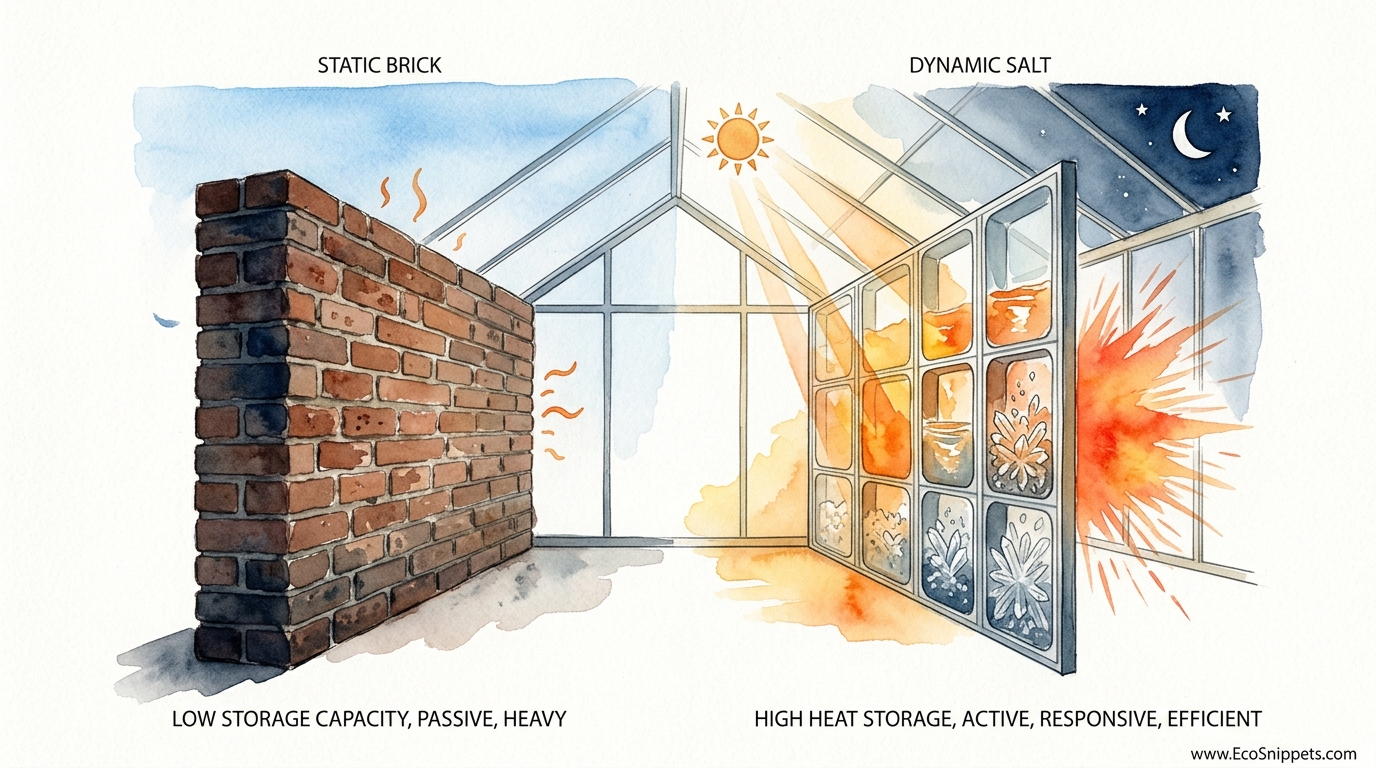
What if your thermal mass could ‘recharge’ like a battery without the bulk of a thousand bricks? Static mass like brick or stone is limited by weight. Dynamic phase-change materials (PCM) can store massive amounts of energy in a tiny footprint. When the sun hits them, they melt and store latent heat—releasing it precisely when your greenhouse starts to freeze.
The old ways of the homestead—stacking stone and hauling water—served us well for generations. But as our understanding of physics deepens, we find ways to pack the heat of an entire masonry wall into a few slim panels or tubes. This transition from static to dynamic thermal mass is not just a technological upgrade; it is a more efficient way to harness the natural cycles of the sun.
Mastering your greenhouse climate requires more than just a heater and a fan. It requires a system that works with the rhythms of the day, absorbing the surplus of the afternoon and surrendering it to the chill of the night. This guide will walk you through the science, the materials, and the practical steps to implement dynamic thermal mass in your own growing space.
Dynamic Thermal Mass For Greenhouses
Dynamic thermal mass refers to a class of materials that do more than just get warm when the sun shines on them. Unlike a standard brick which simply stores sensible heat as its temperature rises, dynamic materials—specifically Phase Change Materials (PCM)—store energy through a physical transition from solid to liquid. This is the same principle that makes an ice cube so effective at cooling a drink; it absorbs a staggering amount of energy just to melt, all while staying at a constant temperature.
In the context of a greenhouse, these materials act as a thermal buffer. They are often engineered to ‘melt’ at temperatures ideal for plant growth, such as 21°C to 25°C (70°F to 77°F). During a sunny day, as the greenhouse air begins to overheat, the PCM absorbs that excess energy to change its state from a solid wax or salt into a liquid. This process keeps the greenhouse cooler during the peak of the day. As the sun sets and the air cools, the material begins to ‘freeze’ back into a solid, releasing that stored energy as heat to keep the frost at bay.
Real-world applications of this technology can be seen in everything from high-tech commercial nurseries to off-grid survivalist greenhouses. While a traditional water barrel or rock wall is reliable, it is heavy and takes up valuable square footage. Dynamic thermal mass provides a way to achieve the same—or better—thermal stability in a fraction of the space. It is a tool for the modern grower who values both performance and efficiency.
How Phase Change Materials Work
The secret to dynamic thermal mass lies in the distinction between sensible heat and latent heat. Most of us are familiar with sensible heat: you touch a stone in the sun, and it feels hot because its temperature has increased. Latent heat is different. It is the energy required to change the molecular structure of a substance during a phase transition, such as from solid to liquid, without actually changing the temperature of the substance itself.
When a PCM reaches its designated melting point, it stops getting hotter. Instead, it begins to melt. During this phase, it can absorb 5 to 14 times more energy per unit of volume than materials like water, stone, or concrete. This high energy density is why a thin panel of PCM can often replace several 208-liter (55-gallon) water barrels.
Once the sun goes down and the greenhouse temperature drops below the material’s freezing point, the process reverses. The liquid begins to solidify, and as it does, it pumps out the latent heat it gathered during the day. This release happens at a nearly constant temperature, providing a steady source of warmth rather than the rapidly declining heat provided by a cooling rock or barrel of water.
To visualize this, imagine a battery. A water barrel is like a lead-acid battery—bulky and loses ‘voltage’ (temperature) steadily as it drains. A PCM is more like a modern lithium battery, providing a steady ‘voltage’ until it is nearly exhausted. This isothermal behavior is what makes dynamic mass so powerful for delicate crops that cannot handle rapid temperature swings.
Types of PCM: Salt Hydrates vs. Paraffin
Choosing the right material for your dynamic thermal mass system is the first step toward success. There are three primary categories used in agricultural settings, each with its own set of trade-offs regarding cost, safety, and longevity.
Inorganic salt hydrates are perhaps the most common choice for budget-conscious growers. These are typically mixtures of salts and water, such as Glauber’s salt (sodium sulfate decahydrate). They boast high latent heat storage and are non-flammable, making them safe for use in enclosed spaces. However, they can be prone to ‘supercooling,’ where the material fails to solidify even when temperatures drop, and they can lose effectiveness over many years if the salt and water begin to separate.
Organic PCMs, such as paraffin waxes or bio-based fatty acids, offer excellent stability. They do not suffer from the separation issues of salt hydrates and can last for decades of daily cycles. Paraffin is non-corrosive and predictable, but it is derived from petroleum and is inherently flammable. Bio-based PCMs made from plant oils are a more sustainable alternative, offering the stability of paraffin without the same environmental footprint, though they often come at a higher price point.
Eutectics are the third category, consisting of mixtures of multiple salts or organics to create a specific, razor-sharp melting point. These are often used in scientific or high-value crop applications where a precise temperature must be maintained. For most home greenhouses, a high-quality salt hydrate or bio-based PCM with a melting point between 20°C and 24°C (68°F and 75°F) provides the best balance of performance and cost.
Benefits of Dynamic Thermal Mass
One of the most immediate benefits of switching to dynamic mass is the reclaimed space. In a small 3×4 meter (10×12 foot) greenhouse, the north wall is often cluttered with black water barrels. Replacing these with slim PCM panels can free up 20% to 30% of your floor space for more planting benches or larger pathways.
The temperature stability provided by PCMs is superior to almost any other passive method. Because the energy is released at a constant temperature, you avoid the ‘thermal peak’ followed by a ‘thermal crash.’ Instead of the greenhouse being 30°C (86°F) at sunset and 5°C (41°F) by dawn, a PCM-heavy greenhouse might stay at a comfortable 15°C to 18°C (59°F to 64°F) for the majority of the night.
Furthermore, dynamic thermal mass reduces the workload of your active heating systems. If you use a propane or electric heater, it will kick on far less frequently because the PCM is providing the ‘base load’ of warmth. This not only saves money on fuel but also extends the life of your mechanical equipment by reducing the number of start-stop cycles.
Finally, there is the benefit of summer cooling. In the heat of July, a PCM system acts as an ‘energy sponge.’ It absorbs the midday heat as it melts, preventing the greenhouse from reaching the scorching temperatures that cause plants to wilt or bolt. It provides a two-for-one benefit: heating in the winter and cooling in the summer.
Challenges and Common Mistakes
The primary hurdle for most practitioners is the initial cost. Phase change materials are significantly more expensive than free rocks or cheap plastic water barrels. If you are building on a shoestring budget, the upfront investment can be daunting. It is important to view this as a long-term infrastructure investment that pays for itself in space and fuel savings over several seasons.
A common mistake is choosing a material with the wrong melting point. If you live in a cold climate and choose a PCM that melts at 28°C (82°F), it may never ‘charge’ during a cloudy winter day. Conversely, a material that melts at 15°C (59°F) may stay liquid all night and never release its heat if your greenhouse stays relatively warm. You must select a PCM that corresponds to the average daytime high and nighttime low you expect inside your structure.
Containment failure is another risk, particularly with salt hydrates. These salts can be corrosive to certain metals. If a DIY container leaks, it can damage your greenhouse frame or contaminate your soil. Always ensure your PCM is housed in high-density polyethylene (HDPE) or specially coated containers designed for thermal cycling.
Supercooling is a technical challenge where the material remains liquid even below its freezing point. This effectively ‘breaks’ the battery because the heat is never released. Commercial PCM products often include ‘nucleating agents’—tiny particles that give the crystals a place to start forming—to prevent this. If you are attempting a DIY salt-hydrate mix, failing to add a nucleator is a recipe for disappointment.
Limitations and Realistic Expectations
It is vital to understand that dynamic thermal mass is a storage system, not a heat source. It cannot create energy; it can only store what the sun provides or what a heater puts out. If you have a week of dark, overcast skies and freezing temperatures, your PCM will eventually ’empty’ and stay in a solid state until the sun returns.
Environmental factors also play a role. A greenhouse with poor insulation—such as a single layer of thin plastic—will lose heat faster than the PCM can release it. For dynamic mass to be effective, it must be paired with a well-sealed, preferably double-walled structure. Think of the PCM as the hot water in a thermos; if the lid is off, the water will cool down regardless of how hot it started.
There is also the matter of thermal lag. PCMs take time to absorb and release heat. If you have a sudden, extreme cold snap that lasts only an hour, the PCM might not be able to dump its energy fast enough to protect a very sensitive plant if the greenhouse is drafty. It is a tool for smoothing out curves, not for fighting against a wide-open door in a blizzard.
Comparison: Static vs. Dynamic Thermal Mass
To help decide which path is right for your homestead, consider the following comparison between traditional static mass and modern dynamic mass.
| Feature | Static (Brick/Water) | Dynamic (PCM) |
|---|---|---|
| Storage Density | Low (Requires high volume) | Very High (Space-saving) |
| Temperature Output | Declining (Gets cooler as it releases) | Constant (Isothermal release) |
| Initial Cost | Very Low to Moderate | High |
| Weight | Very Heavy | Lightweight to Moderate |
| Lifespan | Indefinite | 10 to 30+ years |
Practical Tips for Implementation
Placement is the most critical factor for performance. Your dynamic mass should be placed where it receives direct sunlight during the day. The north wall of the greenhouse is the traditional ‘sweet spot,’ as it catches the low winter sun. If the panels are shaded by plants or shelving, they will not charge fully, leaving you with an empty thermal battery at night.
When sizing your system, a good rule of thumb is to use approximately 5 to 10 kg of PCM for every square meter of greenhouse floor area (1 to 2 lbs per square foot). This varies based on your local climate and how well-insulated your structure is. In colder northern latitudes, you may want to lean toward the higher end of that range to ensure enough heat is stored for long winter nights.
Combine your PCM with active air movement. A small, solar-powered fan that blows air across the PCM panels can significantly increase the rate of heat exchange. This is especially helpful during the ‘release’ phase at night. By moving air over the solidifying material, you ensure the warmth is distributed throughout the greenhouse rather than just lingering near the wall.
Ensure your greenhouse is airtight. No amount of thermal mass can overcome a steady draft of freezing air. Check your seals, use high-quality weatherstripping on doors, and consider a second layer of greenhouse film or ‘bubble wrap’ insulation during the coldest months. This keeps the heat where it belongs—inside your growing space.
Advanced Considerations
For those looking to push the boundaries of efficiency, hybrid systems offer the best of both worlds. Combining PCM panels with a smaller amount of water-based thermal mass can provide a multi-stage heat release. The water provides immediate, sensible heat release, while the PCM kicks in later to provide a long-term, steady floor of warmth throughout the early morning hours.
Active PCM storage involves pumping a heat-transfer fluid, like water or air, through a dedicated ‘heat battery’ box filled with PCM. This allows you to collect heat from the peak of the greenhouse roof—where it is hottest—and store it in a concentrated block. At night, the system reverses, pumping the warmth back out. While more complex and requiring electricity, this method is incredibly efficient for large-scale operations.
Think about the ‘Delta T’—the difference between the outside temperature and your target inside temperature. Advanced growers use PCMs with two different melting points: one set at 15°C (59°F) for frost protection and another set at 25°C (77°F) for peak heat absorption. This creates a sophisticated, multi-tiered climate control system that is entirely passive.
Scenario: The 10×12 Winter Oasis
Let’s look at a practical example. Imagine a 3×3.6 meter (10×12 foot) greenhouse in a temperate climate with overnight lows of -5°C (23°F). Without thermal mass, this greenhouse would likely drop to near-freezing by midnight.
The grower installs 100 kg (220 lbs) of salt-hydrate PCM panels on the north wall, with a melting point of 22°C (72°F). On a clear day, the sun hits the panels, and they melt completely by 2:00 PM, absorbing roughly 25,000 kJ (about 7 kWh) of energy. During this time, the greenhouse air stays at a pleasant 24°C (75°F) instead of spiking to a plant-stressing 35°C (95°F).
As the sun sets, the air temperature drops. When it hits 22°C (72°F), the panels begin to solidify. They release a steady stream of heat that keeps the greenhouse at or above 12°C (54°F) for eight hours. By the time the PCM has fully solidified, it is nearly dawn, and the sun is ready to begin the cycle again. The plants never experienced frost, and the grower didn’t spend a penny on electricity or propane.
Final Thoughts
Dynamic thermal mass represents a bridge between ancestral wisdom and modern efficiency. It takes the core principle of the stone hearth—storing the sun’s energy for the cold of night—and refines it using the laws of thermodynamics. By moving from static materials to those that change phase, we can create more stable, productive, and resilient growing environments.
While the initial cost and the learning curve of selecting the right materials may seem high, the benefits of reclaimed space and reduced fuel dependency are undeniable. For the serious gardener or the self-reliant homesteader, these ‘thermal batteries’ are a powerful tool in the quest for year-round food security.
Experiment with your own setup. Start small with a few tubes or panels, monitor your temperatures, and see how the ‘isothermal’ miracle of phase change works in your unique climate. The sun provides all the energy we need; we simply have to be clever enough to catch it and hold on until the morning.
