How To Become More Self-Sufficient Without Starting a Full-Blown Farm…
Want to start preserving your harvest, making your own soap, or building a backyard root cellar — but not sure where to begin? “Homesteading Advice” gives you instant lifetime access to 35+ practical homesteading books on food preservation, veggie gardening, DIY natural cleaning products (save over $250 per year with this skill alone), brewing, off-grid energy, and a whole lot more…
Click Here To Check It Out Now!
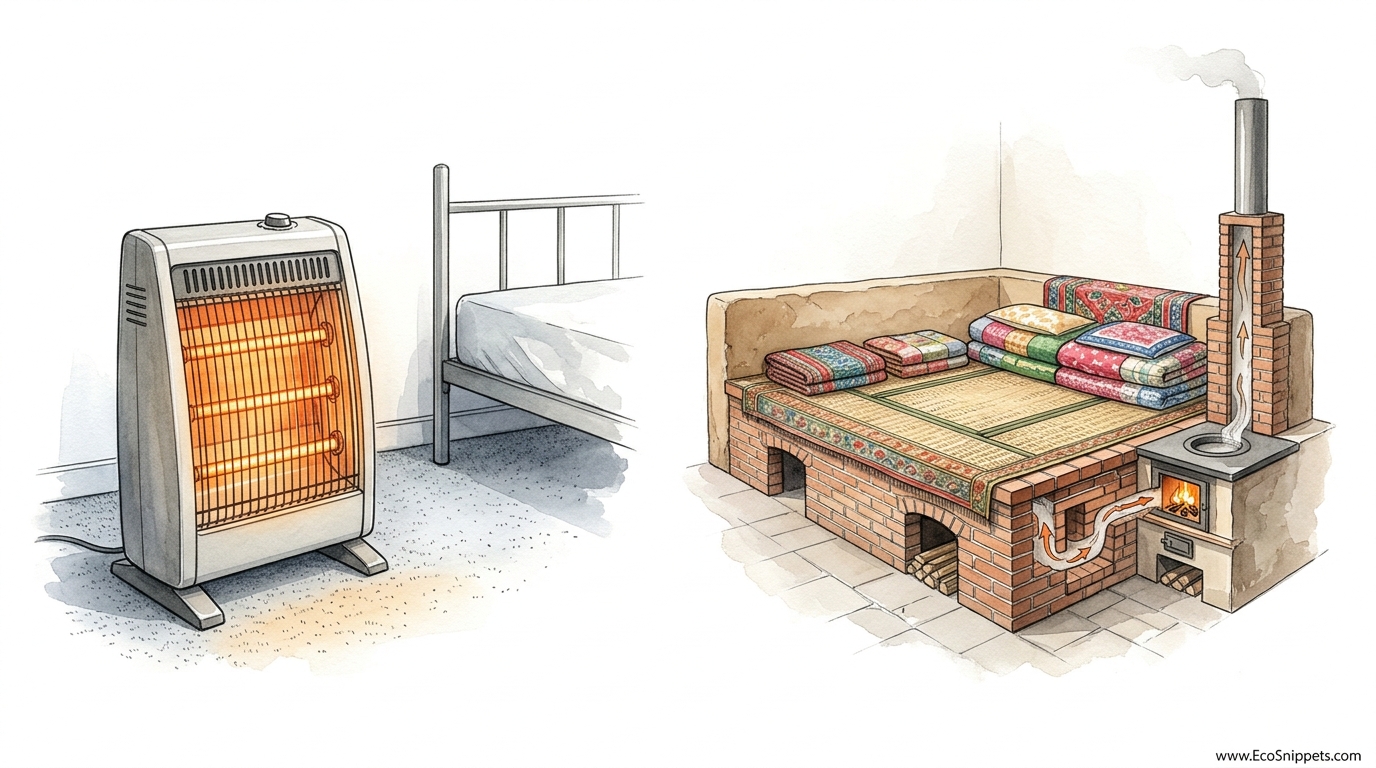
Why sleep on a cold mattress when you could sleep on a thermal battery that heats your home for free? Modern heating is a monthly bill that evaporates the moment the power goes out. But 2,500 years ago, families in northern China solved this with the Kang bed. By routing their cooking exhaust through a brick platform, they created a thermal battery that stays warm for 12 hours after the fire goes out. It’s the ultimate permaculture hack for off-grid comfort.
Imagine a heating system that doesn’t just warm the air, but stores the energy from your morning coffee or evening stew to keep your bones warm all night. This isn’t a complex piece of high-tech machinery. It is a simple, elegant combination of masonry and thermodynamics that has sustained millions of people through winters where temperatures drop to -40°C (-40°F).
The Kang bed is a testament to ancestral wisdom and self-reliance. It challenges the modern notion that comfort requires a constant connection to a volatile power grid. Instead, it relies on local materials like brick, clay, and stone to capture heat that would otherwise be lost up a chimney.
In this guide, you will learn how this ancient system works, why it remains one of the most efficient ways to heat a living space, and how you might adapt its principles for a modern off-grid lifestyle.
Heating Your Home With An Ancient Chinese Kang Bed
The Chinese Kang bed is more than just furniture; it is a structural heating element integrated directly into the home. Traditionally found in Northern China and parts of Central Asia, it is a raised platform made from high-density materials like fired bricks, adobe, or stone. This platform typically occupies one-third to one-half of a room, serving as a bed at night and a living area during the day.
At its core, the Kang is a large-scale heat exchanger. It connects to the primary cooking stove in the kitchen, often called a Dakang when used in this combined fashion. When you light a fire to cook a meal, the hot smoke and gases aren’t sent straight out of the house. They are channeled through a series of internal flues or tunnels built inside the bed platform.
This design turns the bed into a massive thermal battery. The materials used to build the Kang have high thermal mass, meaning they can soak up vast amounts of heat and release it very slowly. While a standard metal radiator cools down minutes after the boiler shuts off, a well-built Kang remains a steady 35°C to 40°C (95°F to 104°F) for many hours after the last ember has died.
The beauty of the system lies in its dual-purpose nature. It solves two of the most energy-intensive needs of any household—cooking and heating—with a single fire. In regions where fuel like wood or coal is scarce, this efficiency is the difference between survival and catastrophe.
The History and Cultural Impact of the Kang
Archaeological evidence suggests that the Kang has been in use since the Han Dynasty (206 BCE – 220 CE). It evolved from simple heated floors to the elevated platforms we see today. In the harsh winters of Heilongjiang or Inner Mongolia, the Kang became the center of the household.
Families would gather on the platform to eat, work, and socialize. Because the platform stays warm, children can play on it without catching a chill from the frozen ground. It also served a practical purpose for hygiene; the dry heat helped keep bedding free from dampness and parasites, which were common issues in traditional earthen homes.
The Mechanics of a Thermal Battery Bed
To understand how a Kang works, you have to look at the three main components: the firebox, the internal flues, and the chimney. Each part must be perfectly balanced to ensure the system draws air correctly and doesn’t leak dangerous gases into the living space.
The firebox is usually located in an adjacent room, typically the kitchen. This allows the heat from cooking to be the primary energy source. As the wood, straw, or corncobs burn, the hot exhaust enters the “fire throat,” a narrow passage that accelerates the smoke into the bed’s internal channels.
Inside the Kang, the flues are arranged in a specific pattern—often a grid or a serpentine path. These channels are designed to maximize the surface area that the hot smoke touches. The goal is to transfer as much thermal energy as possible from the smoke into the bricks before the exhaust reaches the chimney.
The chimney provides the “draft” or suction required to pull the smoke through the long, horizontal path under the bed. Without a strong draft, the smoke would linger or back up into the house. Builders often include a “smoke stopper” or damper near the chimney to control the flow rate. Closing the damper slightly after the fire is out helps trap the residual heat inside the masonry for as long as possible.
Internal Flue Layouts
There are several ways to arrange the internal tunnels. The choice depends on the size of the room and the location of the stove.
- I-Shaped: A simple, straight path for smaller beds.
- L-Shaped: Used when the stove and chimney are on adjacent walls.
- U-Shaped: Maximize the length of the smoke path for larger platforms.
- Grid Style: Uses a series of pillars to support the top slab, allowing smoke to move freely through a large open chamber under the bed.
Practical Benefits of the Kang System
One of the most measurable benefits of a Kang is its fuel efficiency. Studies have shown that a modernized Kang bed can reduce fuel consumption by 36% to 60% compared to traditional open fireplaces or simple stoves. This is because the system captures nearly 90% of the energy produced by the fire, whereas a standard fireplace loses most of its heat through the roof.
Radiant heat is another major advantage. Modern forced-air systems heat the air, which then rises to the ceiling where it is useless. The Kang heats people directly through infrared radiation and physical contact. This “bottom-up” heating keeps your core temperature stable even if the air in the room is quite cold.
Low-tech maintenance makes the Kang ideal for off-grid living. There are no pumps to fail, no sensors to break, and no electricity required. As long as you have a way to start a fire and a pile of dry fuel, you have a reliable heat source. Many rural users in China use agricultural waste like corn stalks or dried animal dung, making the system virtually free to operate.
Comfort during power outages is where the Kang truly shines. In a modern home, a blackout in mid-winter can become a life-threatening emergency within hours. A Kang-equipped home can go 12 to 15 hours without a fire and still maintain a comfortable sleeping surface.
Challenges and Common Mistakes
Building a Kang is not as simple as stacking bricks. The most common mistake is failing to calculate the draft correctly. If the flues are too narrow or the chimney is too short, the smoke will not move. This results in “smoking out” the house, which covers everything in soot and creates a health hazard.
Soot accumulation is an ongoing challenge. Over time, the internal channels will fill with ash and creosote. Traditional Kangs have removable “cleaning bricks” at specific points in the structure. Neglecting to clean these flues once or twice a year will drastically reduce the heat transfer efficiency and increase the risk of a chimney fire.
Uneven heating can also occur if the flues are not laid out properly. One side of the bed might become dangerously hot (burning the person sleeping there) while the other side stays cold. Using a layer of fine sand or clay on top of the bricks helps distribute the heat more evenly across the surface.
Cracking in the masonry is another issue to watch for. Extreme temperature swings can cause the bricks or the plaster finish to crack. These cracks aren’t just an aesthetic problem; they can allow carbon monoxide to leak into the bedroom. Builders must use high-temperature mortar or flexible clay-based plasters to handle the thermal expansion.
Critical Safety Precautions
Safety must be the primary concern when building any system that involves combustion inside the home. Carbon monoxide (CO) is a silent killer—it is colorless, odorless, and can be fatal in a short amount of time. Every room with a Kang must have a high-quality CO detector with a battery backup.
A well-ventilated firebox area is essential. Most Kangs are fueled from the kitchen, which should have its own ventilation to ensure the fire gets enough oxygen. If the house is too airtight, the fire may struggle to draw, or it may pull air back down the chimney, bringing smoke with it.
Insulation from the ground is another technical detail that is often missed. If you build a Kang directly on a concrete slab or the earth, much of the heat will be lost into the ground. Modern builders often place a layer of perlite, foam glass, or specialized insulation under the platform to ensure the heat moves upward toward the occupants.
Comparing Traditional Systems
The Chinese Kang is often compared to the Korean Ondol. While they share the same physics, their application differs based on cultural habits.
| Feature | Chinese Kang | Korean Ondol | Modern Radiator |
|---|---|---|---|
| Heating Method | Radiant Platform | Radiant Floor | Convection (Air) |
| Energy Storage | High (8-12 hours) | High (6-10 hours) | Zero |
| Fuel Type | Biomass/Waste | Wood/Gas/Electric | Gas/Electricity |
| Lifestyle | Elevated (Chair sitting) | Floor-based sitting | Any |
The Kang is generally higher, making it suitable for people who prefer sitting on chairs or the edge of a bed. The Ondol heats the entire floor, which works well in cultures where shoes are removed and activities happen at floor level. Both systems are vastly superior to modern radiators in terms of energy retention.
Best Practices for Modern Implementation
If you are considering building a Kang in a cabin or off-grid home, start by choosing the right materials. Use firebricks for the areas closest to the fire throat where temperatures are highest. For the rest of the body, standard clay bricks or even stabilized earth blocks will work effectively.
Sizing the platform is the next step. A standard Kang is roughly 2 meters (6.5 feet) wide and 1.7 meters (5.5 feet) deep. This provides enough space for a family to sleep comfortably. Ensure the platform is at a comfortable height for sitting—usually around 50 to 60 centimeters (20 to 24 inches).
Incorporate a “clean-out” port for every 90-degree turn in your flue system. These can be simple gaps in the brickwork that are filled with a loose brick and plastered over. When it is time for annual maintenance, you simply chip away the plaster, remove the brick, and vacuum or scrape out the soot.
Consider a hybrid design. Some modern builders connect a high-efficiency rocket stove to a Kang platform. This “Rocket Mass Heater” approach uses a vertical combustion chamber to ensure a much cleaner burn, reducing the amount of soot that enters the flues while still providing the long-lasting warmth of a traditional Kang.
Advanced Considerations for Efficiency
Serious practitioners often look for ways to “tune” their Kang. One method is adjusting the thickness of the top slab. A thicker slab (e.g., 15 centimeters or 6 inches) will take longer to heat up but will hold heat significantly longer. A thinner slab will provide heat almost immediately but will cool down faster.
Using phase-change materials (PCMs) or specialized stone like soapstone can further improve performance. Soapstone has a higher thermal conductivity and heat storage capacity than standard brick. Placing soapstone slabs on the top surface of the Kang will result in a more intense and consistent radiant heat.
Seasonal adjustments are also important. In the summer, you still need to cook, but you don’t want to heat the bed. Traditional homes often have a “summer bypass” flue. This is a secondary chimney path that allows the cooking smoke to go straight out of the house without passing through the bed platform.
Example Scenario: The Off-Grid Cabin
Let’s look at a practical example. A small off-grid cabin in a temperate climate with winters averaging -10°C (14°F). The owner builds a 2-meter by 2-meter (6.6ft by 6.6ft) Kang connected to a small wood-burning cookstove.
During the day, the owner burns a small armful of scrap wood (approx. 5kg or 11lbs) to boil water and cook lunch. The exhaust gases enter the Kang at 250°C (482°F). By the time the smoke leaves the external chimney, it has cooled to 50°C (122°F). This means 80% of that heat is now stored in the 1,500kg (3,300lbs) of brick and clay under the bed.
By 8:00 PM, without any additional fire, the surface of the Kang is a steady 38°C (100°F). The owner sleeps on a thin wool pad directly on the bricks. Even as the cabin air temperature drops to 5°C (41°F) overnight, the occupant remains warm because their body is in contact with the “charged” thermal battery.
Final Thoughts
The Chinese Kang bed is a masterclass in thermal engineering from an era long before computers. It reminds us that the solutions to our most pressing energy problems often lie in the past, waiting to be rediscovered. By focusing on heating the person rather than the room, we can achieve a level of comfort and security that modern systems simply cannot match.
Transitioning to this type of system requires a shift in mindset. It asks us to become active participants in our own comfort—learning to manage a fire, clean a flue, and respect the laws of thermodynamics. In exchange, it offers independence from rising utility costs and the peace of mind that comes with a truly resilient home.
Whether you are building a new homestead or looking for ways to make your current cabin more efficient, the principles of the Kang are worth studying. Experiment with thermal mass, explore the benefits of radiant heat, and consider how you can turn your “waste” exhaust into a source of life-sustaining warmth.
