How To Become More Self-Sufficient Without Starting a Full-Blown Farm…
Want to start preserving your harvest, making your own soap, or building a backyard root cellar — but not sure where to begin? “Homesteading Advice” gives you instant lifetime access to 35+ practical homesteading books on food preservation, veggie gardening, DIY natural cleaning products (save over $250 per year with this skill alone), brewing, off-grid energy, and a whole lot more…
Click Here To Check It Out Now!
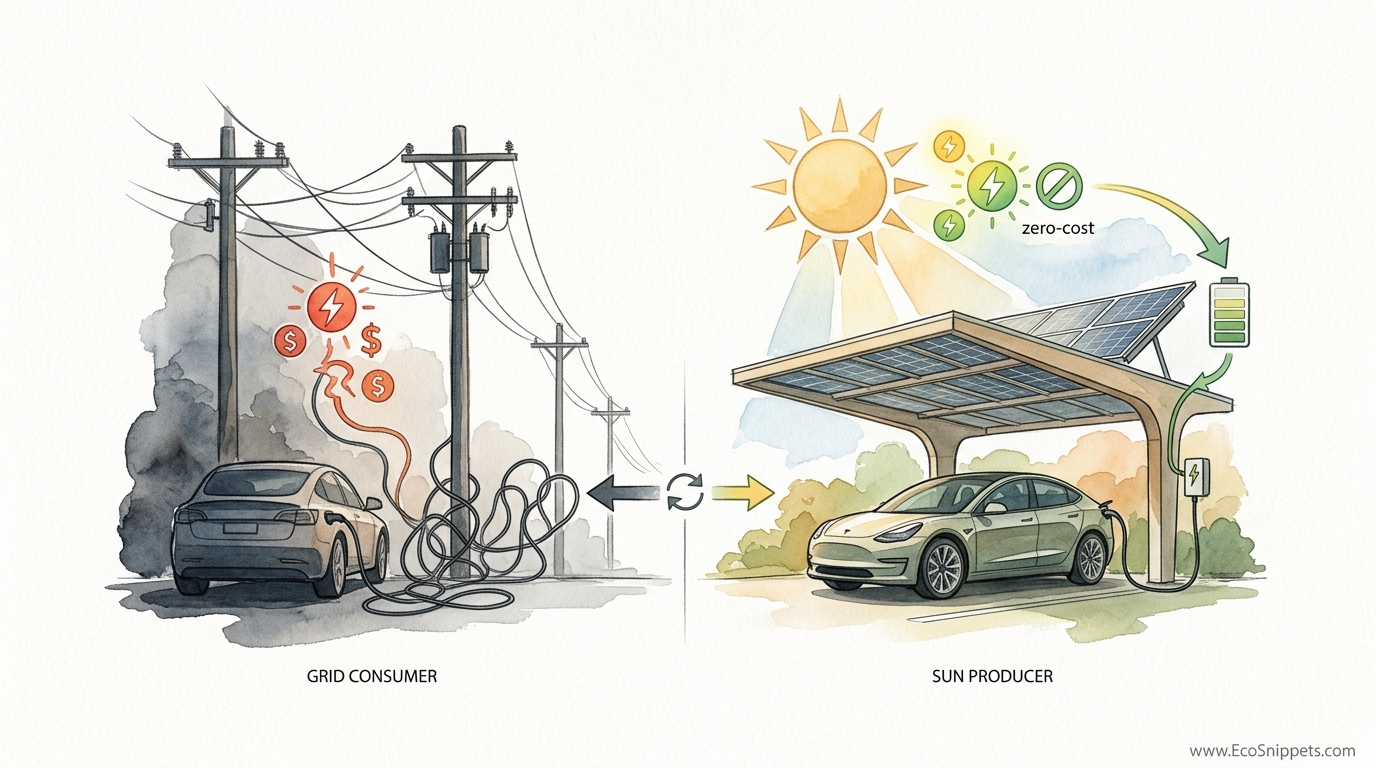
Is your ‘green’ car actually just a 2-ton battery tethered to a failing coal plant? Most EV owners just swapped a gas station for a utility bill. To truly cut the cord, you have to stop being a consumer. A solar carport turns your parking spot into a private fuel station that never raises its prices.
Electric vehicle ownership often promises a future of sustainability, but the reality for many is simply shifting their reliance from one massive corporation to another. Instead of oil giants, you become beholden to the local utility monopoly and their fluctuating rates. Achieving true energy independence requires a shift in mindset: moving from a passive consumer to an active producer. A solar carport is more than just a shelter for your vehicle; it is a declaration of self-reliance that harvests energy directly from the sky.
In practical terms, this means taking the space your car already occupies and turning it into a high-performance energy generator. While rooftop solar is a standard approach, it often faces limitations like shading from trees, poor orientation, or structural aging. A carport, however, is a purpose-built structure that can be positioned perfectly to catch the sun’s arc. It provides the double benefit of protecting your vehicle’s paint and interior from the elements while simultaneously filling your battery with free, clean electrons.
The journey toward becoming a Sun Producer involves understanding the hardware, the physics of energy transfer, and the logistics of structural engineering. This guide will walk you through the entire process, from the first concrete pour to the final click of the charging handle. We will look at why this approach is gaining massive traction and how you can apply these principles to your own homestead or driveway.
How To Charge An EV For Free With A Solar Carport
Charging an EV for free with a solar carport is the process of using a dedicated, standalone structure equipped with photovoltaic (PV) panels to generate all the electricity required for your vehicle’s daily travel. Unlike a standard home solar system that is tied to your roof, a solar carport is a ground-mounted canopy designed specifically to cover one or more parking spaces. This setup allows for optimized sun exposure and easier maintenance without interfering with your home’s main architecture.
In the real world, this works by capturing sunlight through the panels, converting it into direct current (DC) electricity, and then using an inverter to transform it into the alternating current (AC) your car’s onboard charger requires. For many, this system is integrated into the home’s main electrical panel, allowing the car to “divert” excess solar energy that would otherwise be sent back to the grid. This process, often called solar diversion, ensures that every mile you drive is powered by energy you harvested yourself.
Imagine your driveway as a small-scale farm. Instead of planting crops, you are planting silicon panels. Just as a farmer knows how much grain they can expect from an acre of land, you can calculate exactly how many kilowatt-hours (kWh) your carport will produce based on its square footage and the amount of “peak sun” your region receives. This transition from buying fuel to growing your own is the hallmark of the Sun Producer.
The Mechanics of Energy: How the System Works
To build a system that lasts thirty years, you must understand the components and how they interact. A solar carport is a synergy of structural engineering and electrical physics. Every part of the system must be sized correctly to ensure that the energy produced matches the energy consumed by the vehicle.
1. The Structural Foundation
The structure usually begins with concrete footings or heavy-duty anchors. Because solar panels act like large sails, the carport must be engineered to withstand significant wind uplift and snow loads. In 2026, many installations are moving toward ZAM (Zinc-Aluminum-Magnesium) coated steel or high-grade aluminum for the frame. These materials provide superior corrosion resistance, ensuring the “skeleton” of your fuel station doesn’t rust away before the panels reach their half-life.
2. The Photovoltaic Array
The roof of the carport consists of solar panels. For carports, bifacial panels are increasingly popular. These panels have glass on both sides and can capture reflected light from the ground underneath the carport, increasing energy yield by up to 10% to 12.5% compared to standard monofacial panels. This extra “bifacial gain” is essentially free energy harvested from the shadows.
3. The Inverter and Balance of System
The DC power from the panels travels through high-voltage wiring to an inverter. This device is the “brain” of the system. It synchronizes the solar electricity with your home’s power and manages the flow. If you are aiming for a true off-grid setup, you would also include a Battery Energy Storage System (BESS) to store the day’s harvest for nighttime charging.
4. The EVSE (Electric Vehicle Supply Equipment)
Commonly known as the “charger,” the EVSE is actually a smart gateway that communicates with your car. In a solar-integrated setup, a smart charger uses Current Transformer (CT) clamps installed at your main electrical panel to monitor energy flow in real-time. When it detects that the carport is producing more energy than the house is using, it automatically ramps up the charging speed to “soak up” the excess solar power.
Harvesting Independence: The Benefits of a Solar-Powered Canopy
Choosing a carport over a traditional roof mount offers several practical advantages that go beyond simple aesthetics. For the person focused on self-reliance, the carport is a tactical choice that maximizes utility and minimizes long-term risks.
Fixed Fuel Costs for Decades: When you build a solar carport, you are essentially pre-paying for twenty-five to thirty years of fuel at a fixed price. While utility companies might raise rates by 5% or 10% annually, your cost per kilowatt-hour remains locked in at the price of your initial investment. Most systems achieve a simple payback within 5 to 8 years, meaning every mile driven after that point is truly free.
Vehicle Protection and Comfort: Direct sunlight is the enemy of automotive longevity. A solar carport provides shade that keeps your EV’s cabin significantly cooler—up to 20°C (36°F) cooler on a hot day. This reduces the energy the car must spend on “cabin overheat protection” and air conditioning, further extending your range. It also shields the car from hail, snow, and rain, preserving the resale value of your vehicle.
Optimized Energy Harvesting: Unlike roofs, which are often at the mercy of the house’s orientation, a carport can be placed in the most sun-drenched part of your property. You can tilt the panels at the perfect angle (usually equal to your latitude) to maximize production. Furthermore, the open-air design of a carport allows for better airflow under the panels, which keeps them cooler and more efficient than panels flushed against a hot roof.
The Steep Road: Challenges and Common Pitfalls
While the concept is straightforward, the execution requires attention to detail. Skipping steps in the planning phase can lead to structural failure or electrical hazards that are expensive to fix.
Permitting and Zoning: In many jurisdictions, a solar carport is considered a “primary structure” rather than a simple addition. This means you may need both structural and electrical permits, which can involve engineering stamps and site surveys. Attempting to bypass these requirements can result in fines or being forced to dismantle the system when you sell your property. Always check local setback requirements to ensure the carport isn’t too close to the property line.
Shading and Location: A single shadow from a nearby chimney or tree limb can significantly drop the output of an entire string of panels. People often underestimate how much shadows move throughout the seasons. A spot that looks perfectly sunny in June might be completely shaded by a neighbor’s house in December. Using a solar pathfinder or a digital shade analysis tool is non-negotiable for a professional-grade installation.
The “6-Amp Floor”: A technical hurdle often overlooked by beginners is the minimum charging requirement for EVs. Most vehicles cannot charge at a speed lower than 6 Amps. On a standard 240V Level 2 charger, this equals a minimum power draw of about 1.4 kW. If your solar carport is small (say, only 3 or 4 panels) and a cloud passes over, the production might drop below 1.4 kW. Without a battery buffer or grid support, the charging session will constantly stop and start, which is inefficient and can be hard on the car’s contactors.
Practical Constraints: When a Solar Carport Might Not Work
Total energy independence is an admirable goal, but physical and environmental limitations sometimes dictate the boundaries of what is possible. Recognizing these constraints early on will save you from investing in a system that cannot meet your needs.
The most common limitation is available space. A standard single-car parking spot is roughly 3 meters by 6 meters (10 feet by 20 feet). This provides enough room for about 9 to 10 standard solar panels. If you have a high-consumption vehicle like an electric truck and a long daily commute, a single-car carport might only provide 40% to 50% of your total energy needs. In these cases, you either need a larger double-car carport or you must supplement the power from your home’s roof.
Environmental factors also play a role. If you live in a region with heavy, sustained cloud cover or extreme snow accumulation, the ROI will be significantly longer. In northern latitudes, snow can sit on the panels for weeks, zeroing out production unless you are willing to manually clear them. Additionally, if your property is heavily wooded and you are restricted from clearing trees, the “solar window” might be too narrow to justify the cost of the structure.
Grid Consumer vs. Sun Producer: A Direct Comparison
To understand the value proposition, we must compare the traditional way of fueling an EV with the self-reliant method. The following table breaks down the measurable differences over a 25-year lifespan for an average driver traveling 20,000 km (12,200 miles) per year.
| Factor | The Grid Consumer | The Sun Producer (Solar Carport) |
|---|---|---|
| Source of Fuel | Utility Grid (Mixed Sources) | Direct Photovoltaic Generation |
| Fuel Cost (25 Years) | $15,000 – $25,000 (est. with inflation) | $8,000 – $14,000 (Initial CAPEX) |
| Price Stability | Subject to 3-7% Annual Increases | Locked at $0.00/kWh After Payback |
| Vehicle Protection | None (Driveway Parking) | Full Shade & Weather Shelter |
| Energy Self-Sufficiency | 0% – 100% Dependent on Utility | 80% – 100% Independent |
| Maintenance | None (Monthly Billing) | Annual Cleaning & Inspection |
The comparison shows that while the Sun Producer pays more upfront, they gain absolute cost certainty and a physical asset that protects their vehicle. The Grid Consumer remains vulnerable to infrastructure failures and policy changes that can drive electricity prices upward without warning.
Field Notes: Practical Tips for Implementation
Success in this endeavor is found in the details. If you are planning to build or buy a solar carport system, keep these optimization techniques in mind to ensure you get the most electrons for your investment.
- Oversize the Array: If you think you need 5 kW of solar, build 7 kW. Panel efficiency degrades slightly over time, and your future energy needs will likely increase as you add more electric appliances or a second EV to your household.
- Use Bifacial Panels: As mentioned, the extra gain from the underside of the panels is significant for carports. To maximize this, use a light-colored gravel or white reflective coating on the concrete under the carport to bounce more light back up to the panels.
- Install a Hardwired Smart Charger: Avoid “dumb” chargers that just plug into an outlet. Use a hardwired smart charger that can communicate with your solar inverter. This allows the system to prioritize solar power over the grid automatically.
- Plan for Drainage: Solar panels are waterproof, but the gaps between them are not. Use specialized EPDM rubber gaskets or integrated gutter systems between the panels to ensure your car stays dry during a rainstorm.
- Orient for the Afternoon: If you cannot face the carport perfectly south (in the northern hemisphere), aim it slightly toward the west. This maximizes production in the late afternoon when utility rates are often highest and when you are most likely to be returning home to charge.
The Master Plan: Advanced Considerations
For those who want to push the boundaries of what a parking spot can do, the next frontier is bidirectional charging. This includes Vehicle-to-Home (V2H) and Vehicle-to-Grid (V2G) technologies. In this scenario, your EV isn’t just a consumer of the carport’s energy; it is a giant backup battery for your entire life.
Integrating a bidirectional charger allows you to pull energy from your car’s battery to power your home during a blackout or during peak-price hours in the evening. With a properly sized solar carport and a V2H-enabled vehicle, you can achieve a level of resilience that was previously only possible with expensive stationary battery banks like the Tesla Powerwall. Essentially, you are using the battery you already paid for in your car to do double duty.
Another advanced strategy involves “micro-inverters” vs. “string inverters.” For a carport that might experience partial shading from a nearby tree for an hour a day, micro-inverters are superior. They allow each panel to operate independently, so one shaded panel doesn’t drag down the performance of the entire array. This granular control is essential for maximizing the yield from a small, high-density solar structure.
Theoretical vs. Actual: A Real-World Scenario
Let’s look at a realistic example to see how the numbers play out. Consider a driver in a sun-rich area like Denver, Colorado, or Madrid, Spain. They drive a Tesla Model Y and travel approximately 50 km (31 miles) per day. This requires roughly 9 kWh of electricity daily, accounting for charging losses.
A double-car solar carport with 20 panels (each rated at 400W) creates an 8 kW system. In an area with 5 peak sun hours per day, this system produces an average of 40 kWh per day. Even on a cloudy day where production drops by 75%, the carport still produces 10 kWh—enough to cover the daily commute entirely from the sun.
Over the course of a year, this 8 kW carport produces about 12,000 kWh. The vehicle only needs 3,285 kWh for its 18,250 km of annual travel. This leaves a massive surplus of nearly 9,000 kWh that can be used to power the home, offset the air conditioning bill, or be sold back to the grid. In this scenario, the carport doesn’t just fuel the car for free; it effectively pays for its own construction by reducing the home’s overall utility bill.
Final Thoughts
The transition to electric mobility is only half the battle. If you continue to rely on a fragile and expensive grid, you have simply traded one master for another. Building a solar carport is a practical, tangible step toward reclaiming your energy sovereignty. It turns a passive piece of property into a productive asset that serves you for decades.
By following the principles of proper structural engineering, smart energy management, and optimized placement, you can create a fuel station that never runs dry. Whether you choose a DIY approach with a pre-engineered kit or hire a professional team, the goal remains the same: to stop being a consumer and start being a producer.
As you move forward, remember that energy independence is a journey of increments. Start with the carport, optimize your charging habits, and eventually look toward integrating your vehicle’s battery into your home’s ecosystem. The technology is here, the sun is shining, and the only thing left to do is to catch the harvest.
