How To Become More Self-Sufficient Without Starting a Full-Blown Farm…
Want to start preserving your harvest, making your own soap, or building a backyard root cellar — but not sure where to begin? “Homesteading Advice” gives you instant lifetime access to 35+ practical homesteading books on food preservation, veggie gardening, DIY natural cleaning products (save over $250 per year with this skill alone), brewing, off-grid energy, and a whole lot more…
Click Here To Check It Out Now!
That annoying wind corridor between your barns is actually a high-speed power plant waiting to be tapped. Every homestead has that one ‘windy spot’ where the breeze feels twice as strong. Most people just avoid it; we decided to put a turbine in it. Using the Venturi effect, we tripled our wind output without buying a bigger tower.
Harnessing the wind is one of the oldest forms of self-reliance, a tradition passed down from the millwrights and sailors who knew that air behaves like water. It flows, it eddies, and it bunches up when it hits an obstacle. If you can understand how that air moves across your specific piece of dirt, you can turn a structural headache into a reliable source of electricity. Modern homesteading isn’t just about growing food; it is about harvesting every resource the land offers, and wind is often the most overlooked “crop” on the farm.
Effective power generation starts with a shift in perspective. Instead of seeing a gale as something that rattles your windows, you begin to see it as a stream of kinetic energy. Small-scale wind power can provide the “night shift” for your energy system, picking up the slack when your solar panels go dark. Achieving this requires more than just buying a kit and sticking it on a pole. Success is found in the math, the placement, and the respect for the raw power of moving air.
Micro Wind Turbine Placement For Homesteaders
Micro wind turbine placement is the strategic science of identifying where air currents are most concentrated and least turbulent on a piece of land. Unlike massive industrial wind farms that occupy ridge lines with 100-meter (328-foot) towers, a homesteader must work with much smaller equipment, often ranging from 400 watts to 10 kilowatts. Because these turbines sit closer to the ground, they are highly sensitive to “ground friction”—the slowing of wind caused by trees, houses, and uneven terrain.
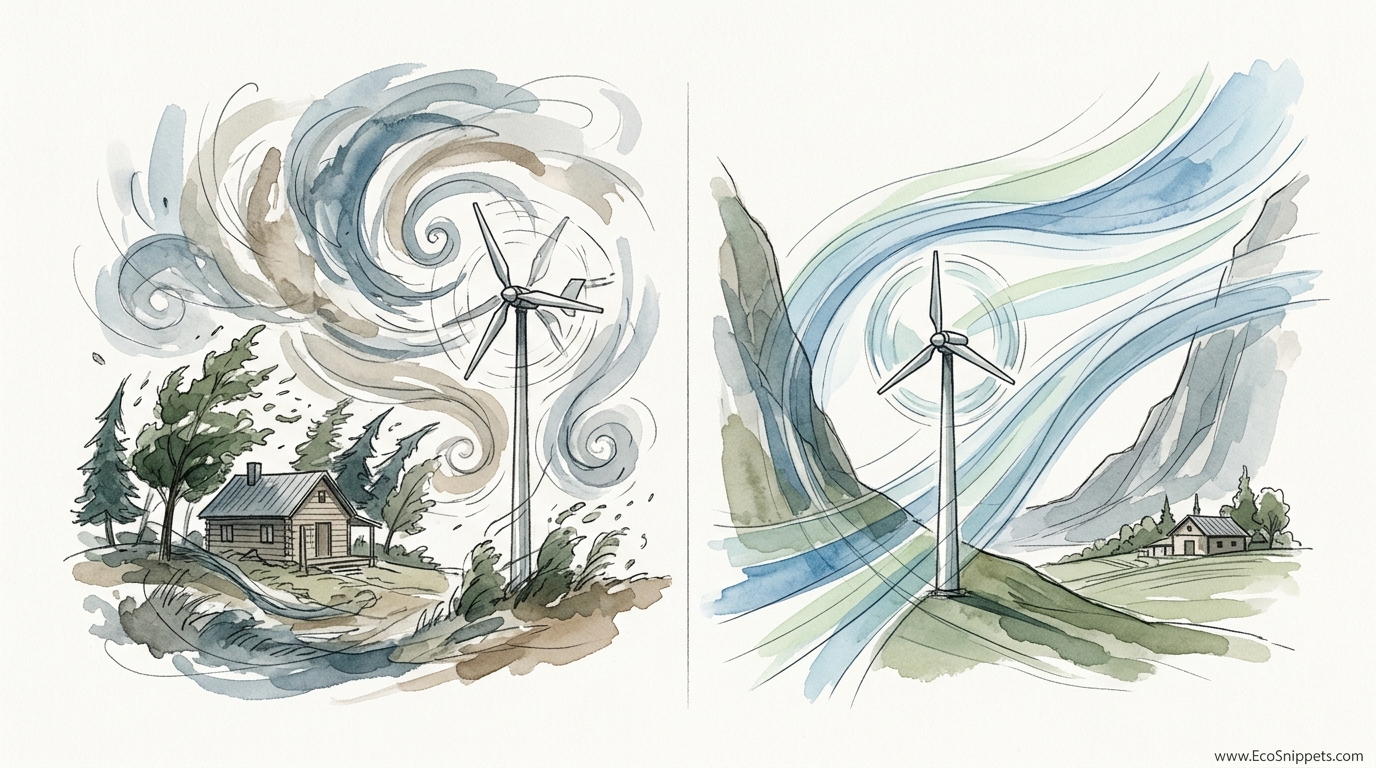
Selecting the right spot involves finding the balance between wind speed and air quality. Speed is obvious; you want the fastest wind possible. However, air quality refers to how “clean” or “laminar” the wind is. Clean wind moves in straight, predictable layers. Dirty wind, or turbulence, is full of swirls and rapid changes in direction. Placing a turbine in turbulent air is like trying to drive a car on a road made of boulders; it beats the machine to pieces and yields very little usable power.
Real-world placement often takes advantage of natural or man-made features. A classic example is the “saddle” of a hill. When wind hits a ridge, it is forced upward. If there is a dip or a lower point in that ridge—the saddle—the wind will naturally funnel through that gap, increasing in speed as it does so. Similarly, the space between two large outbuildings can act as a wind tunnel. This is where the concept of a WIND NUISANCE vs ENERGY TUNNEL comes into play. A spot that makes it hard to walk across the yard is often the perfect place for a turbine hub.
The Physics of Funneling: How It Works
Wind power is governed by the “Cube Law.” This principle states that the power available in the wind is proportional to the cube of its speed. If you double the wind speed from 5 mph to 10 mph (8 kph to 16 kph), you do not get twice the power; you get eight times the power. This is why placement is so critical. A 2-mph increase in average speed can mean the difference between a turbine that barely keeps a battery topped off and one that runs your entire workshop.
The Venturi effect is the homesteader’s secret weapon for “cheating” the cube law. This phenomenon occurs when a fluid (like air) is forced through a constricted area. As the area narrows, the air must speed up to maintain the same mass flow rate. Think of a garden hose; when you put your thumb over the end, the water shoots out faster because you have constricted the opening. On a homestead, your barns, tall hedges, or even the shape of a valley can act as that “thumb,” squeezing the wind and accelerating it right into your turbine blades.
Achieving a successful “energy tunnel” setup requires understanding the 30/500 rule. This industry standard dictates that the bottom of your turbine blades must be at least 30 feet (9 meters) higher than any obstacle within a 500-foot (152-meter) radius. Trees and buildings create a “wake” of turbulent air behind them that can extend for twenty times their height. If your turbine is caught in this wake, the blades will flex and vibrate, leading to metal fatigue and eventual mechanical failure.
Mapping Your Land: Step-by-Step Assessment
Finding the perfect spot requires more than just sticking a finger in the air. You need a systematic approach to map the invisible currents of your property.
- Consult Wind Resource Maps: Start with regional data. Most governments provide wind atlases that show average speeds at different heights. Look for an annual average of at least 10 mph (4.5 m/s) at your proposed hub height to ensure the project is viable.
- Use a Recording Anemometer: Purchase or rent a data-logging anemometer. Mount it as high as possible at your proposed site and leave it for at least three to six months. This provides a “wind rose,” a chart showing which direction the strongest winds come from and how often they blow.
- Read the Trees: Nature leaves clues. Look for “flagging” on trees—this is where the branches grow primarily on one side due to the pressure of prevailing winds. The Griggs-Putnam Index is a scale used to estimate wind speed based on tree deformation; heavily flagged trees suggest a high-energy site.
- The Kite and Ribbon Test: On a breezy day, fly a kite with long, light ribbons tied to the string every 10 feet (3 meters). Watch the ribbons. If they are snapping and swirling, the air is turbulent. If they are streaming out straight, you have found a pocket of clean, laminar air.
- Identify the Tunnel: Look for areas where buildings or hills converge. Walk through these gaps during a storm. If the wind feels significantly more intense in the gap than it does in the open field, you have found your Venturi site.
The Benefits of Micro Wind Systems
Choosing wind power offers distinct advantages that solar alone cannot match. Wind is often at its strongest during the winter months and at night, providing a perfect seasonal and diurnal balance to a photovoltaic system.
Reliability in cold weather is a major factor. Solar production drops significantly during short winter days, precisely when your energy needs for heating and lighting are highest. Wind turbines, however, thrive in the dense, cold air of winter. Cold air is heavier than warm air, meaning it carries more kinetic energy. A turbine spinning in 30°F (-1°C) weather will produce about 10% more power than the same turbine in 90°F (32°C) weather at the same wind speed.
Battery health is another measurable benefit. Frequent, small “sips” of power from a turbine can prevent deep discharge cycles in your battery bank during cloudy weeks. This “float” charging keeps the chemical plates in lead-acid batteries cleaner and ensures lithium banks stay within their optimal state-of-charge window. Over a ten-year period, a well-placed wind turbine can pay for itself simply by doubling the lifespan of your expensive battery storage.
Challenges and Common Mistakes
The most frequent error made by beginners is mounting a turbine directly to the roof of a house. While it seems convenient, it is almost always a disaster. Houses are obstacles that create massive amounts of turbulence right at the roofline. Furthermore, the vibrations from the turbine will telegraph through the structure, creating a low-frequency hum that can make the living space unbearable. Always use a free-standing or guyed tower whenever possible.
Neglecting the “shadow” of trees is another pitfall. A tree that is 50 feet (15 meters) tall today will be 60 feet (18 meters) tall in a few years. If you place your turbine based on current heights, you may find your power output dwindling as the forest grows. Always site your tower with future growth in mind, or be prepared to maintain a significant clearing around the site.
Underestimating the mechanical stress of high-wind events can lead to total system loss. Many cheap, “no-name” turbines lack an effective braking system. When a real storm hits, these turbines can “over-speed,” spinning so fast that the centrifugal force literally pulls the blades apart or burns out the alternator. Investing in a turbine with a mechanical furling system (where the tail pivots to turn the blades out of the wind) or an electronic shorting brake is non-negotiable for long-term survival.
Limitations: When Wind Is Not the Answer
Wind power is not a universal solution. If you live in a deep valley or a heavily forested area where you cannot get a tower above the canopy, the cost-to-benefit ratio will rarely tilt in your favor. Solar panels have no moving parts and require far less maintenance; if your wind resource is marginal, adding more solar is usually the smarter investment.
Zoning and neighbor relations are practical boundaries that can stop a project before it starts. Many jurisdictions have height limits on residential structures, often capping towers at 35 or 45 feet (10 to 13 meters). Since wind speed increases with height, a short tower might prevent you from reaching the clean air you need. Additionally, the visual and acoustic profile of a spinning turbine can be a point of contention with neighbors. It is wise to have a conversation and perhaps a “noise demonstration” before pouring concrete.
Environmental constraints also play a role. Coastal areas face saltwater corrosion, which can seize up bearings and eat through aluminum housings in months. High-altitude sites must contend with icing; ice buildup on blades changes their aerodynamic profile, causing them to stop spinning or vibrate violently. In these environments, you must purchase specialized “marine-grade” or “cold-weather” equipment, which significantly increases the initial price tag.
Comparison: Horizontal vs. Vertical Axis Turbines
Choosing the right machine for your “energy tunnel” depends on the type of wind you have captured.
| Feature | Horizontal Axis (HAWT) | Vertical Axis (VAWT) |
|---|---|---|
| Efficiency | High (25% – 40%) | Lower (15% – 25%) |
| Wind Direction | Must face the wind (Yaw) | Omni-directional |
| Turbulence Tolerance | Poor (Needs clean air) | Excellent (Handles “dirty” air) |
| Maintenance | Complex (High altitude) | Easier (Ground-level parts) |
| Starting Speed | Moderate (7-10 mph) | Very Low (3-5 mph) |
Horizontal axis turbines are the “traditional” three-blade design. They are the champions of efficiency but are temperamental. If the wind shifts rapidly, the turbine must “yaw” (turn) to face it, and during that transition, it produces no power. Vertical axis turbines look like eggbeaters or DNA strands. They don’t care which way the wind blows and can handle the swirling air found in tight corridors, making them a strong contender for Venturi placements near buildings.
Practical Tips and Best Practices
Once you have identified your site, the installation determines the system’s longevity. Use these best practices to ensure your turbine survives the first decade.
- Over-Engineer the Foundation: A turbine tower is a massive lever. In a 60-mph (96-kph) gust, the “drag” on the blades creates thousands of pounds of force. If using a tilt-up tower, ensure your anchors are buried below the frost line and encased in high-PSI concrete.
- Size Your Wires Correctly: Micro turbines often produce “wild AC” or low-voltage DC. Because voltage is low, “line loss” (resistance in the wire) can be massive over long distances. If your tower is 200 feet (60 meters) from your battery house, you may need 0-gauge or even 00-gauge copper wire to prevent your power from simply turning into heat inside the cable.
- Vibration Dampening: Use rubber isolation mounts between the turbine and the tower, and between the tower and the foundation. This prevents the “tuning fork” effect where the entire tower hums, which can scare away livestock and annoy humans.
- The “Kill Switch”: Always install a manual shorting switch at the base of the tower. This allows you to “brake” the turbine instantly for maintenance or before a predicted hurricane-force event.
- Lightning Protection: A metal pole in a high, windy spot is a lightning magnet. Install a dedicated grounding rod at the tower base and use a surge arrestor on the lines entering your home.
Advanced Considerations: Tuning for Efficiency
Serious practitioners don’t just “set and forget” their turbines. They tune them. Maximum Power Point Tracking (MPPT) controllers are essential for modern wind systems. These controllers adjust the “load” on the turbine in real-time. If the wind is light, the controller reduces the electrical draw so the blades can spin up. As the wind increases, it increases the draw to harvest more energy. An MPPT controller can increase your annual yield by 30% compared to a basic PWM controller.
Blade pitch adjustment is another advanced tactic. Some high-end micro turbines allow you to change the angle of the blades. In low-wind areas, a steeper pitch can help the turbine start spinning sooner. In high-wind areas, a shallower pitch prevents the turbine from reaching dangerous speeds too quickly. If you are comfortable with mechanical work, checking and adjusting your blade pitch every season can significantly optimize your output.
Consider the “Hybrid Logic” of your inverter system. Most modern off-grid inverters have a dedicated “Wind/Hydro” input. This allows the system to prioritize wind energy when it’s available, resting the solar charge controllers. If you are building a system from scratch, look for “AC Coupling” options, which allow your wind turbine to feed power directly into your home’s micro-grid, reducing the stress on your battery bank’s DC bus.
Example Scenario: The Barn Corridor Setup
Let us look at a practical application. A homesteader in the Midwest has two large barns spaced 40 feet (12 meters) apart, oriented East-to-West. The prevailing winter winds come from the Northwest. In the open field, the average wind speed is 12 mph (19 kph). However, due to the Venturi effect, the wind squeezing between the two barns accelerates to 18 mph (29 kph).
By the Cube Law, the power available in the 18-mph wind is approximately 3.3 times greater than the power in the 12-mph wind. The homesteader installs a 1-kilowatt HAWT on a 60-foot (18-meter) guyed tower located 20 feet (6 meters) past the exit of the barn corridor. Because the wind is funneled and directed, it stays laminar as it exits the “nozzle” created by the buildings.
The results are measurable: while a turbine in the open field might produce 150 kWh per month, this “energy tunnel” turbine produces nearly 450 kWh. This extra 300 kWh is enough to run a deep freezer, a well pump, and all the LED lighting for the homestead, effectively making the farm energy-independent during the darkest months of the year.
Final Thoughts
Treating your land as a living system is the key to successful wind harvesting. That windy corridor isn’t a nuisance; it is an untapped vein of energy that has been flowing across your property for centuries. By applying a bit of physics and a lot of pioneer-grit, you can build a system that stands the test of time and weather.
Self-reliance is built on these small, smart victories. A micro wind turbine, placed with care and maintained with discipline, provides more than just electricity—it provides the peace of mind that comes from knowing your lights will stay on when the grid falters. It is a commitment to the ancestral wisdom of using what you have, where you are.
Experiment with your site. Start with a simple anemometer or the ribbon test. Once you see the patterns of the air, the placement will become obvious. Whether you are charging a small battery bank for a remote shed or powering a full homestead, the wind is ready to work for you. You just have to give it the right path to follow.
